


TL;DR
We used 100K prompts to examine how Alexa for Shopping presents products, groups alternatives, and explains its recommendations. For brands, a practical priority emerges: prepare each product for the missions it can credibly serve. Clear evidence gives that work direction: document defensible advantages within shoppers’ constraints.
Map credible missions. Identify an ASIN’s intended buyers. Establish which needs it meets within its practical limits. Validate demand before investing in recurring prompt patterns.
Assess placement. Check whether an ASIN belongs in its shopping group. Measure that group’s visibility separately from product rank among nearby alternatives.
Ground recommendations in evidence. Supply variant-specific facts that support useful explanations of product suitability, including relevant conditions or limits.
Build defensible advantages. Explain what makes offers preferable for particular missions. Address weak pricing, confusing pack value, or product problems that copy cannot repair.
Measure commercial results. Track qualified visits, conversion, returns, and profit. Changing an Alexa answer does not demonstrate sales lift.
How Alexa Turns Product Details Into Reasons to Buy
Which product facts become reasons to buy? How can brands make those facts clearer, with better support?
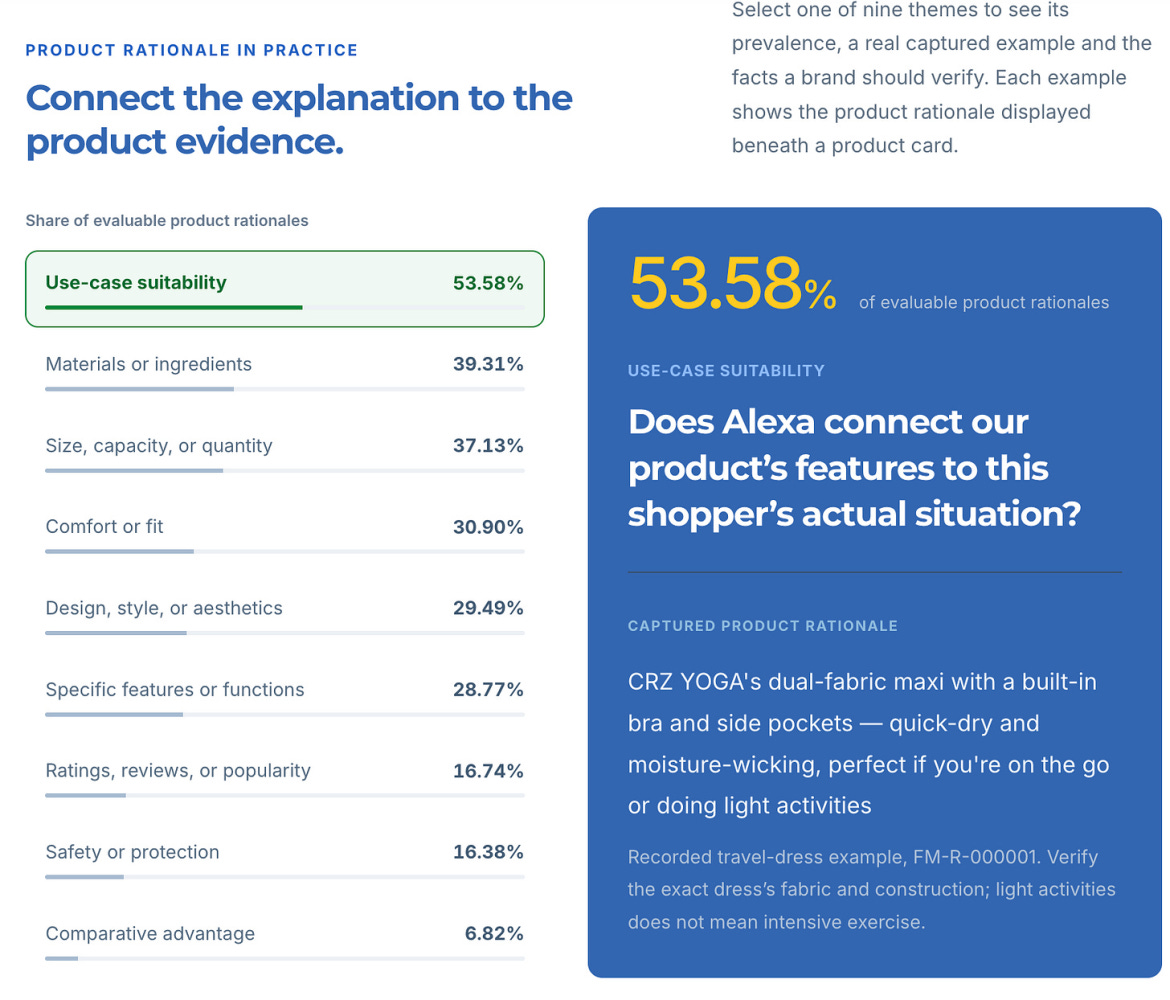
As part of our study, we looked at themes in product explanations across categories. Use-case suitability appeared in 53.58% of explanations, compared with 6.82% expressing comparative advantage. Products were frequently explained through what they were suitable for. We also examined full rationales: 87.33% contained at least two coded themes, often combining several details.
Features become commercially useful when buyers understand their benefits. Brands should make those connections explicit through supported claims about ingredients, materials, or construction.
Our travel-dress example links its built-in bra, pockets, and quick-dry fabric to being on the go or doing light activities. Brands offering those features could explain their practical value through listing content, provided claims hold for that exact dress. Alexa’s wording still needs checking against product evidence.
1 What did we study? Why these prompts?
At ReFiBuy, we used 100K prompts to examine Alexa for Shopping responses. Requests varied by product category, buyer need, budget, comparison, or purchase concern. We reviewed displayed products alongside their explanations to understand what shoppers encounter when seeking buying help.
I wanted to understand where brands could compete more effectively. Which requests trigger recommendations? Which alternatives appear together? What makes each product suitable, according to Alexa? Those questions connect our research to positioning decisions, product content, and offer design.
Individual answers supply examples. Across many prompts, recurring patterns become easier to distinguish from isolated cases, with room to examine category differences.
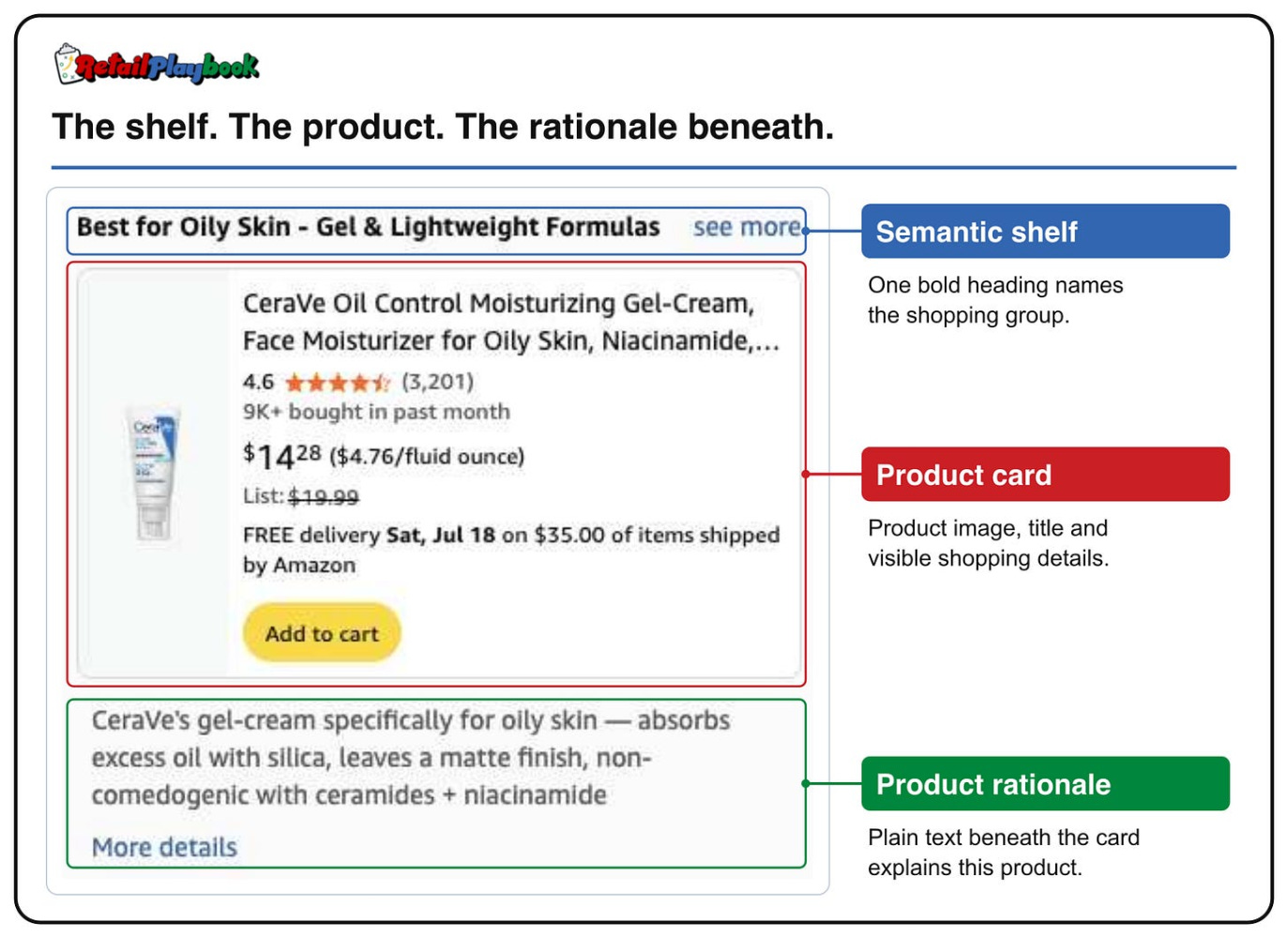
CeraVe illustrates what we studied. Alexa groups its gel-cream with lightweight formulas for oily-skin care. Below its product card, an explanation draws on ingredients with claimed benefits. We examined how often such connections appeared, including their implications for brands.
2 How could this help brands sell more?
Sales depend on shoppers encountering relevant products with convincing reasons to choose them. Alexa can provide one such moment of consideration. Studying those answers helps identify buying situations worth pursuing, with specific weaknesses to address.
Commercial value begins with reaching buyers whose needs your products can meet. Persuasive explanations then need to resolve purchase barriers. For multipacks, clear quantities support fair value comparisons.
I expect this research to help brands prioritize useful improvements. Clear product information can support confident choices; changes to price, pack, or features can strengthen offers.
Our study measured displayed answers, not purchases. Better positioning may improve sales, but that commercial hypothesis still requires testing. Research observations do not establish sales lift.
In our CeraVe example, its semantic shelf names buying needs. Its product card identifies an item; its rationale explains suitability. Reading all three together helps assess whether shoppers receive coherent information about an offer.
3 What did we learn?
Different buying questions create different selling opportunities.
As part of our study, we looked at how consumer packaged goods (CPG) appeared across shopping requests. Product cards appeared in about 91% of completed discovery answers, compared with about 88% of comparison answers. They appeared only rarely in completed answers addressing safety or appropriateness. Buying recommendations differed from responses about whether something was suitable.
Brands should distinguish opportunities for consideration from questions that help shoppers decide. Discovery requests reveal competing offers for particular needs; comparison requests expose differences. Suitability questions uncover concerns product pages should address. These observations inform content decisions.
Placement changes competitive context. As part of our study, we looked at how within-group rank compared with overall answer position. Among product cards that led their own shopping group, 64.52% appeared below first position overall. Local leadership therefore does not establish overall prominence. Compare offers serving the same need, including earlier products that meet equivalent constraints.
Offers must fit customers’ budgets and expectations.
As part of our study, we looked at requests with price ceilings. Among displayed product cards in those answers, 99.50% met those ceilings. Pricing must fit intended customers’ missions. Better wording cannot bring expensive products within lower budgets.
That finding does not call for blanket discounting. Our study also examined price in relation to placement within shopping groups; its adjusted association was close to neutral. Premium products still need supported reasons for costing more. Larger packs need clear quantity information to demonstrate value. Decide which purchases your offers are equipped to win.
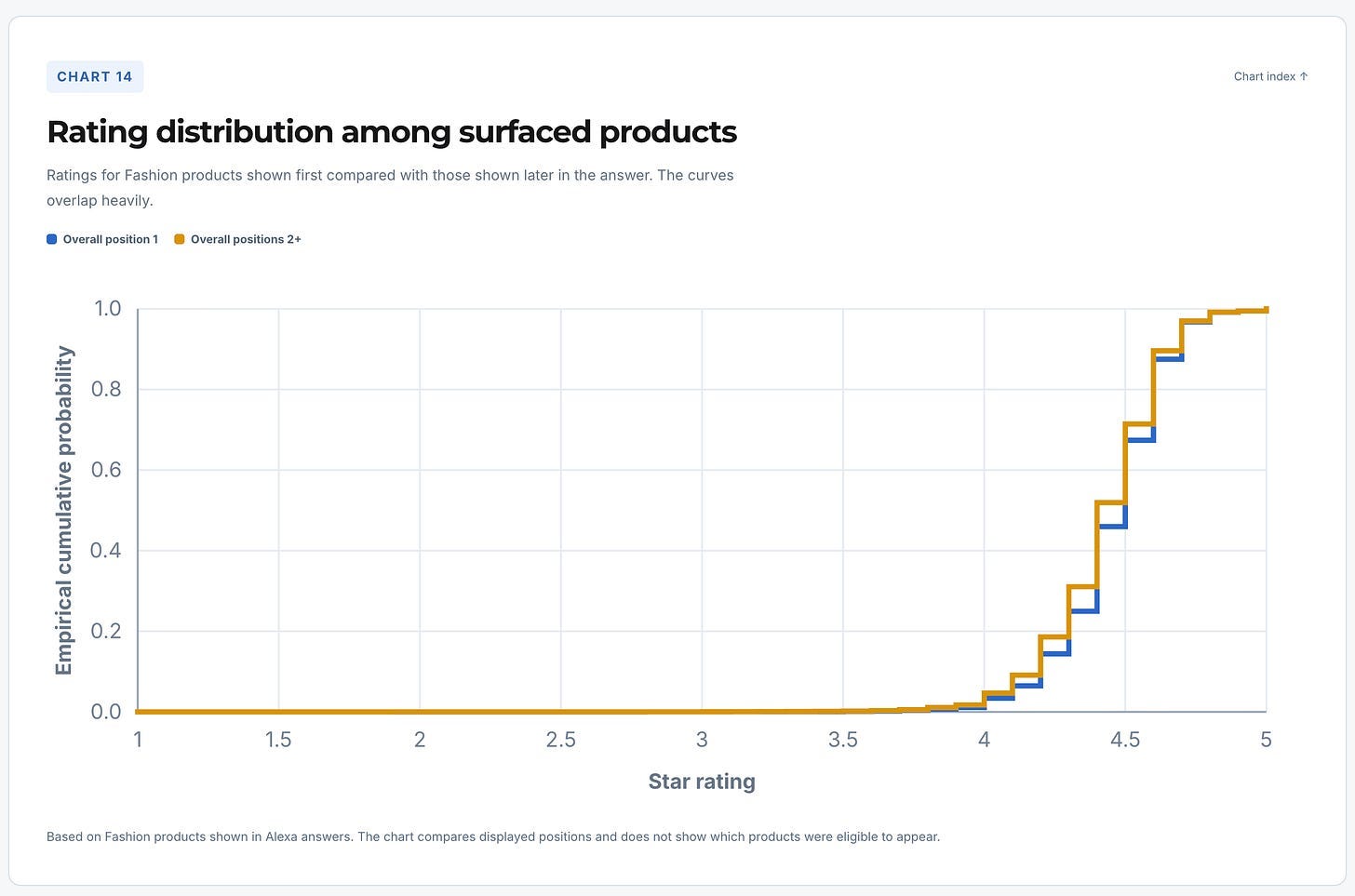
Review depth was consistently associated with earlier placement. In Fashion, star-rating distributions overlapped substantially for first-position products versus later entries. High ratings alone did not distinguish those groups. Reviews can also reveal where product experience falls short of expectations, pointing toward improvements beyond content.
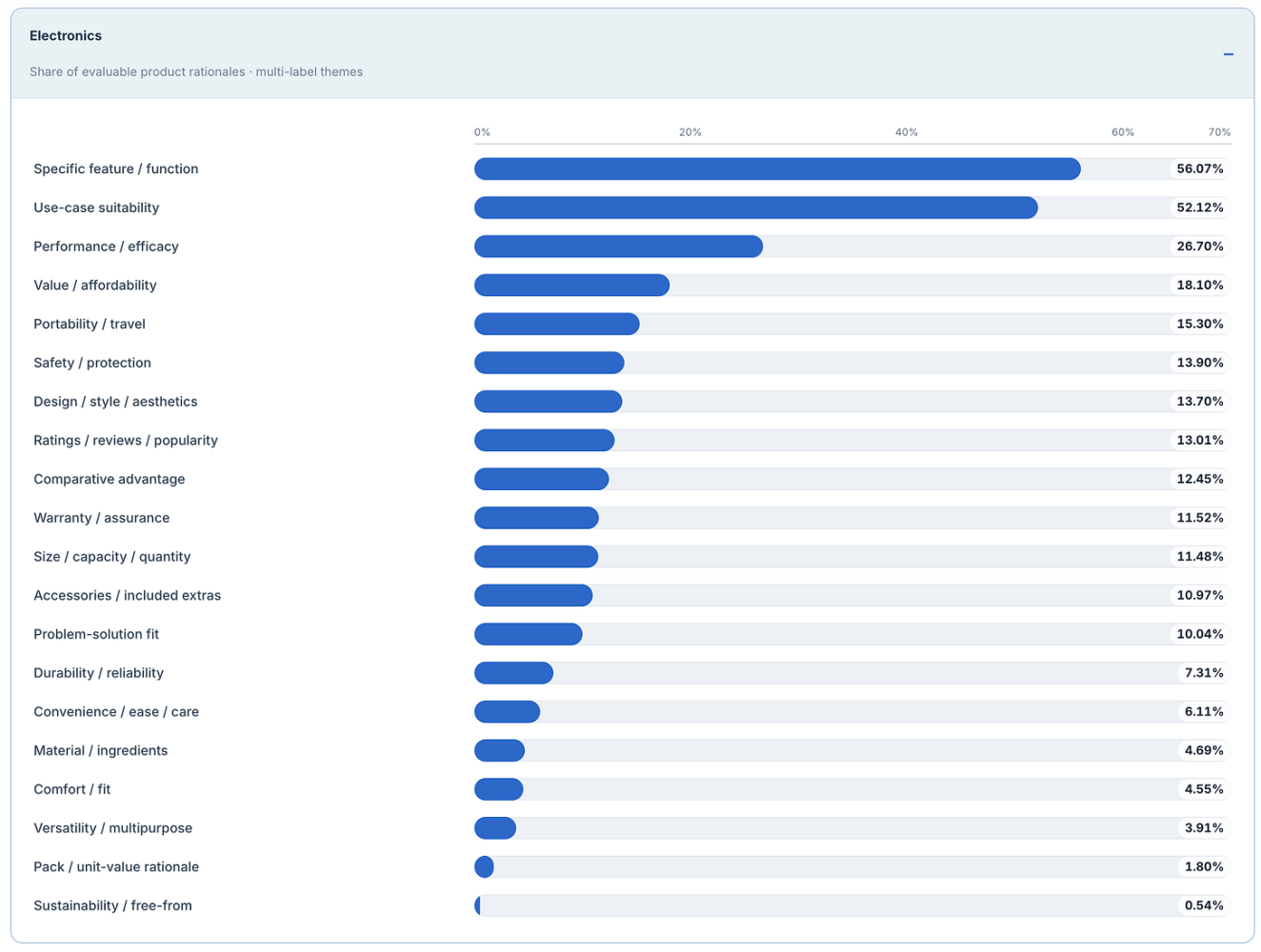
Category differences matter. As part of our study, we looked at product explanations across categories using common theme definitions. Specific features or functions appeared in 56.07% of Electronics rationales. In CPG, size, capacity, or quantity appeared in 63.72%; pack or unit value appeared in 35.51%. Fashion explanations frequently referred to materials as well as fit.
Electronics pages should explain function alongside compatibility requirements. Identify included accessories explicitly. CPG content should make pack quantities clear enough for value comparisons. Fashion shoppers need descriptions of fabric suited to different occasions. Explain how construction shapes fit. Allocate page space according to those buying needs.
Buying information appears across several surfaces.
As part of our study, we looked at where answers supplied information about shopper requirements. Price requirements were more readily supported on product cards; warranty requirements were more often supported in rationales. Relevant group headings alone cannot establish whether items meet every requirement.
For CeraVe, formula details should remain consistent throughout its listing. Pack configuration must be unambiguous. Claims about intended skin type should match documented benefits. Buyers should not have to reconcile conflicting versions of an offer.
External sources also appear in shopping answers. Our Fashion chart shows recurring domains that differ from those in our CPG chart. These patterns suggest places to investigate product descriptions beyond listings. Outdated variant details become specific issues to address when they appear on relevant cited pages, as do unsupported claims.
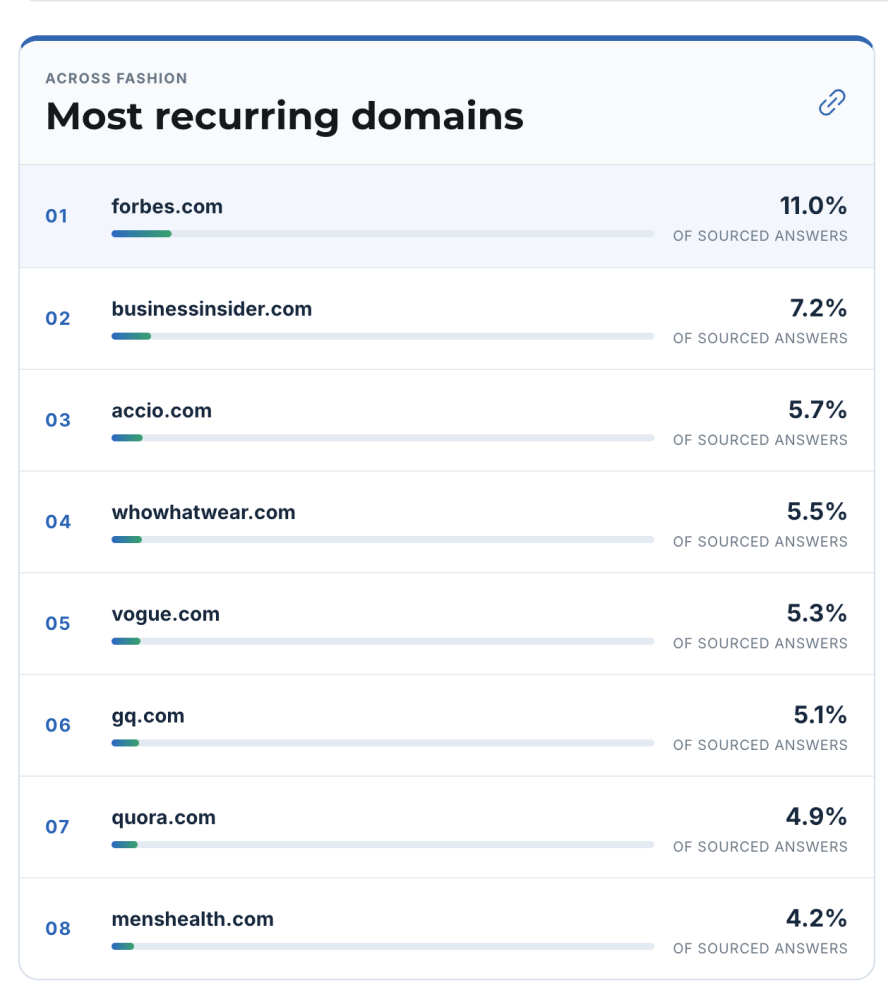
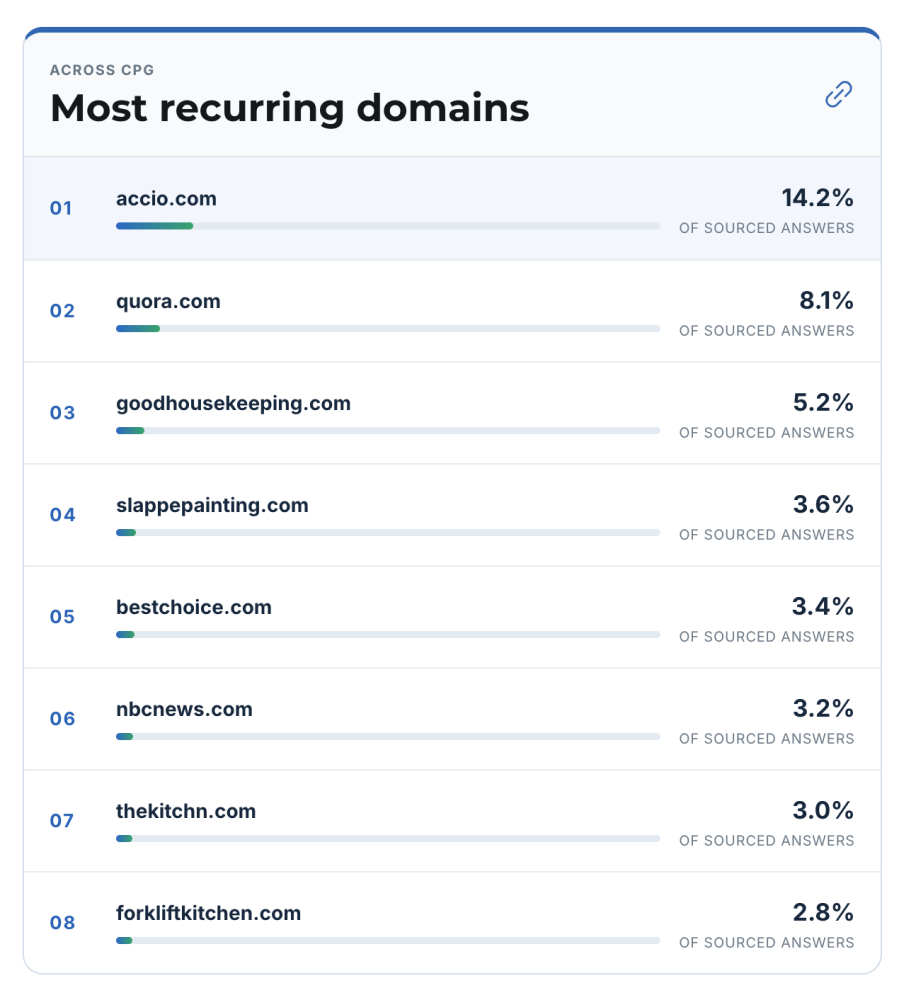
Frequent citation makes domains worth investigating; it does not prove that paid coverage will improve placement. Read relevant pages before pursuing content updates or publisher relationships. Assess whether their coverage gives shoppers accurate, useful accounts of your products.
4 Strategic implication
The Big Idea.
Prepare each product for the missions it can credibly serve.
What this means for a brand
Define each ASIN clearly: identity, the relevant constraints, supported advantages. Evaluate mission fit before assessing shelf relevance. Measure prominence separately. Useful rationales connect product evidence to buyers’ needs.
5 Six questions to ask
Mission coverage
Which shopper situations can this ASIN credibly serve?
Map suitable uses from customer needs. Consider three perspectives: intended audiences, practical constraints, desired outcomes. Test several realistic requests per mission so individual phrasings cannot determine your assessment of visibility.
A clear role for every ASIN
Semantic-shelf placement
Does this ASIN belong in its shopping group?
Semantic shelves group products around named needs. Check whether those needs match missions your ASIN can genuinely serve.
Relevant context for each product
Shelf prominence
How early does that shelf appear?
Record where each shelf appears within the complete answer. Leading later groups provides different visibility from appearing first overall.
Visible placement for each mission
Within-shelf leadership
Does this ASIN lead its local alternatives?
Compare products actually placed together. Record an ASIN’s rank within its shelf separately from its overall answer position.
A strong position among relevant rivals
Rationale alignment
Do shelf, card, and rationale tell a consistent story?
Connect each mission to product-specific evidence. Check whether important claims remain accurate when product facts become recommendation language.
A consistent reason to belong
Product-specific justification
Does this rationale explain why this exact product fits?
Provide structured facts about exact models, including relevant variant differences. Make benefits explicit within stated limits, including conditions of use, so readers can check recommendations against evidence.
Product-specific reasons shoppers can evaluate
6 What should brands do next?
Three strategic priorities
1 Optimize for multiple shopper missions.
Map every ASIN to situations it can credibly serve. Consider practical constraints alongside desired outcomes. Missions may prioritize value, premium quality, specialized use, audience, style, compatibility, safety, or trade-offs. Customer goals should determine priorities. Mission frequency in designed benchmarks does not measure shopper demand.
2 Build mission-specific advantages within each shelf.
Identify documented differences that change purchase decisions. Compatibility, capacity, portability, and protection are examples of criteria worth examining. Explain why an ASIN is preferable for that mission. State where its advantage holds without obscuring trade-offs. Those boundaries define competitive propositions to test within each relevant shelf.
3 Find demand territories through local mission patterns.
Concepts may disappear in corpus-wide keyword summaries yet recur within focused mission families. Check whether product selections reinforce patterns first seen in prompts. Look for supporting language in semantic shelves, titles, product rationales, or stated reasons. Treat consistent patterns as candidate opportunities. Validate actual demand before investing, with product suitability assessed separately.
Putting priorities into practice
1. Choose buying needs your product can serve. Start with one commercially important ASIN that has adequate stock at viable margins. Use search terms, customer questions, reviews, and existing sales to identify valuable needs. For CeraVe, that might mean shoppers seeking lightweight moisturizers for oily skin, provided claims for its exact formula support that use.
Write down who you intend to reach, what they need, which constraints matter, and why your ASIN deserves consideration. Compare that proposition with alternatives Alexa actually presents for the request. Use those competitors to guide your next change.
2. Explain defensible reasons to buy. Keep item names precise about product identity. Reinforce variant details in highlights. Use bullets with images to explain supported benefits. For gel-creams, describe texture in relation to intended skin type, then clarify any documented finish. Broad claims such as “premium skincare” tell buyers little.
Show how ingredients contribute to benefits. Explain what construction features do in practice: pockets can support convenience claims for dresses, while quick-drying fabric requires evidence. Buyers should understand what each feature does, with credible support for its stated benefit.
3. Resolve details that could stop purchases. Correct contradictory pack counts, unclear sizes, missing compatibility details, or confusing variations. Put exact facts in appropriate attributes. Reinforce essential requirements through images, bullets, or A+ content so buyers can determine what will arrive.
4. Fix commercial weaknesses once content is clear. If pricing misses target budgets, reconsider intended customers, pack configurations, or price points. Repeated complaints about product experience call for product improvements, with corrections to any misleading promises. Copy can explain value; it cannot create missing features or repair faulty items.
Choose changes with clear links to business results: more qualified visits, better conversion, fewer expectation-driven returns, or stronger contribution margins. Establish baselines before implementation. Evaluate results over suitable periods. Account for promotional activity as well as fluctuations in advertising, pricing, or availability. Repeat shopping requests to observe presentation changes. Judge commercial success through sales and profit.
Seven strategies organize the implementation. Noun Phrase Optimization supports clear product identity. A9 Optimization addresses relevant search language. Semantic Bridging connects facts to shopper needs, with Inference Optimization clarifying supported benefits. Shopping Missions + Query Planning organizes buying situations to examine. Attribute Optimization maintains accurate structured facts. Product Page Coverage makes essential information available throughout listings (we will conclude this series next week with the latter two).
Start with one priority ASIN. Address the most consequential weakness your evidence reveals, giving buyers stronger reasons to choose it.
Research note
Our study covered 100K prompts. Requests spanned product categories while varying shopper needs, budgets, comparisons, or purchase concerns. As part of our study, we looked at product placement alongside requirement coverage. We also examined themes in product explanations. Different parts used different research subsets; interpret each finding within its stated context.
These requests were designed for benchmarking rather than measuring consumer demand. Findings describe observed answers with their displayed products, not Amazon’s undisclosed ranking rules. Associations involving price or reviews do not establish causal effects. Claims require evidence for each exact product. Commercial recommendations remain hypotheses to test.
Here is the full Comprehensive analysis:
https://alexaforshopping.refibuy.ai/