


Everybody has been asking me why I went to ReFiBuy. “Agentic commerce? Andrew, I thought you were into Alexa for Shopping.” Well, if my recent content hasn’t already made it clear, the tactics I have been covering all point to one thing: ACO Everywhere. And yes, the intention is helping enterprise brands (1P + 3P) track AI visibility, ingest your ASINs, and enrich them with optimization to increase visibility, and thus sales.
Amazon ACO is part of that “Everywhere.” We are officially in the Amazon space.
Going off of the new philosophy of ACO, Scot said:
“Different verticals will have different agentic surfaces and contextual captures that they will want to prioritize. For example, fashion and beauty will lean in on social context more than, say, auto parts.”
What this looks like is everything we’ve been talking about within Amazon. Now we have all of our acronyms under one roof. On Amazon especially, GOOD ACO necessitates GOOD SEO + GOOD Alexa for Shopping Optimization, the dual discovery engine of Amazon: A9 (Amazon SEO) + Alexa for Shopping (ASIN answerability).
On Amazon, that means engineering an ASIN to succeed across two connected discovery systems: traditional marketplace search and Alexa for Shopping. A9 helps determine whether the product enters the candidate pool. Alexa for Shopping reasons over the shopper’s mission, constraints, preferences, product evidence, and context to decide whether the product should be selected.
Every unanswered product content gap is a doorway to a competitor.
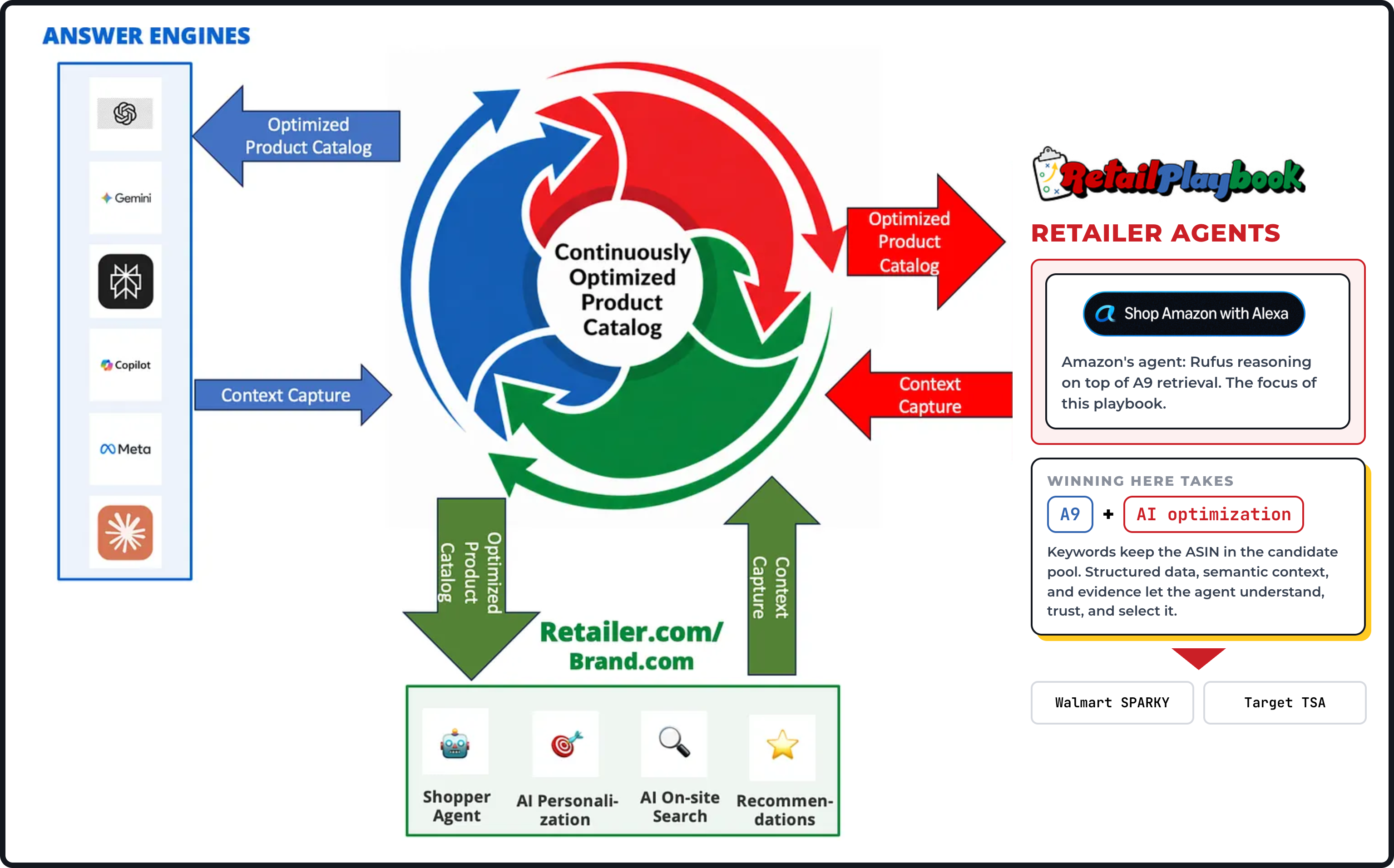
Why “Everywhere” Still Requires Marketplace Specificity
The same underlying product truth should remain consistent everywhere. But consistency does not mean publishing identical content in an identical structure on every platform. Marketplaces diverge in meaningful ways:
One marketplace may require a particular attribute format, while another relies more heavily on retailer-defined taxonomies.
One agent may use marketplace reviews as a central source of evidence, while another leans on the open web.
One retailer may allow extensive A+ or rich-media modules, while another provides a different set of structured fields and merchandising controls.
The organization therefore needs two connected systems:
A shared product-truth layer, containing approved facts, claims, evidence, limitations, use cases, and terminology.
A set of marketplace-specific playbooks, which determine how to encode and publish that truth within each retail environment.
That is where RetailPlaybook fits.
RetailPlaybook helps brands operationalize ACO Everywhere within individual retailer marketplaces.
The RetailPlaybook Extension
ACO Everywhere establishes the imperative to capture context across every meaningful surface and build recursive catalog loops. RetailPlaybook extends that framework in four ways
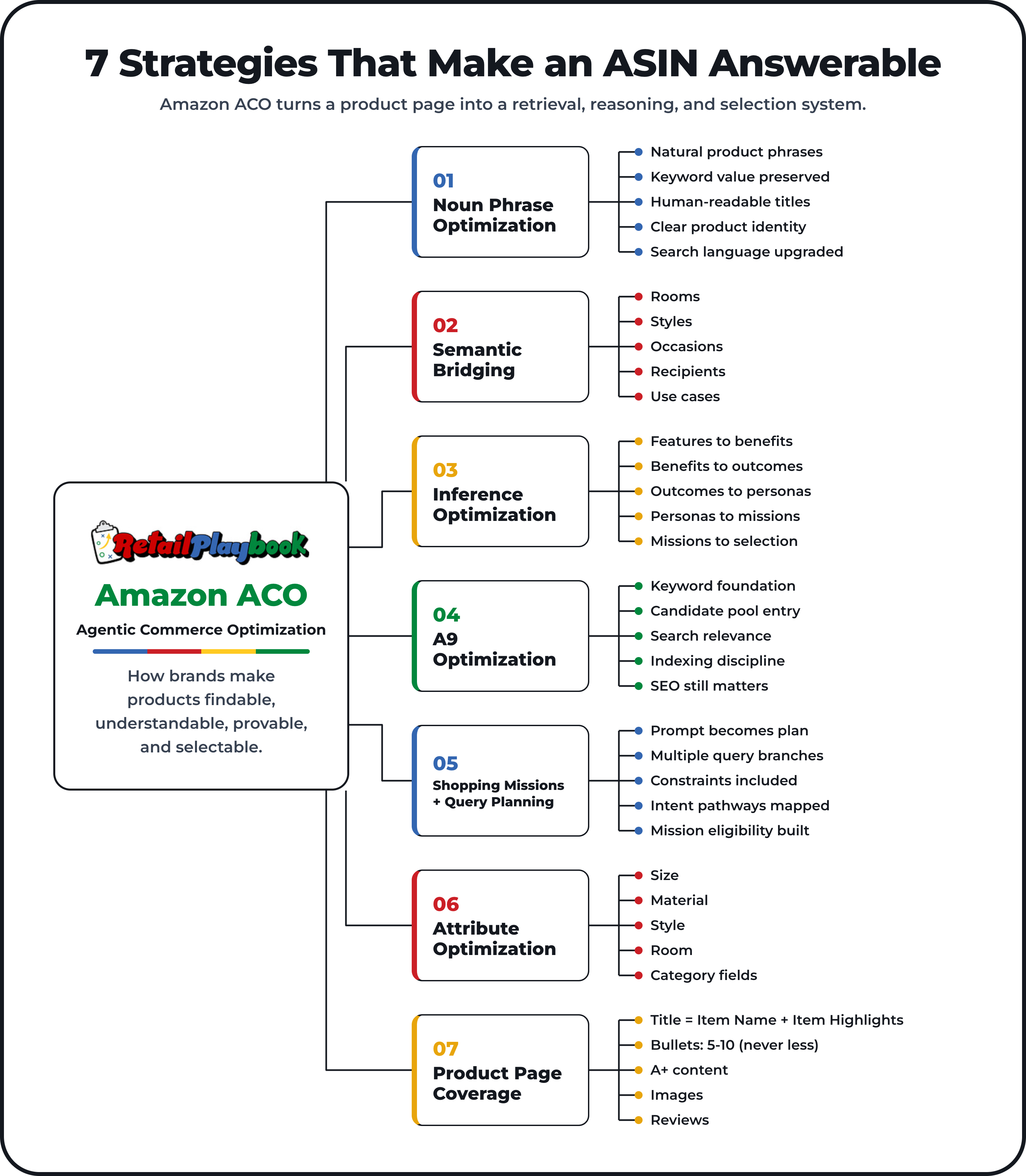
1. It translates universal principles into marketplace mechanics
“Improve the catalog” is strategically correct, but operators still need to know which Amazon fields, content surfaces, retrieval pathways, shopper signals, and evidence types matter for a particular problem. RetailPlaybook focuses on that execution layer.
2. It organizes the work by shopping mission
The shopper’s stated phrase is only one part of the opportunity. RetailPlaybook maps the larger mission, the query branches that mission may generate, the constraints that can eliminate products, and the evidence required to earn selection.
3. It treats language, data, and proof as one system
Keywords alone are insufficient. Attributes alone are insufficient. Creative alone is insufficient. Reviews alone are insufficient. Winning requires convergence across six dimensions:
Retrievable language
Structured product truth
Contextual meaning
Visual explanation
Operational readiness
Trusted evidence
4. It makes the loop category-specific
A beauty product, a replacement auto part, a sofa, a toy, a food item, and a rain jacket do not need the same context taxonomy. Their shopper questions, safety concerns, compatibility requirements, evidence standards, return drivers, and decision criteria all differ.
The playbook must eventually become category-aware, not merely marketplace-aware.
What Comes Next
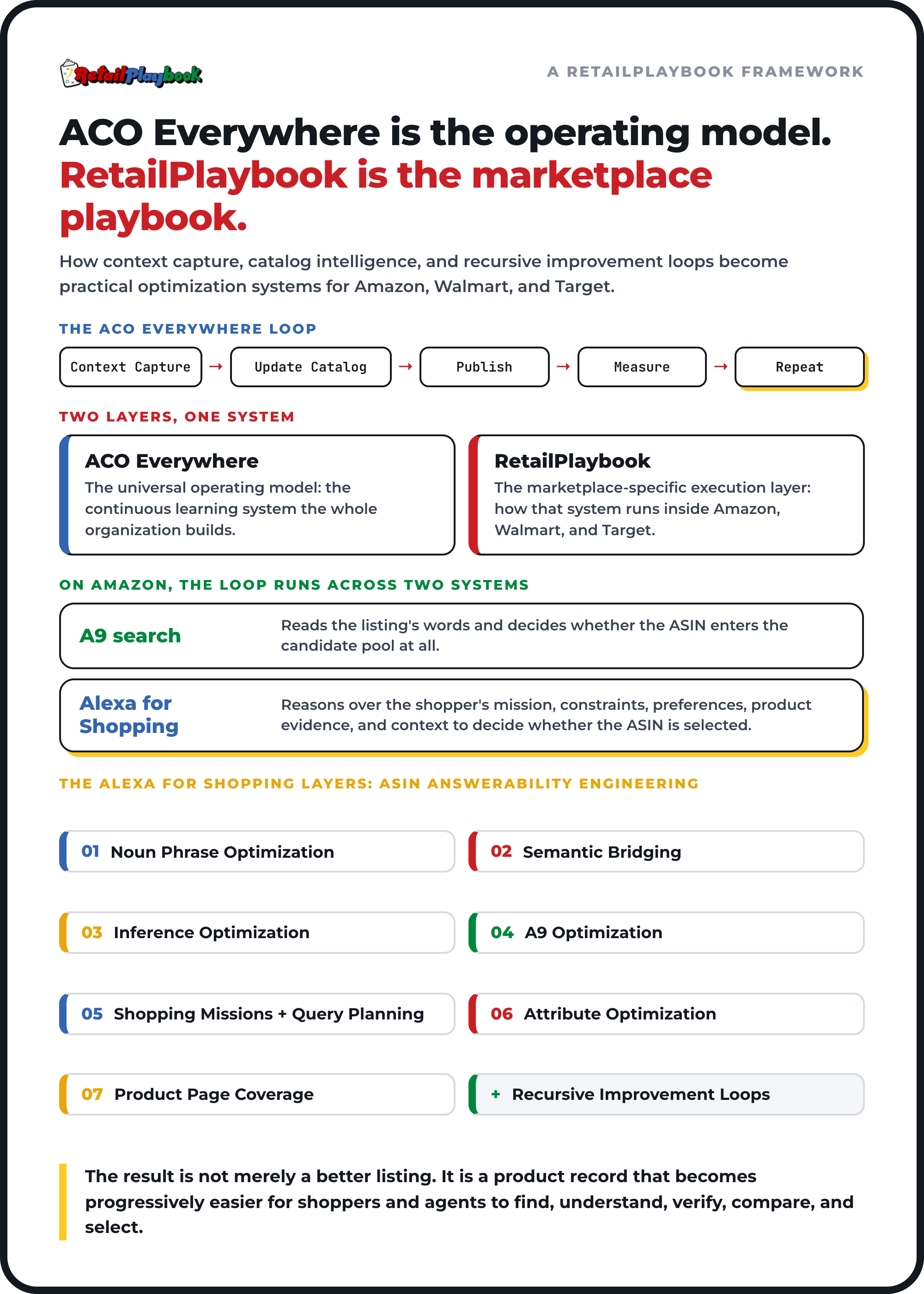
The first phase of agentic commerce optimization was about recognizing that AI shopping interfaces would change product discovery. The next phase is about building the operating systems required to respond.
ACO Everywhere gives brands and retailers the organizational loop:
Capture context. Update the catalog. Publish the truth. Measure the response. Repeat.
RetailPlaybook takes that loop inside the marketplaces. For Amazon, that means making every relevant ASIN:
Findable through A9.
Understandable through structured product data.
Connected to the right shopper missions.
Provable through product-page evidence.
Qualified against the shopper’s constraints.
Selectable by Alexa for Shopping.
For Walmart and Target, the same principles will require different marketplace-specific implementations. That is the purpose of RetailPlaybook.
The definition of ACO remains consistent, but its application changes because every retailer agent retrieves, compares, and recommends products differently. We are building the field manuals that make ACO Everywhere executable.
The future belongs to brands that can learn from context faster than their competitors, translate that learning into better product truth, and distribute that truth across every surface where agents and shoppers make decisions.
If this is where you think Amazon discovery is heading, that is exactly what we are building. See how the full framework comes together in ACO Everywhere, and if you want to help shape it, take a look at the Design Partner Program.