


Alexa for Shopping is no side experiment, thanks to Rufus proving it worked! Andy Jassy put numbers on the assistant recently: more than 350 million customers used it in the last twelve months, and Q2 engagement accelerated, with active users nearly doubling and interactions up more than five times year over year. Amazon also reported that shoppers who click a Sponsored Prompt convert to a sale 48 percent more often, and spend 21 percent more on average, than shoppers who do not. Whatever this assistant reads, cites and repeats is being put in front of a very large number of people, and the shoppers who engage with it buy more. Which sources feed the answer is a commercial question now, not a curiosity.
I have been contending on RetailPlaybook for a while now that Amazon runs a dual discovery system. A9 and the PDP still decide an enormous amount, including which keyword you match, where you sit on the shelf, conversion and the like. None of that has gone away, and I am not going to pretend otherwise. But sitting alongside the old machinery there is now an assistant layer that does something A9 never did: reads the evidence, works out what the shopper is actually trying to accomplish, and then writes an answer in language of its own.
Most of my work on Alexa for Shopping so far has been about what happens inside that layer: how the assistant plans a query, which noun phrases stick, how product evidence on a PDP becomes an explanation, how much of the answer is semantic understanding rather than keyword matching. All of that quietly assumed the evidence being read came from Amazon.
Then I ran a fairly ordinary query and Etsy showed up in the source row, sending me back to study sources far deeper (pherhaps you recall the strategy I set forth in April on authority anchoring).
In my testing it also reads, cites and routes shoppers to pages that sit entirely outside Amazon, including a marketplace that competes with Amazon for the same purchase and a social platform Amazon does not own (but has a deal with!)
Amazon ACO reaches past the edge of brand-controlled information. Seller + Vendor Central have not become less important,
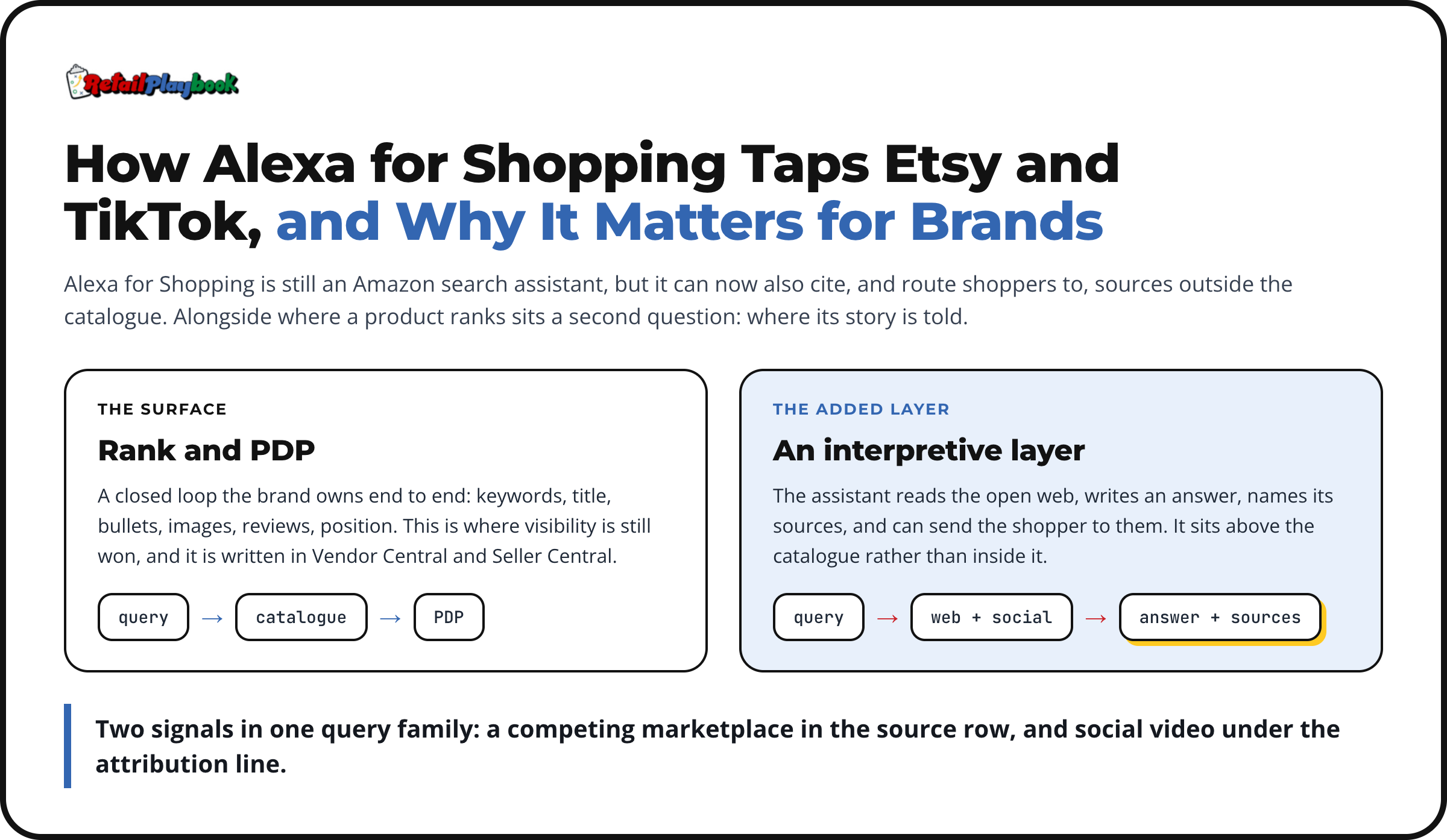
For most of the last decade, winning on Amazon meant winning a closed loop. A shopper typed a query, the engine matched it against the catalogue, and the PDP did the rest of the work. Almost every lever that decided visibility lived inside one account the seller + vendor controlled, from keyword coverage and copy through to imagery, the review base and position on the shelf. If you controlled your listing, you controlled your story.
The interpretive layer evolves that symmetry. This layer sits above the catalogue rather than inside. The assistant reads the open web, writes an answer in fresh words, names the sources used, and then offers to send the shopper to them.
The question for a brand is no longer only where the product ranks, but where the brand gets described, by whom, and whether those descriptions agree.
Why Etsy Appearing in the First Answer Matters
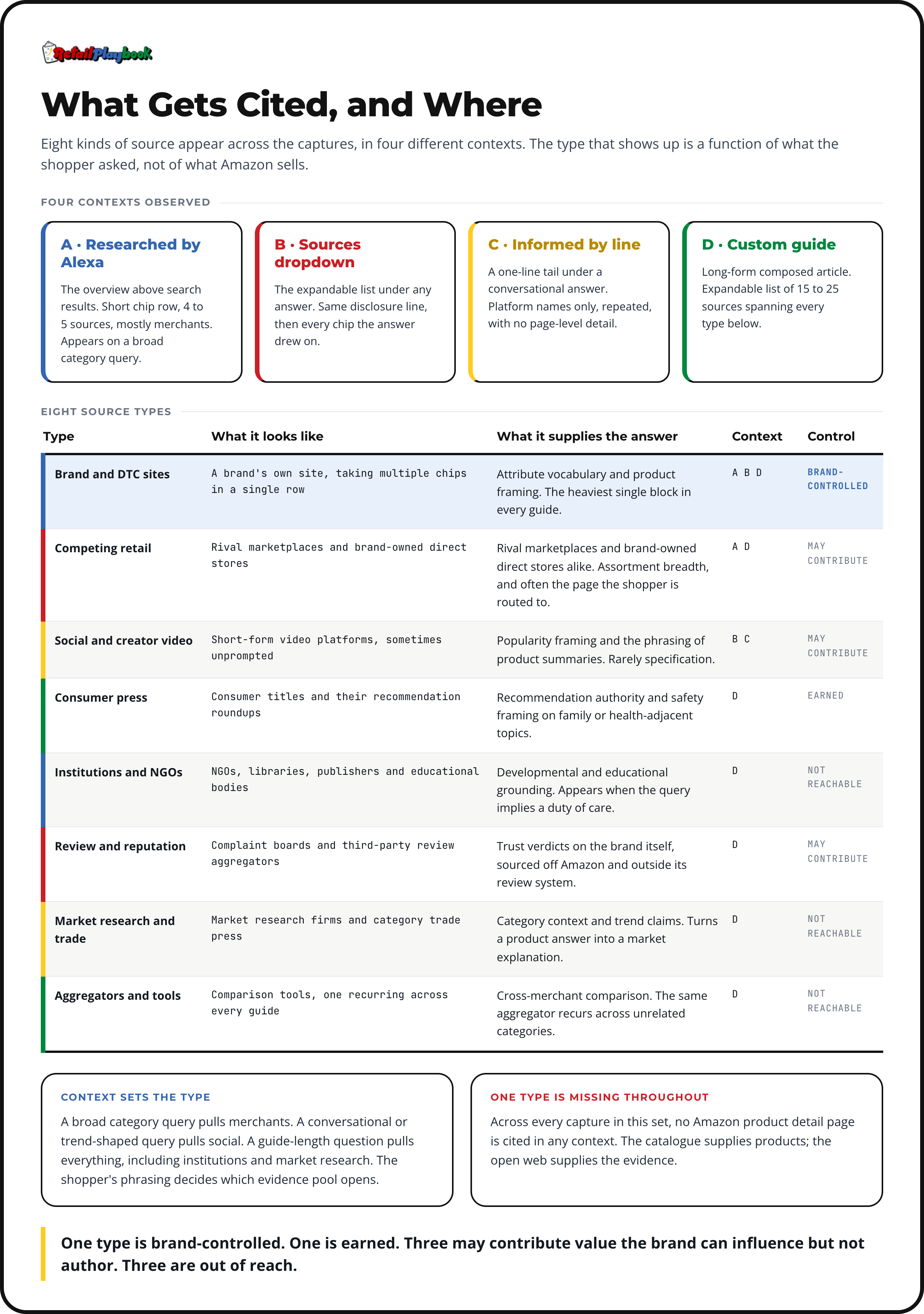
I ran the query custom metal wall art in the Amazon app and opened the Sources row on the “Researched by Alexa” overview. Four chips were named: Bosfori, Etsy, Tailored Canvases and MyPhotoStation.
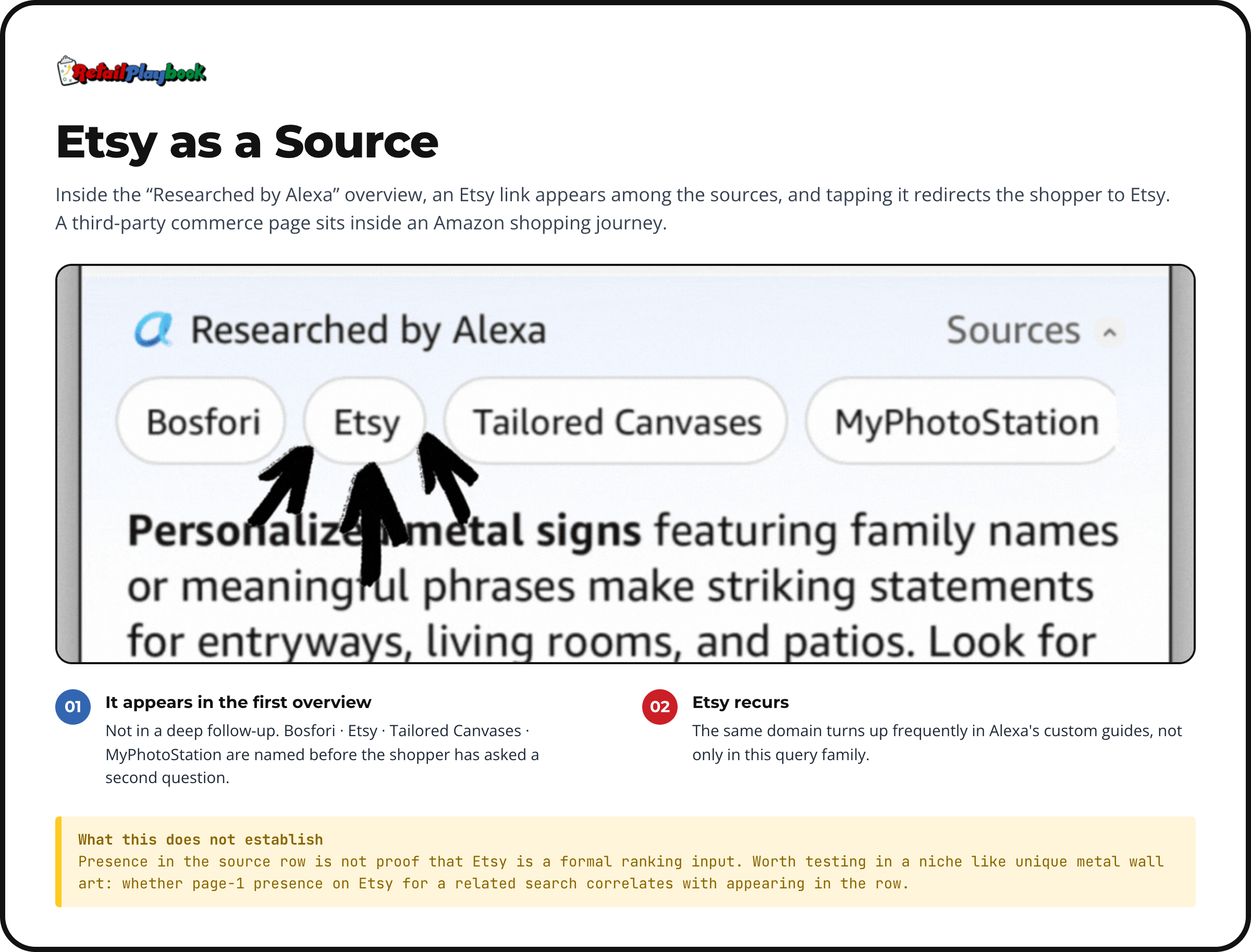
One of those four is not a brand site and not a content page. Etsy is a competing marketplace, sitting inside an Amazon shopping journey, and a tap on that chip takes the shopper straight there.
The timing matters more than the presence. This was the first overview, generated straight off my opening query. I did not drill down, I did not ask a follow-up, and I did not push the assistant toward the open web. Keep prompting Alexa for Shopping and the assistant will pull in pretty well any source you point to, which tells you almost nothing about what the system treats as authoritative. A citation that shows up before the shopper has asked a second question is a different kind of signal. That is the assistant’s own default view of who is worth reading in the category.
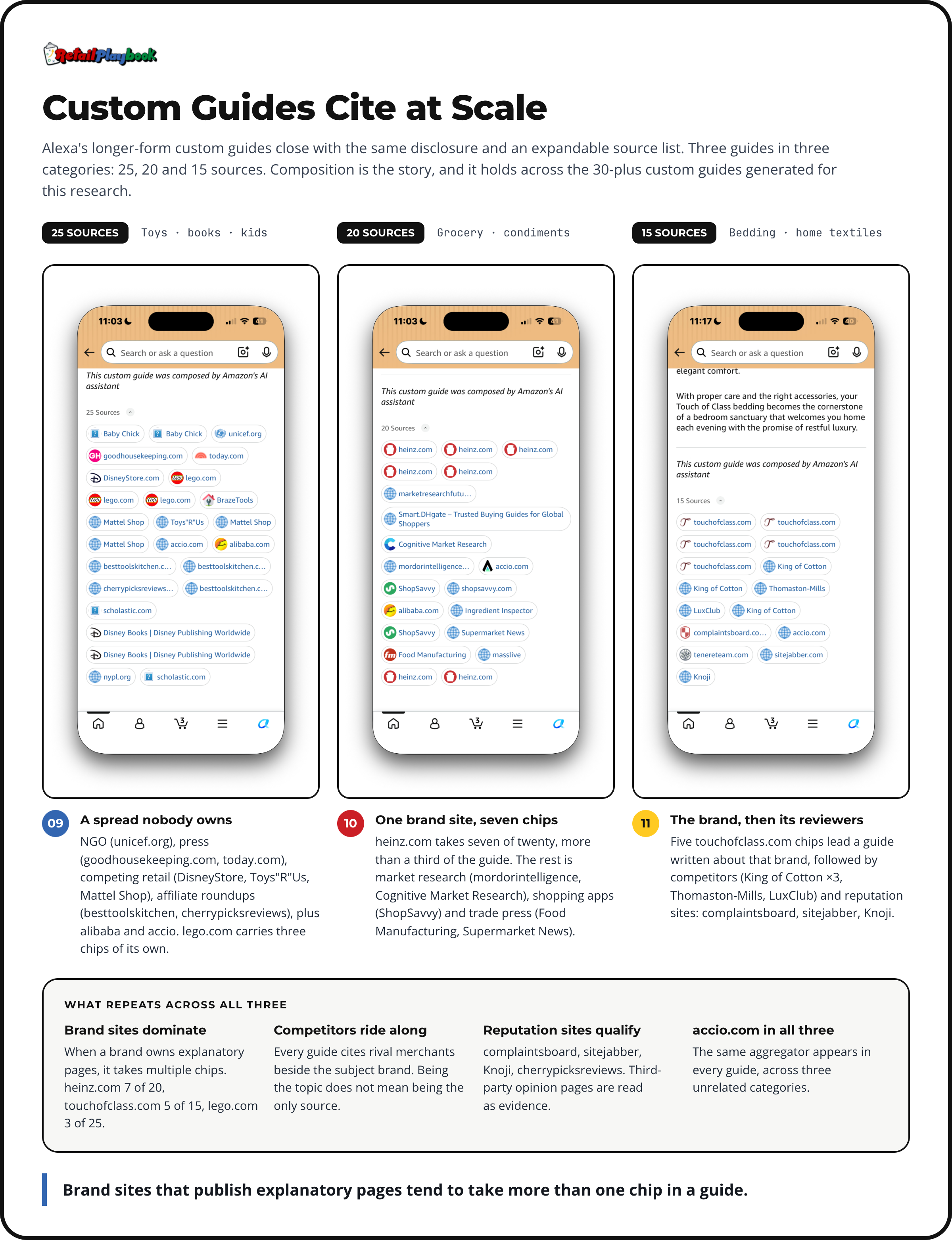
Etsy also recurs. The same domain turns up frequently in Alexa’s custom guides, not only in this one query family. Presence is useful. Recurrence is more meaningful, because it starts to look like category-level authority rather than a single lucky retrieval.
This is exactly the sort of finding that gets over-read. Presence in the source row does not prove that Etsy is a formal ranking input. Nobody outside Amazon can see the complete retrieval logic, and I am not claiming that I can.
What this does establish is that Amazon is allowing an outside marketplace to appear in, and help shape, the answer a shopper sees at the top of an Amazon shopping session.
What this does not establish is why. My working theory is narrow and testable: in a niche like unique metal wall art, page-one presence on Etsy for a closely related search may correlate with appearing in that row. I have not proven that, and I will not present the theory as more than a hypothesis. But a brand selling on both platforms can start answering the question with a few weeks of disciplined logging, which beats arguing about the mechanism.
The Source Chip Is Also an Exit From Amazon
Those chips are not decorative labels. They are tappable, and I tapped one.
Brands have not priced in what happens next. The source row is not only telling the shopper where the answer came from. It is offering them a door out.
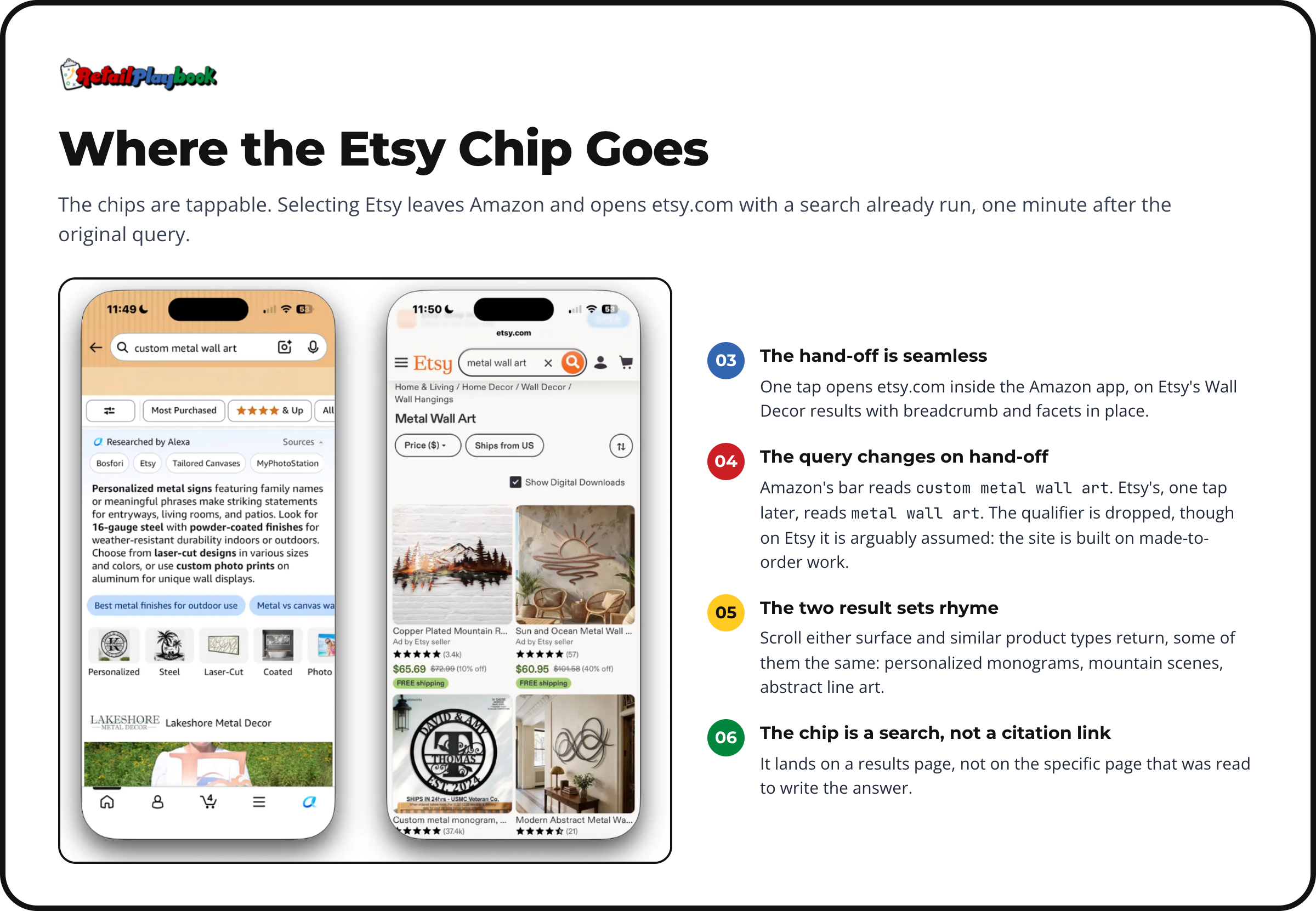
One is the Alexa overview for custom metal wall art inside the Amazon app. The other is etsy.com after I tapped the chip, landing inside the Home & Living / Home Decor / Wall Decor / Wall Hangings breadcrumb, on a Metal Wall Art results page with price and shipping facets already applied. One tap moved me out of Amazon and onto a competitor’s results page, with nothing in the transition that would tell a shopper they had left.
Three things stood out to me when I compared the two screens.
First, the query changes in transit. Amazon’s search bar reads custom metal wall art. Etsy’s reads metal wall art. The qualifier I actually typed is not carried across, so the shopper lands on a broader set than the one they asked for.
Second, the two result sets rhyme. Scroll either surface and the same product archetypes come back: personalized monograms, mountain scenes, abstract line art. Functionally, the assistant pointed me at an adjacent shelf stocked with the same kinds of things it had just been describing.
Third, the chip is a search rather than a citation link. The tap landed me on a results page, not on the specific page that was read in order to write the answer. Whatever Etsy page informed that text stayed hidden from me, and would stay hidden from a shopper too. That matters because the source row is doing two jobs at once, provenance and navigation, and performs the second far better than the first.
The point is not that Amazon is deliberately handing customers to Etsy. The point is that a source chip inside an Amazon answer is now capable of ending the Amazon session, and brands should treat that as part of the surface rather than an edge case.
When TikTok Supplies the Story
Social is the stranger of the two cases, and I have now captured it in two different renderings.
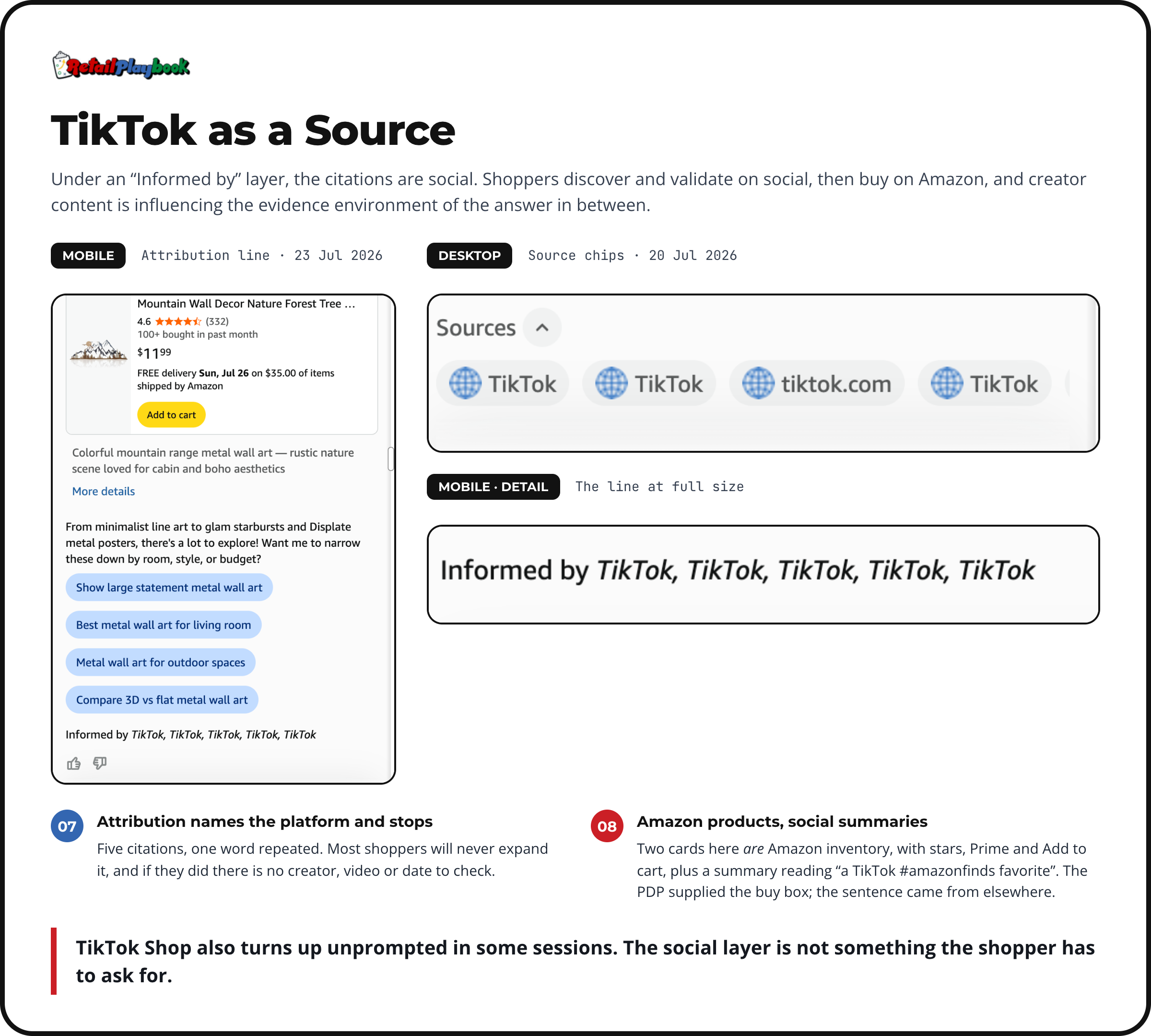
YES, being on Tik Tok not only helps your general presence on Amazon (as has already been proven), but now may contribute to your product card presence on Alexa for Shopping.
TikTok Shop has turned up unprompted in some of my sessions. Nobody asked for the social layer; it arrived with the answer.
A TikTok citation does not produce a sale, and I have no way of knowing whether the citation moves anything at all. What the pattern does show is that Amazon is allowing an outside platform to shape the language of the shopping answer, including the answer attached to an ASIN whose PDP the brand fully controls.
Brand Authority Anchoring: Making Every Surface Agree
The instinct will be to chase citations, to try to get named in the source row. That is the wrong objective, partly because you cannot control Amazon’s source selection and partly because it treats the symptom rather than the cause.
Consistency is the better goal. If the assistant is going to read several surfaces and reconcile them alone, then the work is making sure those surfaces agree. I have started calling this Brand Authority Anchoring, and that is the framework I would build a program around.
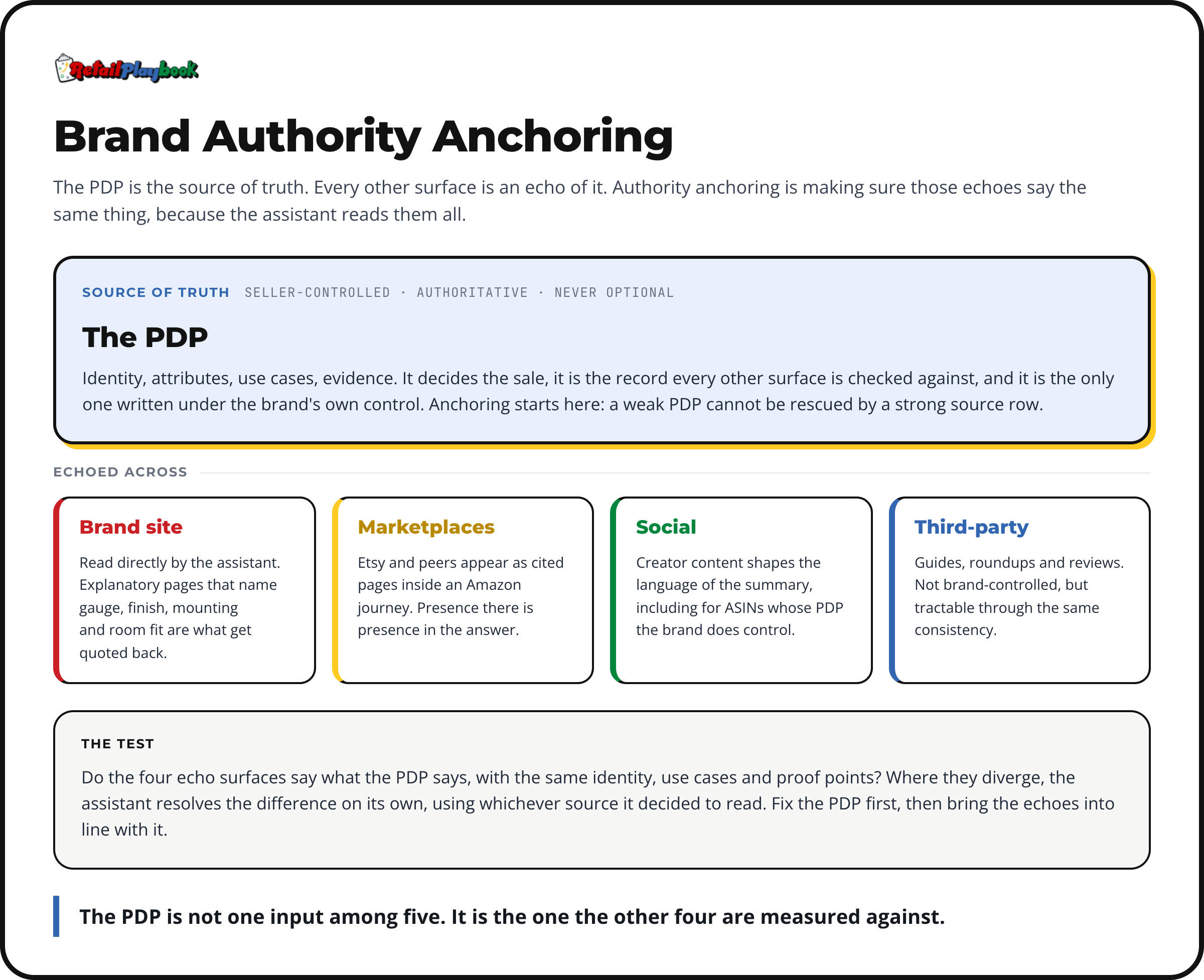
The anchor is the PDP; the authoritative product record, the one page where identity, attributes, use cases and evidence are set down under the seller’s own control. The PDP decides the sale, and every other surface gets checked against that record. Anchoring starts there because a weak PDP cannot be rescued by a strong source row: if your listing is vague about gauge, finish, mounting or room fit, the assistant will pull language from wherever a confident answer did turn up (meaning, maybe not your product page)
Around that anchor sit four echo surfaces. Your brand site and other marketplaces carry the explaining. The brand site is read directly, so the pages that name materials, gauge, finish, mounting method and room fit are the ones that get quoted back to the shopper. Marketplaces like Etsy reinforce category and product identity, and since they can appear as cited pages inside an Amazon journey, presence there becomes presence in the answer.
Social and third-party coverage do something different. Social shapes language, popularity framing and cultural context, the mechanism I documented above, and it reaches ASINs whose PDP you fully control. Guides, roundups and reviews are not brand-controlled, but they tend to repeat whatever the controlled surfaces already agree on, which makes them tractable through the same discipline.
None of that means identical wording everywhere. Copy-pasting your bullets across five surfaces is not anchoring and it reads badly to humans. What has to hold is the way the product is identified, specified, positioned and proven, in whatever register each surface expects.
Run the test yourself. Do those four surfaces say what the PDP says? Checking is easy and failing is uncomfortable. Where they diverge, the assistant resolves the difference alone, using whichever source happened to get read. You do not get a vote in that. So fix the PDP first, then bring the echoes into line.
The PDP is not one input among five. It is the one the other four are measured against.
The Next Measurement Layer of the Digital Shelf
This is where the playbook needs to expand. Rank and PDP quality are of overwhelming importance, by far the majority. However, they no longer describe everything that decides whether a brand appears in the answer, and right now almost nobody has a baseline for the part that is missing.
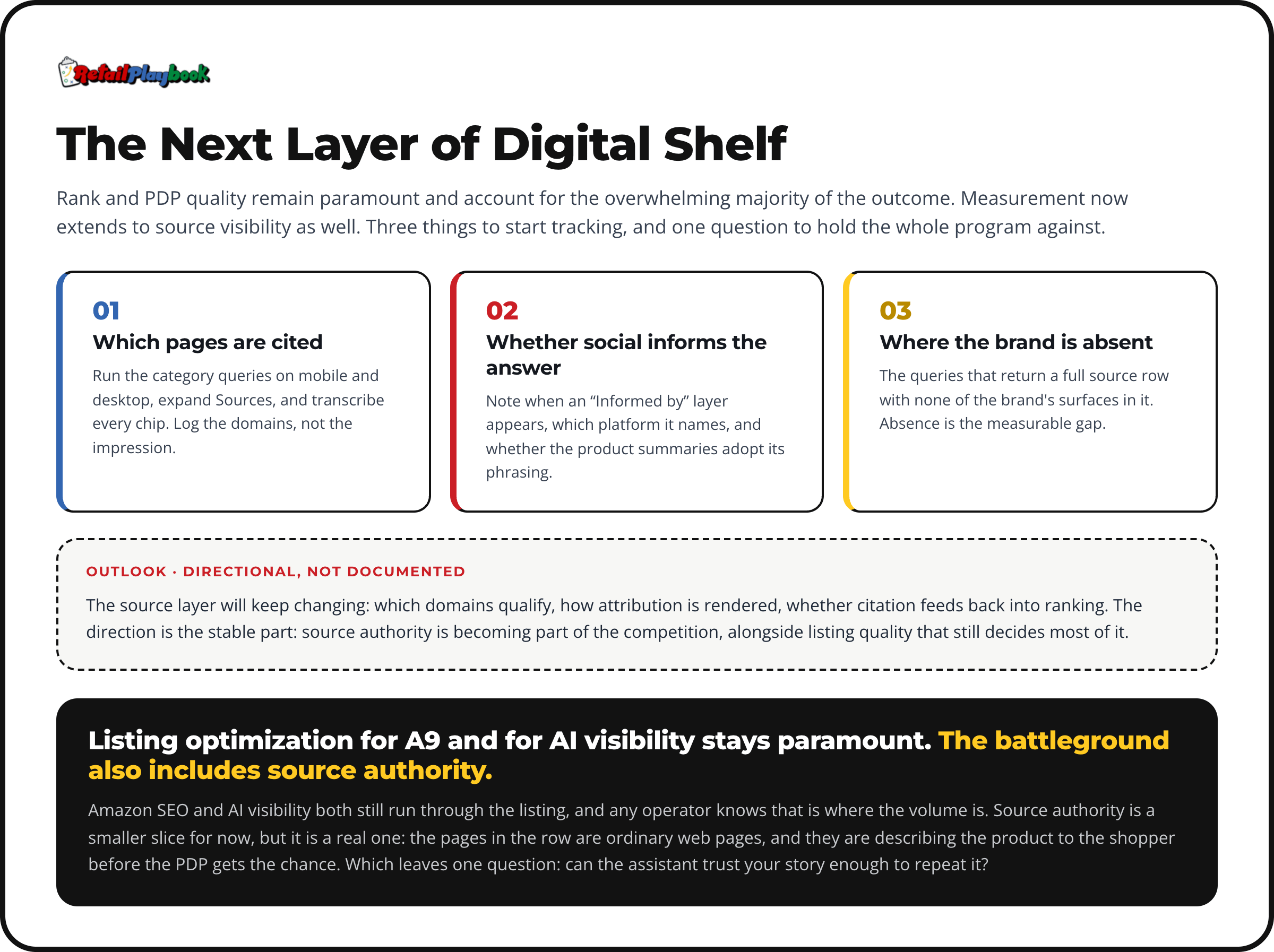
Three things belong in the log from now on.
Start with which pages are cited. Run your category queries on mobile and on desktop, open the Sources row, transcribe every chip, and log the domain. Screenshots are evidence. The domain log is the dataset.
Next, whether social informs the answer. Note when an “Informed by” layer appears, which platform gets named, and whether the product summaries have started adopting that phrasing. When the copy under one of your ASINs stops sounding like your bullets and starts sounding like a video caption, that is the signal.
Most important of all, log where the brand is absent. The most useful queries are the ones that return a full source row with none of your surfaces present. Absence is the measurable gap, and the only signal that tells you where to work next.
All of this is directional rather than documented, and it should be read that way. The source layer will keep changing: which domains qualify, how attribution is rendered, whether citation ever feeds back into retrieval or ranking. I would not build a forecast on any of those specifics. The direction is the stable part, and the direction is that brands will compete on source authority alongside listing quality.
Listing optimization is not going away. Rank determines whether the product is found. Source authority may influence how the product is explained and it may influence how the product is ranked. Those are two different jobs, and brands now need to do both.
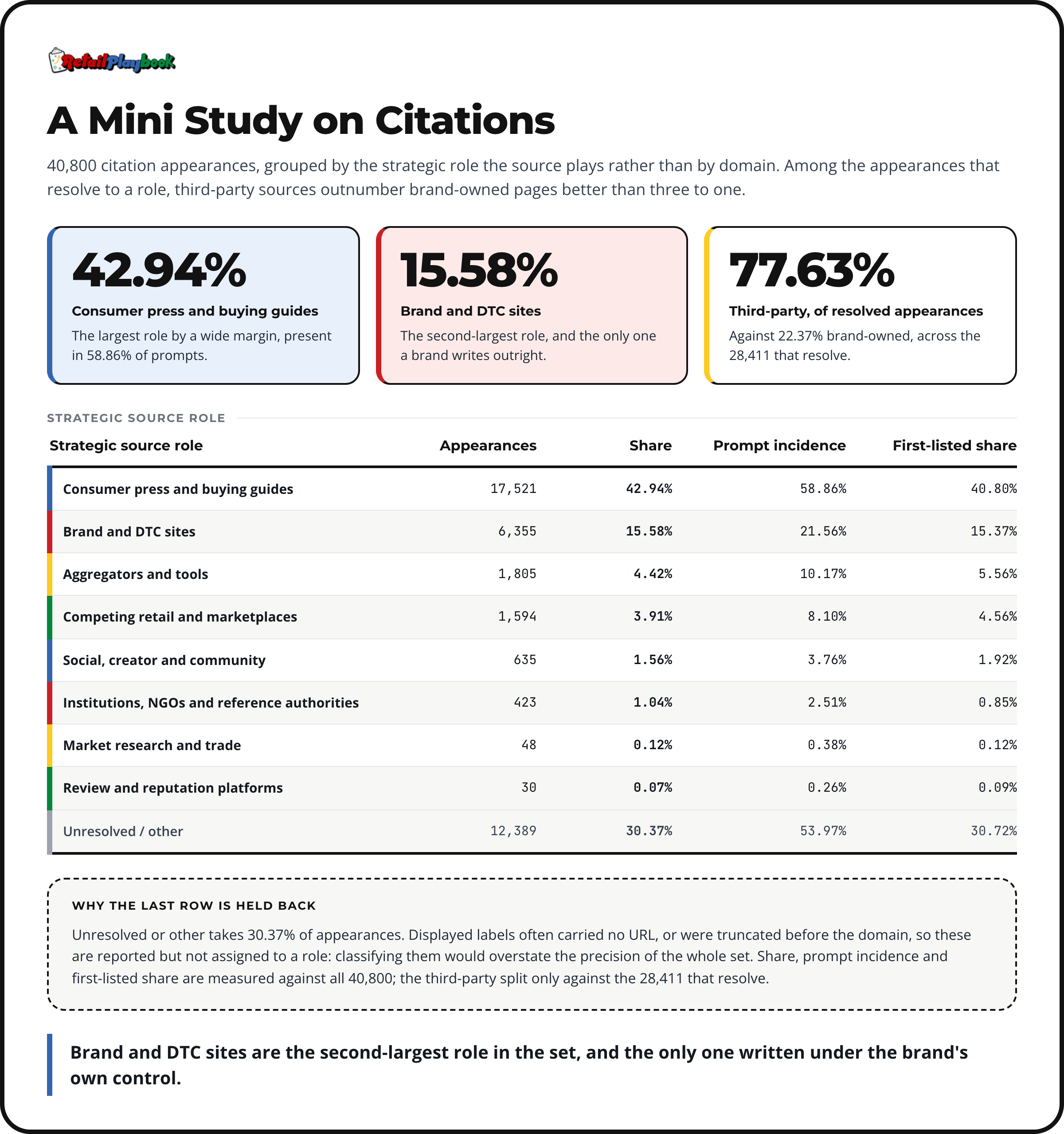
The PDP remains the anchor, and I would far rather see a brand fix a weak PDP than win a citation. Citations are not as important as others will let you believe, at least not yet on Amazon. But the assistant is using outside sources to interpret, describe and validate the product, and the pages it reads are not unattainable ones. Remember, Alexa reads a brand site, possibly a marketplace listing or social commerce site. Those are ordinary web pages that a seller can write or influence, and on this surface they are doing work the PDP is not.
So source authority should become a measurable part of Amazon ACO, sitting alongside rank, content quality and conversion, logged and reviewed on the same cadence.
You cannot make the assistant cite you, and you should stop trying. What you can do is make sure every surface the assistant might read tells the same story about the product: what the product is, what goes into the build, who buys it and why the design works. Which leaves the only question that really matters on this surface: has the brand given the assistant enough consistent evidence to trust that story and repeat it? HAVE YOU done the due diligence?