


Welcome to RetailPlaybook. If this is your first time here, this is a new newsletter and podcast about agentic commerce optimization, in particular, how brands and sellers win on Amazon, Walmart, and Target as AI assistants increasingly decide what shoppers see and buy. Each issue turns Amazon’s patents, science, and real field testing into tactics you can actually run. Glad you’re here.
TL;DR
Amazon ACO is ASIN answerability engineering for a dual discovery system. A9 still matters because it builds the searchable product pool, while Alexa for Shopping (Rufus) sits on top of that pool to interpret the shopper’s mission, reason through context, apply constraints, compare evidence, personalize the result, and select the product that best fits the person, occasion, budget, preference set, and situation. The goal is no longer just to rank for one keyword. The goal is to become eligible across the right family of query pathways, provide enough structured product truth to be understood, prove fit through page evidence, and earn selection as the right product inside a larger shopping mission.
Good ACO is great SEO. Agentic commerce does not replace Amazon SEO. It makes SEO more important because retrieval is still the foundation of recommendation.
A9 determines whether the product can be found. Alexa for Shopping (Rufus) determines whether the product can be understood, trusted, personalized, and selected.
The evolution is from keyword ranking to mission eligibility. A shopper may say one thing, but Alexa may generate many searches from that one request.
A keyword is what the shopper types. A mission is what the shopper is trying to accomplish.
Query Planning Optimization is a new tactical layer. QPO asks whether the ASIN can be found across the likely query branches Alexa may create from a shopper mission.
The new unit of optimization is the query plan. One shopper prompt can branch into searches by product type, room, style, use case, recipient, budget, material, size, constraint, and desired outcome.
Noun Phrase Optimization turns keywords into natural product language. Instead of stuffing isolated terms, brands should build clear phrases that preserve keyword value while helping Amazon understand the product.
Semantic Bridging connects the product to adjacent meanings. A listing should connect the product to rooms, styles, occasions, recipients, use cases, and shopper intents that Amazon may infer.
Inference Optimization maps features to outcomes. Brands need to show how product attributes translate into benefits, buyer personas, real-world use cases, and final purchase confidence.
Attributes are structured product truth. Titles, bullets, images, A+ content, and reviews help explain the product, but attributes tell Amazon what the product actually is.
Missing attributes create silence. If size, material, style, finish, compatibility, room, use case, or category-specific fields are blank, Alexa has less evidence when those details matter to the shopper mission.
Product Page Coverage asks whether the ASIN can answer the questions customers are likely to ask. The product page should clearly cover durability, dimensions, material, installation, style, room fit, gifting, cleaning, compatibility, value, and any category-specific concerns.
The strongest ASIN is not merely keyword-rich. It is clear, complete, specific, current, attribute-rich, review-supported, visually understandable, and semantically connected to real shopper missions.
The bottom line is simple. Brands need to make every ASIN findable by A9, understandable to Alexa for Shopping (Rufus), provable through PDP evidence, and selectable for a specific shopper in a specific situation.
Let's dive in.
Everything begins with a definition.So let’s start there:
What is ACO on Amazon?1
Amazon ACO is the practice of engineering an ASIN so it can be retrieved by keywords, interpreted through structured data, reasoned over through semantic context, trusted through evidence, and selected as the right component inside a shopper’s larger mission
A playbook is not built around using the same offensive and defensive strategy against every opponent. It is built around understanding the specific composition of each team, then designing a strategy that exploits its weaknesses, protects against its strengths, and gives your team the best chance to win.
The same principle applies to marketplace optimization.
What we do for Amazon is not the same as what we do for Walmart. The fundamentals may overlap. You still need strong content, clean data, relevant keywords, persuasive creative, operational readiness, and conversion discipline. In football terms, both teams still pass the ball, run the ball, and put eleven players on the field. But winning depends on more than fundamentals. Winning depends on adapting the strategy to the environment.
For this reason, marketplace distinctiveness matters. A brand wins because it is distinct. Its products, positioning, proof points, customer promise, and category authority separate it from everyone else. But in a world shaped by AI assistants, retrieval systems, recommendation models, and agentic shopping layers, the question changes:
How does a brand communicate its distinctiveness to the platform well enough for the platform to understand it, retrieve it, recommend it, and defend it?
That is the heart of agentic commerce optimization.
Amazon should not be treated like Google. Walmart should not be treated like Amazon. ChatGPT should not be treated like either one. Each marketplace has its own data structure, ranking system, retrieval logic, shopper behavior, recommendation surfaces, and AI interpretation layer. Meaning, each platform requires its own optimization science.
The same is true for ACO.
Amazon ACO should not be copied from traditional SEO, Google SEO, Walmart SEO, or generic AI optimization. It must be built around Amazon’s own marketplace mechanics, product data architecture, ranking systems, recommendation logic, customer review intelligence, advertising signals, and Alexa for Shopping (Rufus) retrieval behavior.
At the same time, ACO does not replace SEO. In fact, one of the central arguments of RetailPlaybook is simple:
Good ACO is great SEO, but great SEO alone is not enough for ACO.
What follows is a practical breakdown of the strategies I have developed through a deep study of Amazon patents, scientific papers, marketplace behavior, and an optimization portfolio of more than 4,000 ASINs, including 1,500 optimized by hand and the rest improved through human-in-the-loop systems.
Earlier I published Alexa for Shopping: the Blueprint. If you are new here, that piece lays the foundation for everything below. Here is the quick recap.
Now, let's recap Alexa for Shopping: the Blueprint
Recap of Part 1:
“Optimization is now missional. Each shopping mission contains constraints, attributes, memories, preferences, budgets, timing, and context signals that shape both the query plan and the final product selection. Winning listings will need to function like structured evidence systems: clear, complete, specific, current, and trustworthy….Alexa for Shopping extends that pattern into a more personalized and agentic interface. Its advantage is that it can use Amazon’s search infrastructure to assemble a stronger candidate pool across multiple related queries, then refine that pool through context. The ranking does not begin from nothing. It begins inside a product selection pool shaped by search relevance, query expansion, product attributes, sales signals, availability, price, and customer intent. Alexa can then apply another layer of judgment: which product fits this person, this occasion, this budget, this preference set, and this shopping mission?
We also learned that Position 1 in Alexa for Shopping is ( after factoring in “eligibility gates”)making a fit decision.
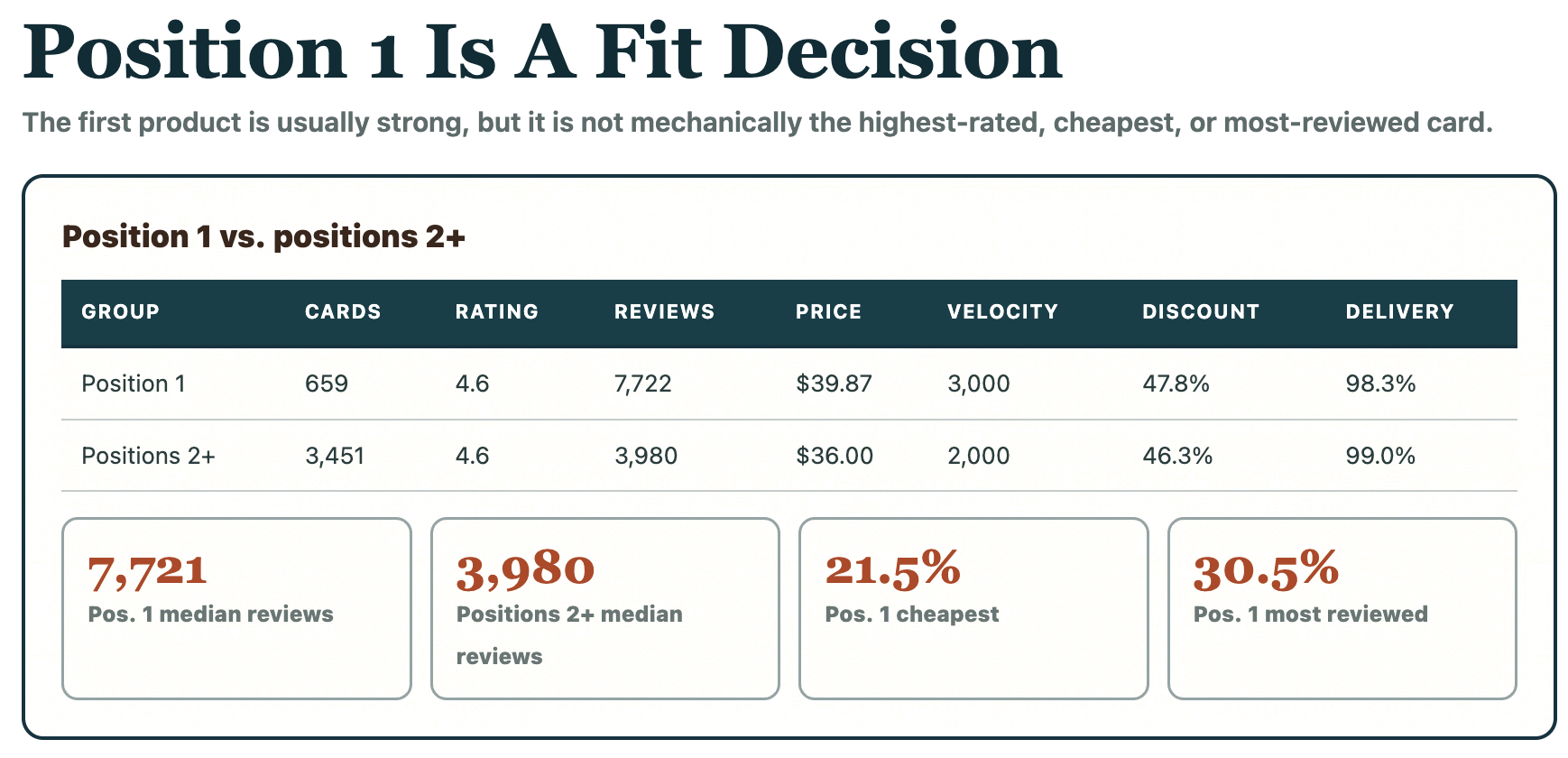
Position 1 appears to reflect overall fit across multiple signals, including relevance, reviews, price, velocity, discount, delivery, and shopper intent.
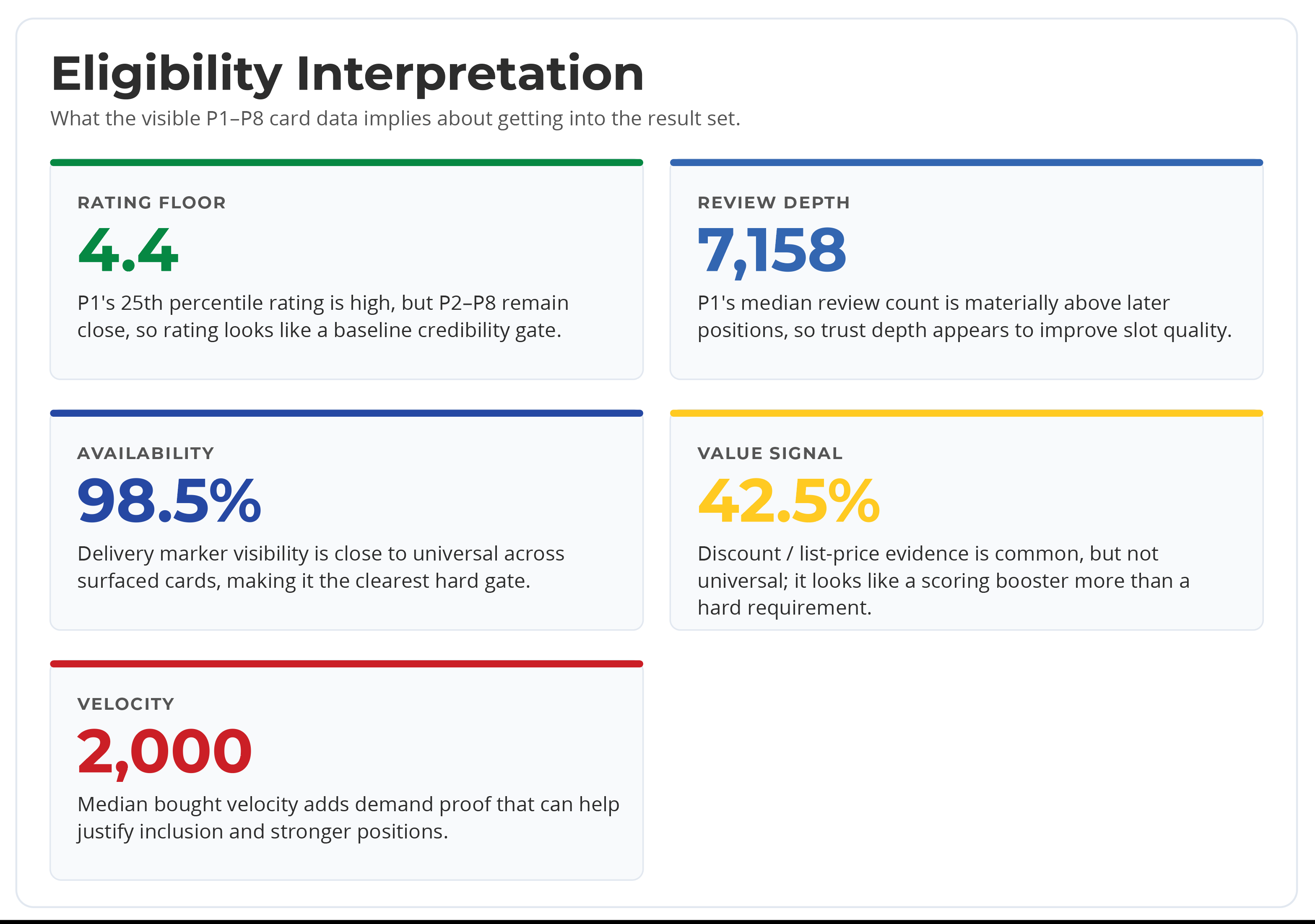
Interestingly enough, a brand new study I did based on an evaluation of 15,000+ Product Cards revealed an eligibility floor of 4.4 stars on product positions 2-8. Reviews and ratings are not as hard of gates other research leads us to believe and as we will explore in later series, category specific rules are imperative.
For some more examples from part 1, see the appendix.
Before we dig into the tactical strategies for your brand, I want to go over key agentic capabilities of Alexa for Shopping.
Agentic Capabilities of Alexa for Shopping
Reasoning
Alexa for Shopping reasons through the customer memory graph, interprets the intent of the prompt, and then constructs a search plan designed to bring in the right product.
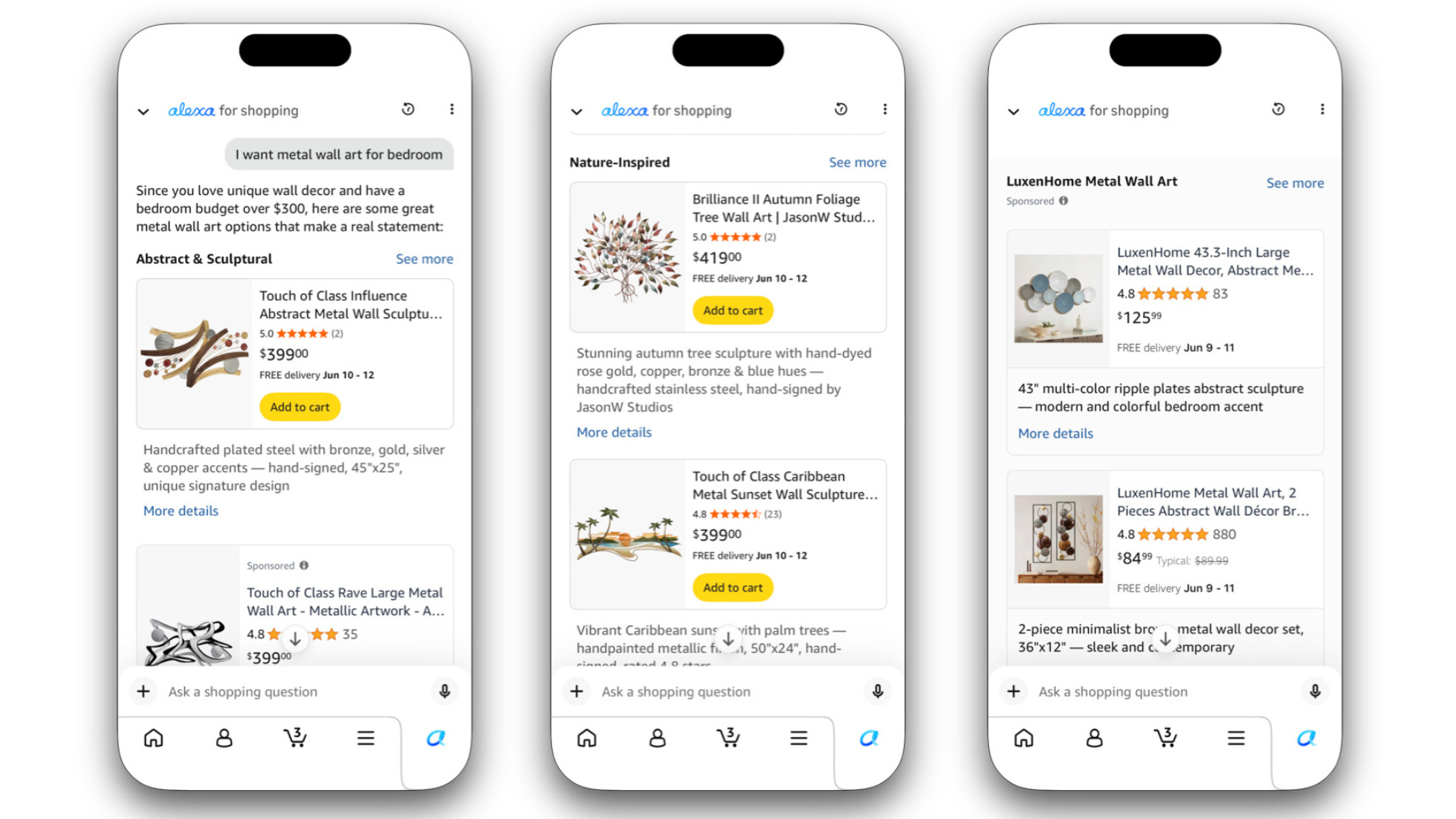
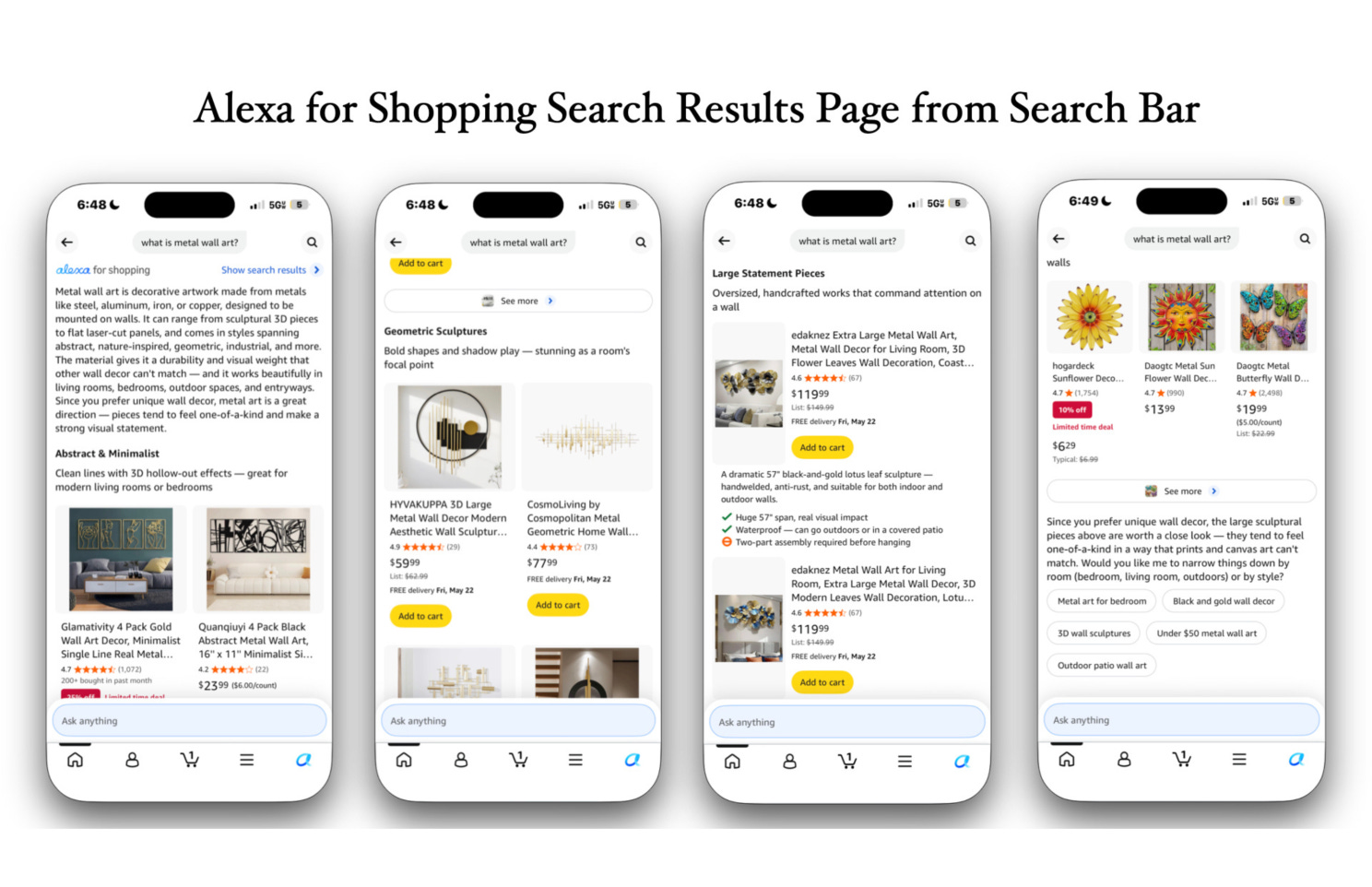
Notice that when I ask for metal wall art specifically for my bedroom, Alexa reasons through my price constraints from earlier conversations, finds a brand known for unique metal wall art, and then surfaces a sponsored brand store ad (Type 2).
That matters because a shopping prompt is rarely as simple as the words the customer says. Alexa may reason across several pieces of context at once: purchase history, stated preferences, household context, room-level needs, style patterns, brand preferences, and prior shopping behavior.
For example, imagine a customer asks for wall decor. Alexa may see that the customer has purchased large wall decor before and also loves dogs. A simple system might assume, “She probably wants dog wall decor.” But deeper reasoning may complicate that. Her past wall decor purchases appear abstract, not pet-themed. That could lead Alexa to prioritize abstract wall decor instead. Then another piece of context appears: the only room left to decorate is a dog room. Now dog-themed decor becomes relevant again. Then Alexa sees that the dog is a German Shepherd, so it may include at least one search path for German Shepherd wall decor while still keeping abstract wall decor in the candidate pool.
The point is not that every shopping journey will be this complex. The point is that real-life shopping intent can be messy because people are messy. Their preferences, rooms, occasions, recipients, budgets, and constraints overlap. Query Planning is the result of deeper reasoning capabilities applied to that messy intent.
On product pages specifically, Alexa can pull from almost every facet of the product detail page to decide whether a product fits the mission. Titles, bullets, images, A+ content, reviews, ratings, price, delivery promises, variations, brand information, product attributes, and customer language all become potential signals.
For brands, this means optimization is not just about ranking for one keyword. It is about giving Alexa enough structured, visual, textual, and review-based evidence to understand where the product fits, who it fits, what mission it solves, and why it deserves to be included in the search plan.
Remembering
Search history (actual terms you have used)
Browsing history (products overall)
Purchasing history (recency and historical)
Cart Awareness (everything in your cart currently)
Price Preferences
Brands you prefer (even ones you do not)
Everything about you cultivated from your Amazon interactions shapes the searches and selections Alexa for Shopping makes on your behalf. Plus, directly applies to reasoning as well.
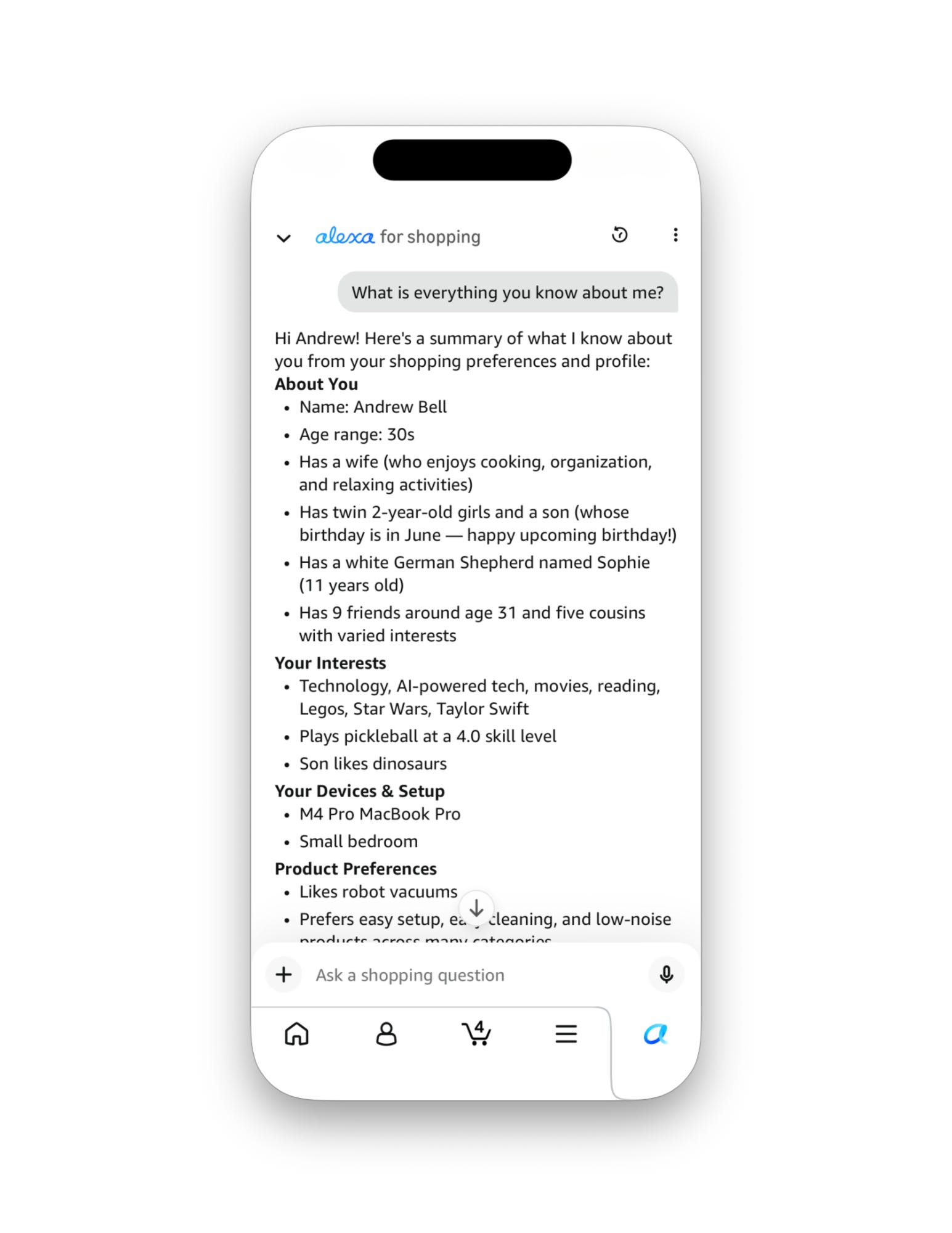
In the example below, Alexa knows my age, the fact I have a wife (even her own interests), information about my kids, my nine different friends and their interests, my sweet white German Shepherd Sophie, how I like my macbook set up and what skill level of a pickleball player I am (and we all know that matters!).
Researching
Alexa sometimes researches the web to inform decisions on products, especially if those products are mentioned in third party review sites, such as techradar, Toms Guide, Cosmopolitan and the like.
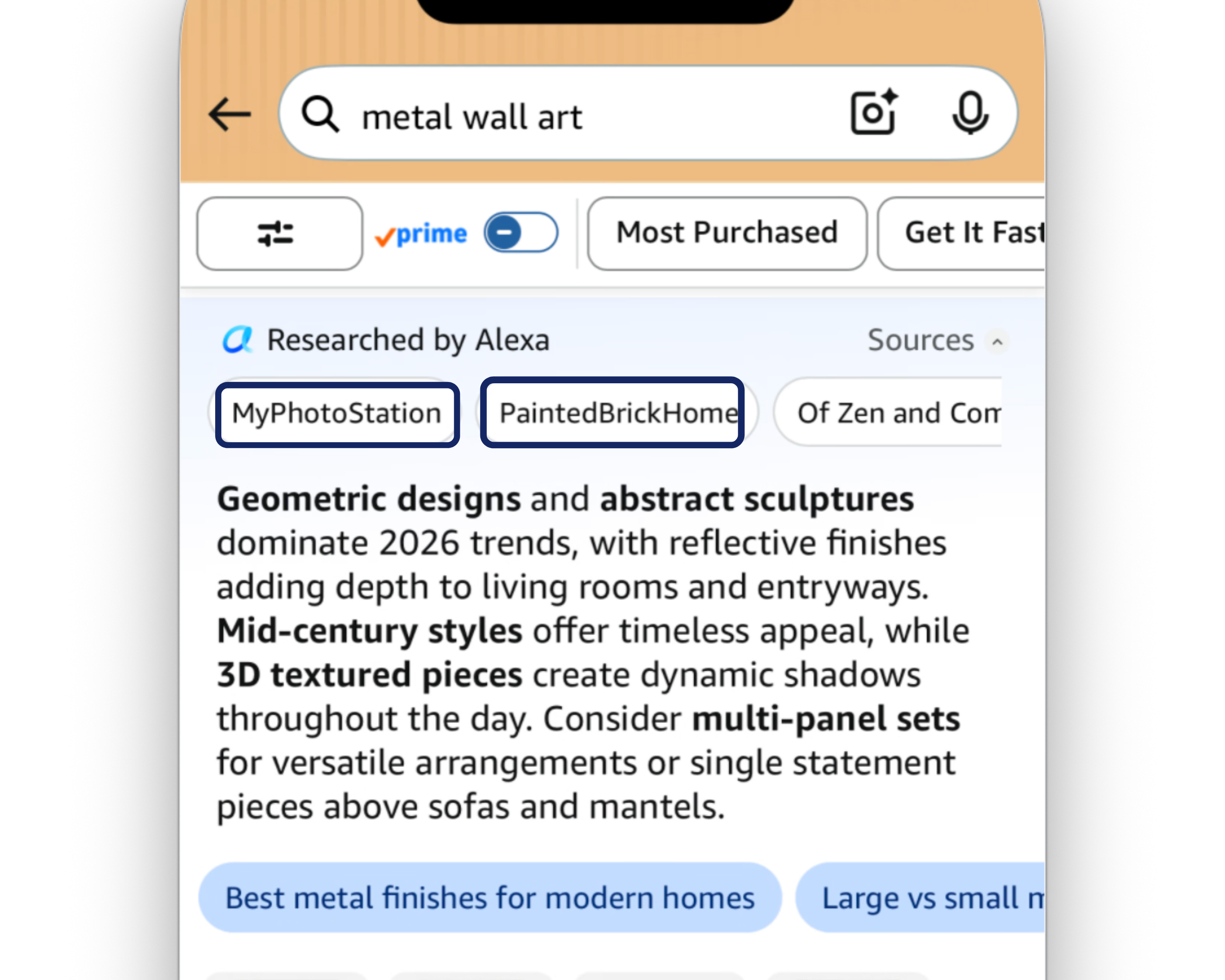
However, with Alexa AI overviews on broader terms, sources are provided for each of the answers
As an example below, researched by Alexa includes citations of third-party sites,
If the third-party web describes your product better than you do, the web wins the citation. Earned coverage has become off-page authority you cannot edit so the work is to make the off-Amazon story match the on-Amazon one.
Find ways to get yourself in these publications, since they inform AI Alexa overviews and answers in the conversational interface.
Retrieval
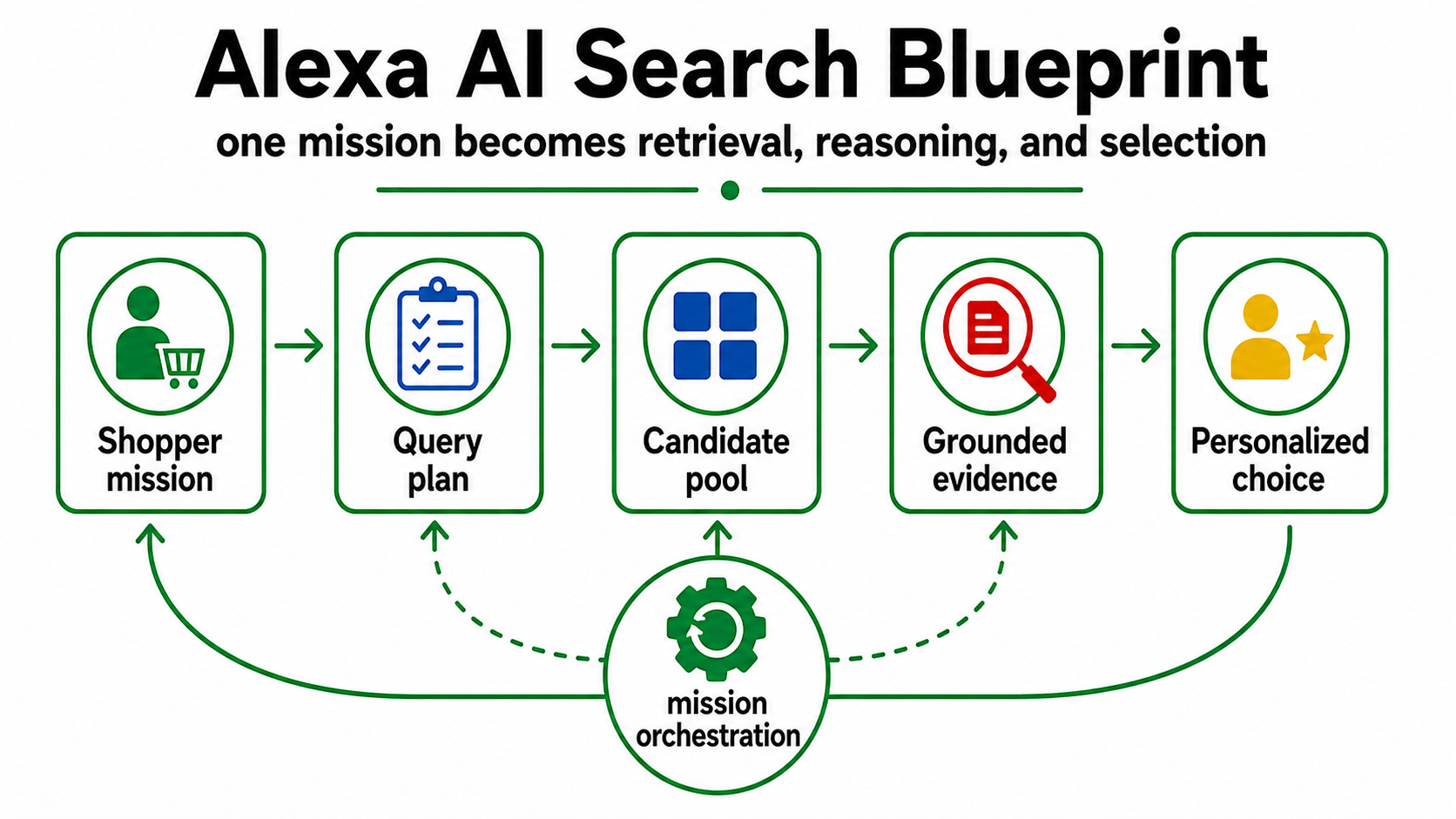
After reasoning through intent and remembering who you are, Alexa still has to go and get products, a step called retrieval. Alexa does not run one search. Alexa builds a query plan, a family of searches fanning out across the catalog from a single human request. "Metal wall art for my living room" does not become one query; one query becomes many: one for the core phrase, others for "industrial metal wall sculpture brass gold," "oversized abstract metal wall decor," "wrought iron wall sculpture living room," and so on. Each reaches a different region of the catalog, including products listed under language a shopper never typed. Those queries fire in parallel against Amazon's search index, and results are pooled, deduplicated, and cleaned into a single candidate set. From there in theory a larger set of products are chosen from. One signal matters more than any other here: frequency. A product surfacing across four of nine queries reads as broadly relevant, far stronger evidence than a product appearing in only one. Retrieval assembles the candidate pool a winning product gets chosen from. And a product no query searched for can never be chosen.
In future articles, we will explore the Anatomy of a Product Card for Alexa for Shopping.
Ranking
Retrieval decides what can be found. Ranking decides what gets shown. And ranking inside Alexa is not a single sort but a stack of layers. First come hard filters, binary and unforgiving: in stock, genuinely deliverable, sitting in a correct category, past rating and review floors, inside any stated budget, and clear of anything a shopper has ruled out. A product with ten thousand five-star reviews still gets cut for failing a single hard constraint. Structured attributes act as gates. A product missing a size or material field gets excluded before scoring even begins, never penalized inside scoring. What survives gets scored across many weighted signals at once: style and aesthetic fit, quality-confidence (rating shaped by review count and distribution, not a headline number), price-value, brand trust, color and finish compatibility, size and scale, actual review text, and listing completeness.
No single signal wins. Power lives in convergence, and when signals disagree, Alexa may weight toward negatives. Because disappointed buyers are often the most honest voices in any set. One move separates Alexa from a results page. she does not return a top eight by score, because a top eight tends toward near-duplicates. Alexa selects a best set, spanning style, price tier, brand, size, and finish, then re-scores against you specifically: your room, your history, your stated preferences. Hence Position 1 in Alexa for Shopping reflects a fit decision, not a pure relevance score. A winning product did not match the most words. A winning product best completes the person's mission.
How do we Optimize for Alexa for Shopping?
1. NOUN PHRASE OPTIMIZATION
According to the patent I broke down in January 2025, one strong recurring theme throughout the paper was this idea of Noun Phrases, that is, a set of natural language phrases that moved keyword stuffing titles to searching terms far more human, WITHOUT sacrificing years of proven search science. At that time I coined the term, Noun Phrase Optimization. What is NPO?
Simply, NPO is the science and practice of taking the search terms with highest sales volume and relevant overlap to produce natural language phrases. As with anything, methods were developed, for example noun stacking.
“metal wall art”
“Large metal wall art”
“Large metal wall art for bedroom”
“Large modern metal wall art for bedroom”
“Large modern metal wall art for contemporary bedroom.”
“Large modern style metal wall art for contemporary bedroom, living room and entryway”
Especially for titles and bullets, noun phrases make far more sense than previous strategies and I will argue throughout RetailPlaybook, noun phrases are the future of PRODUCT TITLES too. In my estimation, 75 characters is plenty of room to capture the true identity of a product without sacrificing the fundamentals of keyword research.
To help with Noun Stacking, try this GPT: Noun Stacking GPT
2. SEMANTIC BRIDGING
Semantic Bridging is the practice of connecting your product to the adjacent meanings Alexa may infer: the rooms it fits, the occasions it serves, the recipients it suits, and the intents a shopper never typed but clearly meant.
Alexa for Shopping absorbing Rufus's product intelligence did not erase its semantic richness or superior product understanding. I have access to billions of data points actually pointing to semantic-based autocomplete search, however due to costs, Amazon has yet to fully operationalize, despite having the technology with proven gains from their own patents and science. With that said, the technology does exist in Alexa for Shopping, even if not fully in A9 (traditional/evolving amazon search methods).
The key difference:
Old way: String keywords together
New way: Create detailed, natural descriptions that capture:
What the product is
Its key features
How it will be used
Who it is made for
Take a single product: a large black metal wall sculpture. The literal keyword is “metal wall art.” But Alexa can bridge that product into meanings the shopper never typed:
Room: living room above the couch, entryway, primary bedroom accent wall.
Occasion: housewarming gift, new-home decor, anniversary present.
Style: industrial, modern farmhouse, transitional.
Use case: large statement piece for a tall blank wall, conversation starter for an entertaining space.
Each connection is a separate door into the catalog. The product never changes. The number of shopper missions it can answer multiplies.
The more adjacent meanings your listing legitimately connects to, the more query branches it can answer, and the more often it shows up as the right answer to a mission the shopper only half-described.
3. INFERENCE OPTIMIZATION
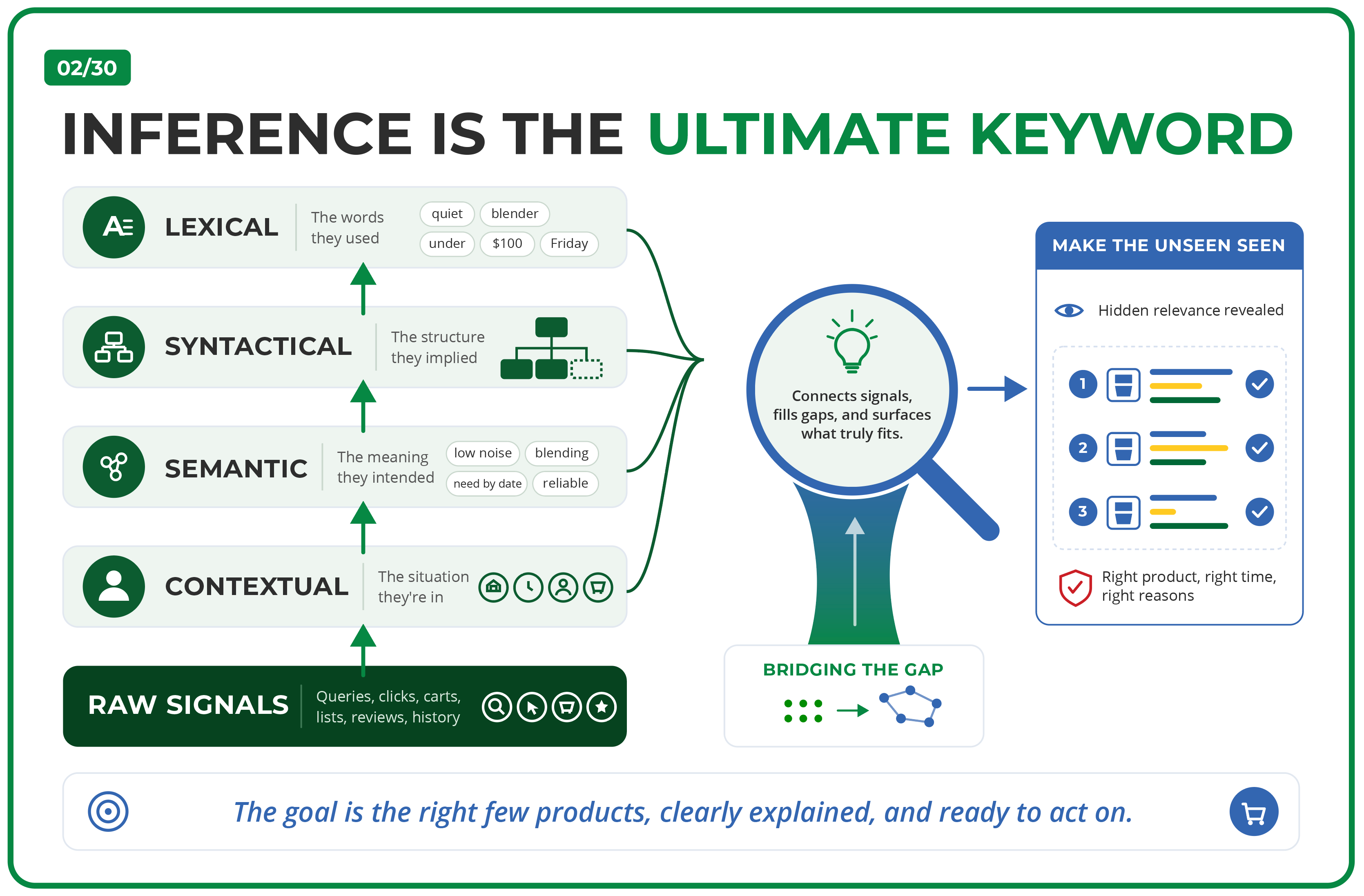
One reality about Amazon AI you will hear often from me is inference. Similar to its technical definition, inference is making a determination of something to be true (or possibly true) based on reasoning and evidence. In the end, inference time connects all relevant signals, fills gaps and then surfaces what product truly fits.
I came to the realization (inference!) based on all the evidence from patents, science papers and operating experience, Alexa for shopping (Rufus), operates across several dimensions, lexically (the words the customers use), syntactically (the structure from the search + prompt), semantically (underlying meaning of intent), contextually (the situation the customer is in). And most IMPORTANTLY, what distinguishes Amazon and places them above all others in the AI shopping agent world, RAW SIGNALS, Queries, clicks, carts, lists, reviews, history or purchases. Then Alexa+ provides personalization at a scale unheard of, prime video watch history with timestamps, connections between shows and merchandise, datapoints ChatGPT, Claude and Gemini could only dream about possessing. Quite literally, Alexa for shopping works off a treasure trove of personalization and product intelligence.
In a sense, “inference” has become the ultimate keyword. It was in Rufus: The Blueprint that the art of inference pathways was born.
Inference pathways map product features to benefits and outcomes, helping Amazon Rufus and customers connect product attributes to their real-world applications. Connecting the dots between your product features reveals the benefits of what the product does, why it matters, real-world outcomes, and who it is most ideal for.Inference is the ultimate keyword. The goal is no longer to rank for “metal wall art.” It is to be selected for inference-rich situations “large black metal wall art under $100 for a living room,” “modern metal wall decor above a fireplace,” “outdoor metal wall art that won’t rust.” Clearly, these are shopping situations your listing has to be inferable into.
EXAMPLE OF AN INFERENCE PATHWAY
Inference Pathways for a Leather Couch
Inference pathways map product features to benefits and outcomes, helping customers understand how specific attributes translate into real-world value.
Primary Features and Inferences
Genuine Leather Upholstery
Primary Inference:
“Premium Material → Creates a Luxurious Look and Feel.”
Secondary Inferences:
“Enhances the Perceived Value of the Living Space.”
“Develops Character Through Natural Aging and Patina.”
“Provides a Timeless Style That Remains Relevant Across Design Trends.”
“Offers a High-End Seating Experience.”
That’s the pattern: one feature, one primary inference, and a handful of secondary inferences that connect the attribute to real-world value. A full couch has eight or more features like this, which then combine into contextual pathways (“Genuine Leather + Durable Construction → Luxury That Lasts”) and map onto buyer personas (families, luxury buyers, long-term value seekers, entertainers). Rather than print the entire breakdown here, I built it into a GPT so you can generate the full pathway for any product.
4. A9 OPTIMIZATION (Yes, Keyword Optimization)
Unfortunately, not everything written about Amazon algorithms that ends up in LLM training data is accurate. For example, the mythological idea of an A10 algorithm had been perpetuated (no pun intended) so long, the training absorbed the content from ad hoc sources, well-intentioned companies and others flat out desperate to produce content at scale.
I bet you can guess, A9 is the real algorithm behind Amazon search technology currently deployed on Amazon. There was never an A1, A2… etc. Simply A9.
Think of the A9 Algorithm as the force of ranking behind what products show up in Amazon search result pages (among other things). Or, even better, A9 is the Amazon version of SEO.
How exactly does A9 connect to AI search optimization? Instead of Amazon creating a distinct method of search, why not use the most proven method of search to purchase then Amazons search philosophy. Their team likely posed the question years ago: how do we make search intelligent to the user's context and preferences?
keep the proven engine, then layer reasoning on top. Amazon did not throw out twenty years of search science to chase a chatbot. A9 still forms the candidate pool, fast and at scale, answering the old question well: does a listing carry the words a shopper used? Alexa for Shopping then sits on top and asks the harder one: does a product answer what a shopper is trying to accomplish? Same retrieval foundation, a new layer of judgment.
Good ACO is Great SEO. A9 and Alexa do stack together in symbiotic union. A9 decides whether a product can be found. Alexa decides whether a product gets understood, trusted, and selected. Optimize for one and ignore the other, and you either win retrieval but lose the recommendation, or read beautifully while never entering a pool A9 builds first.
5. SHOPPING MISSIONS and QUERY PLANNING OPTIMIZATION (Brand new to the playbook)
The difference between a keyword and a mission becomes clear through the example of a mother shopping for Christmas gifts. Her objective may be simple: find something meaningful for each of her children. On a traditional search interface, however, she must repeatedly reformulate that objective. “LEGO for boys” may become “Marvel LEGO,” then “Marvel LEGO gift,” “Marvel LEGO for adults,” or “Marvel LEGO under $100.” A beauty search for one daughter may evolve from “makeup” into searches involving lipstick, preferred brands, ingredient standards, cruelty-free requirements, shades, gift sets, and price limits. The mission remains stable while the search language changes. Traditional search requires the customer to perform that reformulation manually. An agentic shopping assistant can perform it on the customer’s behalf by considering recipients, interests, product categories, brands, constraints, delivery needs, prior behavior, and contextual preferences. The customer experiences one conversation, but Amazon executes a family of searches underneath it. Sellers must therefore optimize not only for what the shopper says, but also for the queries the assistant is likely to generate from what the shopper means.
What QPO measures, and where it sits
Strip away the acronym and QPO measures one thing: whether Amazon’s system covers the primary intents and the routing logic for your product, whether every major way a shopper could come looking has a door, and whether that door leads somewhere. Coverage and routing, surfaced across both layers of the system: A9 search and Alexa for Shopping.
QPO asks a harder question: of all the queries this mission will generate, how many can my product be found by, and how many can I truthfully win? It does not replace keyword work, it sits on top of it, because the keyword is now one branch of a tree the shopper never sees.
A NEW UNIT OF MEASURE
One new unit of optimization is the query plan.
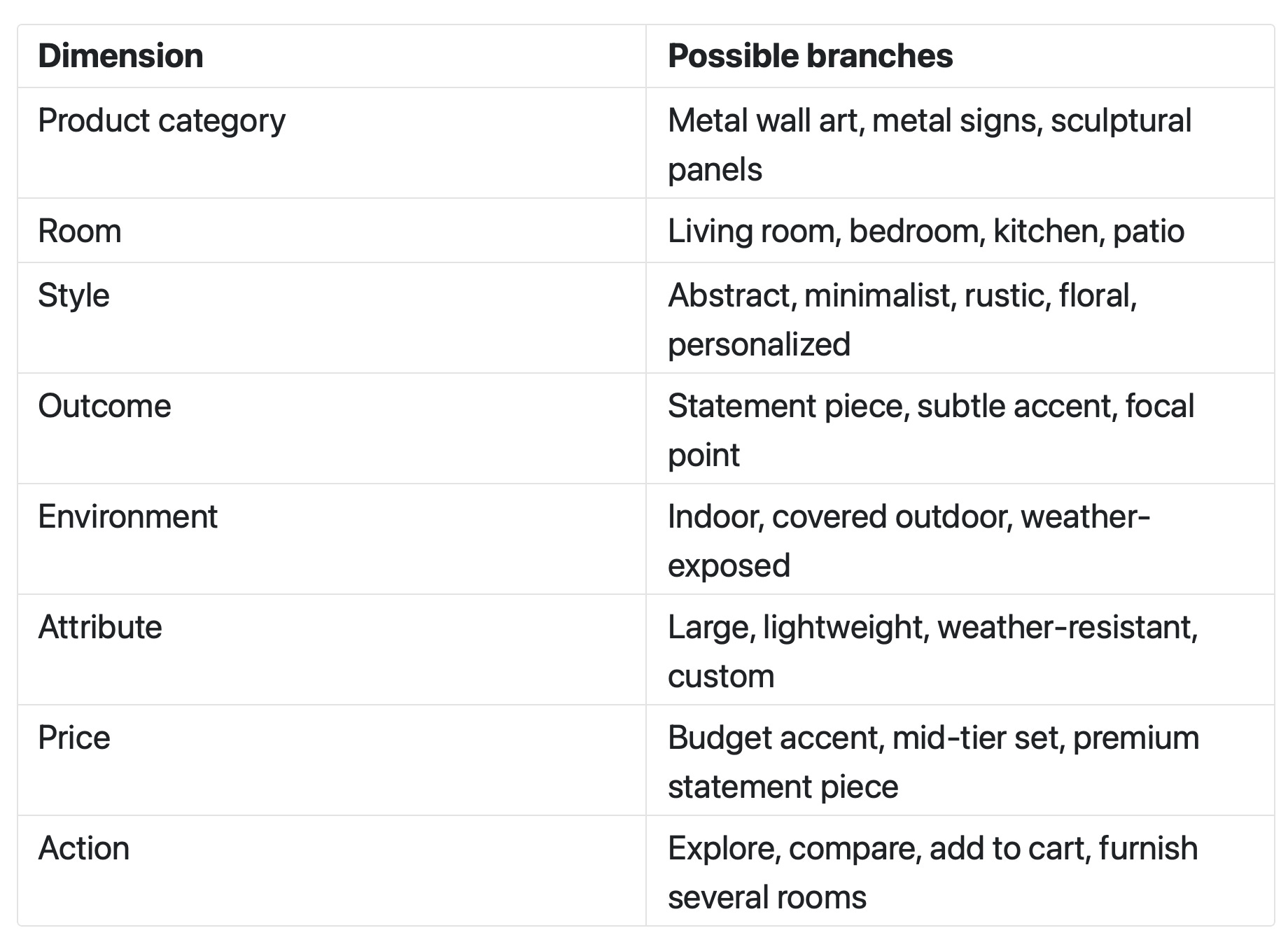
A query plan contains multiple branches representing different interpretations, contexts, recipients, constraints, and product needs.
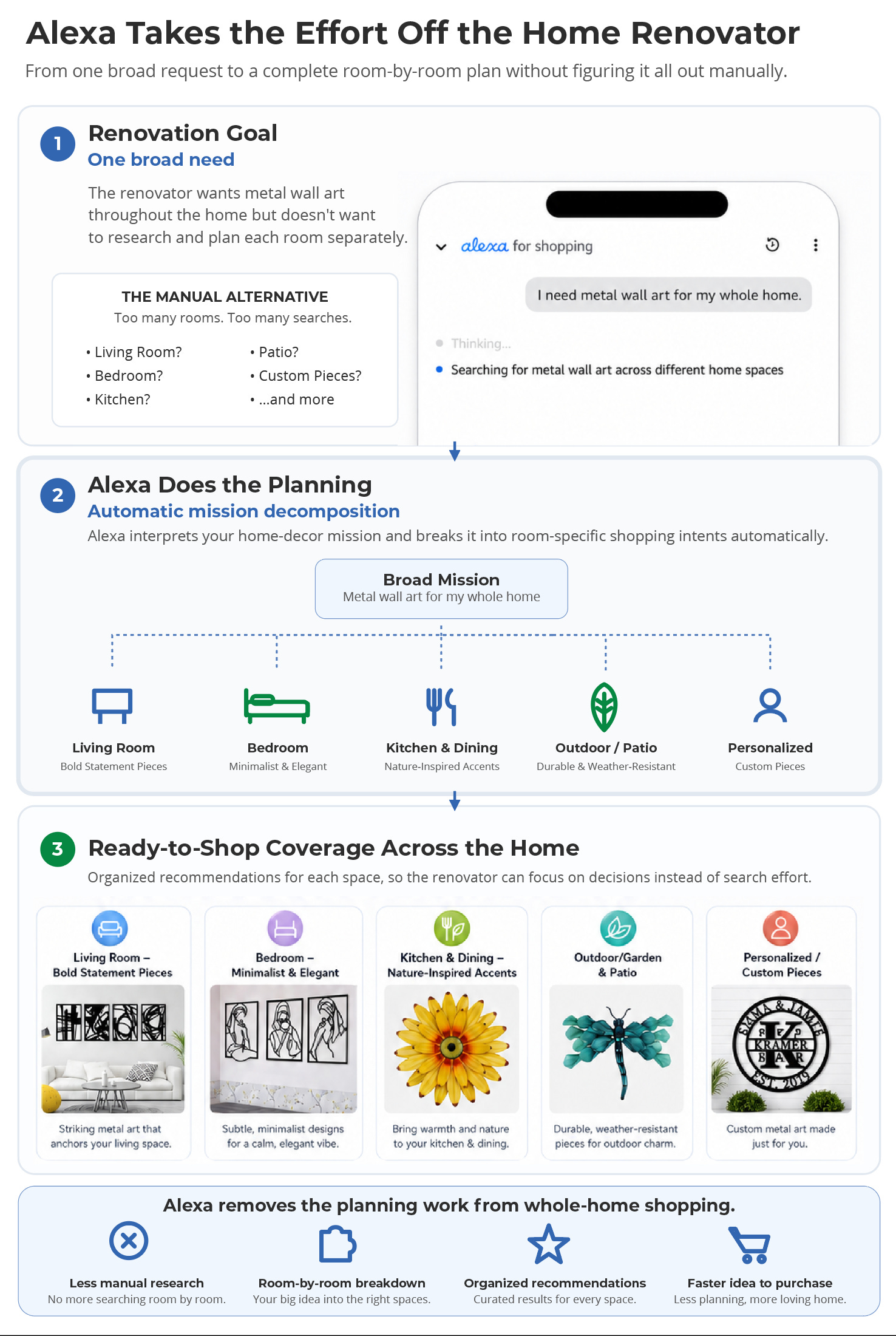
For the wall art mission, the plan could contain several dimensions simultaneously:Alexa can combine these dimensions into more specific retrieval queries:
Large black abstract metal wall art for living room.
Minimalist three-piece metal line art for bedroom.
Floral metal wall accent for kitchen.
Weather-resistant dragonfly wall art for patio.
Personalized metal family name sign.
Lightweight statement wall decor that is easy to mount.
Metal wall art under $50
EXAMPLE: “I need Metal Wall Art for my Whole Home”
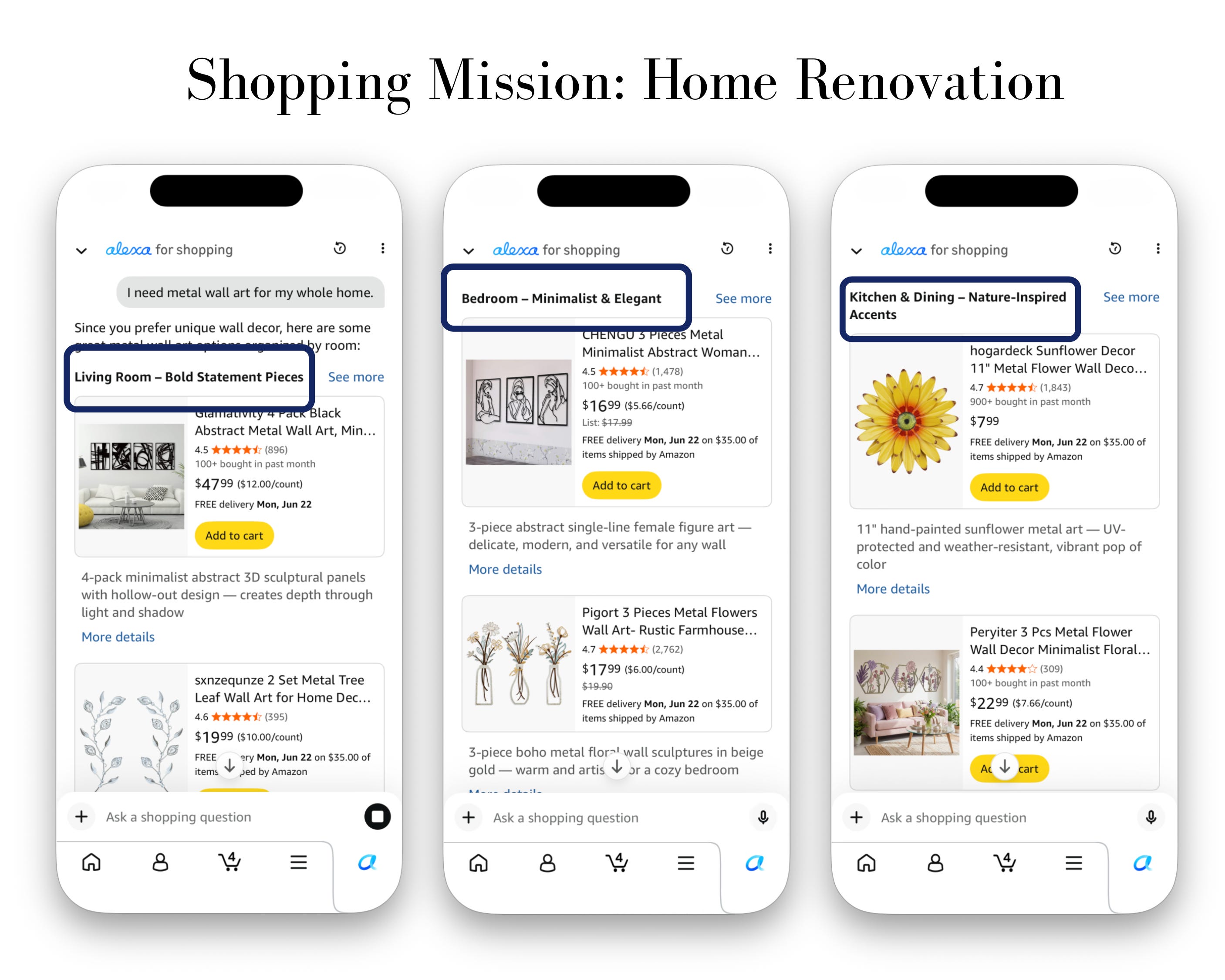
Breakdown of Example
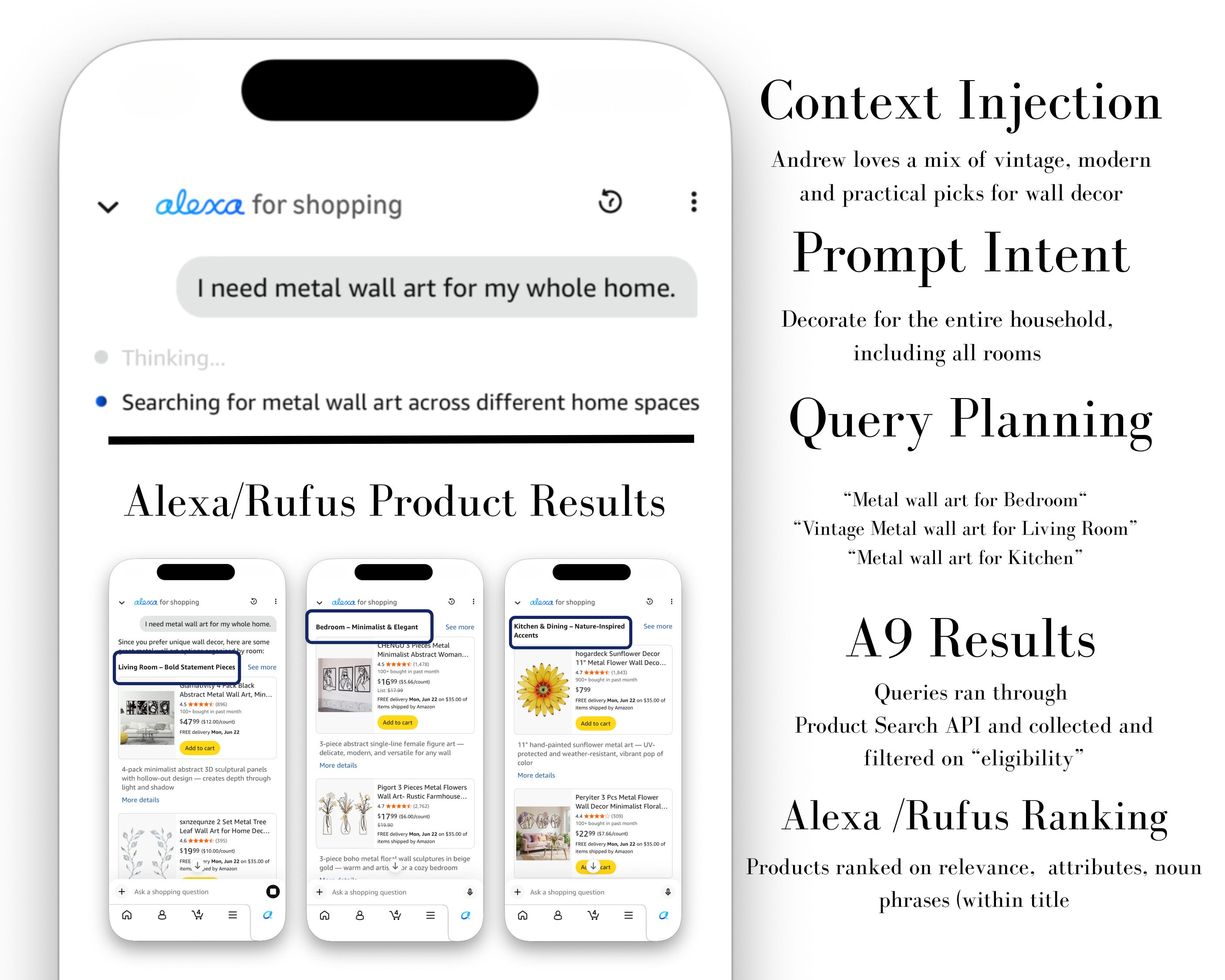
Mission Mapping:
A keyword is what the shopper types. A mission is what the shopper is trying to accomplish.
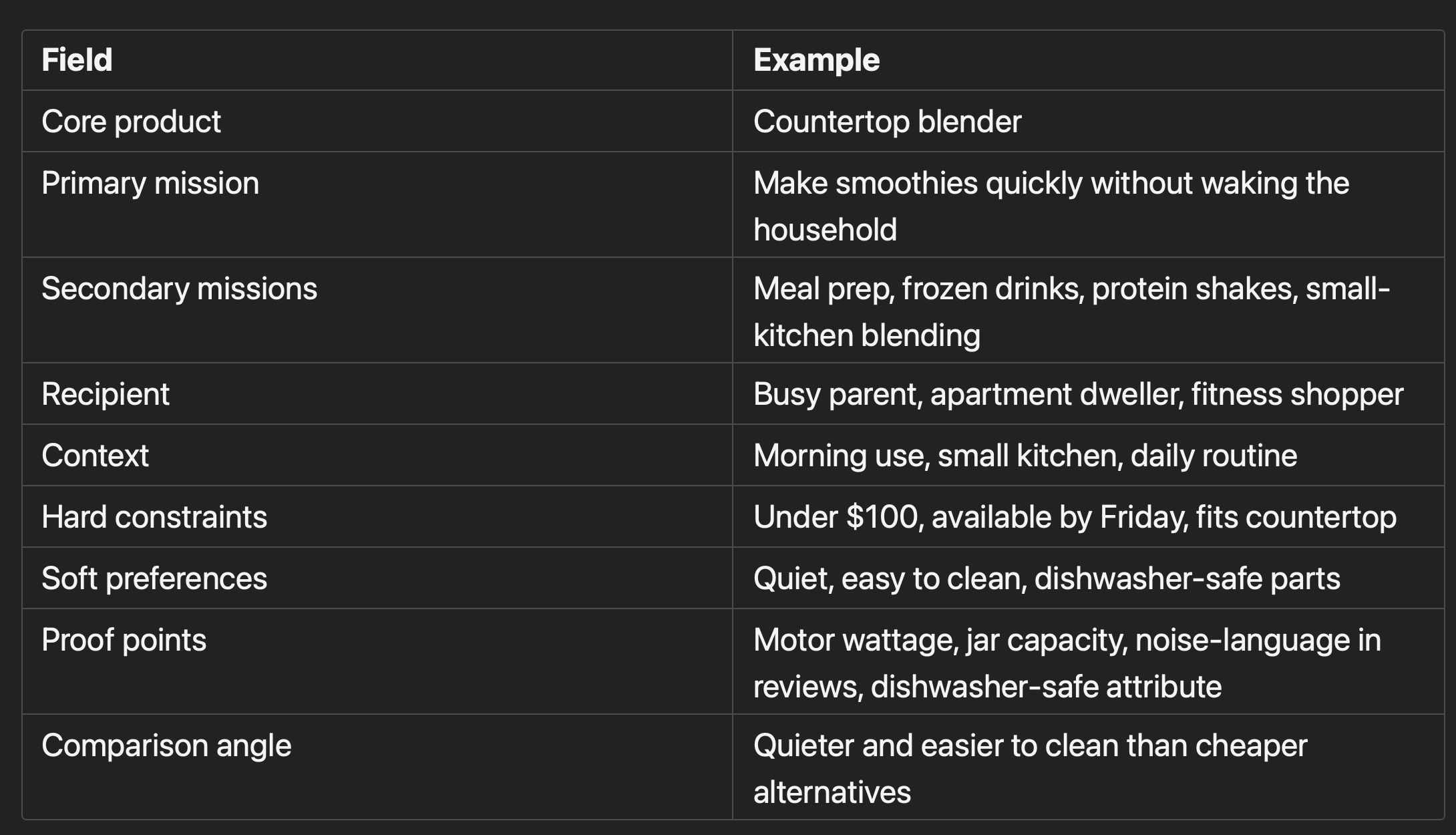
For example, “blender” is a keyword with no background of the mission. “Quiet blender for daily smoothies in a small apartment under $100” is a mission
Tactical Exercise: Build a Mission Map
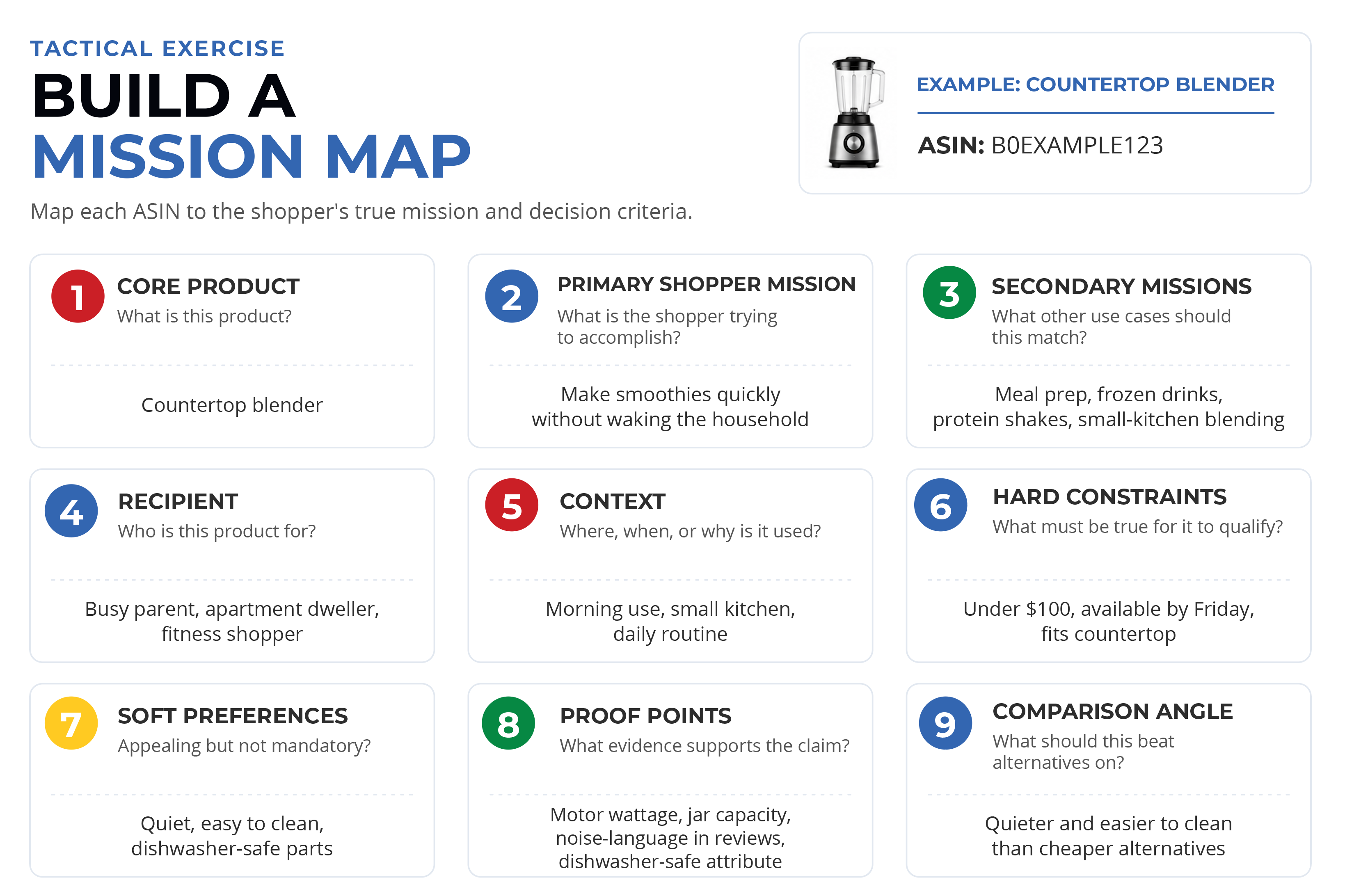
For every ASIN, create a mission map with these fields:
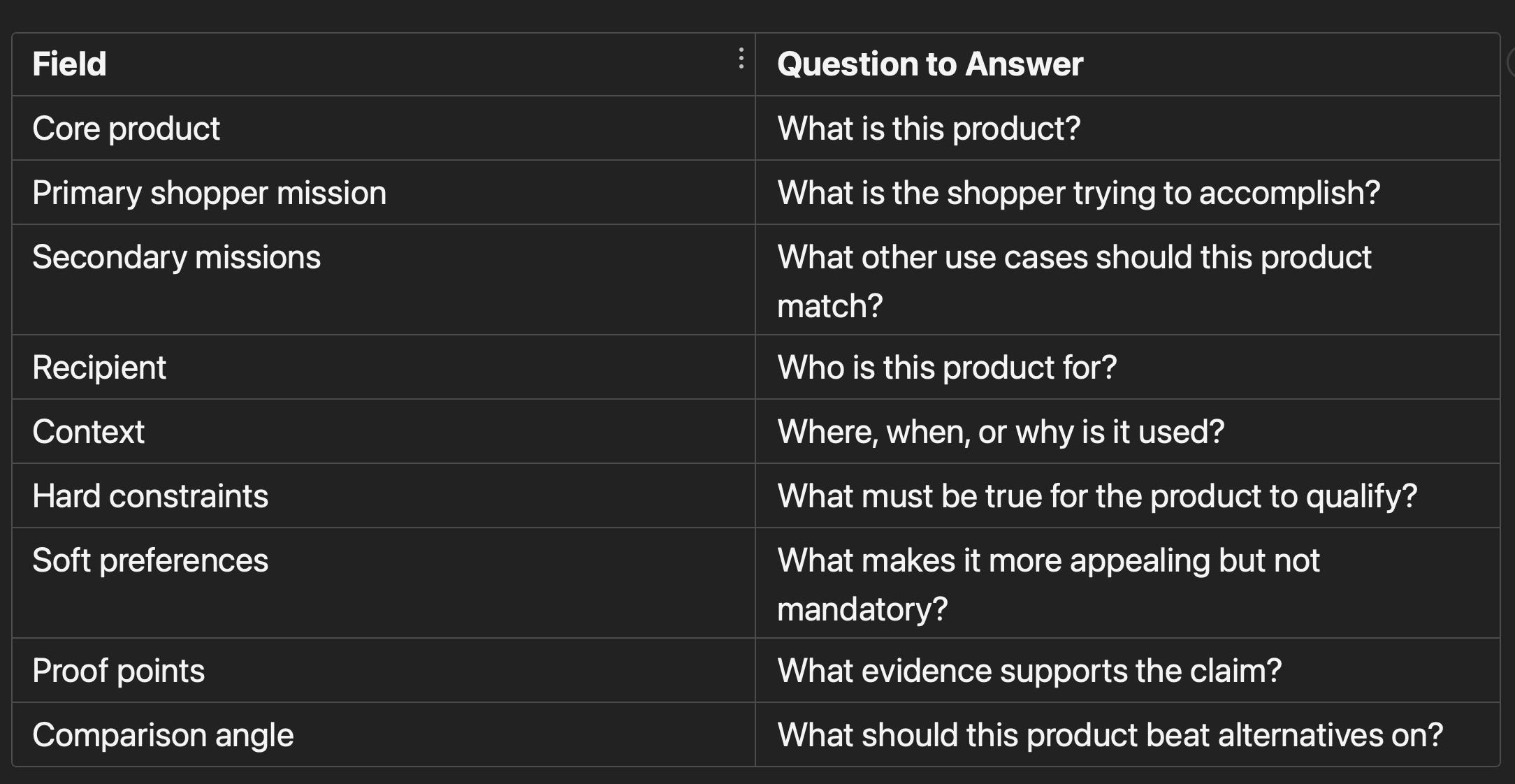
Here is an example: Counter Top Blender
But “Andrew, what does this look like for me”, to help you get started I developed a GPT. Millions of products out there, I cannot describe them all here.
Mission Mapping GPT
6. Optimization for All Amazon Attributes
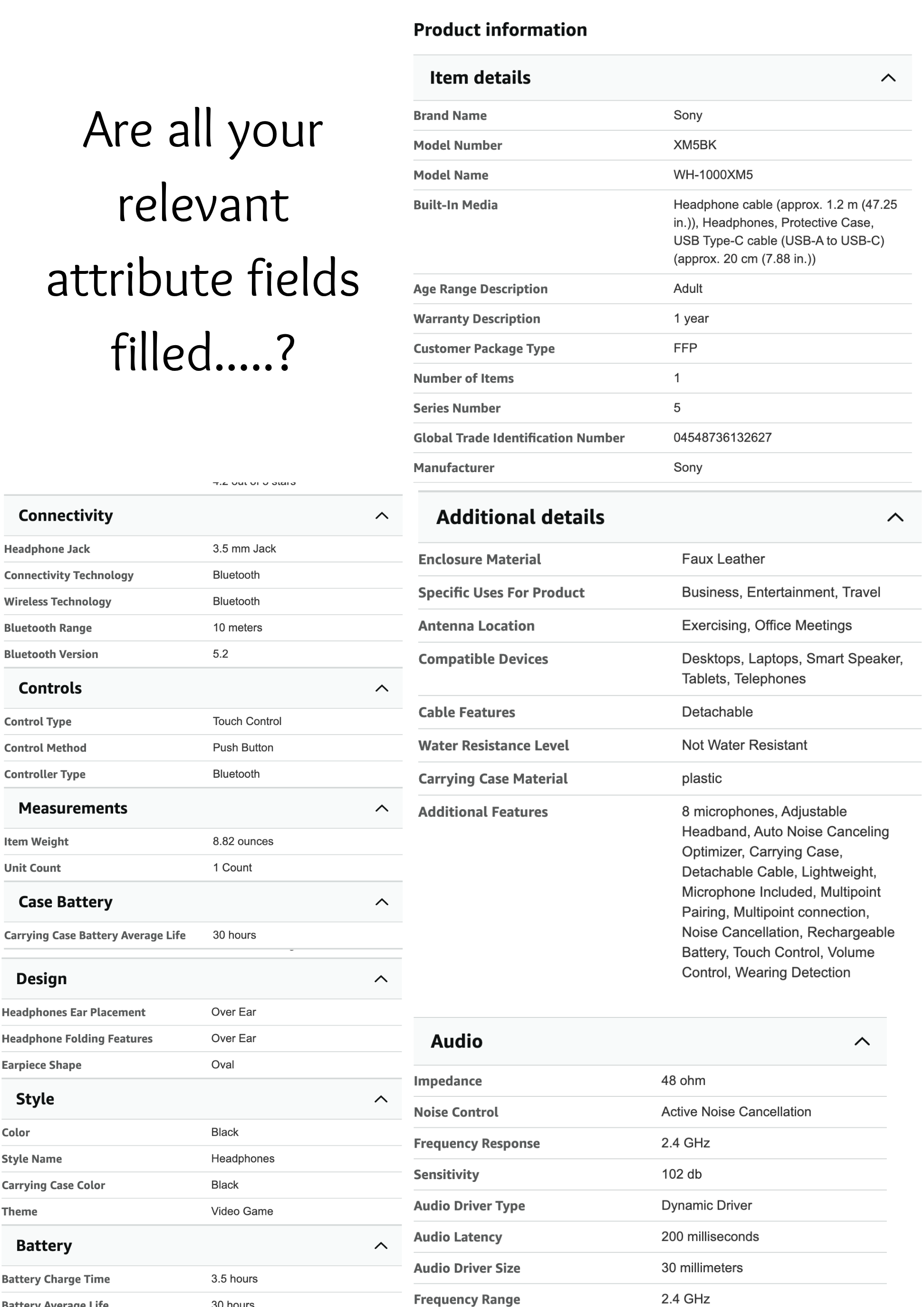
I say optimize for all attributes, going far beyond “Cosmo relations”2 to a deeper categorically aware attribute field guide. I encourage you (the brand) to provide all possible fields, because truthfully, most brands are not optimizing to the truest depth within their category. Which means, making requests crystal clear to Amazon you need EVERYTHING for attribute guide as a 1P brand.3 (Make sure you are Brand Registered). For 3p brands, you already have full control without Amazons approval (assuming you have Brand registry).
In point of fact, Amazon recently published a Level 54 Science Paper regarding LLM guided attribute graphs. Essentially, modern commerce search is becoming a three-stage system where retrieval finds candidates, attribute graphs represent product reality, and LLMs reason over those attributes to determine which products best satisfy the shopper's mission (we will tackle papers such as these in future newsletters).5 Going beyond Cosmo it brings deeper categorical relationships.
Along with the Title and New Item highlights, attributes are the contextual glue and ground truth for the retrieval of relevant products within Alexa for Shopping.
I proved the importance already in my two-part deep analysis of an Alexa+/Rufus patent where attributes were described as one of the more important aspects to include in your product detail page to prepare for retrieval and rank (another one had been relevance filtering based on profile information and more).
For this one, no GPT or Claude Skill can truly capture the essence of a category attribute graph I recommend new tools coming to ReFiBuy. I believe you will wish you had sooner.
Example of a Category Specific Attribute “Graph”
7. Product Page Coverage
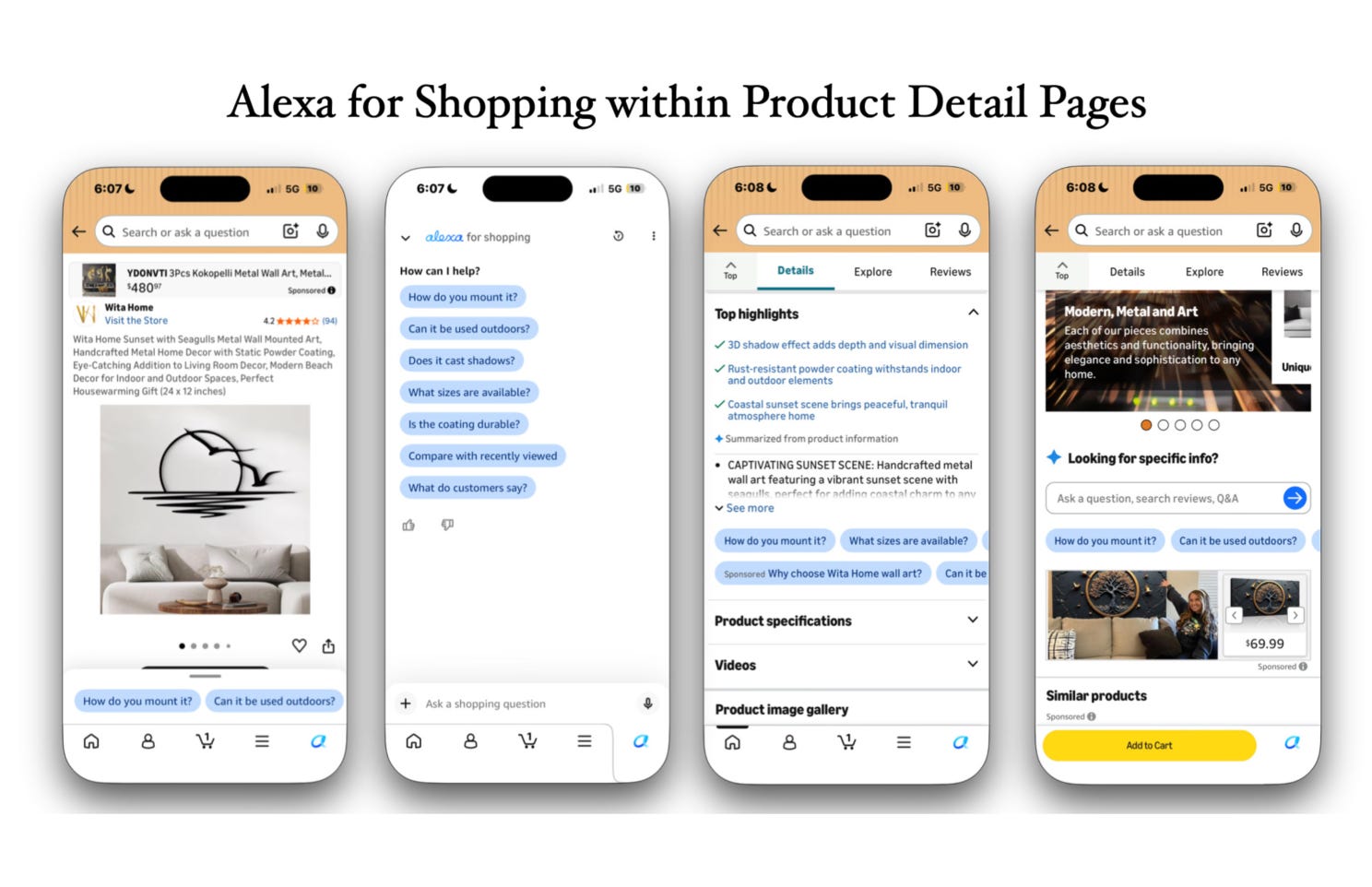
This section covers optimization for whether your listing answers the prompts customers are typing and likely typing. I have already proven, via the first Rufus patent, that click training data heavily influences prompt pills. In other words, the prompts you see on a product detail page are the results of customer click data (with the exception of templated ones like “compare with similar” or “show price history”). In essence, we are asking here, are you the answer? 6 We know for sure, Alexa for Shopping/Rufus will index almost all information on the product detail page for answering, IF it is on the product detail page.7
Title (now will be product name + item highlights)
Bullet Points (1P brands should have access to up to 10 bullets, indexable all the way through the 10th bullet.)
Product Description
NATIVE A+ Content Text
Lifestyle Photographs with AND without text (more often though with text)
Video indexing is in the works, computational expense at scale too vast for now.
Everything above is the written playbook. The podcast is where we talk it through. In the launch episode, Scot Wingo sat down with me — Andrew Bell, now ReFiBuy’s VP of Research to introduce RetailPlaybook and go deep on Alexa for Shopping, Amazon’s patent playbook, and what agentic commerce optimization looks like across Amazon, Walmart, and Target. We get into why good ACO is a different playbook for every marketplace, the ~100 million shoppers now reaching Alexa for Shopping, and the conversion lifts I’m seeing on optimized product pages. If you’d rather listen than read, start here.
RetailPlaybook Podcast
Part of RetailPlaybook is our new podcast!
In our first launch episode, we’re announcing two things at once: Me joining ReFiBuy as VP of Research, and the debut of RetailPlaybook. Going forward, I’ll host RetailPlaybook, but for episode one Scot Wingo jumped in to introduce the channel and interview me in person.
🎧 Listen wherever you get your podcasts: Spotify, Apple, etc.
Or, we have a video version on YouTube (make sure to subscribe!) →
FINAL THOUGHTS
Fundamentally, I am obligated to say, the rise of agentic shopping does not make traditional Amazon search irrelevant. It makes search more important because retrieval becomes the foundation from which the assistant constructs a smaller, more personalized recommendation set. A9 forms candidate pools for individual searches. Alexa for Shopping can interpret the mission, generate and prioritize those searches, apply hard constraints, evaluate evidence, compare qualified products, personalize the result, and support action. For sellers, this changes the objective from winning one typed keyword to becoming eligible across the correct family of query pathways. It also changes the definition of a successful product page. The strongest ASIN is not merely the one with the most keywords, the highest rating, or the most attractive creative. It is the product Amazon can retrieve, verify, compare, explain, personalize, and confidently select for a specific shopper in a specific situation. The product must become the right puzzle piece inside the larger mission. Query Planning Optimization provides the retrieval strategy, while Agentic Commerce Optimization provides the structured data, evidence, governance, and feedback system. The final objective is clear: become eligible, remain qualified, prove fit, and earn selection.
The fields you populate become the ground truth Alexa draws from. The fields you leave blank become the silence Alexa hears when the shopper asks the question those fields would have answered.
Alexa for Shopping reasons over a graph of typed relationships between products and needs, and precise noun phrases populate strong, specific edges in that graph. The more exactly you describe the product, the more specific the edge that routes a matching shopper to you and the more separate queries in step 2 your listing answers, which is the frequency signal that triangulates you as broadly relevant. Attributes create structured truth, noun phrases create retrievable meaning, and context creates inference. Keywords are not dead. The way we used to use them (bare, isolated, stuffed) is the part that is dying.
Over time we will tackle these tactics with increasing depth, exploring nuances that would otherwise go unaddressed.
Some of this is inferred from Amazon’s public AI shopping materials, Amazon Science research, patents, and field testing, not from a disclosed production ranking document
APPENDIX + FOOTNOTES
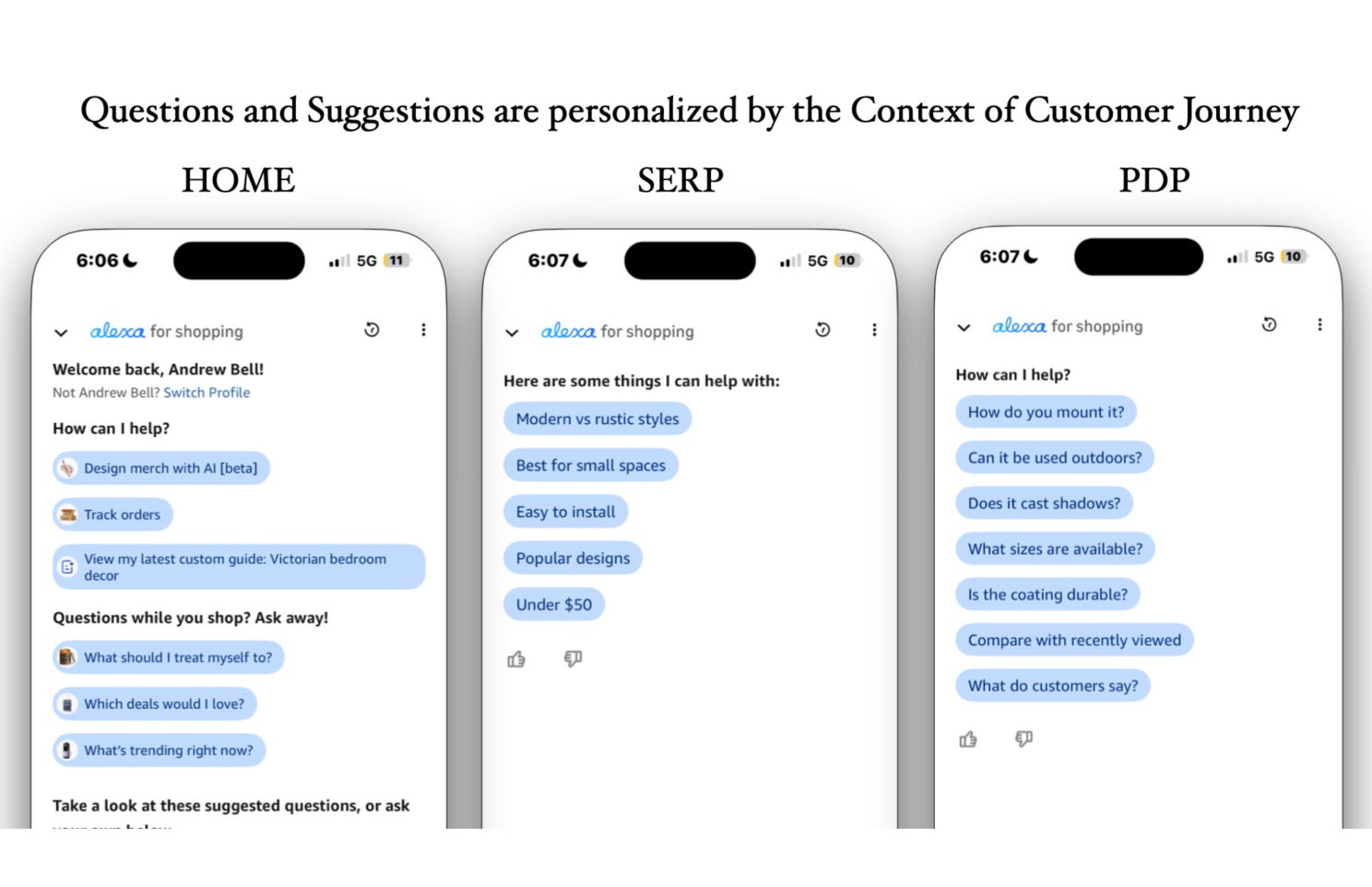
Alexa for Shopping works within the context of your spot in the journey. Amazon breaks this into Exploratory (Home Page/Search Bar), Comparison (SERP) and Decision (PDP).
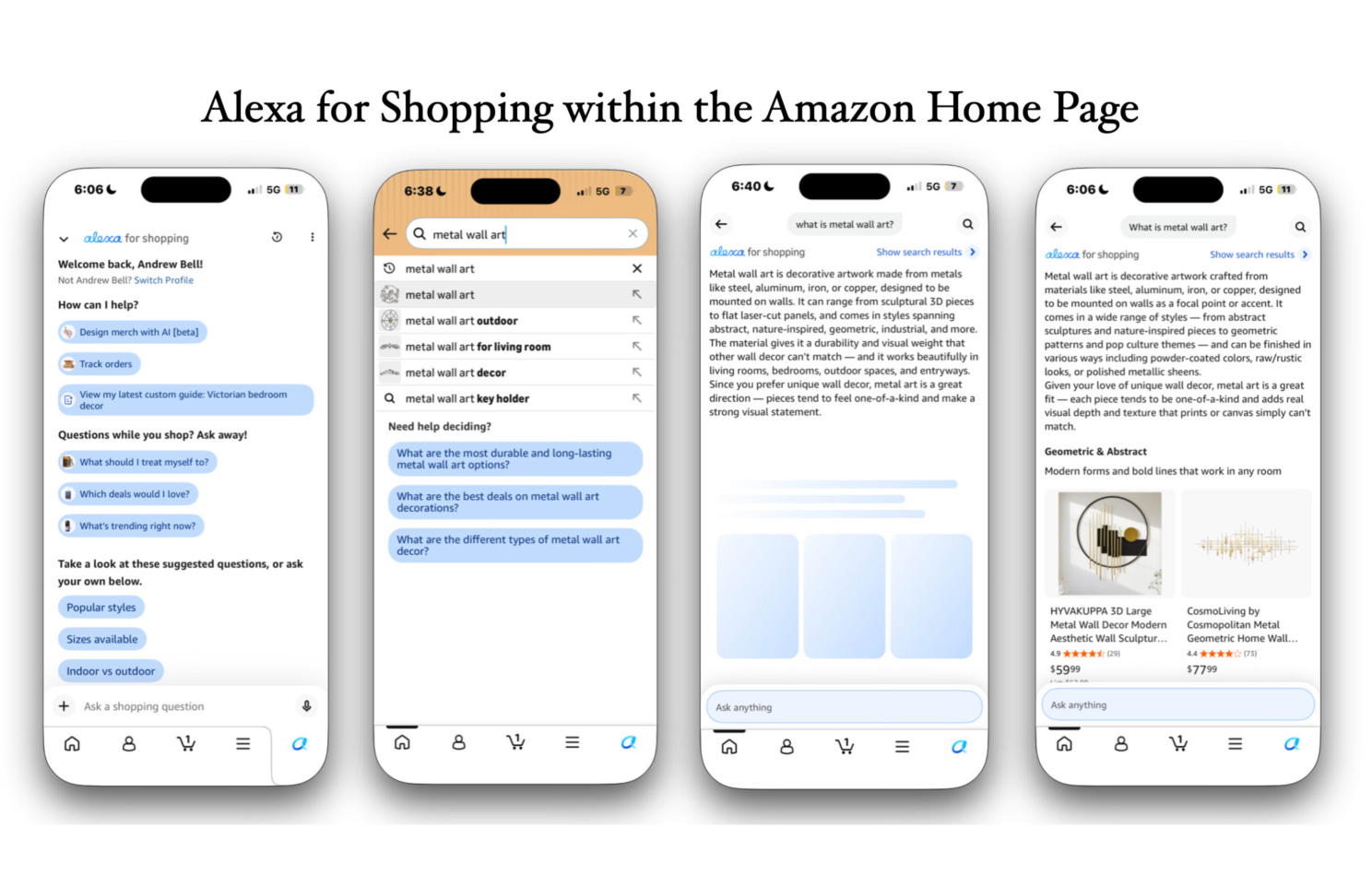
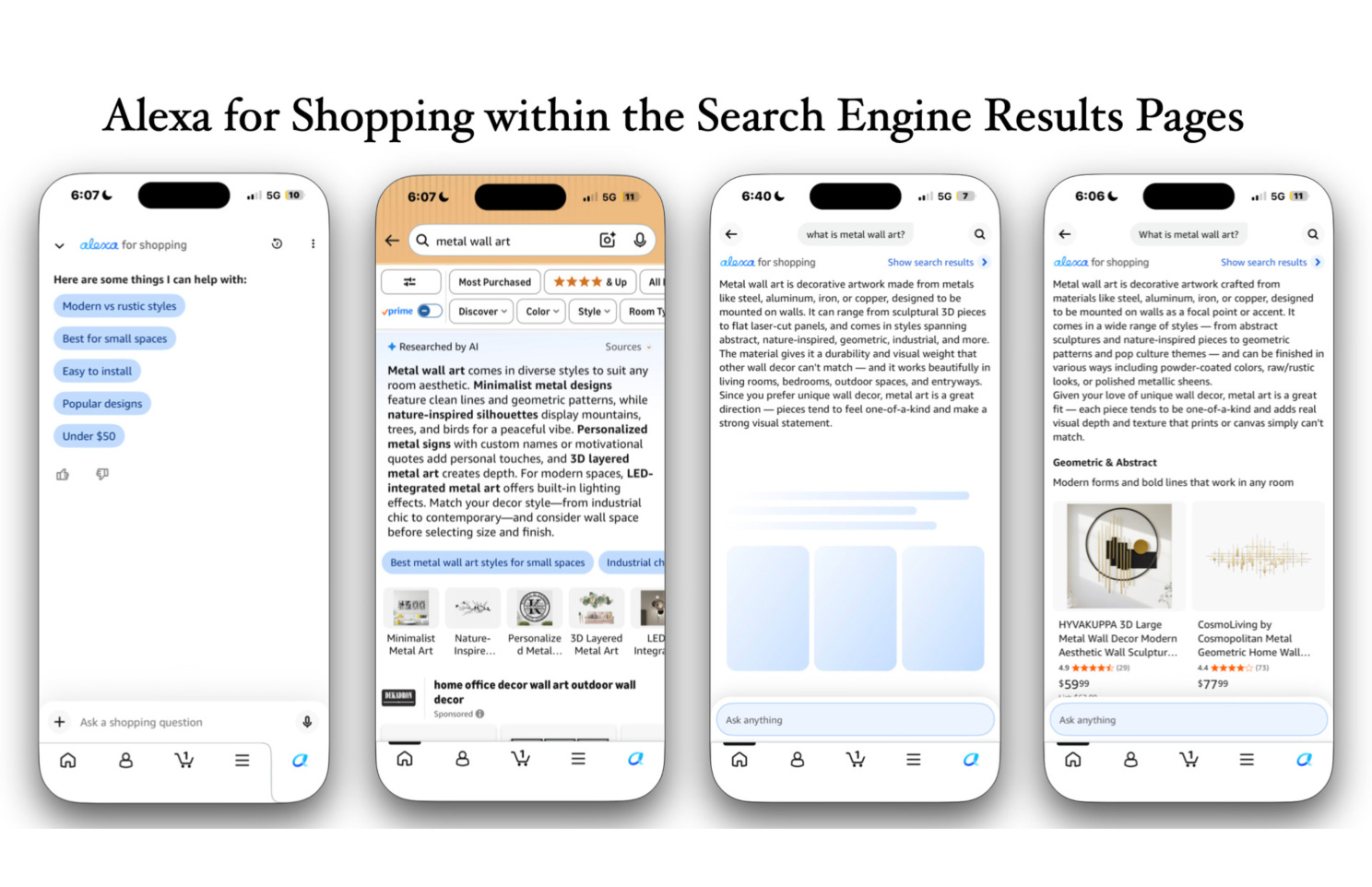
Amazon ACO is ASIN answerability engineering for a dual discovery system. A9 determines whether the product can be retrieved. Alexa for Shopping (Rufus) determines whether the product can be understood, trusted, and selected for the shopper’s mission, optimized on all attribute fields, Titles (now broken into product name + item highlights), Bullet Points, NATIVE text based A+ Content and Lifestyle photograph image indexation.
I have written extensively on Cosmo, one of Amazons many knowledge graphs for product understanding. Cosmo relations refers to the 15 type fields, providing a deep intent aware knowledge graph for retrieval, in particular I have seen significant evidence of this in navigational aspects, but not near as much as in search systems.
I am intimately acquainted with 1P/3P distinctions, particularly the actual level of control a brand has in editing their product page. Either way, make sure to get Brand Registry. You do not want your product truth coming from someone other than the source of truth.
Level 5 is the highest score I give to Amazon Science Papers have been in production/tested live on Amazon.
Predating Amazon's paper, I argued for RPO (Reasoning Pathway Optimization), essentially proving the same thing.
Product pages have three spots for prompt pills to appear, on both desktop and mobile (some of mobile as shown up to 4 on a product page though), Almost all prompt types are the same.
If you mine deep enough from the home page or search results page, technically, you can gather all that information, but statefully (by default) information is limited on Home Page and Search Results Alexa/Rufus context.