


A shopper is holding a lipstick she has not bought yet. The price is fine, the delivery date is fine, and one doubt remains: is it really dual-ended? Amazon has started selling the right to answer her. And the answer does not exist until she asks.
TL;DR. Amazon is turning the shopper’s next question into paid media. Sponsored Prompts reached general availability in the United States on March 25, 2026, eligible campaigns are enrolled automatically, and clicks bill through existing cost-per-click budgets, so the format is probably running on your account already. Instead of buying a click to a product page, you are now paying to trigger an AI-generated explanation inside Alexa for Shopping, built from your product content, reviews, and other Amazon signals. The patent behind it describes a larger system, one in which shopper missions, product aspects, generated questions, evidence retrieval, and conversational paths all become part of the advertising layer. For brands, that shifts the work away from writing ads and toward making product claims retrievable, provable, variation-correct, and safe, then continuously monitoring what Amazon generates on your behalf. You pay for the question. Amazon writes the answer.
The paid unit is changing. Brands are paying for the right to answer a shopper’s next question rather than for placement beside a keyword, and the patent describes that answer being retrieved and composed only after the click has been billed.
Reviews and product content are becoming advertising infrastructure. They help determine which aspects Amazon can credibly surface and what evidence can support the generated answer.
Retrieval sets the ceiling. If Amazon cannot reliably retrieve clear, specific evidence for a claim, the language model cannot safely or consistently turn that claim into a strong answer.
Advertisers have influence, but Amazon controls the execution. Brands can inspect and pause prompts, while Amazon determines the aspect, question, evidence, answer, placement, personalization, and follow-up path.
The strategic advantage becomes answerability. The brands best positioned for this system will have the strongest mission relevance, clearest aspect ownership, and most retrievable evidence, not simply the highest bids.
PPC means optimizing for relevance too. For the longest time Amazon SEO and PPC operated in symbiotic union with one another, and they still do. But now organic AI visibility is interacting directly with paid AI visibility. I will let the community sit with that one.
Amazon created a new way to sell the next step in a shopper’s reasoning.
In the live experience, a Sponsored Prompt appears beside a product or a brand, opens Alexa for Shopping (Rufus), restates the paid question, generates a product explanation, keeps a purchasable product card in view, and offers further questions that can carry the shopper deeper into consideration.1
Amazon’s patent, granted and published in May 2026, describes a larger system the format could sit inside. It describes an advertising marketplace in which eligible suppliers, or the candidate branded questions themselves, can enter an auction. The system can infer positive product and brand aspects from review data, filter them through advertiser preferences, select the aspect most relevant to the shopper’s context, generate the question, retrieve supporting evidence, and construct the answer only after the click. So the result goes well beyond an AI-enhanced Sponsored Products extension.
Amazon is building a marketplace for the right to influence what the shopper considers next.
Out of that come three kinds of inventory which did not previously exist as separable objects:
Question inventory. Which question is presented to the shopper.
Aspect inventory. Which product or brand strength that question emphasizes.
Conversational inventory. Where in the decision process the paid question appears.
Each plays a distinct role. The question supplies the visible creative, the aspect the semantic proposition, the conversation the monetized environment. Almost everything that follows is a consequence of those three sentences.
Six findings that matter most
Clicking a prompt buys an explanation, not a destination. A traditional sponsored click carries the shopper to a page. This one triggers a generated answer, and the patent describes that answer being retrieved and composed only after the click has been billed.
Reviews have moved upstream into paid media. In the architecture Amazon’s patent describes, review content helps determine which product strengths are eligible to become paid questions and what evidence exists to support the answer.
Retrieval, not the language model, sets the ceiling on what you can claim. The answer is assembled from a ranked, truncated subset of evidence. Diffuse, hedged, or contradictory source content underperforms at best and can fail to be retrieved at all.
Published performance figures do not measure incrementality. The 48 percent conversion and 21 percent spend claims compare self-selected clickers with non-clickers.
No canonical creative may exist to approve. Personalization can change which brand, which aspect, and which question a shopper receives.
The work moves from setup to monitoring. Automatic enrollment means setup work drops close to zero and monitoring work climbs. The advertiser no longer writes the question or the answer but still carries the reputational and regulatory exposure when a claim goes wrong. The practical burden shifts to auditing what Amazon says on a brand’s behalf, and to making the product’s strongest truths easy to retrieve and hard to misstate.
How to read the evidence
This piece draws on four kinds of material, and they are not equally authoritative.
Observed experience means the behavior appeared in captured Amazon interfaces on a live account.
Amazon-documented functionality means Amazon Ads or another official Amazon source publicly describes it as available.
Patent-described architecture means Amazon’s issued patent describes the method, or one possible embodiment of it. It does not prove that the component is active in the shipping product.
Strategic interpretation means the conclusion follows from connecting the observed product, the documentation, the patent, published research, or account-level data, but Amazon has not said it in those words.
Part I. The unit, as shoppers actually meet it
Lipstick makes the journey unusually easy to see. First, the Kaely Sponsored Products card appears in search results with the question, “Does it have a dual-ended applicator?” The question sits low in the card, immediately above the Add to cart area.
Second, a closer view shows why the location is strategic. The prompt follows the price and the delivery message, so it arrives after the shopper knows what the product is and what it costs, but before the purchase action. It answers the kind of last-mile uncertainty that can stop a conversion.
Third, one tap opens Alexa for Shopping. The question reappears with a Sponsored label. The response explains the two-in-one design, a product card carries the price and Add to cart button forward, and four organic-looking follow-up prompts invite the shopper to keep evaluating finish, feel, durability, and everyday use.
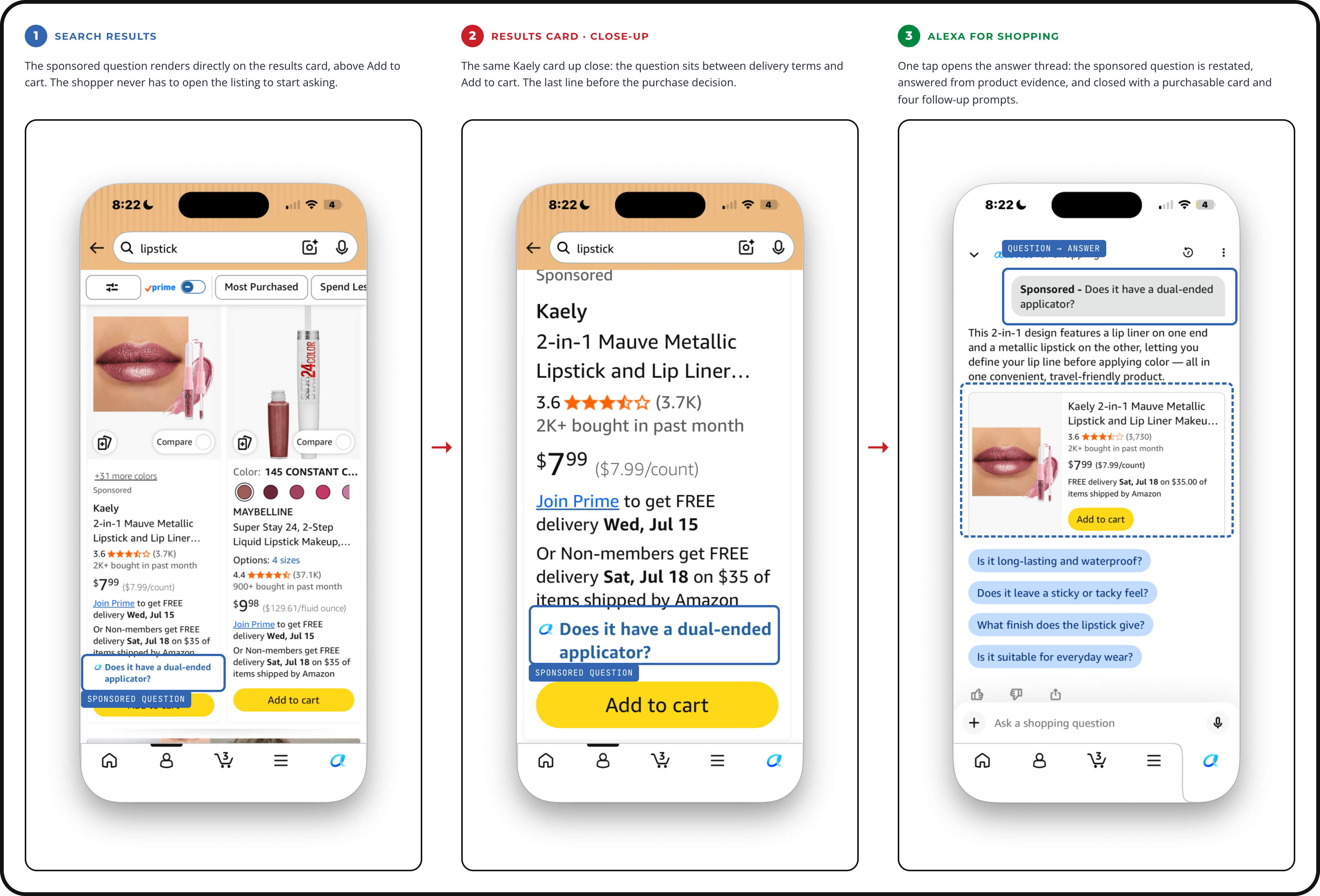
The unit sits closer to the opening turn of a guided sales conversation than to a static ad extension.
Bedding shows the pattern is repeatable
Bedding follows the same logic with a different purchase concern. The Sponsored Products card for a CozyLux comforter set asks, “Is it breathable for comfortable sleep?” Hardly a broad awareness question. It addresses comfort, materials, and overnight use: the exact concern a shopper weighs just before buying bedding.
After the tap, Alexa for Shopping answers with product-specific claims about microfiber, breathability, sweat absorption, and down-alternative fill. The answer is followed by the same product card, current offer, delivery message, Add to cart button, and related questions about deep mattresses, care, and year-round use.
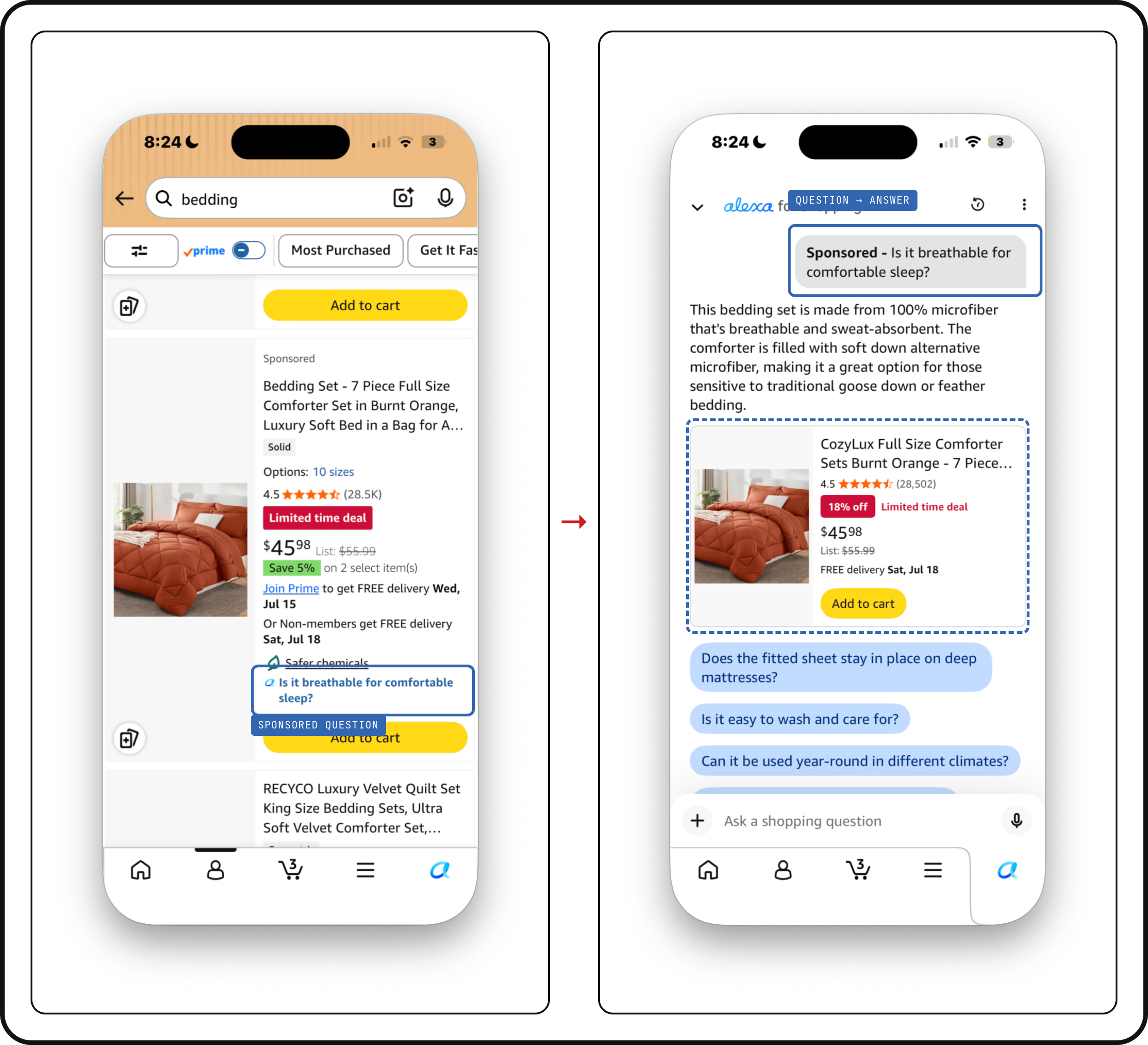
Two categories, one underlying design: place a high-intent question beside the buying decision, then remove the next objection without forcing the shopper to restart the search.
Four entry points, one destination
Product cards form only one entry point, and the remaining captures matter for breadth rather than narrative. They establish that the same destination is being reached from several different places on Amazon.
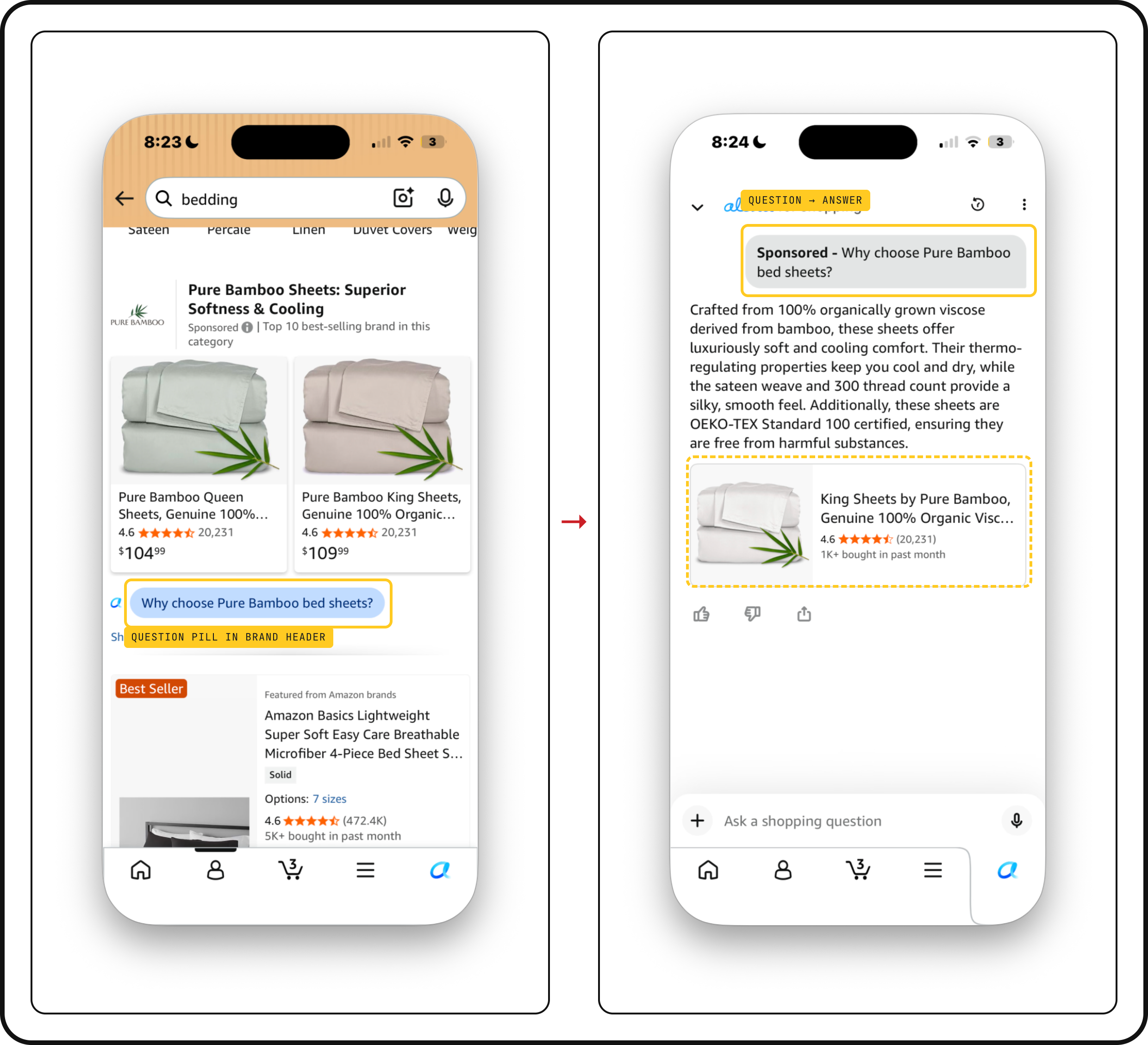
Pure Bamboo’s Sponsored Brands header carries the question, “Why choose Pure Bamboo bed sheets?” Tapping it opens an Alexa answer about softness, cooling, weave, thread count, and certification, then presents a specific product card.
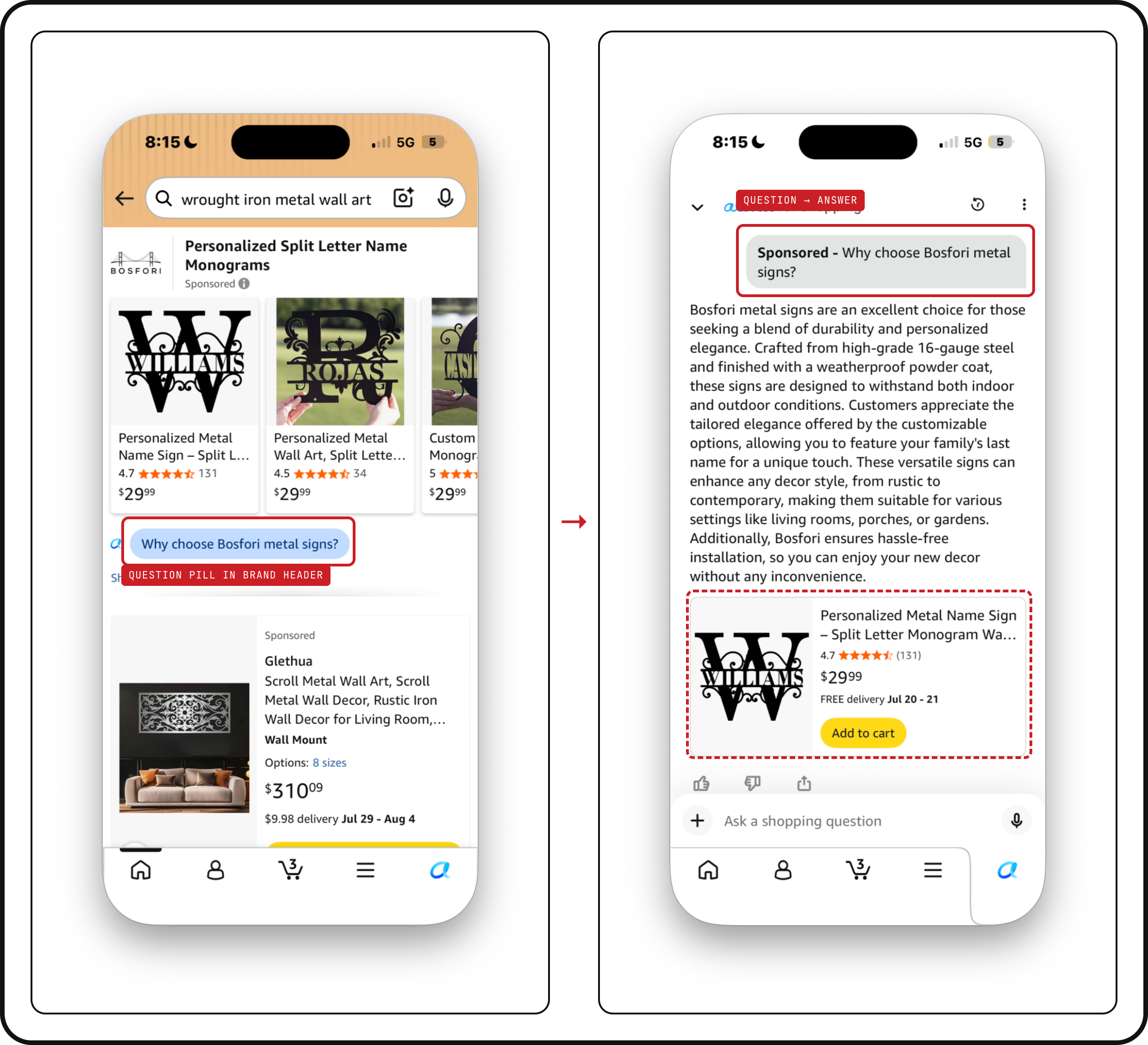
Wrought-iron wall art repeats the brand-header pattern, where a Bosfori question opens an answer about steel gauge, weather resistance, customization, installation, and use cases before presenting a purchasable monogram sign.
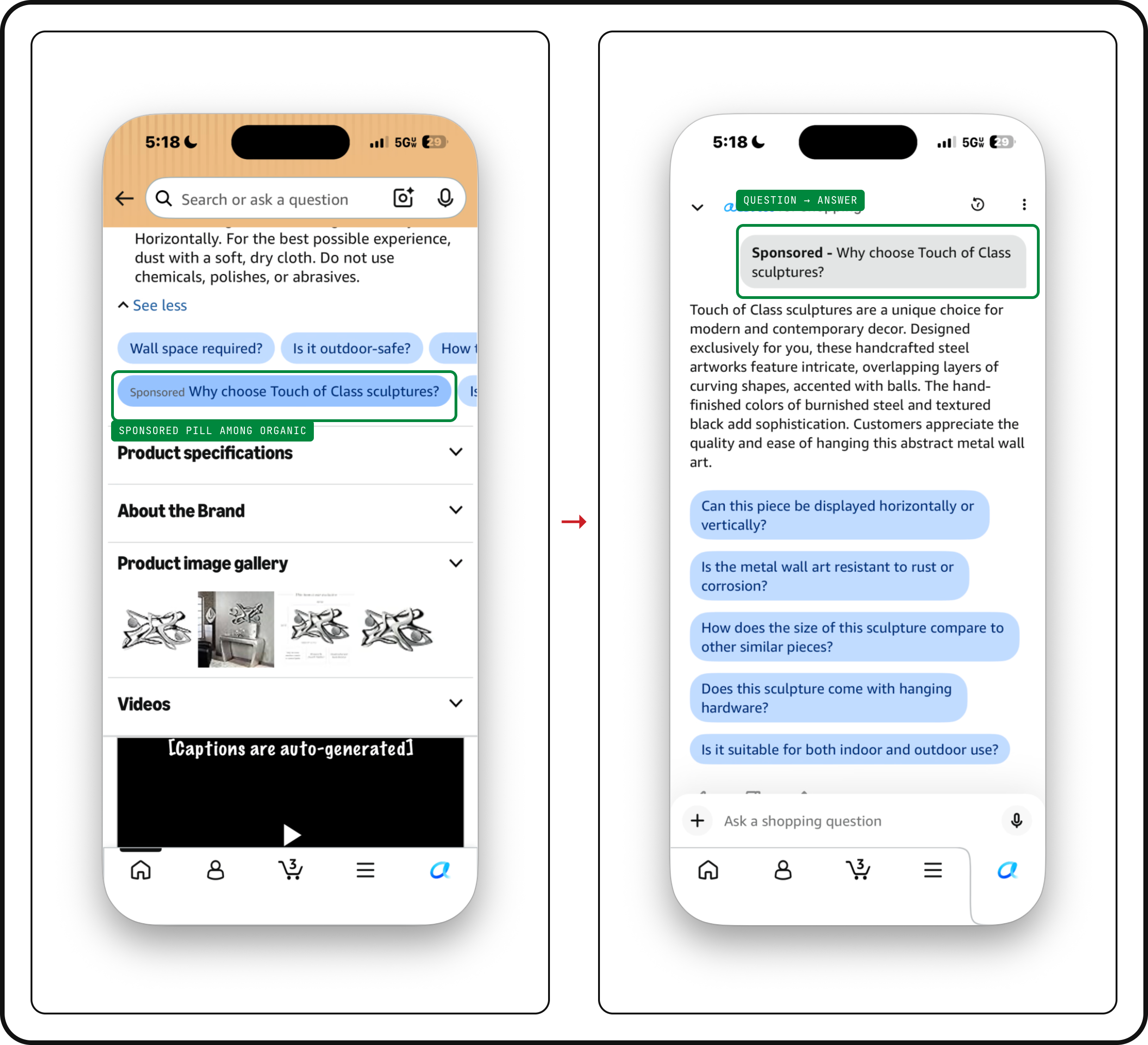
On a Touch of Class product detail page, a Sponsored Prompt sits among the page’s suggested question pills, native in appearance and marked only by its Sponsored label.
The newest capture pushes the format one step further. Inside a Sponsored “Explore key features” module, Amazon presents short product-led statements such as “Epoxy coating for lasting wall art” beneath individual cards. The wording never frames it as a shopper’s question at all, but the tap produces the same conversational journey: Alexa for Shopping restates the feature as Sponsored, explains the claim, keeps the Empire Art Direct product card in view, and offers related questions.
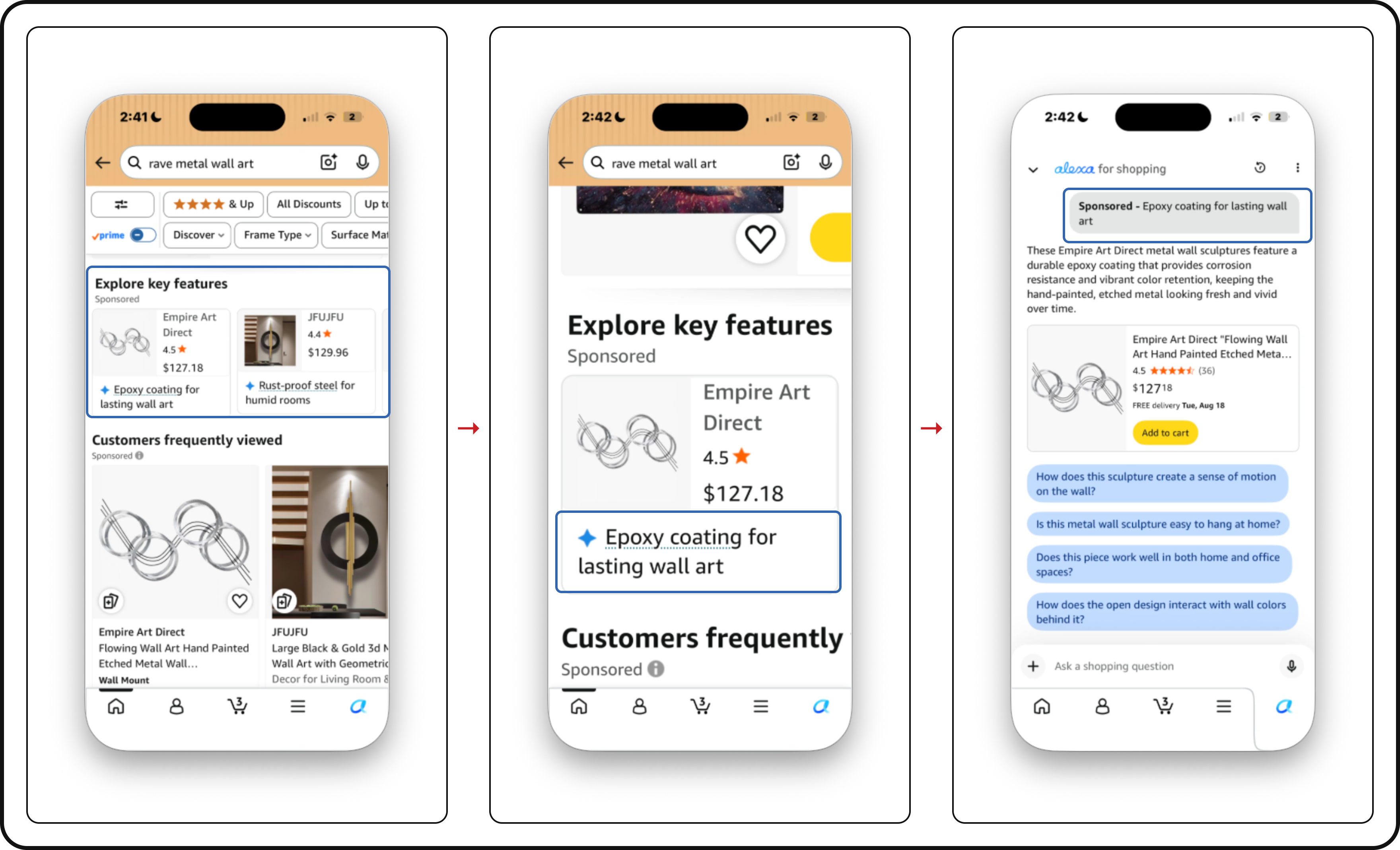
A prompt does not have to look like a question. Amazon can use a specific product attribute as the entry point and let the assistant turn that attribute into an explanation, which is exactly what an aspect-driven generation system would be expected to produce.
Across these captures, the observed placement inventory is:
A Sponsored Products card in search results.
A Sponsored Brands header above a product carousel.
A suggested-question row on a product detail page.
A Sponsored “Explore key features” module with feature-led statements.
Entry points change. Destinations do not: a sponsored question, a generated answer, product proof, and a way to keep shopping. The captures above are a handful chosen for clarity. They illustrate the pattern rather than constitute it.
Behind what looks like a new interactive ad extension sits the visible edge of something much larger. The rest of this piece is about what sits behind it.
Part II. What is actually live today
The format officially goes by Sponsored Products prompts and Sponsored Brands prompts. The company introduced them in open beta in November 2025 and moved them to general availability in the U.S. on March 25, 2026.
According to Amazon Ads, prompts are generated from brand-provided inputs (product detail pages, Brand Stores, and campaign data) along with other Amazon-verified first-party signals. Eligible U.S. Sponsored Products and Sponsored Brands campaigns are automatically enrolled, and clicks are billed through the campaign’s existing cost-per-click budget.
Launch materials say prompts can appear in shopping results and on product detail pages. A click may open a dialog in Rufus or return an answer directly on the page. In the mobile examples captured here, the destination is visibly branded Alexa for Shopping. Whatever name appears at the top of the interface, the advertising job stays the same: turn a paid question into a conversational product explanation.
Reporting arrives at the prompt level, and individual prompts can be paused.2
The commercial numbers, and what they can and cannot support
During its Q2 2026 earnings commentary, Amazon said shoppers who click a Sponsored Prompt convert to a sale 48% more often and spend 21% more on average than shoppers who do not. Amazon has also said that adding prompts to a Sponsored Brands ad drove a 6% increase in conversions.3
Read them carefully. The 48% and 21% figures compare clickers with non-clickers, and shoppers who tap a detailed product question are self-selected: further along, more engaged, and more likely to buy anyway. That reflects association, not demonstrated incrementality. The 6% conversion claim reads more like a treatment effect, but Amazon has not published sample sizes, categories, baselines, confidence intervals, or assignment method for any of these figures. Treat all of them as directional evidence that the format works, as opposed to benchmarks to plan against.
The more important economic change: the prompt click is a new billable event
Coverage of this format tends to skip what comes next, which matters more than any of the performance percentages. A traditional sponsored click carries the shopper somewhere: to a product page, or to a Store. It buys a destination. A Sponsored Prompt click can instead buy an explanation. The patent is explicit that the supplier may be charged when the shopper clicks the sponsored pill, and separately describes the question being presented first, with the answer requested only when the shopper selects it.
So the funnel now has a step in it that did not exist before:
Exhibit A. The new billable funnel. Impression → prompt click (billed) → answer exposure → product-card interaction → detail page or cart action → purchase.
Monetization now reaches the shopper’s decision to request an explanation, before the shopper has necessarily asked for a product page at all. On Amazon’s documented implementation this still runs through existing campaigns, budgets, and bid controls, so it is not yet a separate inventory type an advertiser can buy or withhold. What has changed is what the click delivers, and that explains why the format deserves understanding at the architectural level rather than treating it as another ad extension to switch on.
The strongest objection, stated fairly
Skeptical readers can assemble a deflationary case out of Amazon’s own documentation, and it belongs on the table. Campaigns are automatically enrolled. Clicks bill to the existing cost-per-click budget. No separate bid exists, no aspect control, and no way to buy or withhold the format independently of the campaign it rides on. Reporting arrives as new columns in a familiar table. On that reading this is a Sponsored Products extension with a generated creative and a conversational landing page, and the marketplace described in the rest of this piece is a patent rather than a market.
My answer runs narrower than the headline, but it holds. What has changed does not yet touch the buying object. It touches what the click delivers and when the creative gets composed. The advertiser is charged before the persuasive content exists, and that content is then assembled from evidence the advertiser does not select. That is a different risk profile from any placement that preceded it, whatever the console calls it.
One commercial question follows immediately, and it is the first thing a media buyer will ask. If a shopper taps a prompt and the click is billed, then taps the product card inside the conversation, is that a second billable click on the same journey? And does prompt volume draw clicks away from the product-card and detail-page paths the campaign was already paying for? Amazon’s published materials do not answer either question, and prompt-level reporting as described will not separate the two.
Do not wait for Amazon to answer it. Ask your account team whether prompt clicks and in-conversation product-card clicks are both billable, and whether both land in the same click column. Then test it yourself: hold budget, bid, and targeting constant, and compare the thirty days before prompt activity first appeared with the thirty days after. Look for a rise in clicks per thousand impressions without a matching rise in detail-page views or add-to-cart events. A step change in the first without the second is the signature of a second billable event on the same journey. The difference between an incremental step and a double-charged one is the difference between a format that earns budget and one that quietly absorbs it.
Three observations would weaken the argument in this piece materially. Prompt exposure that stays concentrated in a narrow set of ASINs over a long window would suggest a feature rather than a marketplace. Continued absence of any aspect-level or question-level control in the Ads Console twelve months from now would suggest the auction layer is not coming. And prompt engagement that remains a rounding error in shopper behavior would make the architecture real and commercially inert. Each is measurable, and each is worth watching.
Part III. The patent: the system behind the surface
The clearest public description was granted and published on May 5, 2026, roughly six weeks after the format reached general availability in the U.S. U.S. Patent No. 12,619,668 B1 covers machine-learning generation of question and answer pairs for a conversational agent.4 It calls the units sponsored pills and calls advertisers suppliers, but the mechanism is unmistakable.
Carry two cautions into this section.
First, a grant date tells you more than a filing date does. Claims can be amended right up to allowance, so the set Amazon secured in May 2026 reflects what Amazon still wanted to own in 2026, not only what it drafted two years earlier. The underlying description cannot take on new matter after filing, so read the specification as a 2024 document and the claims as a 2026 one. Neither date proves that every element runs in production today. The live product may implement some of the document, all of it, or a variation of it.
Second, the issued claims and the specification are different things.5 Where this piece describes the fuller embodiments, it says the specification describes, and that language is doing real work.
Two things stand beyond doubt: the timing and the vocabulary. This document surfaced in the same year Sponsored Prompts reached general availability, and it shares the live format’s language almost line for line.6
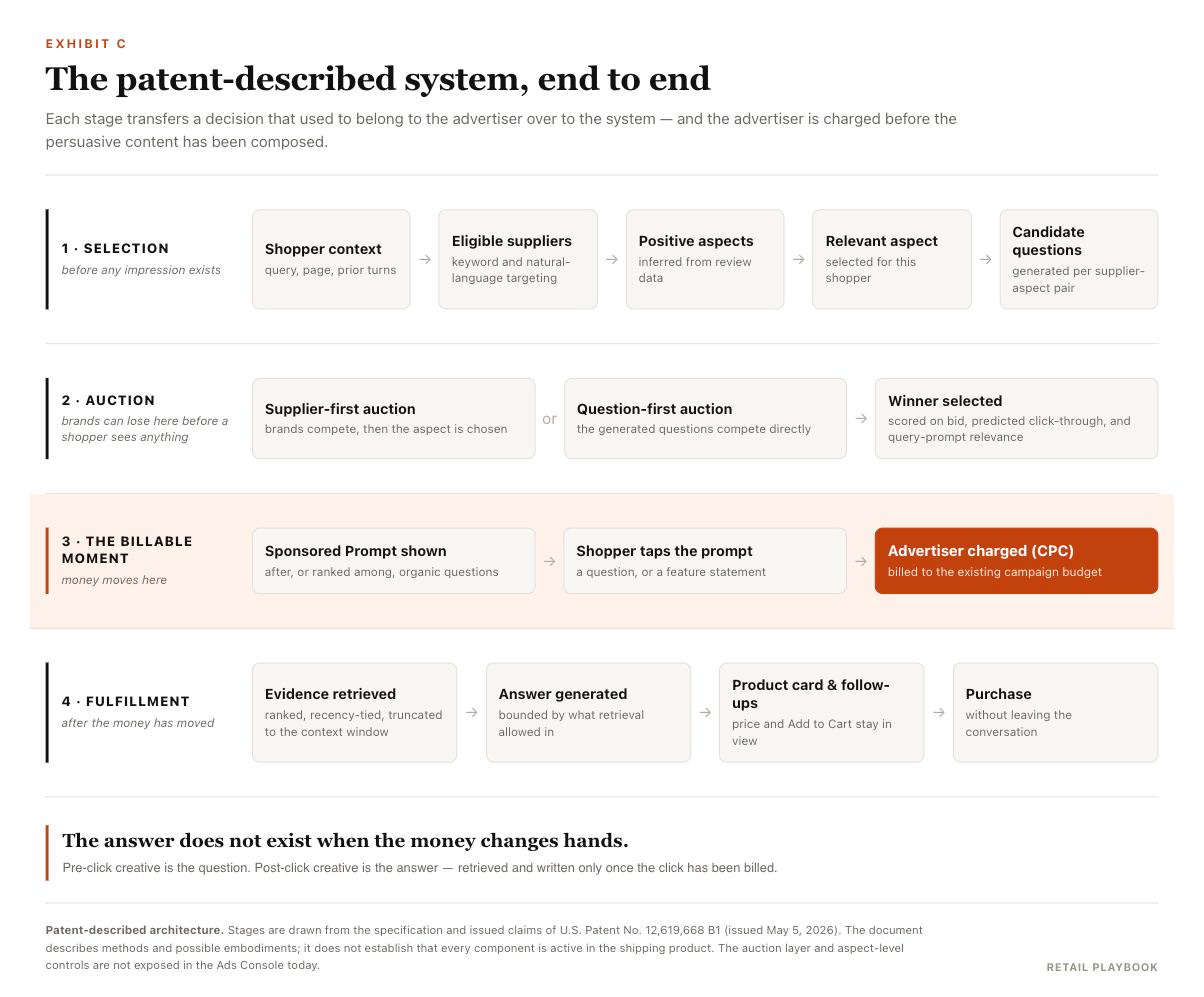
Exhibit B. The patent-described system, end to end.
Shopper context → eligible suppliers → positive aspects → contextually relevant aspect → candidate questions → supplier or question auction → Sponsored Prompt → CPC click → evidence retrieval → generated answer → product card and follow-ups → purchase.
Every disclosure that follows fits somewhere on that chain. It is worth walking it stage by stage, because each stage transfers a decision that used to belong to the advertiser over to the system.
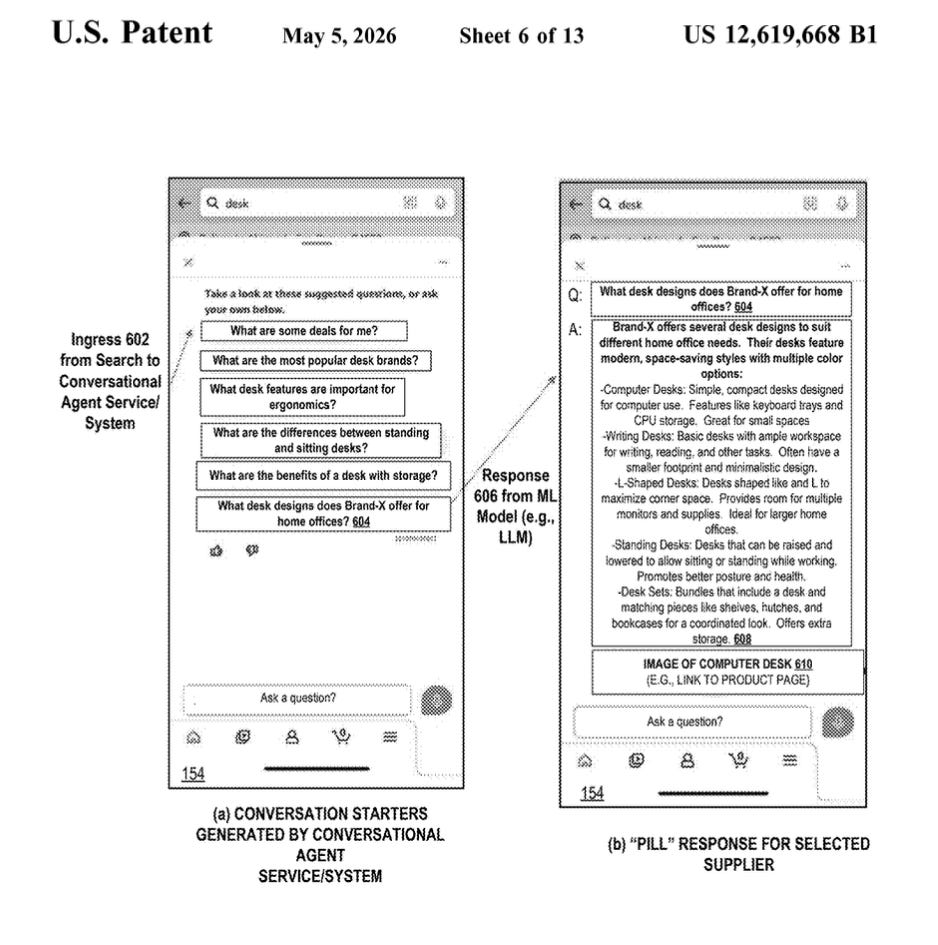
What Figure 6 of the patent shows
Figure 6 makes the placement logic obvious. Panel (a) shows a shopper arriving from a search for “desk” and receiving six suggested questions. Five are organic.7 The sixth is sponsored (“What desk designs does Brand-X offer for home offices?”) and it sits last in the stack, closest to the input box. Panel (b) is what the tap produces: a branded answer walking through the advertiser’s desk range, followed by a product image linked to the product page. Two things stand out. The sponsored question is stylistically indistinguishable from the five above it, and the answer is not a single fact but a merchandised tour of the advertiser’s assortment.
Stage 1. Amazon establishes context and identifies eligible advertisers
Context extends well past a typed keyword. The specification contemplates ingress from search, product detail pages, home pages, and existing conversations, as well as other shopping-page interactions. It also describes continuation questions that can be built from a summary of the preceding conversation or from recent conversational turns.
Amazon may eventually select a Sponsored Prompt using far more than the shopper’s original phrase. It can reflect the current page, the product being viewed, previous questions, previously expressed constraints, the aspect currently under investigation, and historical interactions. The pattern has a name: conversational context accumulation. The longer the shopper talks, the more targeting signal exists.
Context decides when a prompt can appear; eligibility decides whose. Many assume conversational ad formats make keyword research obsolete. The patent says otherwise. Supplier targeting can be based on traditional search keywords and on natural-language advertiser targeting descriptions (for example, targeting shoppers looking for office furniture), which are then mapped to possible search keywords. That resolves the apparent contradiction between keywords and shopping missions. They do different jobs:
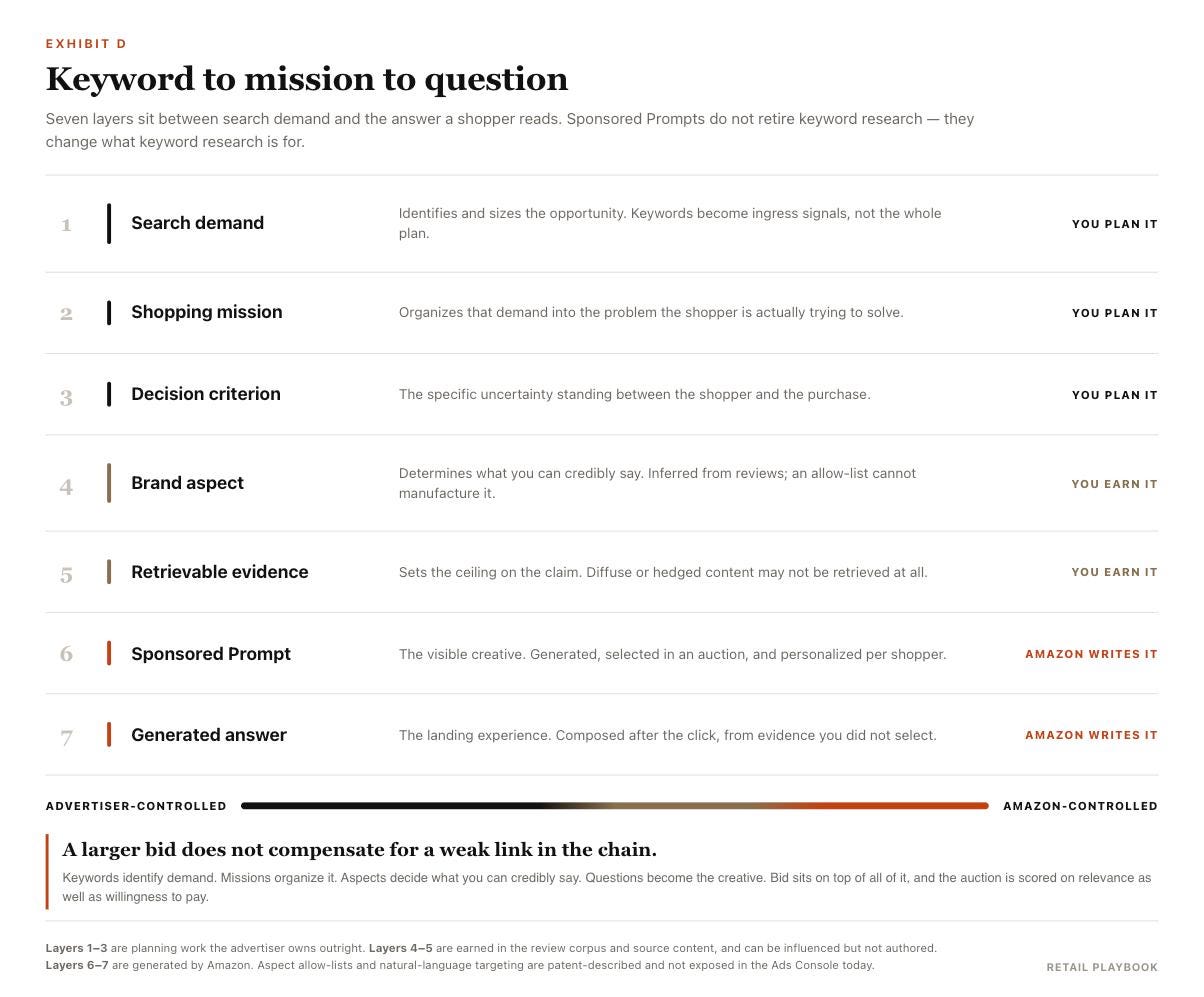
Keywords identify and quantify the opportunity. Shopping missions organize it. Aspects determine the message. Questions become the generated creative. Sponsored Prompts do not retire keyword research; they change what keyword research is for. Keywords become ingress signals and demand evidence from which complete shopper missions can be reconstructed.
Stage 2. Reviews become an aspect inventory
This is the disclosure that should change how brands staff and budget for this format. The patent describes positive aspects being inferred from review data at the product-identifier level. It allows aspects to be aggregated to the supplier level, and allows the supplier to provide an allow-list of aspects it wants promoted.8 A language model then chooses whichever aspect is most contextually relevant to the shopper’s current search.
Three conclusions follow, and each one carries an operational cost.
Review content becomes upstream paid-media infrastructure. In the architecture Amazon describes, reviews are no longer relevant only to conversion rate, star rating, trust, and organic visibility. They help determine what a product is known for, what a brand is known for, which aspects are eligible to become paid questions, and which evidence is available to construct the answer. Review strategy stops being a post-purchase function and becomes an input to creative.
An allow-list cannot manufacture evidence. A supplier may be able to indicate that it wants durability, design, or comfort highlighted. The preference does not create proof. The system still needs something retrievable. A brand that wants to compete on an aspect it has never earned in its review corpus is asking the system to advertise a claim it cannot substantiate.
Aggregation creates a product-specificity risk. If positive aspects are rolled up from products to the supplier or brand level, a brand can become broadly associated with an aspect that is not equally true of every advertised product or variation. It is a structural consequence of the architecture, and it is where variation mismatch comes from.
Stage 3. Amazon generates the question
The patent does not simply say that a language model writes a question. It supplies a sample generation prompt with four inputs: the shopper’s keyword, the supplier, the aspect to emphasize, and advertiser-provided context. The model is instructed to produce a concise question in a form such as, “Why is [Supplier] known for its [Aspect]?”
Exhibit C. Question generation, in and out.
Keyword: running shoes
Supplier: Brand H
Aspect: cushioning
Advertiser context: shock absorption and comfort
Generated question: Why is Brand H known for its cushioning?
Prompts amount to more than isolated sentences someone wrote. They emerge from an upstream selection system, and the leverage sits upstream of the wording.
Feature-led statements observed in the live captures make sense in that light. The specification allows the architecture to relax the fixed aspect-question format and generate broader branded-question candidates. “Epoxy coating for lasting wall art” is conceptually consistent with an aspect-driven generator that has been permitted to drop the interrogative form. Treat that as consistency, not proof that the live statement came from the exact patented method.
Stage 4. The auction: who competes, how it is scored, how it starts cold
Another diagram, Figure 3, traces the branded question auction end to end, and repays a slow walk from left to right. A search for “desk” produces a set of eligible suppliers, X, Y, and Z. A lookup pulls positive aspects for each from reviews and supplier inputs: design and cushion for X, durability for Y, material for Z. The language model picks the contextually relevant aspect per supplier, generates a question for each supplier-aspect pair, and only then does a question selection service choose the winner. A retrieval model fetches matching review snippets and supplier inputs, and a second generation step writes the answer.
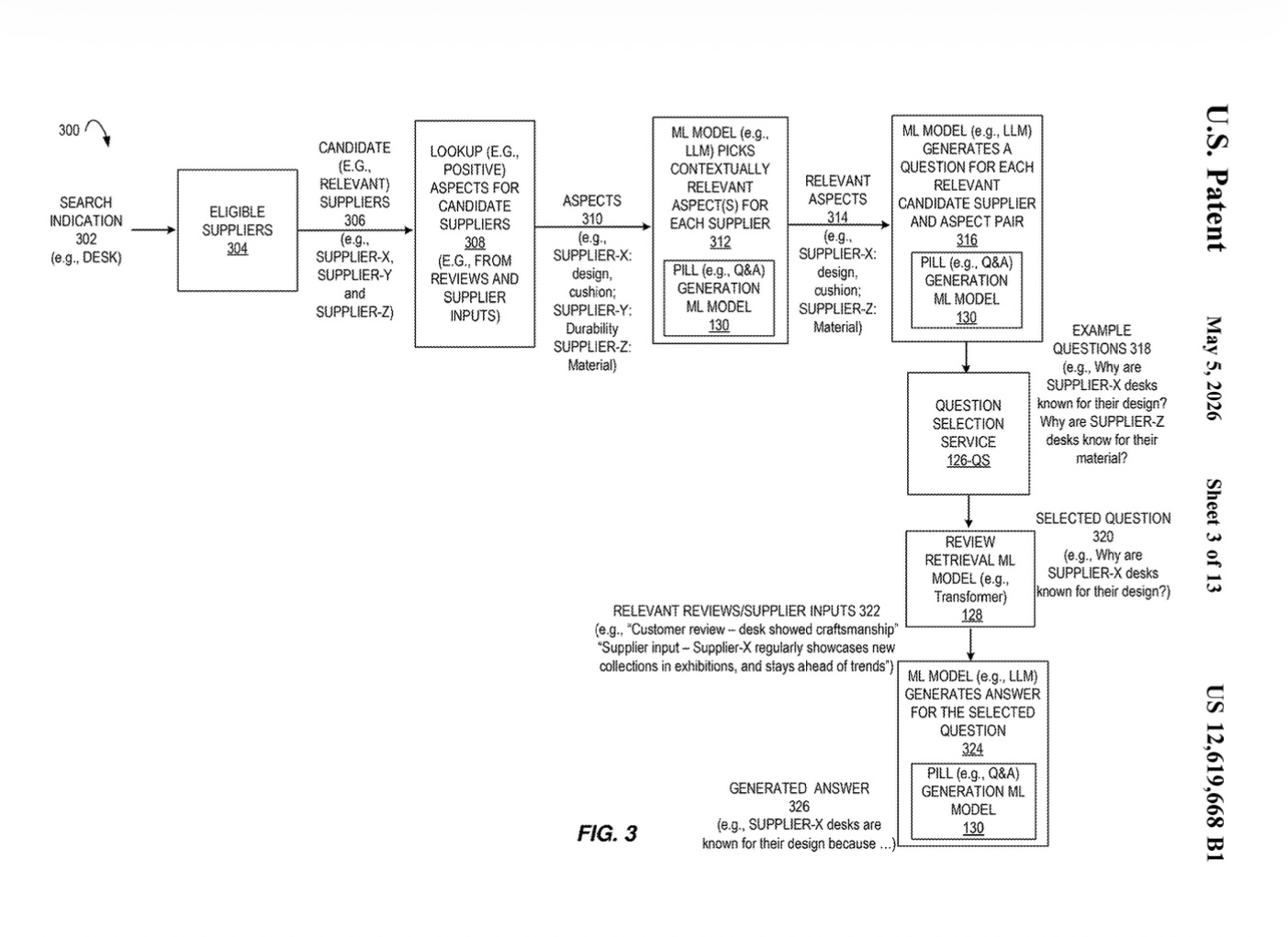
Note what that ordering means. Several advertisers can have questions generated about them for the same query and lose before a shopper sees anything. Generation does not equal serving. Nothing demonstrates more clearly that a prompt export shows only the questions that survived a competition the advertiser never sees.
Candidate auction designs come in two shapes, and the difference between them amounts to more than a detail.
Supplier-first. Amazon selects a supplier. After the supplier wins, the system retrieves its positive aspects, chooses the aspect most relevant to the current context, generates the Sponsored Prompt, retrieves evidence, and generates the answer. This design is less computationally demanding and can run on supplier-level engagement estimates.
Question-first. Amazon creates candidate questions for eligible supplier-and-aspect combinations, and the questions themselves compete. The patent identifies the advantages plainly: multiple candidate questions from a single supplier, different potential bids for different aspects, question-specific click-through predictions, purchase estimates closer to the creative actually displayed, and greater auction depth.
The second design carries large consequences. The eventual unit of bidding may not be the keyword, or even the brand. It may be the brand’s right to discuss a specific aspect through a specific generated question. Nothing in the public Ads Console exposes that control today, and this should be read as a patent-described design rather than a documented current capability. But it tells you what Amazon has at least contemplated building.
Whichever design ships, the bid alone does not decide the winner. Auction scoring, as the specification describes it, draws on the advertiser’s cost-per-click bid, a predicted click-through rate conditioned on the query, the prompt, and the shopper, and a term measuring irrelevance between the search query and the prompt, tuned by scaling coefficients.
The patent describes an auction score incorporating the CPC bid, predicted CTR, and a measure of query-prompt irrelevance.9 The practical implication is that Amazon can price the expected usefulness and engagement of the question alongside the advertiser’s willingness to pay. The conclusion that matters follows directly: a larger bid does not necessarily compensate for a poor semantic fit.
Something worth naming begins here. Call it paid relevance engineering: maintaining a credible, evidenced relationship between the shopper’s mission, the targeted query, the selected aspect, the generated question, the product evidence, and the expected downstream purchase. If any link in that chain is weak, more money is a poor substitute.
Any new conversational ad format faces an obvious cold-start problem: no question-level engagement data exists to predict from. The specification proposes approximating the score from existing inline product ad data across the advertiser’s product identifiers (product-level click-through and relevance signals) combined with a personalized deep interest model.
That offers one plausible mechanism by which Sponsored Prompts could inherit signal from established Sponsored Products performance while prompt-specific data remains sparse, and it may help explain why early exposure concentrates around products that already perform in search. It does not establish the causal relationship, and the account-level sample below cannot test it.
Stage 5. The answer is generated after the click
This stage deserves a name, because it breaks a long-standing assumption about what an ad can be. Sponsored Prompts work as a two-stage generative ad.
Pre-click creative means the question or feature statement Amazon selects and generates. Post-click creative means the answer, retrieved and generated only after the shopper selects the prompt. The patent describes exactly this sequence: the shopper receives the question first, and the click triggers review retrieval and answer generation. The lipstick shopper from the opening met this sequence without seeing it. Her answer did not exist when she tapped. It was composed for her, from evidence the brand never selected, after the click had already been billed.
The ad need not exist as a completed object at the moment of impression. The question extends the invitation. The answer delivers generated fulfillment. No traditional sponsored format works this way, and every downstream implication (auditing, brand safety, claims liability, measurement) follows from it.
Stage 6. Retrieval decides what the model is allowed to know
Underneath it all is what the specification calls a Conversational Advertisement Information Retriever, or CAIR: a model fine-tuned so that aspect-relevant snippets are pulled in while unrelated snippets are pushed away.10
The answer is assembled like this: take the selected question or aspect, search the review and supplier-input corpus, retrieve semantically related snippets, rank them by relevance, break ties by recency, fit the strongest evidence into the model’s limited context window, and generate the answer from what fits. That sequence changes the optimization job more than anything else in the patent. The language model writes the answer, but retrieval determines what the model is allowed to know at that moment.
Polished listing copy is not sufficient. The system needs evidence that runs specific, consistent, current, variation-correct, semantically concentrated around the aspects that matter, and easy to associate with the right question. Diffuse, hedged, or contradictory content does not merely underperform. It can fail to be retrieved at all.
Technical sidebar. Those retrieval details are embodiment specifics rather than guaranteed production facts. They matter to advertisers for one reason only: they establish that the answer is assembled from a ranked, truncated subset of available evidence. Not everything true about a product will make it into the window.
Stage 7. Advertisers influence the system without authoring it
Supplier inputs, as described, include preferred aspects, aspect allow-lists, brand-safety guidelines, supplier context, and images, audio, and video. It even depicts a supplier interface through which preferred aspects and safety guidelines can be entered.
The control model comes down to three words: advertiser influence, Amazon generation, evidence-bounded output. The advertiser can shape the territory. The system still decides eligibility, contextual relevance, question generation, auction ranking, evidence retrieval, final wording, placement, and personalization. The full three-column map of who controls what appears further down, once the account-level evidence is on the table.
Personalization belongs on that list, and it deserves isolating, because it reaches further than ad ranking. Personalized click-through models, also described, consider a shopper’s recent interactions with prompts and products. Its own example: a shopper who has repeatedly engaged with design-related pills becomes more likely to receive a design-oriented question.
Two shoppers searching the same phrase could therefore receive different brands, different aspects from the same brand, different generated questions, different prompt positions, and different follow-up paths.
So there may be no single canonical Sponsored Prompt creative at all. A screenshot is a sample of one execution, not a description of the ad.
Stage 8. Sponsored questions may compete with organic ones
Few accounts of the format develop what follows. The patent says a sponsored pill can be placed after the organic pills or dynamically ranked among them, with ranking informed by relevance, expected engagement, and expected conversions or purchases.
The competition here runs wider than it does for other Sponsored Prompts. The format may be competing for position inside a blended question environment. Organic questions identify the decision paths that are naturally useful. Sponsored questions introduce advertiser-supported paths. A shared ranking environment then decides which the shopper sees first. Paid and organic visibility begin to converge at the level of the shopper’s next question. For anyone who has spent a decade separating those two disciplines, that takes some absorbing.
Stage 9. The surface keeps expanding, including off Amazon
The specification extends the architecture to search starter questions, conversation-continuation questions, product-detail-page questions, home-page questions, same-brand upselling, questions about alternative suppliers, multimodal answers built from advertiser-supplied video and audio, and personalized prompts.11
Within that list, one detail deserves separate attention. On a product page, candidate questions may involve the same supplier or another supplier offering a similar product. That points to a future in which the detail page serves not purely as a brand-owned consideration surface but as an auctionable conversational one, usable for same-brand upselling, portfolio navigation, cross-selling, and competitive alternatives. If that ships, it ranks among the most consequential changes to Amazon merchandising in years.
Expansion already shows up outside Amazon. In June 2026, Amazon announced that Responsive eCommerce Creative would begin placing product-specific conversational questions inside display ads on third-party publisher sites starting in July. The examples Amazon shared are plainly shopper-style: “What hair types is this best for?” and “How long does one bottle typically last?”12
Clicks do not go to a landing page. They go into Alexa for Shopping. That reverses the usual shape of display advertising: impression, click, landing page, self-directed browsing becomes impression, question, assistant conversation, explanation, product card, cart. Alexa for Shopping becomes the landing experience for off-Amazon media, and Amazon keeps control of the consideration step instead of handing the shopper to a page and hoping.
Taken together, the surface roadmap says something simple. Amazon is making the conversational answer the destination across an increasing number of media environments, and buying that destination is the product.
Amazon is not alone, and that strengthens the case
The paid-question-into-generated-answer shape is not an Amazon invention, and this piece is stronger for saying so. Sponsored placements inside AI answer surfaces have been appearing elsewhere for two years. Google has shown ads in AI Overviews since 2024 and has been extending them into AI Mode. Perplexity has sold sponsored follow-up questions since late 2024 and now offers related-question and sponsored-answer placements. Microsoft runs ads inside Copilot and by mid-2025 was publishing performance comparisons against traditional search. And in late 2025 Walmart began testing sponsored prompts inside Sparky, its own shopping assistant: the same name, the same shape, one aisle over. The convergence is the point. The question that leads to a generated answer is becoming the default unit of advertising on assistant surfaces.
What separates Amazon’s version is ownership of the whole chain. Everyone else monetizes a question that leads somewhere. Amazon owns the review corpus that supplies the evidence, the assistant that composes the answer, and the checkout that closes it, which is why its answers can be evidence-grounded and immediately purchasable in a way a general-purpose assistant’s cannot. It is also why the aspect layer matters more here than anywhere else.
Part IV. Reading the account data through the architecture
With the system described, the account-level evidence becomes far more interpretable, and far more clearly limited. Sponsored Prompts are not a reporting black box. The prompt is already visible as a measurable, controllable unit inside Ads Console. In the Prompts tab, advertisers can see the generated prompt beside its linked ad and ASIN, switch individual prompts on or off, open a sample response, share feedback, and choose reporting columns. One view exposes prompt-level impressions; another brings total cost, purchases, and sales into the same row.
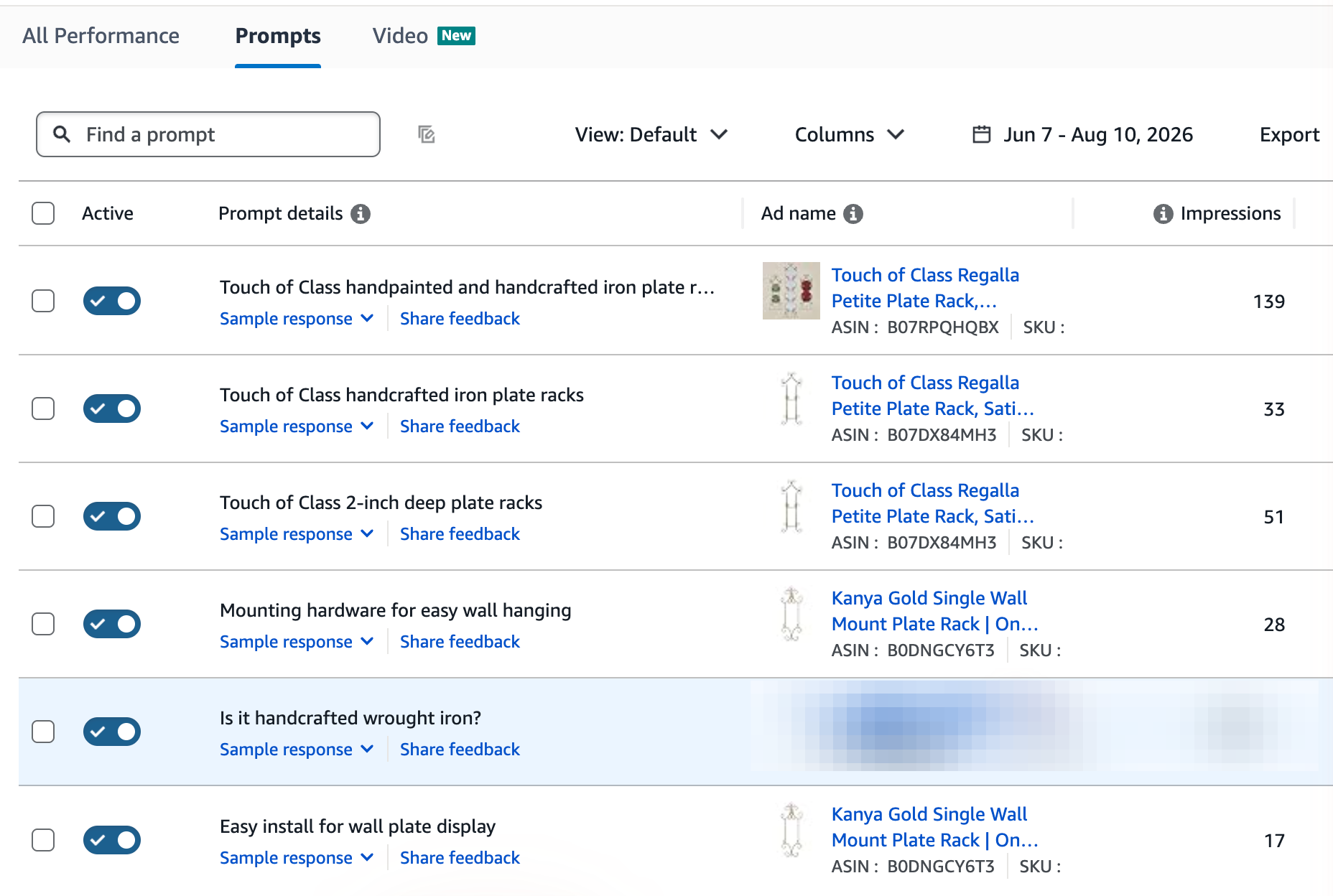
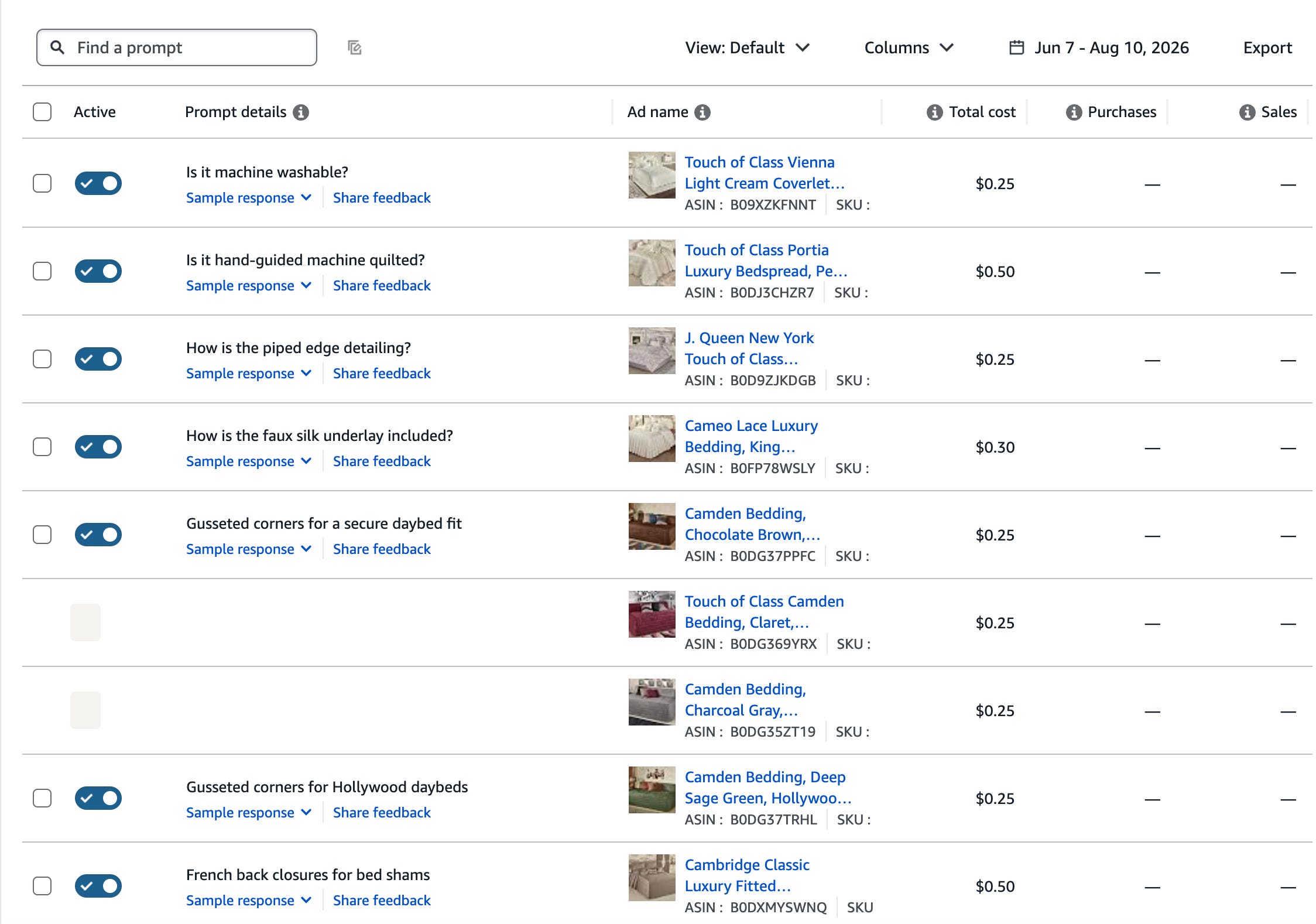
Screenshots here provide an account-level snapshot, not a performance benchmark.13 The signal worth taking is the visibility itself: each question or feature statement can now be treated as a reportable hypothesis.
What the first export shows, stated precisely
One inclusion rule governs everything below. Amazon says the Prompts view lists prompts only after they have received at least one click. If the export follows the same rule, then every figure here is conditioned on the prompt having already worked once: the click-through rate is biased upward by construction, and the count of prompt-active ad groups measures report visibility rather than prompt coverage. Read what follows as a census of prompts that already earned a click, not as a sample of prompts that ran.
With that stated, the export covers two ad groups. Between them they produced 21 prompt rows, generating 1,955 impressions and 26 clicks. None of those clicks produced an attributed purchase in the selected period, June 7 to August 10, 2026.
The observed 1.33% is not a benchmark; it is the click-through rate among rows that were included because they already had clicks.14
Two ad groups cannot describe coverage, and absence in a report is not absence of generation. A blank row can mean several different things.15
And “most prompts are not questions” is too broad a claim. What the data supports is narrower: both forms run side by side in the same account. Feature-led statements such as “Mounting hardware for easy wall hanging,” “Easy install for wall plate display,” and “Gusseted corners for a secure daybed fit” sit in the same export as plainly interrogative prompts such as “Is it machine washable?” and “Is it handcrafted wrought iron?” That coexistence is the finding. A sample this size cannot establish the ratio between the two forms, and I am not going to pretend it can.
Concentration is high as well. Two curtain prompts account for 1,045 impressions, or 53% of the sample, while several prompts appear after only one to six impressions. A 100% click-through rate on a one-impression row is an anecdote.
Observation, plausible mechanism, evidentiary limit
A sample this small means holding three columns apart.
Feature-led statements appear alongside interrogative ones. Plausible mechanism: an aspect-driven generative system permitted to relax the interrogative format. Limit: 21 rows from two ad groups in one account cannot establish the ratio.
Exposure is concentrated in a few prompts. Plausible mechanism: unequal eligibility, predicted-engagement differences, query relevance, auction outcomes, or reporting thresholds. Limit: the sample cannot identify which of those produced the concentration.
The sample says nothing about coverage. Plausible mechanism: any of the five explanations above. Limit: two ad groups cannot support a coverage claim in either direction.
No attributed purchases appeared. Plausible mechanism: insufficient volume. Limit: 26 clicks cannot evaluate conversion at all.
Used that way, the export is genuinely valuable, as diagnostics rather than performance. It reveals which product claims Amazon chooses to make on a brand’s behalf, where those claims earn attention, and which source content deserves work long before the sample is large enough for optimization decisions.
Part V. The control map: who decides what
Most confusion about this format comes from collapsing three different categories of control into one. Separating them makes the operating model obvious.
Exhibit D. The control map.
Documented live advertiser controls.
Inspect the generated prompt text.
Identify the associated ad and ASIN.
Open a sample response.
Submit feedback.
Monitor prompt-level performance.
Pause an individual prompt.
Change the underlying campaign and the source content.
Patent-described controls not publicly exposed today.
Aspect allow-lists.
Supplier brand-safety guidelines.
Natural-language targeting descriptions.
Aspect-specific question bids.
Supplier-provided multimedia assets.
Amazon-controlled system decisions.
Which advertiser is eligible.
Which aspect is contextually relevant.
Which question is generated.
Which question wins the auction.
Which evidence is retrieved.
How the answer is written.
Where the prompt appears and in what position.
Which shopper receives it.
Which follow-up questions appear.
How product cards are presented.
The middle column is where the interest lies. If aspect allow-lists and brand-safety guidelines ever ship in a visible form, they become the single most important controls in the format, more important than bid, because they govern what the system is permitted to claim on the brand’s behalf.
The three objects every advertiser must audit
The sample-response panel warns that actual responses may differ from the sample. That one line means there is not one creative object to check. There are three.
The prompt shown in the ad or in the console.
The sample answer shown in Ads Console.
The live answer generated for an actual shopper execution.
Validating the experience takes more than a screenshot of one execution. Wording can shift with shopper context, placement, conversation history, personalization, retrieval results, inventory, variation, and edits to the detail page or Brand Store. Prompt auditing therefore has to be execution-based rather than console-based: observe the same prompt repeatedly, across time, devices, and surfaces, and record what changes. Somewhere in that variation sits the lipstick shopper’s answer: an execution nobody at the brand approved before she read it, and one nobody may ever see again.
Part VI. Seven consequences that change the job
Seven consequences follow from the architecture. They are ordered from the most conceptual to the most operational.
1. A Sponsored Prompt is a paid semantic bridge
The link runs from shopper context to a decision criterion, that criterion to brand evidence, that evidence to a generated explanation, and the explanation to a purchasable product. The advertiser is not buying an impression beside a product. It is buying a bridge into the shopper’s reasoning process.
2. The unit of competition is becoming the shopper’s problem
Brands no longer compete only for jeans, comforter, or lipstick. They compete to answer which jeans fit this body shape, which comforter solves overheating, which lipstick format reduces application friction, which wall art survives outdoor exposure, which product is compatible with a specific use case. Shopping missions have stopped being a planning abstraction and become a media asset.
3. Keywords remain instrumentally essential
Query targeting and keywords still appear in the patent. But keywords are now one layer in a larger system. Keyword research identifies demand. Mission design explains the demand. Aspect selection determines what the brand can credibly say. Sponsored questions operationalize that message. Anyone declaring keyword research dead has read the interface and not the architecture.
4. The aspect becomes a new creative and bidding object
Traditional structure ran campaign, keyword, ASIN. The emerging analytical structure is campaign, shopping mission, aspect, generated question, answer, ASIN. Treat that as an analytical model rather than a console hierarchy; Amazon does not publicly expose all those controls today. But the data already behaves like that structure.
5. Review content needs a new owner
Stage 2 has an organizational consequence most brands have not absorbed. If reviews and detail-page copy are the raw material the ad is generated from, then the team that owns them is doing creative work, and the budget that funds them is media budget. In most organizations review operations sit with customer service or brand, detail-page content sits with catalog or e-commerce operations, and neither reports to whoever owns paid search. Somebody has to own answerability end to end. Today, in most companies, nobody does.
6. The AI answer is the landing experience
Shoppers no longer click an ad and inspect a page. The shopper requests an explanation, receives an AI-mediated argument, sees a product card, and may continue through further questions. Landing-page optimization therefore expands into answer quality, evidence quality, follow-up quality, product-card continuity, and conversational path design. Those skills differ, and in most organizations they do not currently sit with the same team.
7. Creative becomes dynamic and partially unbounded
Advertisers may write neither the exact question nor the final answer, and the experience can vary by query, page, product variation, shopper, device, conversation history, retrieved review snippets, inventory, and current source content.
That is the central operational irony of the format: automatic generation reduces setup work and increases monitoring work. The less you author, the more you have to watch.
Part VII. A prompt-quality framework, borrowed from Amazon’s own research
More than a year before the ad product launched, Amazon researchers published a SIGIR 2024 paper on generating shopping question suggestions from product metadata. It was not an advertising paper, but it framed the exact problem Sponsored Prompts now solve at scale, across six dimensions: relevance, usefulness, answerability, fluency, shopper-like style, and diversity.
The scores are the useful part. Fluency sat near the ceiling across every method tested. Usefulness, answerability, and shopper-like style all landed materially lower.16
Translated for advertisers: models have no trouble writing a smooth question. The difficulty lies in generating one that proves commercially useful, phrased the way a customer would actually phrase it, and, above all, whose answer is genuinely supported by the available evidence.
Researchers also found that more than half of the questions labeled unanswerable were at least partially answerable from context. That middle state carries the danger. A partially grounded answer can open with a true fact and drift past the evidence, which is far harder to catch than an obviously wrong claim.
Those six dimensions convert directly into an audit. Two more are needed for a paid context, giving an eight-part scorecard:
Relevance. Does the question match the shopper’s actual query and mission?
Usefulness. Does answering it move a real purchase decision forward?
Answerability. Can it be answered fully from retrievable evidence?
Fluency. Is it clean, readable, and natural?
Shopper-like wording. Would a customer phrase it this way?
Diversity. Does the prompt set cover distinct criteria rather than restating one?
Evidence specificity. Is every material assertion supported for the exact product and variation being advertised?
Commercial safety. Does the wording avoid prohibited, inflated, medical, environmental, compatibility, or guaranteed-outcome claims?
Auditing never asks whether some of the answer is supported. It asks whether every commercially material assertion holds at the right product, variation, quantity, and use-case level.
The failure modes the architecture predicts
None of these risks is generic: each one traces to a specific stage described above.
Partial-truth expansion follows from Stage 6. When an answer is generated from a ranked, truncated subset of retrieved evidence, hedged source language degrades predictably: “water-resistant material” becomes “completely waterproof,” “designed for sensitive skin” becomes “will not cause irritation,” “compatible with select models” becomes “works with all models.”
Variation mismatch follows from Stage 2. If positive aspects are aggregated from product level up to supplier or brand level, an answer can describe the parent listing or a sibling child ASIN rather than the exact item being advertised. The aggregation provides the feature; the mismatch follows as its shadow.
Stale sourcing follows from Stage 5. Because the answer is generated at click time from current content, prompts and answers age badly after changes to formulation, packaging, dimensions, included accessories, warranty, certification, model year, or compatibility. The creative you approved will not serve next quarter.
Regulatory exposure follows from all three. Supplements, cosmetics, ingestibles, children’s products, environmental claims, and anything touching guaranteed outcomes carry real risk here. Disclosure is a second exposure. The captures and the patent both show a sponsored question sitting among organic ones, distinguished only by a small label, which puts the format inside the native-advertising questions a legal team already knows how to ask. The prompt is automated. Responsibility for the claim does not obviously automate with it.
That last point is worth turning into three specific questions for counsel rather than leaving as a warning. First, does the indemnity language in the Amazon Ads agreement contemplate copy that Amazon generated from Amazon’s own review corpus, or does it assume advertiser-supplied creative? Second, who is the advertiser for substantiation purposes when neither the question nor the answer was written or approved by the brand? Third, and most practically: the only controls documented today are retrospective. You can pause a prompt after you have seen it. You cannot approve one before it serves. If the answer to the first two questions is that liability still lands on the brand, then answerability auditing is not a performance activity. It is a compliance control, and it should be resourced and documented like one.
Part VIII. A measurement framework for a two-stage ad
Standard prompt reporting covers roughly one and a half of the five layers this format actually has. That gap explains why so many advertisers will conclude the format either works brilliantly or not at all, depending on which number they happen to look at.
The five measurement layers.
Exposure. Prompt impressions, prompt-active ad groups, placement, device, query or ingress context, and prompt position relative to organic prompts.
Engagement. Prompt clicks, prompt click-through rate, cost per click, cost per engaged conversation, and continued-conversation rate.
Answer quality. Claim accuracy, evidence completeness, variation correctness, answer stability across repeat executions, brand-safety compliance, product-card presence and position, and follow-up relevance. Little of this appears in current prompt reporting. Most of it has to be collected by observation.
Commerce. Product-card clicks, detail-page visits, add-to-cart rate, prompt-to-order conversion, sales, ROAS, ACOS, and new-to-brand orders.
Incrementality. Incremental conversion lift, incremental sales, incremental new-to-brand acquisition, cannibalization of existing sponsored or organic traffic, and cost relative to comparable sponsored placements.
Layer five sits beyond what Amazon’s own reporting can help with, by construction. Comparing prompt clickers with non-clickers is not a randomized incrementality study, and no amount of prompt-level reporting turns it into one. If the format is going to earn incremental budget rather than absorb it, that test has to be designed and run by the advertiser.
Part IX. The operating model: monitoring replaces setup
No checklist can carry a format whose creative is generated, whose evidence is retrieved, and whose output varies by shopper. What follows is a program rather than a launch task.
1. Build a shopping-mission map. Use search-query, keyword, customer-question, review, and conversion data to identify the complete problems shoppers are trying to solve, not the terms they type on the way to solving them.
2. Build an aspect portfolio. For every important product and brand, document the aspect, the missions it serves, the supporting ASINs, the search-demand evidence, review sentiment, listing evidence, Brand Store evidence, claims risk, variation coverage, and competitive ownership. This is the asset the auction is actually pricing.
3. Audit answerability before optimizing prompts. For each important aspect: is the claim explicitly supported, is it supported for the exact child ASIN, is the evidence current, is it internally consistent, does the review corpus support it, can it be stated without qualification, and does it require a disclaimer?
4. Harvest the generated prompt corpus. Export and capture prompt text, feature statements, associated ASIN, campaign and ad group, placement, impressions and clicks, the sample answer, the live answer, follow-up questions, product cards, and the date, device, and shopper context. Done consistently, this becomes a new form of conversion research.
5. Classify prompts by mission and decision criterion. Benefit, objection, fit, compatibility, comparison, trust, proof, value, brand choice, use case, material, care, safety. Classification is what turns a list of rows into a diagnosis.
6. Audit all three creative objects. The generated prompt, the console sample response, and repeated live responses. Never validate only the preview.
7. Connect prompt economics to answer quality. A high-CTR prompt with a weak answer can consume budget without moving the shopper forward. A lower-CTR prompt may be worth more if it attracts qualified shoppers and resolves a decisive objection. Judge the pair, not the click.
8. Improve the source system. Revise the product page, Brand Store, structured attributes, images, comparison content, and FAQs around the most consequential gaps. The objective is not to force Amazon to repeat brand copy. It is to make the product’s strongest truths easier to retrieve and harder to misstate.
9. Pause selectively. Use prompt-level controls on unsafe or economically weak prompts while preserving the underlying campaign.
10. Retest continuously. Answers can change after listing edits, Brand Store edits, new reviews, variation changes, inventory changes, pricing changes, model updates, ranking changes, device changes, and shifts in shopper context. Sponsored Prompt optimization is a monitoring program, not a setup task.
Amazon has patented a marketplace for decision paths, and shipped half of it
Together, the question, the answer, and the path that follows become a single advertising system. Keywords still identify demand, but they no longer describe the whole opportunity. Shopping missions supply the context. Product and brand aspects supply the proposition. Reviews and other trusted inputs supply the evidence. The generated question becomes the creative. The AI answer becomes the landing experience. The continuing conversation becomes the path toward purchase.
Competition now runs past a search term, a product slot, or a click. It reaches a place inside the shopper’s decision process. Amazon has patented a marketplace for decision paths and shipped the shopper-facing half of it. Whether the auction layer arrives is the open question, and it is the one to watch. The brands best prepared for it will not simply have the largest bids. They will have the clearest mission relevance, the strongest aspect ownership, and the most retrievable evidence. And when a shopper pauses over a lipstick with one question left, the answer built from that evidence will be the one she receives.
Current evidence supports that conclusion, and deliberately no more than that.
There is much more data still to come in from brands, and I am looking forward to seeing how it changes the picture over time. If you have made it this far, thanks for reading.
Sources
Terminology in this piece: Sponsored Prompts is shorthand for the live Amazon Ads product, which Amazon itself calls Sponsored Products prompts and Sponsored Brands prompts. Sponsored pills appears only when quoting the patent’s own vocabulary. Alexa for Shopping (Rufus) is used on first reference, and thereafter whichever name is visible in the interface being described.
The reported metrics are impressions, clicks, click-through rate, cost per click, spend, sales, ACOS, ROAS, and seven-day orders and units.
Two further Amazon figures are not relied on here: nearly 20% of shoppers who interact with a prompt continue the conversation about the brand, and in one U.S. study seven in ten customers who purchased after clicking a Sponsored Brands prompt were new to the brand.
U.S. Patent No. 12,619,668 B1, assigned to Amazon Technologies, Inc.; Shaunak Mishra first-named inventor; Appl. No. 18/893312, filed September 23, 2024; issued May 5, 2026.
The issued claims cover review-derived supplier aspects, contextually relevant question generation, selection based on predicted click-through or relevance, supplier guidelines, and presentation alongside other questions. The fuller embodiments (CPC auctions, the retrieval model, natural-language targeting, multimedia answers, continuation questions, personalization) sit in the specification.
The shared vocabulary includes sponsored questions beside organic ones, per-click billing, brand safety inputs, review-grounded answers, and dynamic placement.
The five organic questions concern deals, popular brands, ergonomic features, standing versus sitting, and storage benefits.
The specification gives more than 80% positive sentiment as an illustrative qualifying threshold. It is an embodiment parameter, not a documented production setting.
Precision matters here because the patent excerpt does not specify the signs of every coefficient.
In one embodiment CAIR is a T5-based, twelve-layer model of roughly 220 million parameters, fine-tuned with a three-tower structure and triplet loss. The specification also describes approximate-nearest-neighbor retrieval, and gives an example of five matching snippets retrieved before the generator is prompted.
Mobile and desktop get separately trained click-through models, because layout changes position bias.
Amazon’s headline REC figures (up to 37% higher click-through rate and 26% higher conversion versus standard creative) describe the broader adaptive creative capability, not the conversational prompt subset. They are not Sponsored Prompt benchmarks.
The rows carry small impression totals and low costs, and the second view shows no attributed purchases in the selected slice.
Amazon says the Prompts view lists prompts after they have received at least one click. If the export follows the same inclusion rule, the exported population is conditioned on having generated a click.
A blank row can mean no prompt was generated, a prompt was generated but not served, a prompt was served but received no click, the prompt had not crossed the reporting threshold, or the selected date range contained no qualifying activity.
Fluency scored 0.95 to 0.99 across every method tested. Usefulness landed around 0.72 to 0.75, answerability between 0.63 and 0.72, and shopper-like style between 0.61 and 0.70.