


Over the last several issues, I have been building Amazon Agentic Commerce Optimization (ACO) one layer at a time. The original playbook established seven listing-optimization disciplines for making an ASIN retrievable, understandable, factually grounded, semantically relevant, answerable, and ultimately selectable inside a shopper’s larger mission. Noun Phrase Optimization (NPO) then moved deeper into the language layer, showing how isolated keywords become complete product concepts. Semantic Bridging followed by connecting those established concepts to the rooms, problems, uses, audiences, occasions, constraints, and outcomes surrounding the product.
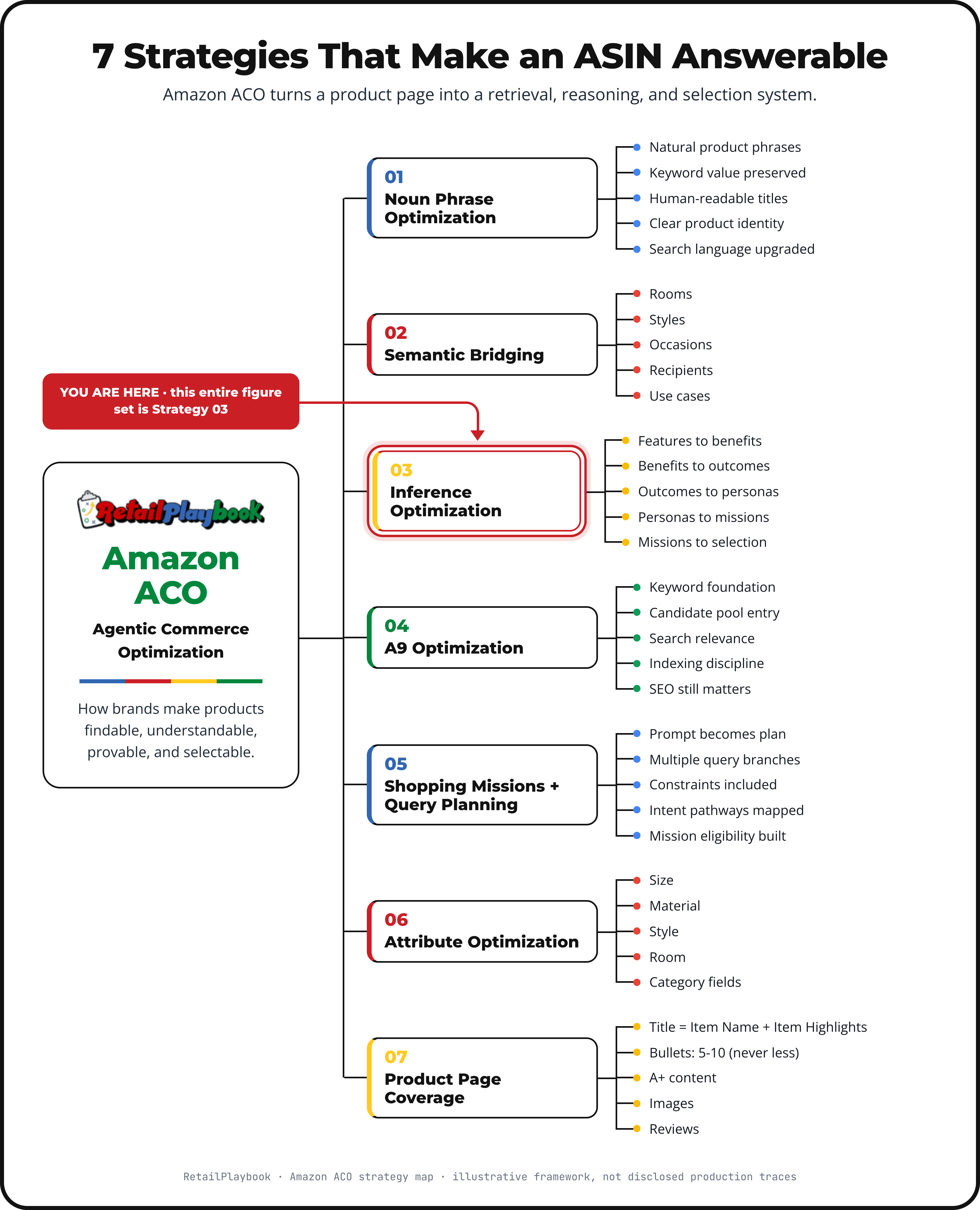
Previously, the product might have been optimized around a phrase such as “large modern metal wall art for living room.” NPO protects the product identity inside that phrase. Metal wall art remains the head concept, while size, style, material, and room make the concept progressively more specific. Semantic Bridging then moves outside the phrase and asks what legitimate customer meanings surround it: a blank wall above a couch, a large living-room accent wall, a housewarming occasion, a modern-industrial interior, or a shopper trying to make a room feel finished.
Most recently, that work created another question. Once Amazon understands what the product is and what it may be related to, how does Alexa for Shopping determine whether the relationship actually applies? A console table can be relevant to an entryway without fitting every entryway. Relevance to daily smoothies does not mean a blender satisfies every daily smoothie routine. Being relevant above a sofa gets a wall sculpture nowhere if the dimensions, orientation, style, weight, mounting requirements, or visual scale are wrong for that particular room.
The difference between possible relevance and actual fit is exactly where inference begins. Semantic Bridging establishes that a product-to-need relationship deserves consideration. Inference evaluates what follows when that relationship meets product facts, PDP evidence, shopper context, and real constraints. The bridge can remain true even when the conclusion is no. Console tables remain relevant to entryways in general, but a 46-inch-wide table does not fit a shopper’s 38-inch wall. The semantic relationship survives. The specific inference changes.
Consider the practical consequence for brands. Alexa for Shopping appears to reach conclusions about fit whether or not the listing was deliberately prepared for that reasoning. Product facts, listing language, attributes, images, reviews, questions, answers, shopper context, preferences, and constraints can all combine into a judgment about whether the product suits the request. Your choice as an operator is not whether inference happens. The choice is whether she has to reason through ambiguity, missing facts, weak relationships, unsupported claims, and contradictions, or through an evidence path you deliberately prepared.
That is the optimization opportunity.
TL;DR
Inference is the process of moving from known facts, observed evidence, meaningful relationships, and available context to a conclusion that is not necessarily stated directly. In ecommerce, inference allows Alexa for Shopping to move from what a product is, to what it does, to why that matters, to where that matters, and finally to whether it fits a particular shopper’s mission. Alexa moves forward from evidence toward a conclusion. The operator should work backward from the desired conclusion toward the facts and proof required to earn it.
Stated formally,
Inference Optimization is the discipline of identifying the commercially important conclusions Alexa for Shopping may need to reach about a product, then reverse-engineering and strengthening the factual, functional, contextual, evidentiary, and cross-surface pathways that make those conclusions defensible and appropriately confident.
On the PDP, that means engineering product truth and supporting evidence so Alexa can move from what the product demonstrably is to what it does, why that matters, where it matters, what outcome it may support, and which shopper mission it may satisfy without crossing an unsupported reasoning gap.
The pathway looks like this: Product Fact → Functional Consequence → Customer Benefit → Context → Desired Outcome → Mission-Fit Conclusion. Evidence and boundary conditions surround every meaningful step. The goal is not to write “perfect for small apartments” five times. The goal is to establish the dimensions, footprint, storage requirements, capacity, operation, cleanup, limitations, and contextual proof required for small-space relevance to become a reasonable conclusion.
Traditional copy declares the endpoint. Inference Optimization builds the route that earns it.
Part I: What Inference Actually Is
Everything begins with premises and conclusions. Premises are the facts, observations, relationships, assumptions, or evidence available to the reasoner. A conclusion is what the reasoner determines from those premises. When a product page states that a console table is 9.8 inches deep, the measurement is a premise. When a shopper says the entryway is narrow and they want furniture that does not project far into the walkway, that statement becomes another premise. The conclusion may be that the shallow depth makes the table relevant to the shopper’s space.
Suppose the listing only says “9.8 inches deep.” The number does not explain itself. Something must connect depth to wall projection, wall projection to passage space, and passage space to the shopper’s entryway problem. Retrieval can find the number. Inference determines what the number means.
Notice how quickly the certainty changes as the pathway grows. “The removable components are dishwasher safe” can be a documented fact. Take one step out and you get an inference from that fact: the shopper may need to perform less manual washing. Another step reaches convenience for frequent use. A fourth step arrives at a person who makes smoothies every morning and strongly values easier cleanup, which adds a routine, a preference, and a mission on top of the original premise. Every added step increases the reasoning distance and the amount of evidence needed to support the conclusion responsibly.
Unlike a simple factual lookup, most ecommerce fit decisions are conditional. A 9.8-inch-deep table may appear appropriate for a narrow hallway until the shopper reveals that the wall is too short, the door swings into the placement area, the shelf blocks a vent, or the anchoring requirement cannot be satisfied. New information can defeat an otherwise reasonable conclusion. That is why shopping inference is often defeasible rather than absolute: the evidence supports a conclusion until another fact changes it.
Much of bad listing copy ignores this conditional nature. “Perfect for every apartment,” “ideal for all families,” and “works in any entryway” sound confident, but confidence is not the same as support. Strong optimization makes the premises, consequences, context, and limits visible. It gives Alexa enough information to say yes when the fit is justified, no when the product fails a hard constraint, and “it depends” when decisive shopper information remains unknown.
Part II: Why Inference Matters to Ecommerce
Shopping missions arrive incomplete. Someone may ask for “a lamp for reading beside my chair,” but that request leaves the available floor space, chair height, desired brightness, dimming preference, bulb temperature, outlet location, style, and budget unstated. Traditional search can retrieve products associated with “reading lamp.” Alexa for Shopping has to interpret the mission, determine which unstated conditions matter, compare candidate facts, apply constraints, and eventually decide which product appears to fit best.
Customers also approach the same product from different directions. One shopper names a category. Another describes a problem. A third describes a room, recipient, occasion, routine, or desired outcome. “Blender” names an object. “What blender will not wake my family when I make smoothies before work?” names an object, a noise constraint, an early-morning routine, a smoothie task, a shared-household context, and likely expectations around cleanup and storage. The exact sentence may never appear on a PDP, yet Alexa still has to determine which products legitimately qualify.
Product pages face the opposite limitation. No catalog can include a dedicated field for every imaginable shopper situation. There is no practical attribute for “good for one person who makes a smoothie every morning, lives in a small apartment, hates difficult cleanup, and does not want to wake a roommate.” Instead, the listing contains smaller pieces of truth: dimensions, capacity, blade configuration, cleaning instructions, storage requirements, documented noise-reduction features, images, reviews, and Q&A. Inference recombines those pieces into a contextually useful answer.
Three inference problems therefore appear to run at once. Shopper-side inference asks what the customer means. Product-side inference asks what the product facts imply. Mission-fit inference asks whether the interpreted product satisfies the interpreted need better than the alternatives. That final judgment cannot be produced by keyword matching alone. It depends on facts, relationships, evidence, context, constraints, and comparative fit.[3]
RetailPlaybook treats this as the reasoning layer of Amazon ACO. The framework does not claim to reproduce Alexa for Shopping’s internal production architecture. It organizes the listing responsibilities brands can actually control. A9 Optimization handles the query-to-ASIN relationship. Query Planning Optimization (QPO) handles the mission-to-query family. NPO handles product reality to product language. Attribute Completeness handles product to structured facts. Semantic Bridging handles product facts to customer needs. Product Page Coverage handles shopper questions to PDP evidence. Inference Optimization handles evidence and context to conclusions.
Under that model, the same piece of information can serve every discipline without collapsing them into one. A 9.8-inch table depth can support “narrow console table” retrieval language, a mission branch around small entryways, an accurate noun phrase, a structured depth field, a semantic connection to constrained passage space, a PDP answer about physical fit, and an inference about whether the table works in a particular hallway. The content overlaps. The optimization job does not.
Part III: The Boundaries Between the Disciplines
NPO asks how the product should be expressed. “Narrow black console table with storage shelf” is a coherent product concept, organizing product identity and modifiers into language shoppers and systems can understand. The discipline stays centered on the product concept even when the phrase includes a room, audience, use case, or constraint. Its optimization object remains the phrase.
Why that product concept could matter somewhere else is a different question, and it belongs to Semantic Bridging. “Narrow console table” may connect to constrained entryways. “Storage shelf” may connect to key organization or decorative display. “Black finish” may connect to certain modern interiors. The bridge expands from intrinsic product meaning into an external customer situation, and its optimization object is the relationship.
Attributes ask what is explicitly true. Depth equals 9.8 inches. Width equals 40 inches. Shelf count equals two. Assembly required equals yes. Those are premises, not conclusions, and they should never be buried inside marketing language when you can populate them directly.
Coverage takes the decision-relevant question instead. “Will this fit my hallway?” may require depth, width, door clearance, shelf access, anchoring requirements, scale imagery, and the shopper’s actual dimensions. A complete attribute record does not automatically create a complete answer, which is why Product Page Coverage audits whether the full PDP holds enough consistent evidence to resolve the question.
Where does the mission send Amazon searching? That is QPO’s problem. A shopper’s “table for my narrow apartment entryway” mission could lead to “narrow console table,” “slim entryway table,” “small hallway table,” “shallow console table,” or “apartment entryway furniture.” Inference runs the opposite direction, taking the retrieved product evidence and recomposing it into a conclusion about the original mission.
Getting these boundaries right matters because the strategies solve different listing failures. Weak NPO creates representation failure. Missing attributes create grounding failure. Absent semantic bridges create relevance failure. Thin Product Page Coverage creates answer failure. Unsupported inference creates reasoning failure. A product can be excellent in one discipline and weak in another.
Part IV: Getting There First
Begin with the conclusion Alexa may need to evaluate, not with the empty content field in Seller Central. Suppose the target conclusion is “potentially suitable for a narrow entryway.” Working backward exposes the requirements. The table must occupy relatively little passage depth. That consequence requires a verified depth. The available width, door movement, shelf access, baseboards, anchoring, and actual hallway dimensions can still defeat the fit. Each condition needs an appropriate home somewhere on the product page.
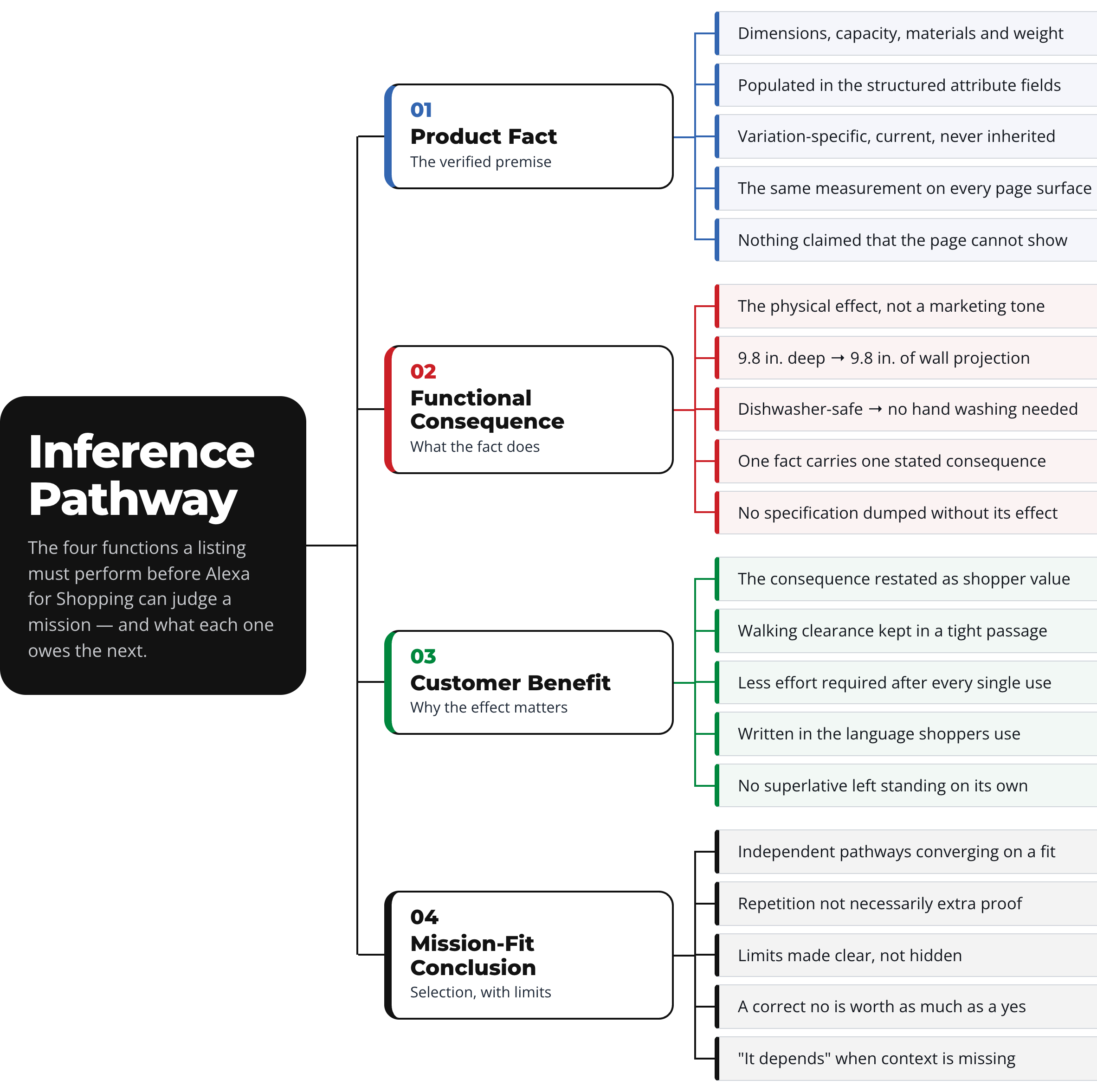
Working backward changes your direction of travel. Alexa moves from Product Facts → Functions → Benefits → Contexts → Outcomes → Fit. You move from Desired Fit → Required Conclusion → Required Context → Required Benefit → Required Function → Required Facts → Required Evidence → Required PDP Surfaces. That reversal is the practical heart of Inference Optimization, and it is the part I most often see brands skip, because the content fields in Seller Central are laid out in the opposite order.
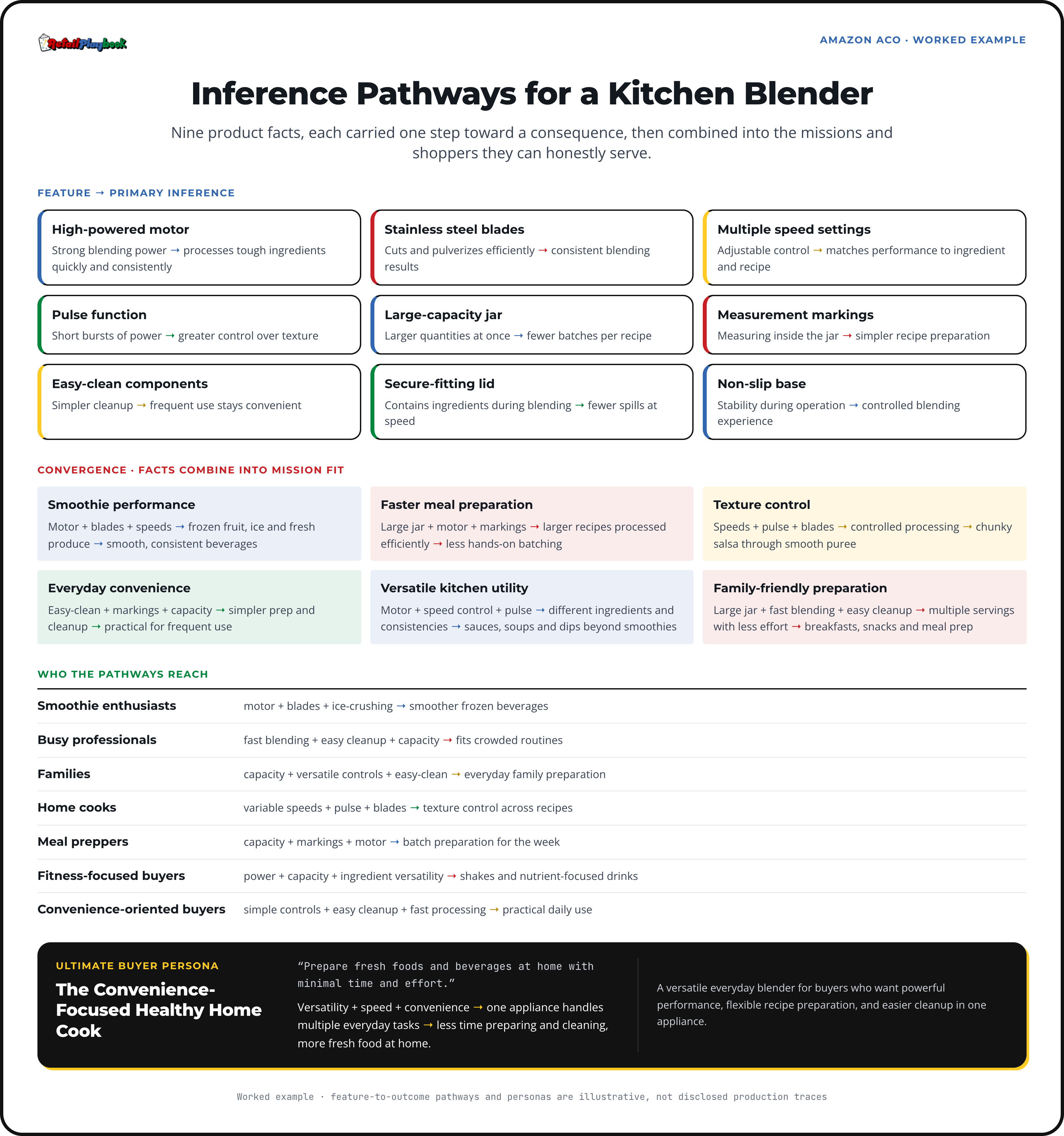
Take a blender mission: “quiet blender for daily smoothies in a small apartment.” Space fit may require compact dimensions and manageable storage. Task fit may require documented smoothie capability. Routine fit may require practical cleaning. Household fit may require credible noise evidence. Price and capacity may operate as hard constraints. No single bullet resolves the mission. Several distinct pathways have to converge.
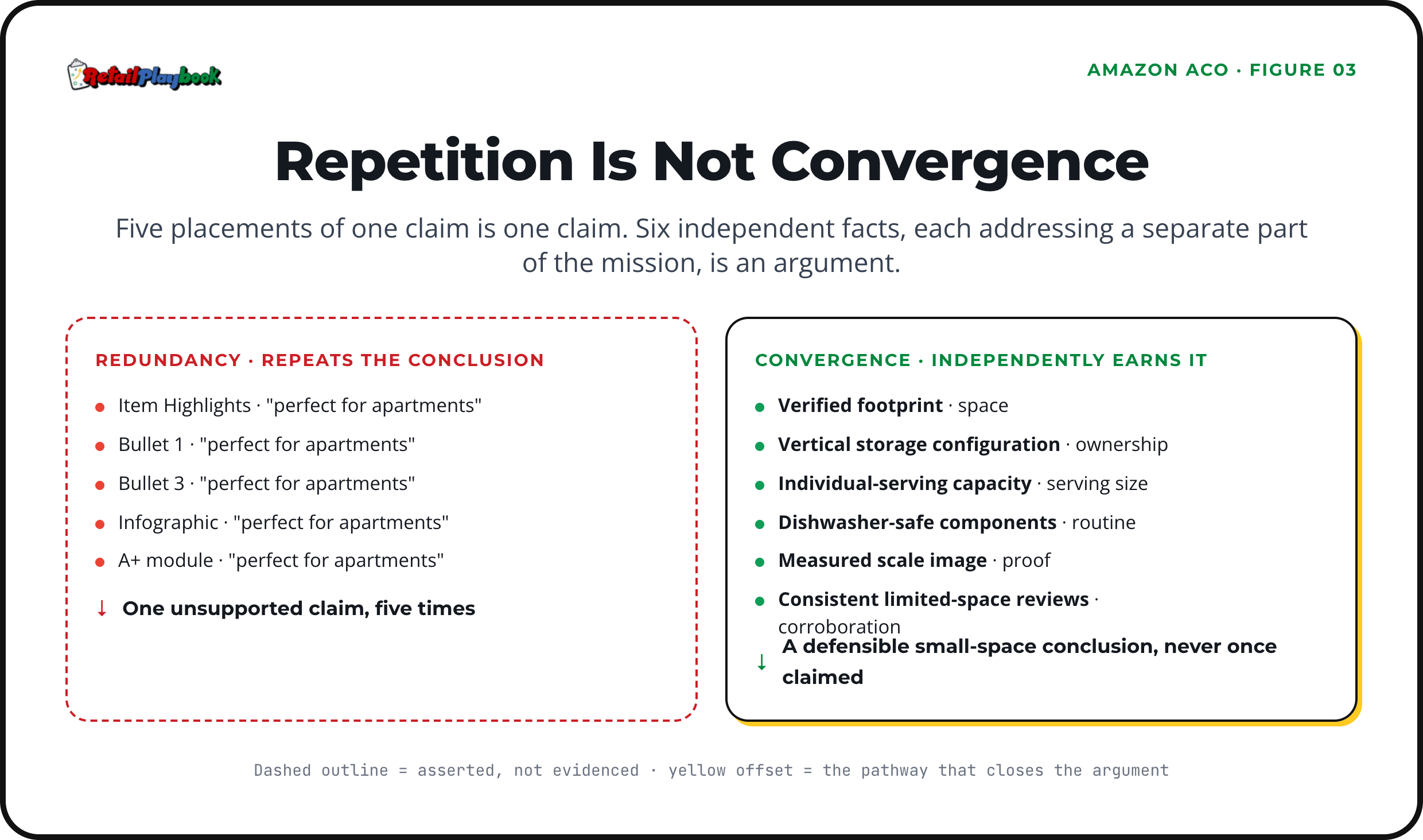
Now compare two listings. Product A says “perfect for apartments” but hides the dimensions, provides no storage information, avoids the noise question, and collects reviews saying it takes up more space than expected. The second listing never uses the phrase at all, and instead provides exact dimensions, a vertical storage configuration, individual capacity, dishwasher-safe components, a measured scale image, and consistent real-world feedback about limited-space use. That listing gives Alexa the stronger evidence environment, and it never once claims to.
Another way to frame the strategy is uncertainty reduction. A poor listing leaves Alexa with “maybe.” A strong listing increasingly supports “yes, because X, Y, and Z,” “no, because this constraint fails,” or “I need the shopper’s available width before I can determine fit.” Calibrated uncertainty is more useful than confident vagueness.
Part V: The Inference Pathway
Trace the console table in full. The product fact is a 9.8-inch depth. Functionally, the table projects 9.8 inches from the wall, which consumes less passage depth than a substantially deeper table. That difference matters in an entryway or hallway where walking clearance is limited, because the shopper’s outcome is a surface and some storage without crowding the passage. The mission-fit conclusion follows: the table may be a strong candidate for certain narrow-entryway missions, subject to available width, shelf access, anchoring, door movement, and the shopper’s real measurements.
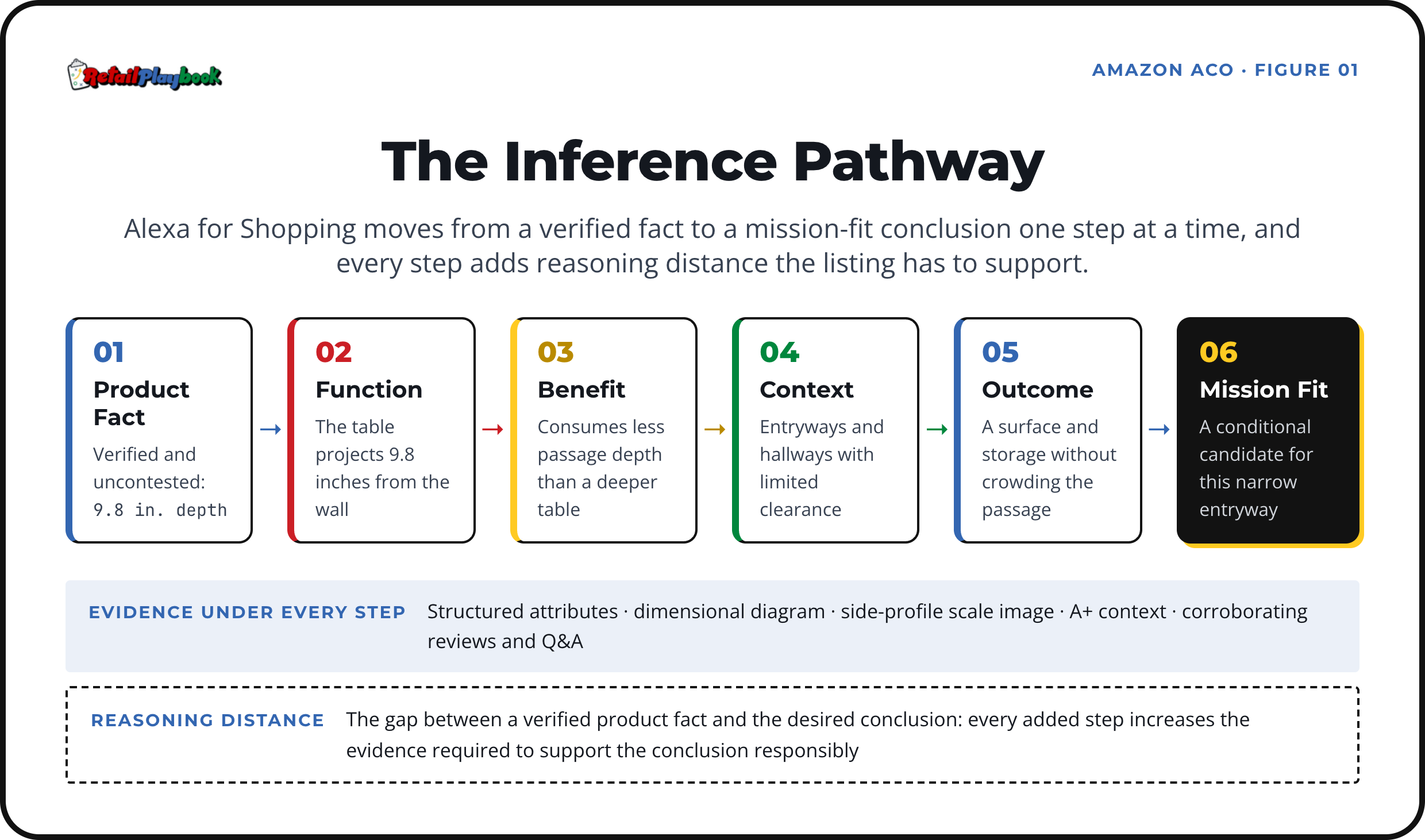
The chart below is a simplified overview of the inference pathway. In practice, each step can contain additional evidence, context, constraints, and boundary conditions.
Follow the blender through the same six stages. Specified removable components are dishwasher safe, so those parts can be cleaned in a dishwasher under the documented conditions, which means less manual washing may be required. Cleanup effort matters more when the blender is used every morning, and the outcome the shopper wants is a frequent smoothie routine with less post-use effort. The conclusion is conditional: the blender may be a stronger candidate for repeated use, provided its capacity, storage, noise, and actual blending performance also satisfy the mission.
Wall art provides a third pathway. A 48-inch horizontal width means the piece occupies a broad horizontal span and can provide greater visual coverage than a substantially narrower piece. Visual coverage matters above large furniture or on a broad blank wall, where the outcome is a wall that feels intentionally filled rather than under-scaled. Whether the piece belongs above a particular sofa still depends on the available wall, preferred proportion, mounting requirements, weight, and aesthetic fit.
I call the gap between the verified fact and the desired conclusion the Inference Distance, and it is an operator construct rather than a disclosed Amazon metric. A direct inference stays close to fact: dishwasher-safe means the documented part can go in the dishwasher under stated conditions. A functional inference moves farther, reaching reduced manual washing. Add a routine and you get a contextual inference, where reduced washing matters to someone using the product every day. Combine several pathways at once, and you arrive at mission fit, where compact dimensions, task performance, capacity, cleaning, price, storage, and shopper context together support daily small-apartment use.
Evidence burden should rise with that distance. One authoritative fact may support a direct conclusion. A distant mission-fit conclusion should require several independent pathways. The farther the desired conclusion sits from verified product truth, the less you should rely on assertion and the more you should rely on convergence.
Repetition is not convergence. Writing “perfect for apartments” in Item Highlights, three bullets, an infographic, and A+ content creates one claim repeated five times. Verified dimensions, storage design, individual capacity, cleaning characteristics, scale imagery, and repeated customer observations are different, because each addresses a separate part of the mission. Redundancy repeats the conclusion. Convergence independently earns it.
Boundaries belong inside the pathway, not outside the strategy. A generally relevant console table can still fail on width, door swing, shelf access, or anchoring. Capacity, unsupported ingredients, cabinet height, noise, or cleaning limitations can each disqualify a generally relevant blender. Wall width, weight, hardware, orientation, and indoor-only construction do the same work for a wall sculpture. Accurate qualification requires you to make the disqualifying facts as legible as the qualifying ones.
Contradictions deserve priority over expansion. When an attribute says 9.8 inches, an infographic says 11.2 inches, and a bullet says 10 inches, every downstream conclusion becomes less trustworthy because the premise itself is unstable. Adding more semantic language cannot repair conflicted product truth. Fix the record first.
Part VI: The Product Page Is the Inference Surface
Surface area changes the strategy substantially. Inference Optimization is not restricted to the title, or even to the search-indexed part of the listing. It extends across the 75-character Item Name, the 125-character Item Highlights field, the next 800 characters or so that appear to function as priority indexed copy in the current operating model, the remaining bullet space, ideally up to ten distinct bullets where the account and product justify them, structured attributes, specifications, variations, images, native A+ content, comparison modules, video, reviews, and Q&A.
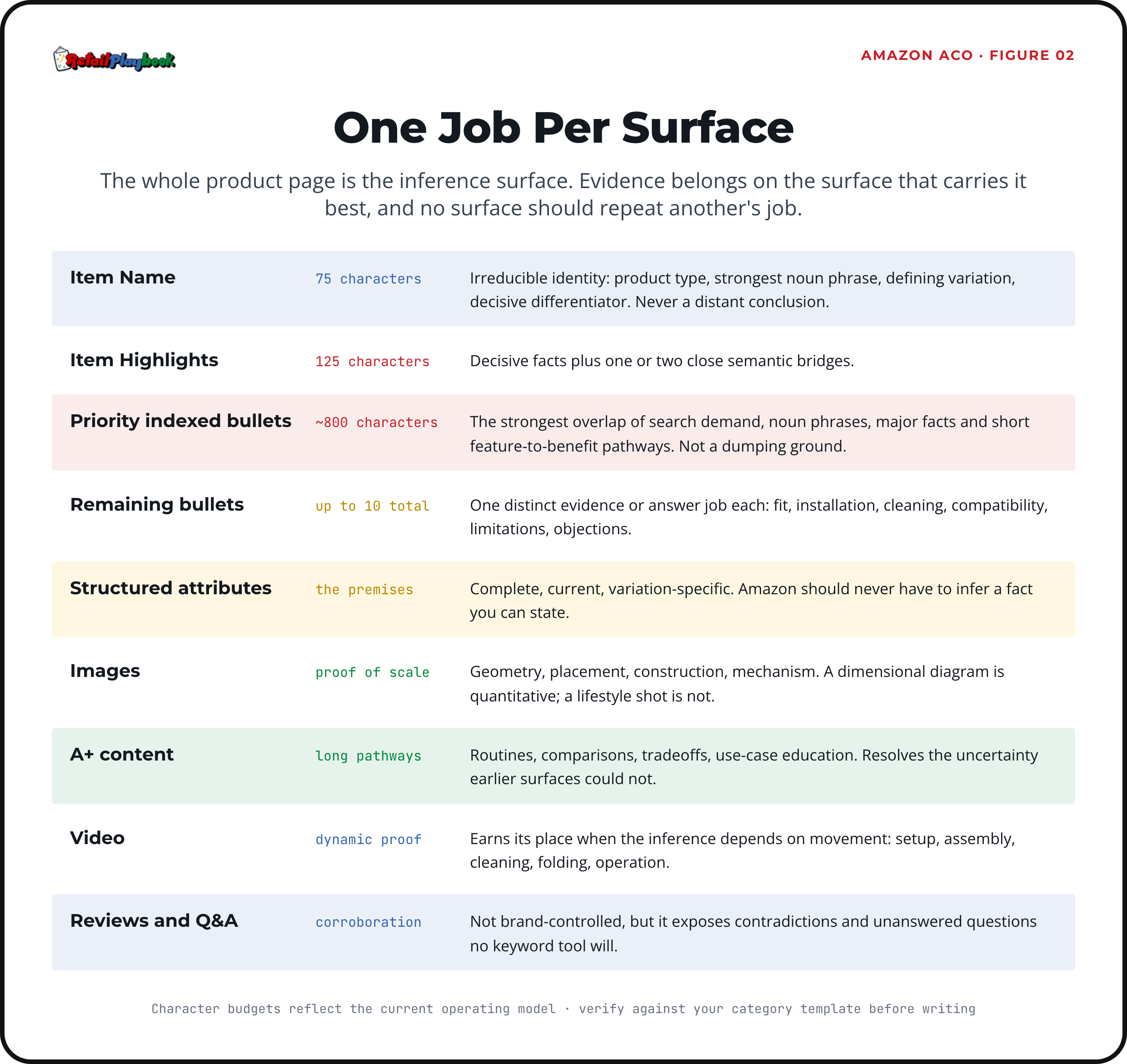
Within the 75-character Item Name, the priority remains irreducible identity: core product type, strongest noun phrase, defining variation, and decisive differentiators. “Narrow Black Console Table, 9.8-Inch Deep, Two Shelves” provides a better foundation than “Perfect Apartment Entryway Table That Saves Space and Organizes Everything.” The second version spends scarce identity space on distant conclusions before establishing the premise.
Extend that identity into decisive facts, high-value query-plan refinements, and one or two close semantic bridges in Item Highlights. “9.8-inch shallow depth, two open shelves, and slim wall profile for entryways, hallways, and behind-sofa placement” connects product truth to contextual relevance without asking the Item Name to carry the entire argument.
The priority indexed bullet copy that follows should carry the strongest overlap among search demand, noun phrases, major product facts, decisive differentiators, important constraints, and short feature-to-benefit pathways. Those characters are not a dumping ground for every possible use case. They are the most valuable language budget you have after the first 200.
The bullets below the indexed zone are not leftover copy either. Where ten useful positions exist, each one should perform a distinct evidence or answer job, drawn from dimensions, material, construction, fit, installation, cleaning, maintenance, compatibility, included components, variation differences, limitations, comparisons, use cases, and common objections. Ten bullets should never become ten repetitions of the same keyword family.
The rest of the page divides along the same principle, one job per surface:
Structured attributes establish the factual premises. Dimensions, materials, compatibility, capacity, quantity, finish, assembly, power requirements, included components, and category-specific fields should be complete, current, and variation-specific. Amazon should not have to infer a fact you can directly provide.
Images prove what prose struggles to prove: scale, geometry, placement, construction, included parts, mechanism, visual style, and physical relationships. A dimensional diagram can establish exact width, height, and depth, and a side-profile image can make wall projection visible. A lifestyle image demonstrates context, but it is not quantitative proof when the real measurement remains unclear.
A+ content carries longer pathways involving routines, comparisons, tradeoffs, style systems, product portfolios, and use-case education. It is a far better place for a distant contextual pathway than the Item Name. Good A+ does not restate the bullets in larger type; it resolves uncertainty the earlier surfaces could not.
Video earns its place when the inference depends on movement, setup, assembly, cleaning, folding, storage, noise behavior, or operation. A demonstration can show the actual cleaning sequence or assembly burden, though it does not substitute for controlled quantitative evidence when the claim requires measurement.
Reviews and Q&A reveal how the inference performs in the real world. Organic customer content can corroborate a pathway, expose contradictions, surface unexpected use cases and limitations, and show which questions the listing has failed to answer. You do not control that evidence, but you can learn more from it than from any keyword tool.
Part VII: Six Reasons Inference Optimization Is Necessary on the Listing
First, product facts need their implications made legible. A measurement, material, mechanism, or capacity can remain commercially meaningless when it sits alone. Inference Optimization turns “9.8 inches deep” into an understandable pathway involving wall projection, passage space, and constrained placement.
Second, general semantic relevance does not establish specific ASIN fit. Console tables can be relevant to entryways while this particular table remains too wide, too deep, difficult to anchor, or incompatible with the available space. The listing has to carry enough evidence to move from category-level possibility to ASIN-level qualification.
Third, compound missions require several facts to work together. A quiet blender for daily smoothies in a small apartment under $100 involves task performance, noise, routine, footprint, storage, cleanup, capacity, and price. No single feature or phrase resolves that request.
Fourth, the same fact means different things to different shoppers. A 20-ounce cup may be ideal for one person and inadequate for a household. A 48-inch artwork may appear substantial above one sofa and undersized above another. Clear facts let Alexa apply the evidence to the shopper’s context rather than treating every attribute as universally positive.
Fifth, important conclusions require convergence rather than repetition, and they require visible boundaries. Dimensions can address space, capacity can address serving size, performance evidence can address the task, cleaning can address the routine, and storage can address ownership. Width, compatibility, installation, exclusions, load limits, and power requirements do the opposite and equally necessary job, letting Alexa reach correct negative conclusions instead of forcing positive fit where the product does not qualify.
Sixth, Alexa needs a defensible explanation rather than a repeated claim. The strongest answer is not “this is good for apartments because the listing says it is.” The stronger answer is that compact dimensions, individual capacity, a vertical storage configuration, and manageable cleaning make the product relevant where space and repeated use matter. Inference Optimization gives Alexa a defensible because.
Part VIII: The Inference Gap
An Inference Gap appears whenever a commercially valuable conclusion may be legitimate but the pathway is incomplete, unsupported, contradictory, or too distant. Seven types show up repeatedly on real listings:
Factual gap: the premise is missing entirely.
Functional gap: the feature is present, but the listing never explains what it enables.
Benefit gap: the customer consequence is left unclear.
Context gap: the page never shows when the benefit matters.
Evidence gap: the relationship is asserted without proof.
Contradiction gap: different surfaces give different answers.
Distance gap: product truth is asked to support a conclusion too remote from the available evidence.
Three of these cost brands the most money, and they are worth examining closely.
Factual gaps are the easiest to diagnose and the most common. “Good for narrow spaces” without dimensions leaves Alexa with no stable starting point, and “compatible with most devices” without a complete compatibility record creates the identical problem in another category. Functional gaps hide behind specification dumping, where “1200 watts,” “three-layer construction,” “48 ounces,” and “aircraft-grade aluminum” sound impressive while leaving the shopper and the system to work out what the specification actually changes in use.
Proof gaps separate saying from showing, and they are the ones I watch most closely in a listing audit, because they survive every review that only checks whether a claim is present. “Quiet operation” requires a documented mechanism, a test condition, a comparison, or a credible demonstration. The desire for quietness does not prove the product is quiet, and a bullet that asserts it without support gives Alexa nothing to reason from.
The remaining four gaps follow the same logic at different points in the chain. Benefit gaps name a function without connecting it to customer value, so “removable blade assembly” never becomes the cleaning, maintenance, replacement, or storage consequence that actually matters. Context gaps make generic benefits sound interchangeable until the page explains why cleanup matters inside a frequent morning routine or a shared kitchen. One incorrect variation attribute or outdated image can open a contradiction gap wide enough to undermine a conclusion supported everywhere else. Excessive distance produces the most obvious marketing overreach of all, where “stainless steel” is asked to lead to “perfect for busy mothers” across too many unstated assumptions.
Part IX: The Inference Optimization Workflow
Ten steps, in order. The first three are planning, the middle four are construction, and the last three are governance.
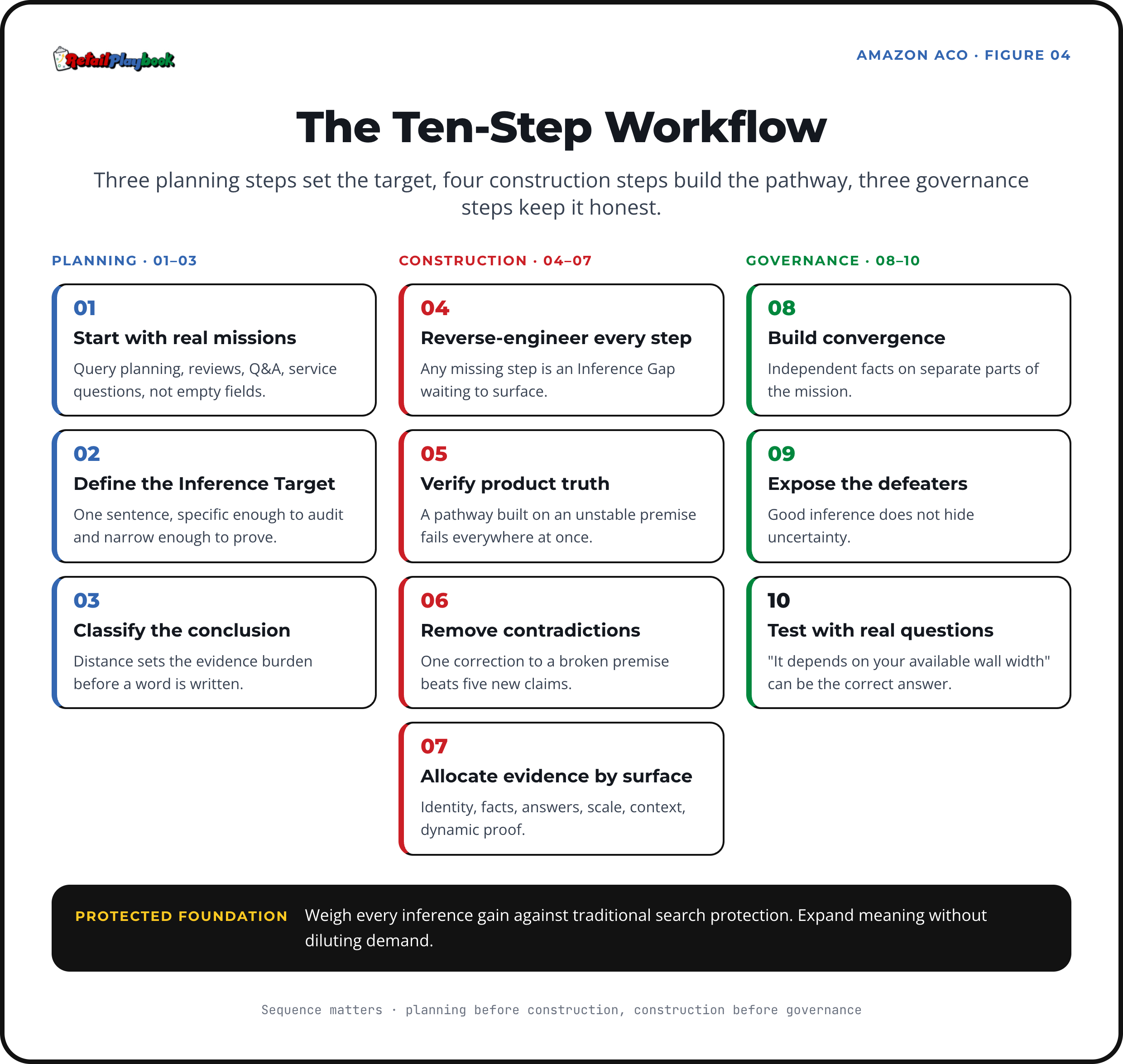
Start with the shopping missions the product is genuinely meant to satisfy. Use query planning, search behavior, reviews, Q&A, customer-service questions, comparison behavior, category knowledge, and observed Alexa prompts. Do not begin by filling empty space with generic benefits.
Define the Inference Target in one sentence. “Potentially suitable for a narrow entryway.” “Useful for frequent individual smoothie preparation.” “Easier to clean after repeated use.” A useful target is specific enough to audit and narrow enough to prove.
Classify the conclusion before building it. Direct facts, functions, benefits, contexts, audiences, subjective fit, compatibility, and compound mission fit all carry different evidence burdens. The farther the target sits from product truth, the more support it should require.
Reverse-engineer every important step, moving from desired conclusion to required context, from context to benefit, from benefit to function, and from function to the product facts. Any missing step is an Inference Gap waiting to surface.
Verify product truth before writing around it. Confirm dimensions, materials, included components, compatibility, capacity, cleaning requirements, assembly, limitations, and variation differences. The fastest way to destroy a pathway is to build it on an unstable premise.
Remove contradictions before expanding meaning. Audit attributes, Item Name, Item Highlights, bullets, specifications, images, A+, variations, packaging, and manuals. One correction to a broken premise often creates more value than five new claims.
Allocate evidence to the surface that carries it best, following the division in Part VI: identity in the Item Name, decisive facts and close relevance in Item Highlights, search-and-meaning overlap in the priority bullets, answers and limitations below, structured truth in attributes, scale in images, longer context in A+, dynamic proof in video, and corroboration in customer content.
Build convergence around the conclusions with the greatest commercial importance. Seek independent facts addressing separate parts of the mission, and never count repeated wording as additional evidence.
Expose the conditions that can defeat the conclusion. Ask what additional shopper information would change the answer, and state the limitations that matter. Good inference does not hide uncertainty.
Test the completed pathway with realistic shopper questions. Ask whether Alexa can provide the correct facts, explain why those facts matter, identify missing shopper context, state limitations, and avoid overstating certainty. “It depends on your available wall width and door clearance” can be a better answer than an unsupported yes.
Part X: Measurement and Search Protection
Measurement should begin with a fixed prompt portfolio rather than one favorable answer. Test direct fact questions, functional questions, use-case questions, compatibility questions, comparison questions, objections, and compound missions. Repeat the observations, because personalization, price, inventory, reviews, advertising, wording, seasonality, and Amazon experimentation can all change the result between one test and the next.
Track more than appearance. Evaluate factual accuracy, pathway completeness, cross-surface consistency, constraint awareness, explanation quality, comparative fit, and the number of commercially important conclusions the page can responsibly support.
Weigh inference expansion against traditional search protection every time. A listing change that improves conversational explanation while weakening proven query visibility, click-through rate, conversion, or sales is not a clean win. The earlier Semantic Bridging framework established the same governing principle: expand meaning without diluting demand.
Protect the search foundation throughout the work. Good ACO is great SEO, but great SEO alone is not enough for ACO. Inference Optimization should increase what Amazon can responsibly conclude without erasing the language that gets the product retrieved in the first place.
Final Thoughts
Inference is the operation that turns product information into product meaning inside a shopping situation. NPO gives Amazon the product concept. Attributes give Amazon structured truth. Semantic Bridging gives Amazon legitimate relationships. Product Page Coverage gives Amazon answers and evidence. Inference Optimization makes those pieces usable as a defensible conclusion.
Your responsibility is not to make Alexa repeat the claim you prefer. The responsibility is to prepare the strongest factual and evidentiary route to the conclusion your product can honestly earn. Ask what she would need to believe in order to recommend the ASIN, then ask what she would need to see in order to reasonably believe it. Work backward from there.
Some of this framework is inferred from Amazon’s public AI-shopping materials, Amazon Science research, patents, observable marketplace behavior, and field testing, not from a disclosed production ranking document. RetailPlaybook’s contribution is the operator discipline: do not optimize only what the listing says. Optimize what the listing allows Alexa for Shopping to conclude.
Which raises the question I cannot yet answer, and the one I expect to spend the next issue on. You can prepare the pathway, but you cannot watch Alexa reason across it. There is no report showing which conclusions she reached, which she declined, or which premise stopped her. Every discipline in this playbook so far has assumed the operator can observe the result of the work. Inference is the first layer where that assumption breaks, and until we build a measurement loop that survives the opacity, the pathway remains an argument we make into the dark.