


TL;DR
For nearly 30 years, Amazon trained shoppers to compress messy human needs into short, machine-friendly searches. A recent conversation between Doug Herrington and Rajiv Mehta reveals a different model: shoppers can say more of what they actually mean while Alexa for Shopping handles more query planning, retrieval, refinement, comparison, verification, personalization, and selection behind Amazon’s familiar search box. Mehta describes shoppers “opening aperture,” Amazon coordinating multiple internal and external models plus specialized agents, and Alexa learning preferences across conversations and shopping behavior. Herrington places those capabilities inside a much larger ambition: helping each customer navigate enormous selection through an expert-salesperson experience, eventually reaching household replenishment where purchases can happen with far less manual involvement. Search remains foundational underneath every interaction, while human responsibility moves toward expressing a need and Amazon responsibility expands toward understanding, investigating, evaluating, and resolving that need.
Amazon wants shoppers to say whatever comes to mind. Mehta’s “open aperture” describes freedom from decades of compressing shopping needs into Amazon-friendly keywords.
Alexa performs more search work for each shopper. One request can generate multiple search paths, apply constraints, retrieve candidates, compare options, verify facts, and guide further refinement.
One conversation can coordinate many forms of commerce intelligence. Mehta describes external models, internal models, conventional search, plus specialized agents such as a dedicated price-history capability.
Personalization can reshape discovery before final ranking. Remembered preferences, inferred interests, prior behavior, and conversation history can influence searches Alexa runs plus products entering consideration.
Herrington frames conversational shopping as a scaling technology for enormous selection. Expert-salesperson logic gives Amazon a way to help shoppers navigate hundreds of millions of products, with autonomous household replenishment representing a later expression of much deeper search, reasoning, verification, and selection capabilities.
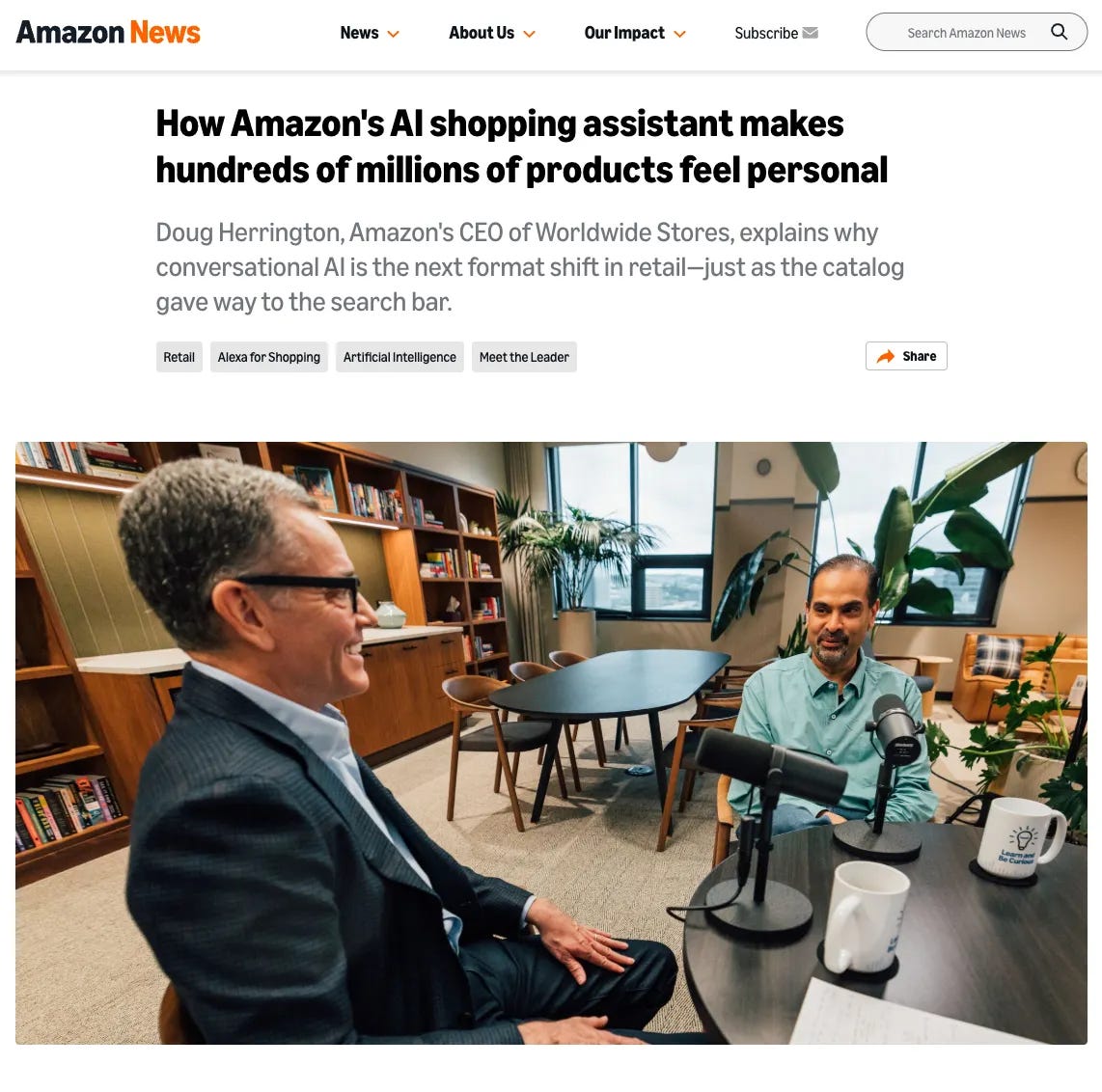
.For the longest time, Amazon trained everyone to speak the language of the machine. Now, the machine can receive the language of the customer and interpret those words within the context of each person’s shopping mission
I remember walking into my grandparents’ house sometime in 2021 and, completely out of nowhere, pointing at the refrigerator and telling my grandfather one day Amazon would know the filter was broken and reorder it for him…. same with that dryer too. He laughed, thought the idea sounded neat, and the conversation basically ended there. At the time, the possibility felt futuristic enough to be interesting but still distant, and neither of us spent much more time thinking about it.
Five years later, we are not actually very far away. During a recent conversation between Doug Herrington and Rajiv Mehta, Amazon’s Vice President of Conversational Shopping, Herrington described a future closely mirroring the one I had casually imagined: 1
“We’re going to look back five years from now and let’s say the house is kind of reordering its regular supplies for itself and we’re going to think that’s totally normal.”
The moment I heard him say it, I immediately thought about the refrigerator filter and the random conversation with my grandfather.
Many of the pieces required to imagine such a future already exist. The obstacle is scale, and at Amazon, scale is gospel. Recognizing one refrigerator needs a replacement filter is one problem. Reliably identifying the appliance, verifying compatibility, distinguishing OEM from aftermarket choices, checking previous purchases, evaluating pack size, price, availability, and delivery timing, then repeating the process across millions of households and hundreds of millions of products is a far larger undertaking.
Agentic commerce often gets discussed through a futuristic demo rather than the infrastructure required to make the outcome dependable at Amazon scale. Herrington acknowledges the uncertainty himself, describing the scenario as science fiction today and admitting he does not know precisely how the future will unfold. Amazon is not announcing autonomous refrigerator-filter purchases tomorrow morning, but one of the most senior executives in Amazon Stores is openly describing household replenishment as a future state capable of eventually feeling ordinary.
Brands do not have to wait for a refrigerator to order its own filter before recognizing the larger movement. The extraordinary opportunity already sitting directly in front of us is the Amazon search bar, the place where Amazon can reshape a behavior shoppers have spent decades learning without requiring them to adopt an unfamiliar starting point. The path from traditional ecommerce search toward agentic commerce therefore begins inside an interface customers already use instinctively.
Amazon Taught Shoppers to Speak Machine
For nearly 30 years, Amazon trained shoppers to grow remarkably skilled at translating human needs into search-engine language. We learned to compress a messy shopping mission into a handful of product nouns, attributes, sizes, materials, brands, rooms, use cases, and price modifiers. Compressed language offered the most efficient route through an ever-expanding catalog. The shopper controlled the search bar, and much of the work happened on our side of the interface: decide which details deserved priority, invent the query, scan the results, notice what was missing, reformulate, search again, compare, and eventually make the decision.
Rajiv Mehta described the result perfectly:2
“know what to type and they know what not to type.”
The second half reveals the deeper behavioral change. Amazon Search became so effective, and shoppers grew so practiced at using it, that we learned to withhold much of the actual shopping mission and provide only the compressed pieces we believed the machine needed.3
The Search Bar Begins to Search for Us
Alexa for Shopping begins to reverse the division of labor by taking over more of the search work behind the bar. The shopper can provide the complete need, and the company can decide what should be searched, which constraints deserve priority, how the request should be reformulated, which products belong in consideration, what product facts need verification, and which options best fit the buying situation. Amazon is not abandoning the search science, SEO, retrieval, ranking, attributes, behavioral signals, or relevance models developed over decades. Search still happens, but more of the work moves behind the interface as AI operates proven commerce capabilities on the shopper’s behalf. The massive movement underway is not the replacement of search with conversation. Amazon is turning the search bar from a place where people manually operate search into a place where they can state what they mean and let AI perform more of the searching for them. Mehta described the behavioral change with a compact phrase:
“open the aperture.”
The familiar box thereby becomes the front door to something much larger than a traditional results page.
The old division of labor asked the person to formulate the searchable instruction and Amazon to rank the products returned. The emerging division allows the same person to state more of the real-world need and asks Amazon to formulate more of the search work required to resolve it. Control does not mean Alexa ignores the buyer or purchases whatever it wants. It means AI increasingly operates the query, retrieval, comparison, and reasoning machinery people previously operated through repeated manual searches.
Shoppers shortened complicated needs into keywords, inspected what came back, changed the phrase, added a size, material, room, brand, style, price, or use case, and searched again until the results looked closer to the original intent. We became exceptionally fluent in searchable product language. Fluency was required to navigate the store effectively. Amazon’s interface rewarded people who knew how to strip away context and preserve only the modifiers most likely to alter the product grid.
Consider a person who needs something for the large empty wall behind the couch, has a modern room, knows their spouse dislikes anything too busy, thinks black will work better than gold, and does not want to spend more than $150. The complete thought represents the buying objective in the shopper’s head, yet historically most people would not type the entire need into Amazon. They might begin with “large modern wall art,” refine it to “large black metal wall art,” move to “large metal wall art living room,” and eventually reach “modern metal wall decor under $150.” The underlying goal remains stable even as the person keeps changing the search language.
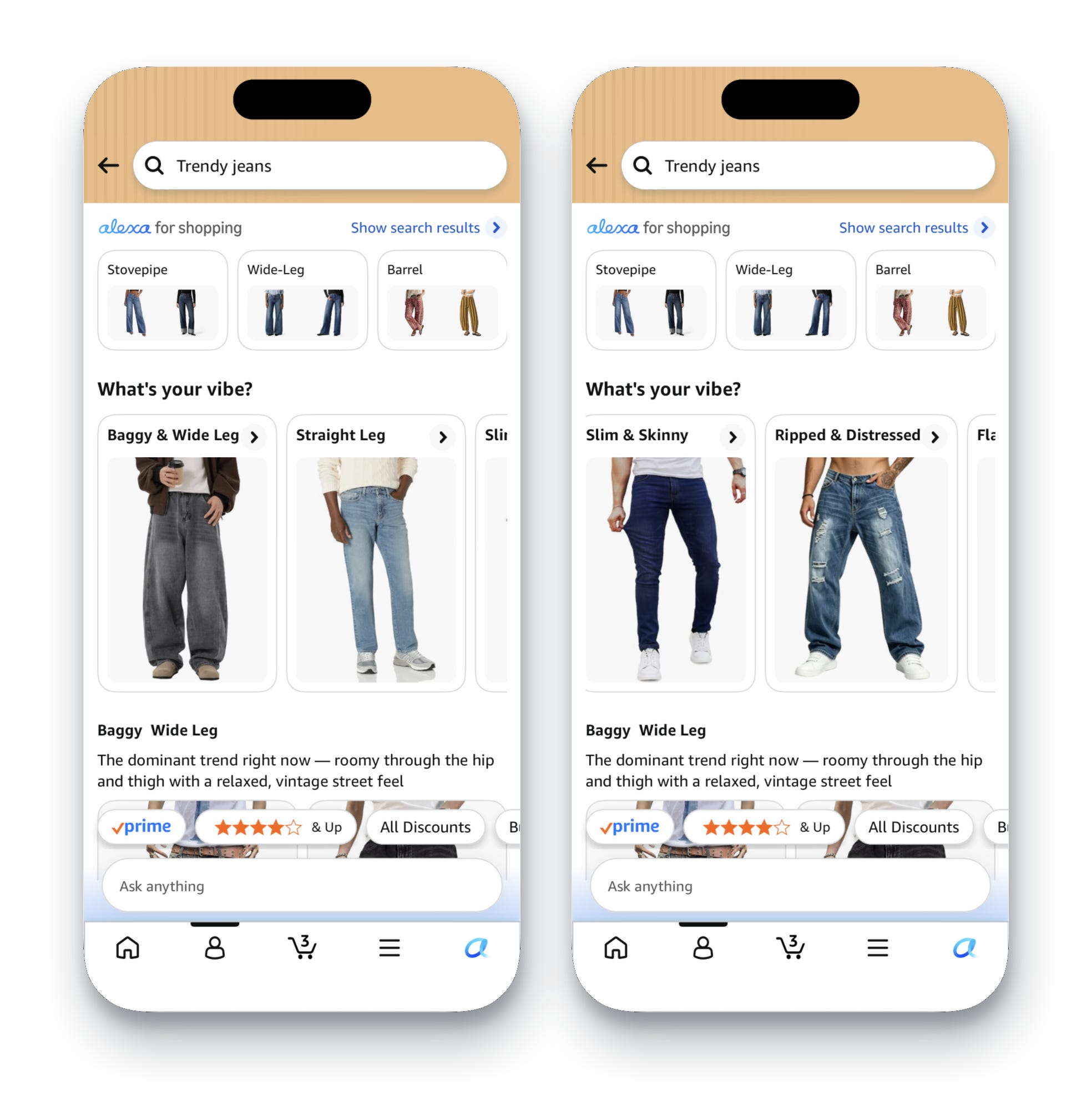
Figure 1: A vague request for “trendy jeans” becomes structured silhouette routes, shopper-vibe choices, and an explanation of the dominant trend, evidence that relevance is being interpreted beyond literal keywords.
Mehta describes the future behavior directly:
“Anytime they see a box that they can type something into, they’ll just type whatever is on their mind.”
Paired with his comment about opening the aperture, the statement signals a new behavioral contract between the shopper and Amazon’s most familiar interface. People will not need to suppress the context surrounding the purchase merely to make the request legible to a product-search engine.
Mehta’s phrase is easy to nod along with and easy to underestimate, so let me show what an opened aperture actually looks like. Three screenshots, three claims from this conversation, and, for readers who have followed this series, three arguments I have made before, now running live inside the box people have used for twenty years.
The first is the reversal itself. Nobody compressed anything. The shopper stated a need the way she would state it to a person, and the machine performed the translation that thirty years of Amazon search trained us to perform ourselves. The habit I described in “Amazon Taught Us What Not to Type” is running backward on screen.

Figure 2: A plain-language question about metal wall art becomes a generated digital shelf: Alexa defines the category, searches across distinct aesthetic routes, surfaces purchasable products, and recommends the next refinements without sending the shopper back to a traditional results grid.
The second is the search work becoming visible. Look at what “handcrafted” has to be in that answer. It is not a keyword. It is a claim Amazon had to locate in the catalog, believe, and be willing to repeat out loud next to its own name. That is Semantic Bridging doing its job: a verifiable product fact connected to the situation that needs it.
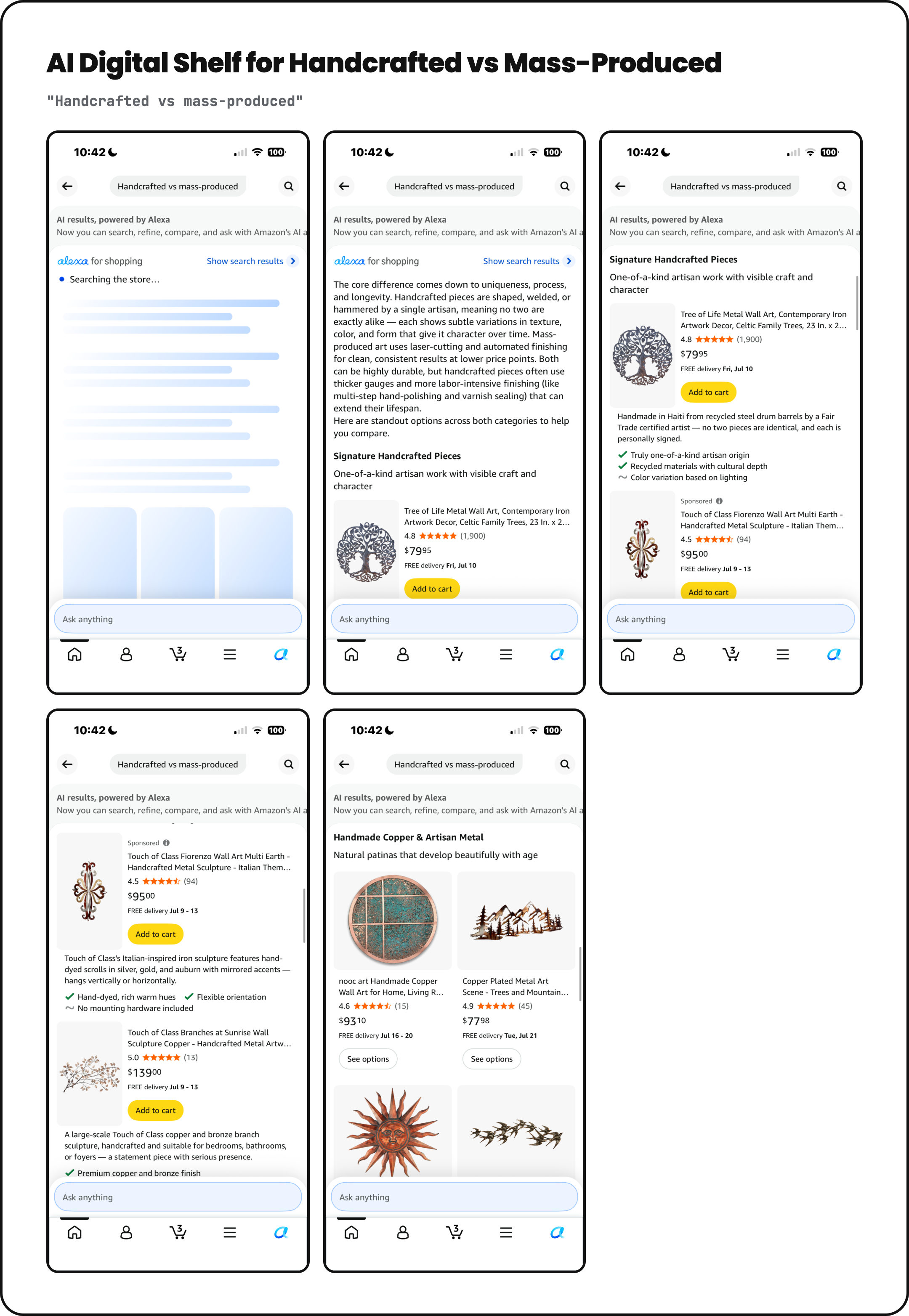
Figure 3: The “handcrafted vs mass-produced” request shows the search work becoming visible: Alexa moves from “Searching the store” to a category explanation, a qualified handcrafted recommendation, sponsored and organic alternatives, and a deeper artisan-material route.
The third is the one that should make every brand team sit forward. A generic bedroom-art request expands through interests the shopper never typed, remembered or inferred from the account. Mehta explains the mechanism later in the conversation, and I will return to it, but notice what it means for the candidate set: it was reshaped before ranking ever began. Two people typing identical words are no longer running identical searches.

Figure 4: A generic bedroom-art request expands through remembered or inferred interests (Taylor Swift, Star Wars, abstract art, and metal wall art), showing how account-level context can reshape the candidate set before final ranking.
One request opened wide, one claim verified out loud, one candidate pool reshaped by memory. That is the new division of labor in three frames. The rest of this piece is the two men responsible for it explaining how it works.
Under the emerging contract, people no longer have to determine every query manually in every journey. The company assumes more responsibility for deciding which parts of a need deserve their own search path, which requirements should narrow the candidate pool, which facts require confirmation, and which products merit further evaluation. The visible interaction may consist of one human request even when far more search activity, routing, comparison, and reasoning occurs underneath.
Here is that sentence as a screenshot. One broad console-table request, decomposed into form, material, storage, style, and price-oriented routes: five search paths, none of them typed, with sponsored and organic candidates coexisting inside each. It is also the beginning of a shopping mission we will follow for the rest of this piece, because what Alexa does with this furniture hunt across successive turns is the clearest picture I have found of the machinery this conversation describes.
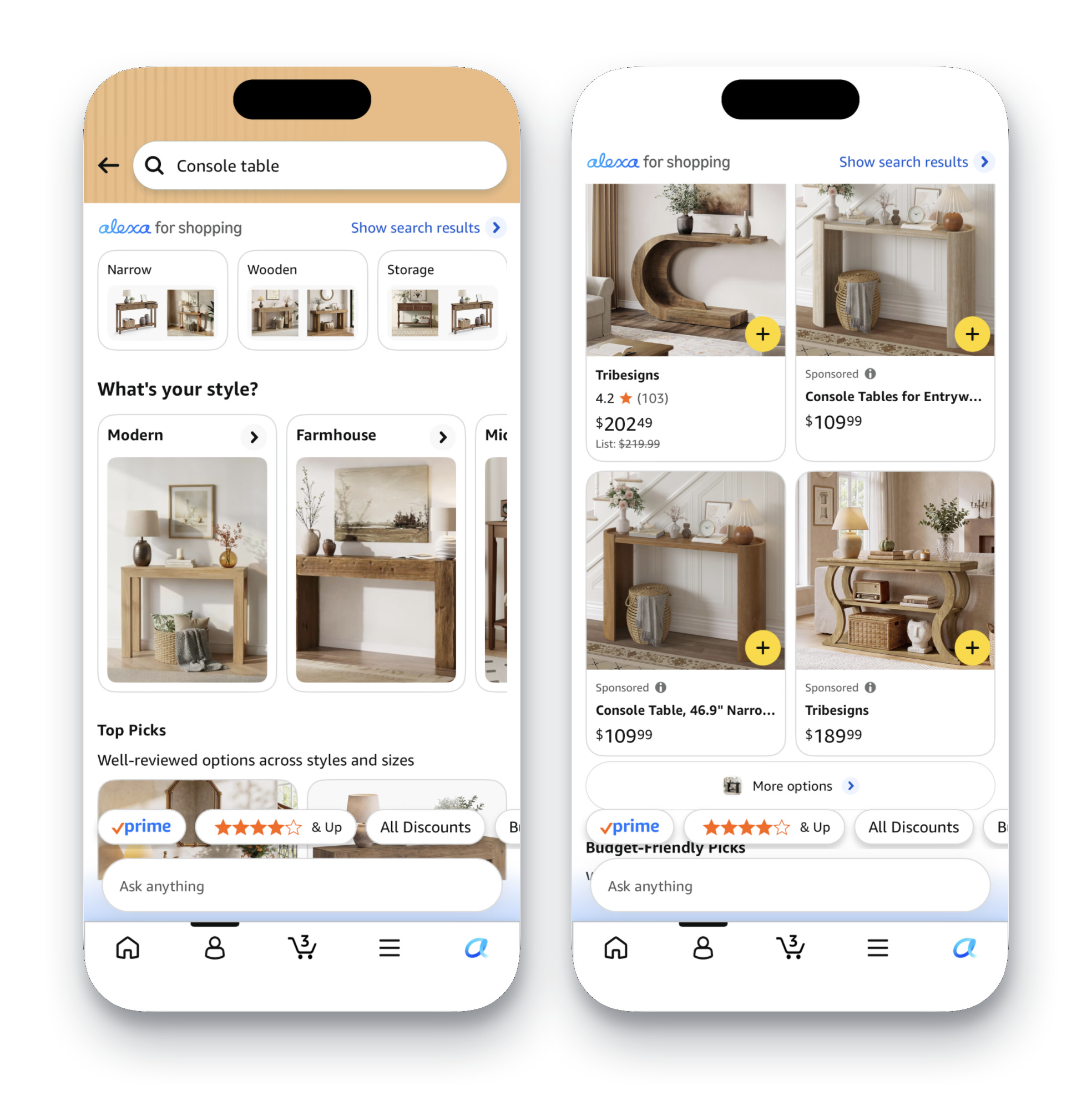
Figure 5: A broad console-table request is decomposed into form, material, storage, style, and price-oriented routes while sponsored and organic candidates coexist inside the Alexa for Shopping conversational SERP.
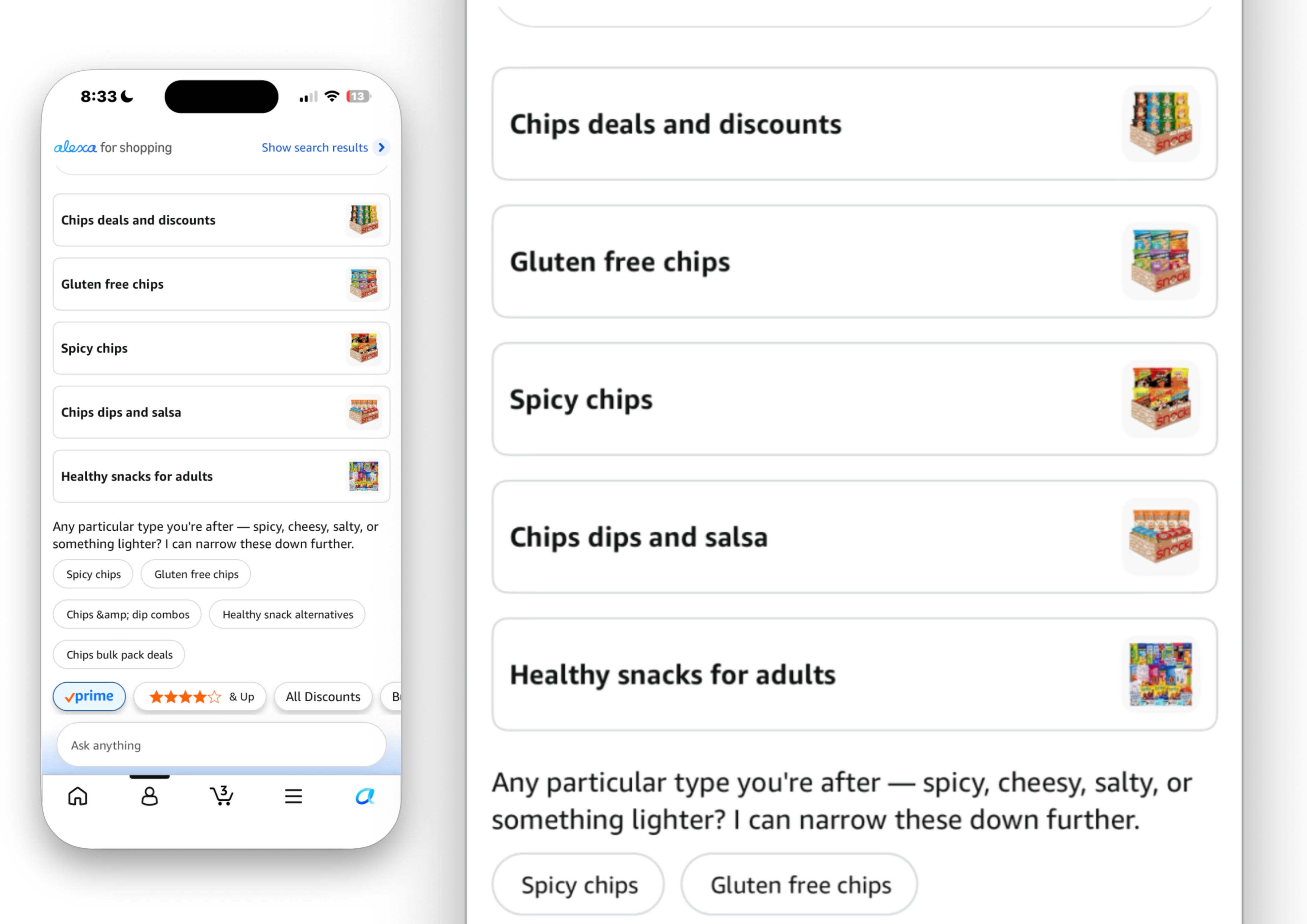
Figure 6: Within the Alexa for Shopping conversational SERP, AI exposes several query routes and guided refinements while keeping the shopper inside the assisted experience rather than returning them to a traditional results page.
Search Remains the Engine
Behind the conversational response still sits a search stack built from proven disciplines. The platform must classify the request, identify likely product types, generate or reformulate queries, access the catalog, rank candidates, apply filters, interpret structured attributes, and account for commercial conditions such as price, availability, and delivery. AI may coordinate more of those actions, but orchestration only works when the underlying search and product-data layers remain strong. A beautiful conversational answer cannot rescue a candidate pool filled with the wrong products.4
RetailPlaybook has always argued that good ACO is great SEO, but great SEO alone is not enough for ACO. The company did not need to discard proven retrieval methods when conversational AI arrived. Search remains exceptionally effective at one of ecommerce’s hardest problems, which is locating potentially suitable products inside an enormous catalog. Alexa for Shopping adds reasoning and selection around the retrieval foundation, interprets the buying objective, determines what needs to be searched, evaluates the products returned, and decides which options fit.5
The assistant absorbs more of the reformulation burden and still relies on the indexing, ranking, semantic matching, behavioral learning, and product-data disciplines responsible for Amazon Search’s commercial power. Keywords do not lose their value merely because the person no longer types every formulation by hand. When an agent explores several legitimate routes toward the same objective, a product still requires enough linguistic and catalog coverage to appear across the relevant paths.
Watch the coverage requirement in motion. A broad wall-decor mission narrows to macramé, then to geometric macramé, and Alexa carries the category context across every step. A product that speaks only the language of the first search is invisible by the third. Keywords did not stop mattering. The number of formulations a product must be ready for went up.
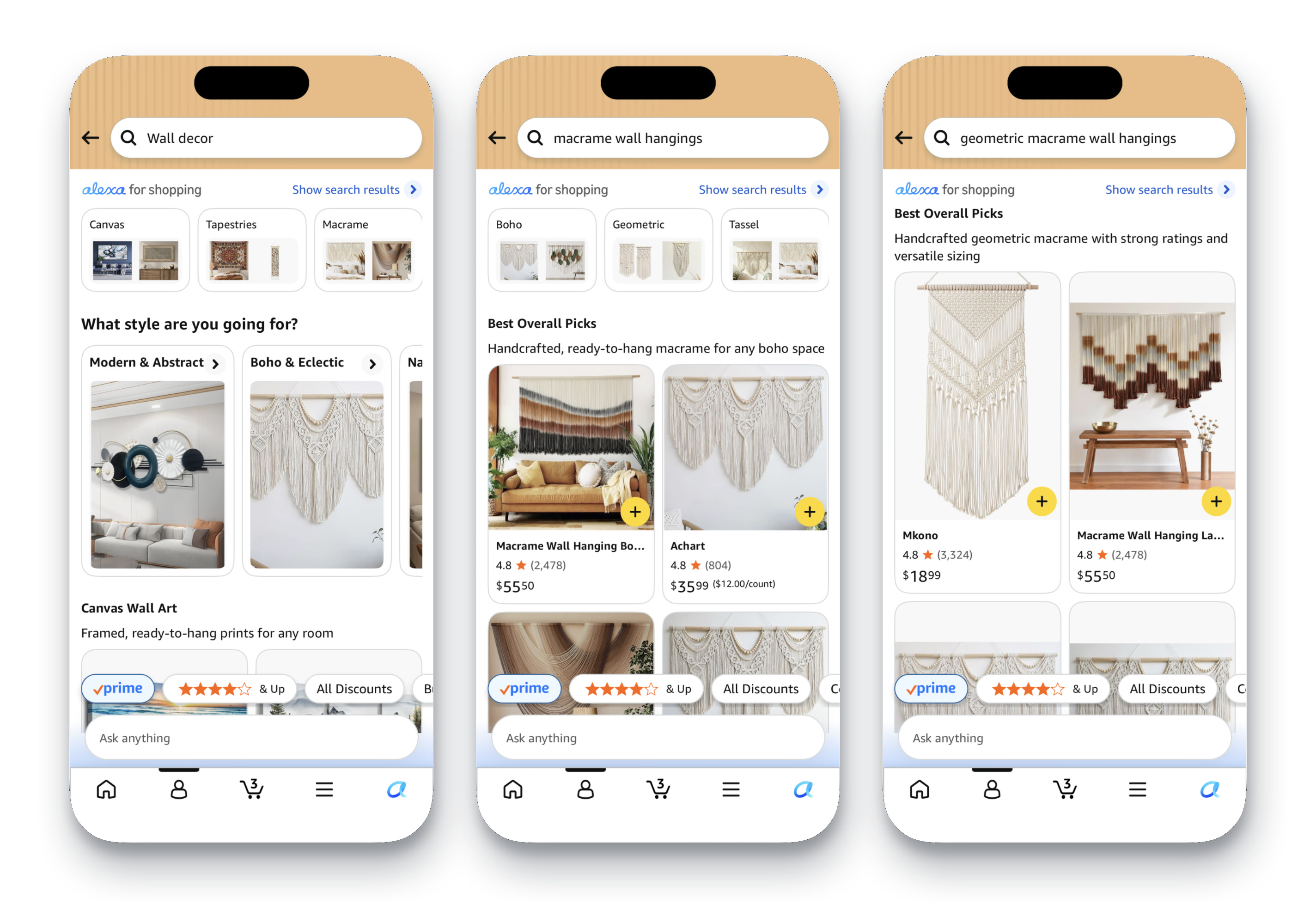
Figure 7: A broad wall-decor mission is progressively refined into macramé and then geometric macramé, demonstrating how Alexa can carry category context across successive searches.
Answerability Is the New Conversion Requirement
Once the transfer of search work is clear, the rest of the Herrington and Mehta conversation starts to snap into place. Mehta explains how Amazon originally expected users to derive the greatest value from long conversations with Rufus. Actual usage revealed a more immediate need:6
“One of our greatest use features is helping customers just get basic product questions and answers.”
The first wave of value was not an elaborate autonomous workflow. It was easier access to basic product information.
His examples sound ordinary: Does the product have a battery? How wide is the bookshelf? Is it waterproof? Are the notebook pages perforated? Such questions often determine whether a shopper continues evaluating the item, opens a competing listing, or completes the purchase. Their simplicity makes them commercially powerful, since a single unanswered detail can stop the decision cold.
This is the discipline I have been calling Product Page Coverage, and the next screenshot shows what it looks like when a listing passes the test.
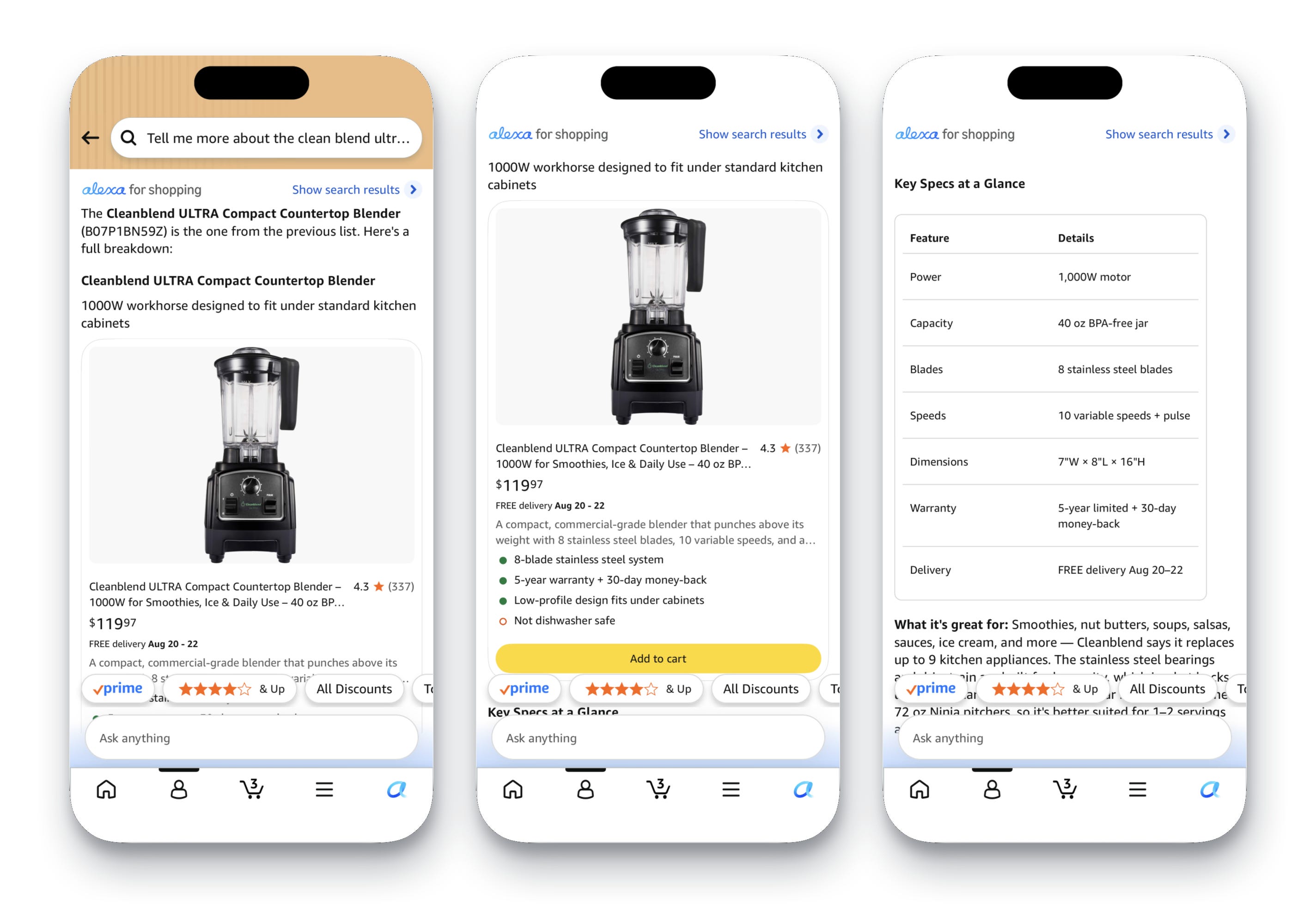
Figure 8: Alexa for Shopping converts a follow-up product request into an answerable product brief: core specifications, fit, limitations, delivery, and Add to cart remain inside the conversational SERP.
Basic question answering sits directly beside conversion. A buyer who cannot verify dimensions, compatibility, waterproofing, included components, care requirements, or another decisive fact often leaves the page rather than accepting uncertainty. Alexa reduces the effort required to locate an answer, but only when the underlying product information is clear enough to retrieve and safe enough to state. Product Page Coverage therefore addresses lost confidence as much as it addresses content completeness.7
Immediately afterward, Mehta notes the needed information may already exist somewhere in Amazon’s store or on the product detail page, yet people often struggle to locate it. Information being present is not equivalent to information being answerable. A fact can sit inside the page and still remain inaccessible to the shopper, difficult for the assistant to isolate, or unsafe to apply to the selected variation.
A dimension buried in one image does not carry the same clarity as a dimension expressed consistently across structured attributes, copy, and imagery. Compatibility statements hidden deep inside A+ content offer weaker support than compatibility represented coherently across catalog fields, bullets, visuals, and review feedback. A material claim appearing in one location while another surface contradicts it creates a reconciliation problem.
Viewed through an answerability lens, a beautiful PDP is not necessarily an answerable PDP, and a keyword-rich page is not automatically an answerable one either. A listing may convert well for people already familiar with the category yet fail buyers who need help deciding. AI shopping exposes those gaps as the assistant must convert page content, catalog data, reviews, and other source material into language on the shopper’s behalf.
Later in the discussion, Mehta describes how Amazon embedded conversational technology across the store, including product pages and search results, with certain queries receiving a conversational response instead of only the traditional grid.8 Amazon is not trying to move every shopper out of search and into a detached chatbot. The company is bringing conversational intelligence into the surfaces where people already browse, compare, question, and buy.
Mehta describes search-bar requests that conventional product retrieval could misread. Someone asking where previously ordered AA batteries are might receive a grid of batteries when the real need is order status. A question about regular versus cold-brew coffee makers calls for category education before a recommendation.
Alexa for Shopping classifies those requests, answers the underlying question, and then connects the response to personalized products. The familiar field therefore initiates more than one kind of shopping task.
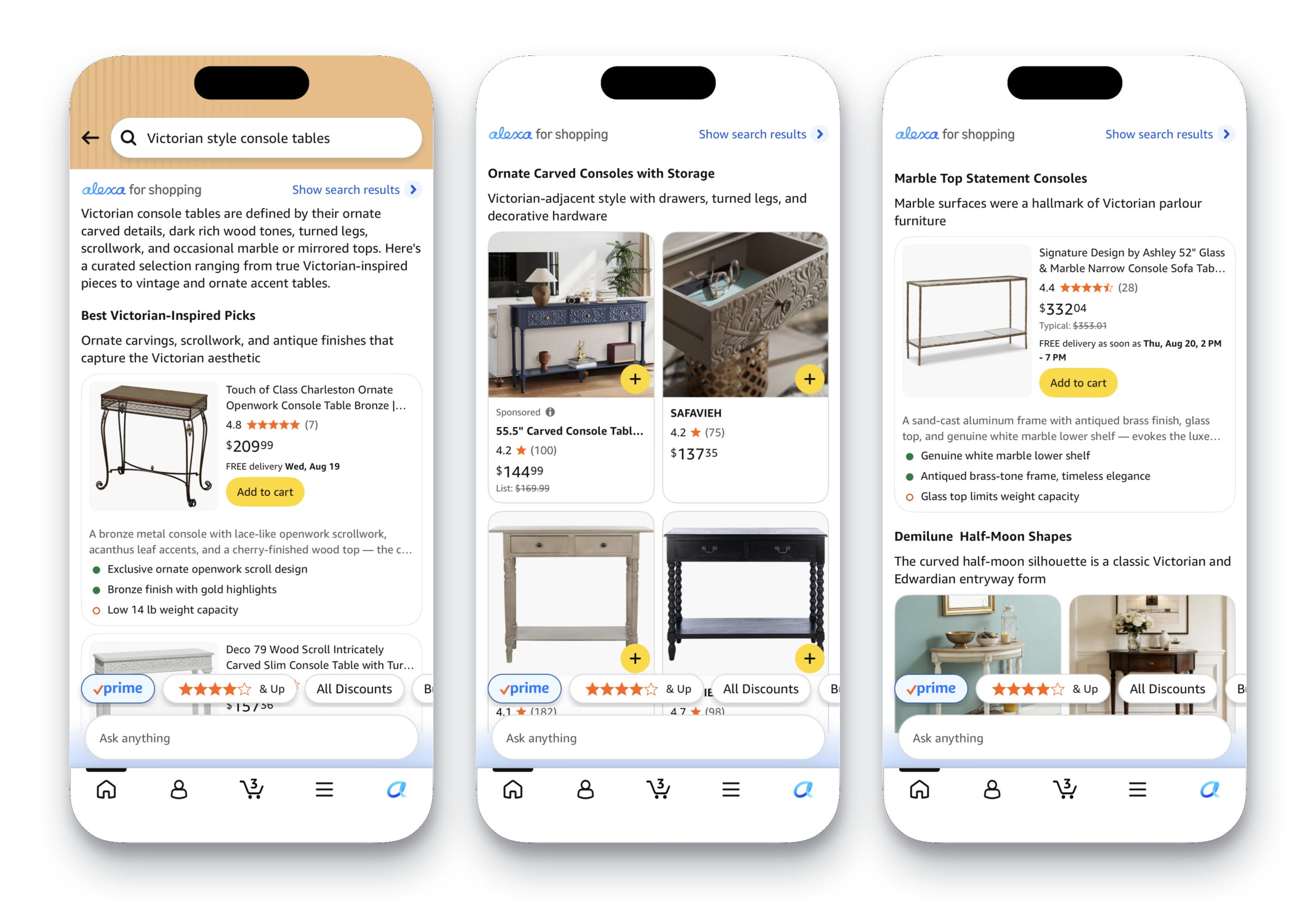
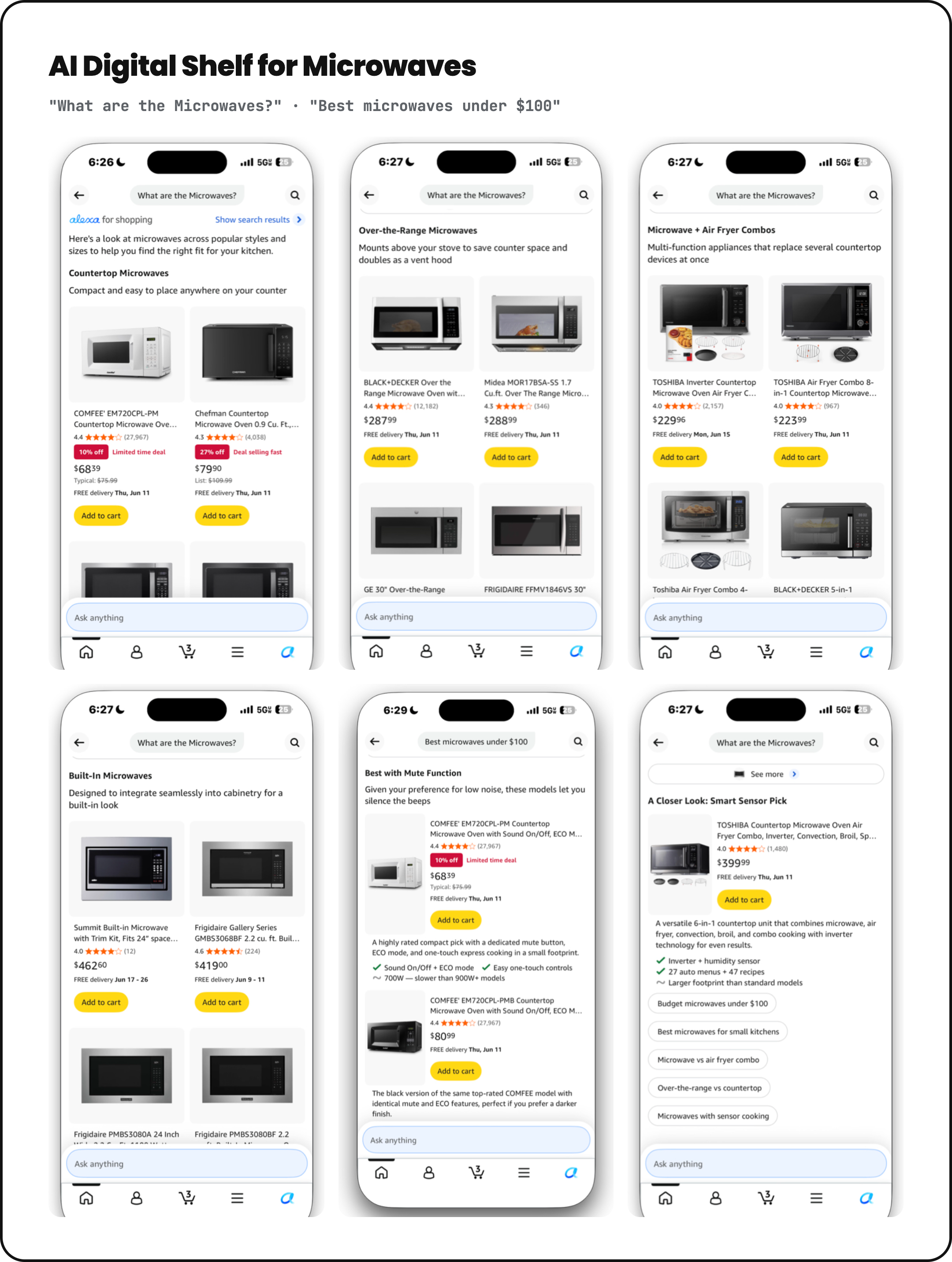
Figures 9 and 10: Across Victorian console tables and microwaves, Alexa first explains the category, then organizes the digital shelf into decision-ready routes, preserves commercial context, and connects education directly to purchasable recommendations.
Together, the examples show that the conversational layer can resolve both a style-led furniture mission and a constraint-led appliance mission without forcing either shopper back into manual query reformulation.
And the mission does not reset between turns. Refine the Victorian console hunt toward dark wood and Alexa produces a closer best-pick explanation plus alternative material and finish routes: the query plan re-planned, not replayed. This is the same furniture shopper we met in Figure 5, three turns deeper, and Alexa has not once sent her back to a results grid to start over.
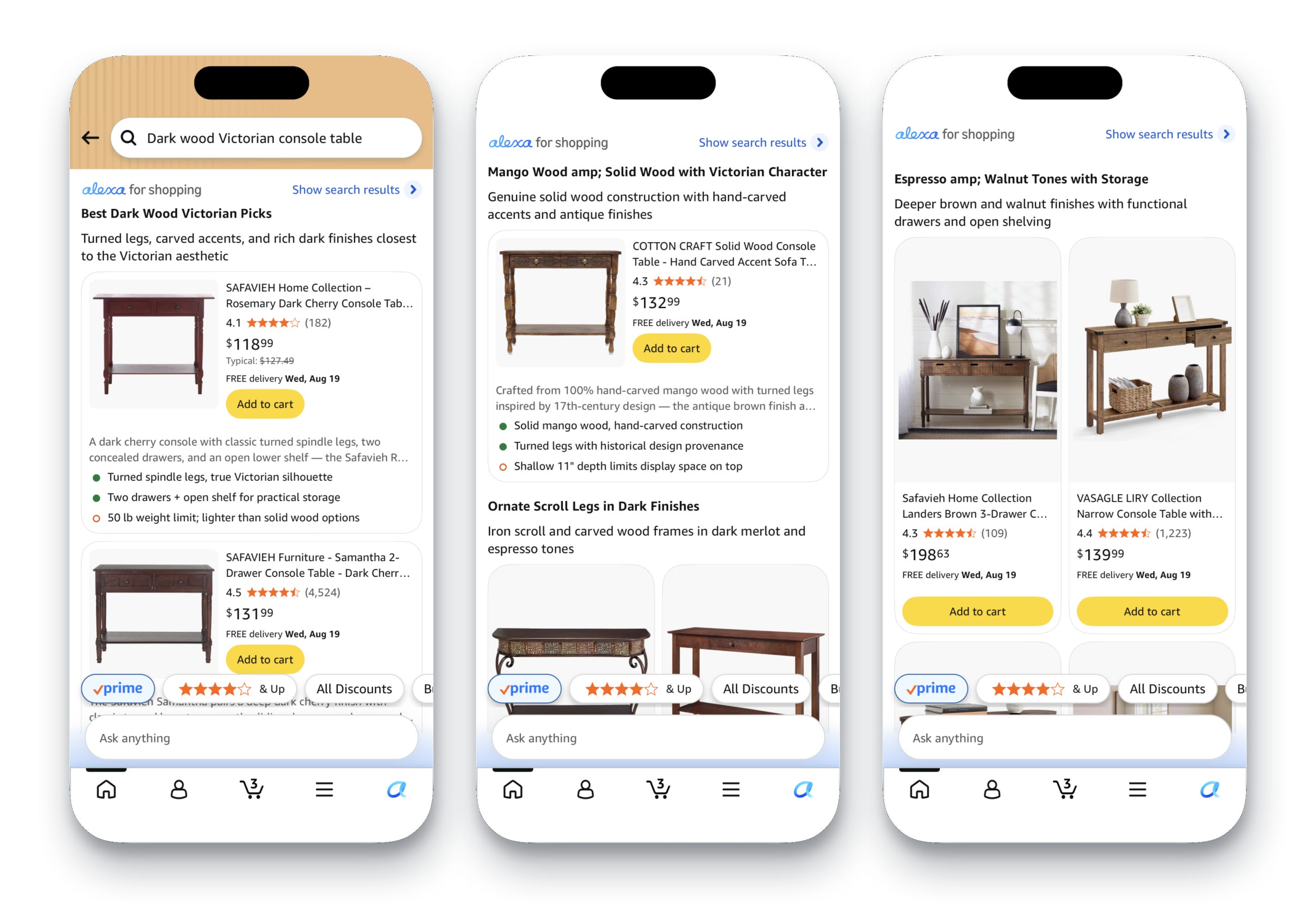
Figure 11: Refining the Victorian-console mission toward dark wood produces a closer best-pick explanation and alternative material and finish routes, reinforcing how Alexa deepens an established query path.
The search bar occupies a unique position, bridging the old behavior and the new one. People already know where to begin when they want something from Amazon, so the company does not need to teach hundreds of millions of people a new starting ritual. It can alter what happens after a person types into the box they have used for years.
AI acts as the operator of search on the shopper’s behalf, with Amazon’s retrieval infrastructure continuing to find products underneath.
Doug Herrington describes the original Rufus vision in a way that clarifies Amazon’s structural advantage. After recalling how the early model was trained with Amazon data, including the catalog and customer reviews, he summarizes the ambition:9
“This is going to be a model that knows shopping, especially shopping on Amazon better than any other model out there.”
Although the architecture evolved, the goal of specialized shopping intelligence remained central.
Beneath the ambition sits a commerce environment few companies can replicate. The marketplace possesses catalog data, structured attributes, reviews, ratings, prices, inventory, delivery promises, search histories, browsing behavior, carts, purchase histories, brand preferences, and the conversations people now have with Alexa. The value comes not from a language model alone, but from the combination of product intelligence, shopper context, and immediate transactional capability.10
One Conversation, Many Models
The platform has also changed dramatically, and the evolution may be one of the most revealing technical disclosures in the entire conversation. Mehta describes the shift directly:11
“We’ve gone from a dedicated shopping model that we built to we now use a mixture of a state-of-the-art model from outside of the company, as well as a bunch of internal models.”
His description replaces the image of one monolithic shopping brain with a modular collection of models and capabilities.
Brands should not imagine a single “Alexa algorithm” through which every product question, comparison, recommendation, price-history request, and PDP answer travels in the same way. Amazon’s own explanation points toward a more distributed architecture. Task type, latency, cost, answer quality, novelty, and available source material may shape which capability handles a request.
Specialized tasks therefore call for specialized intelligence. Mehta gives a concrete example when he explains what happens with price history:
“That’s going to a special model and a special agent that’s being called just for price history.”
What follows is an architectural principle with broad consequences. A single shopper request may require conventional product search, product-question answering, price history, comparison, memory, personalization, or another task-specific capability. The person sees one conversation, but the platform may coordinate several forms of work before producing the response.
AI orchestrates more of the company’s proven commerce capabilities, deciding when to search, what to search for, which agent or model to invoke, what supporting material to inspect, and how to assemble the result.
Personalization Changes Relevance
Personalization changes the calculation again. Mehta describes the persistence of shopper context:12
“Alexa is learning continuously about my preferences. It remembers things that I’ve told it.”
He then explains how Alexa may infer preferences from shopping behavior and prior conversations, even when the person never stated them directly. The immediate query therefore sits inside a broader account-level context rather than functioning as the complete expression of need.
Two people may type the same words and carry completely distinct buying situations. One coffee-maker buyer may live in a small apartment, value quiet operation, and make a single cup each morning. Another may own a large kitchen, purchase premium coffee equipment, and prepare drinks for several people. A third may display strong price sensitivity or a history of loyalty to one brand. Identical lexical input does not guarantee identical decision criteria.
Personalization means the search work itself may change before ranking ever begins. The assistant may emphasize compact machines for one account, premium equipment for another, or lower-cost options for someone whose behavior reflects a tighter budget. The visible phrase may remain unchanged, yet the generated searches, applied constraints, comparative criteria, and explanation may diverge. Personalization therefore reaches deeper than rearranging an identical product grid.13
The bedroom-art expansion we watched back in Figure 4 is this mechanism at work: the account, not the query, reshaped the candidate set before ranking ever began.
The query may match perfectly even when the contextual fit does not. Relevance can extend beyond keyword-to-product matching into a relationship among the product, the buying objective, the shopper, the circumstances, the constraints, and the available product support. Amazon’s selection layer therefore has reasons to distinguish seemingly similar products whose fit against one person’s needs differs sharply.14
Recommendations Must Be Explainable
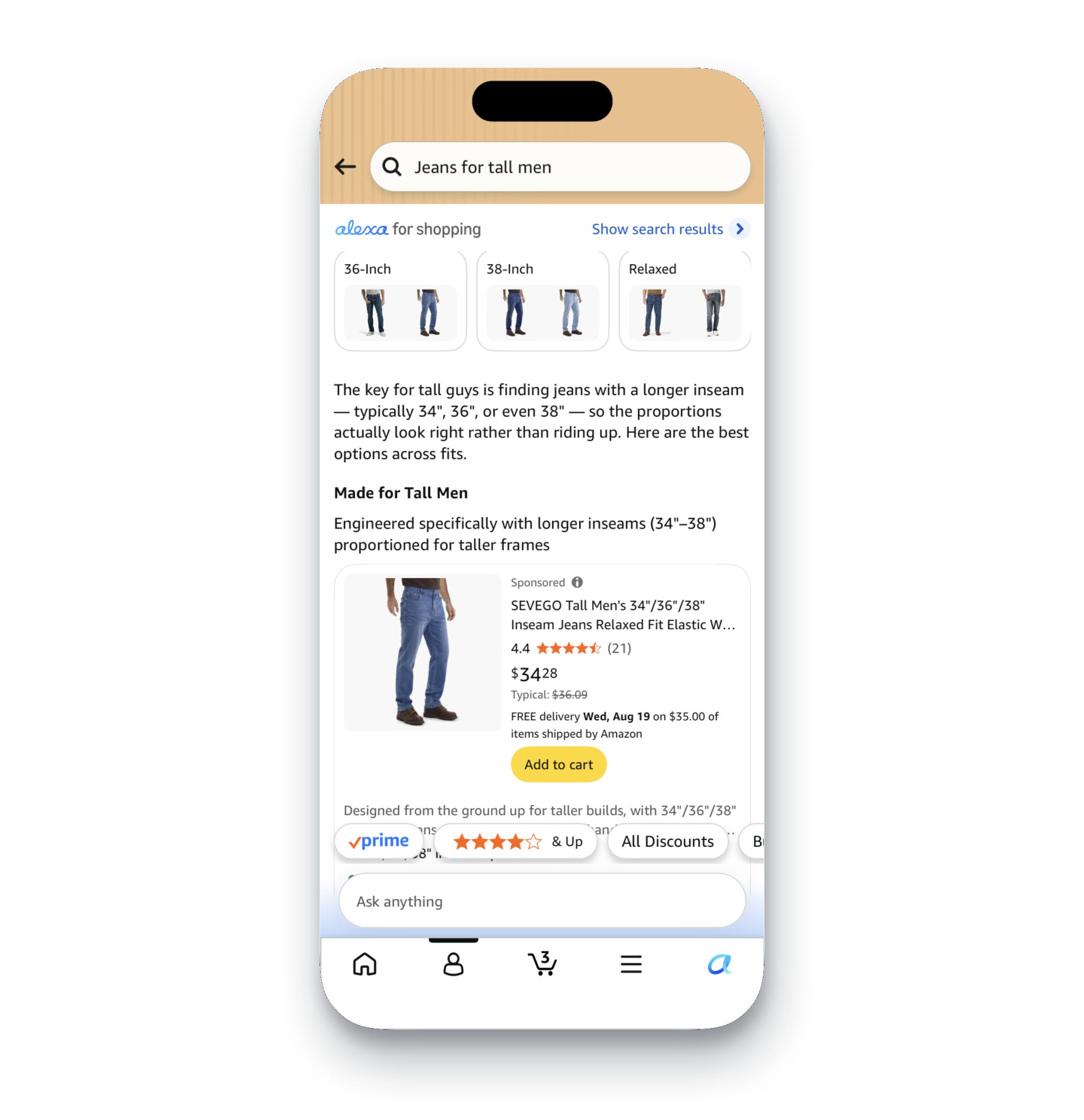
Figure 12: “Jeans for tall men” becomes explicit inseam routes, fit education, and a qualified product recommendation: the same translation we watched in the trendy-jeans search of Figure 1, a human constraint becoming decision-ready criteria, which is Noun Phrase Optimization operating in the wild.
Another section of the conversation raises the stakes for substantiation. Mehta says people increasingly value knowing why Alexa recommends something, and he describes explanations tied to observed interests or preferences. Recommendation rationale moves part of the ranking logic from an invisible score into customer-facing language.
Traditional recommendation engines could display a product without explaining why it appeared. Conversational shopping gives the assistant a reason to articulate the fit, including the preference used, the qualifying characteristic, or the connection between the item and the buyer’s situation. Once the explanation itself influences confidence, the quality of the underlying facts carries greater commercial weight.
A buried, vague, contradictory, unsupported, or variation-misaligned differentiator cannot reliably support a generated explanation. Reviews may reinforce the claim, complicate it, or directly contradict it. The AI layer cannot transform weak product information into durable truth without creating risk. Better organic product support therefore expands the range of claims Amazon can state safely and persuasively.
The commercial endpoint appears in one of Mehta’s simplest comments:15
“The stuff you want to buy is right there in the conversation. And people really love that.”
The sentence captures the retailer’s advantage over general-purpose assistants, since the answer, recommendation, product card, and transaction can coexist within the same interaction.
Such conditions explain why I keep returning to ASIN answerability engineering. The brand-side challenge extends beyond completing a PDP. Amazon needs to locate the relevant product facts, interpret them correctly, connect them to the requested item and variation, reconcile conflicts, and express the answer with enough confidence to support a recommendation. Every missing, vague, stale, or contradictory field weakens the quality of the response Amazon can safely produce.
Conversational Shopping Solves the Selection Problem
Herrington later explains why Amazon needs such an interface by comparing retail formats. The Sears and Roebuck catalog could hold only so much selection before the physical format became the constraint, and a store faced its own spatial ceiling. Amazon’s digital marketplace broke through those limits, but hundreds of millions of products introduced another problem: helping one person locate the right option without manually navigating an effectively infinite shelf.16
Massive selection therefore creates a decision problem after the assortment problem has been solved. Herrington describes the need for a new scaling technology:
“At some point you have so much selection and we needed some kind of new technology to make it possible for individuals to find the best products for them inside of an ever-increasing selection of product. I think this technology is that.”
Conversational shopping is being positioned as a scaling technology for product choice.
Herrington makes the contrast more provocatively:
“The traditional search bar and search results was going to make it very difficult to do 10X of the selection, but not this new world.”
I do not read the statement as a rejection of search science. I read it as recognition of the customer-operated query box as an eventual choke point when the assortment grows faster than any person’s willingness to search, filter, compare, and reformulate.
By moving query formulation behind the interface, Amazon can expand selection without asking people to expand their search expertise at the same rate. The person does not need to know every product category, technical term, or catalog attribute before asking for help. Alexa can use the intent expressed in ordinary language to navigate a category unfamiliar to the person, which is precisely where traditional query construction creates the most friction.
Search itself remains exceptionally useful. What stops scaling gracefully is the expectation for one human to continually invent the right query sequence for every unfamiliar category, recipient, project, budget, and constraint. AI can remove more of the interface burden by operating the search machinery on the shopper’s behalf.
The Expert Salesperson Across an Infinite Catalog
Rajiv offers perhaps the clearest analogy when he describes walking into the world’s largest sock store. A person navigating the entire store alone would face overwhelming choice, but a knowledgeable salesperson familiar with every product could narrow the selection quickly. Mehta summarizes Amazon’s aspiration:
“that expert salesperson across all of that.”
His analogy captures the combination of catalog knowledge, shopper context, comparison skill, and immediate action Amazon wants Alexa to provide.
What Brands Must Make Knowable
The expert-salesperson analogy offers the clearest explanation of what RetailPlaybook prepares brands for. Amazon is building a sales associate capable of operating across an effectively infinite catalog, with AI controlling more of the search work used to navigate it. The brand-side question no longer stops at whether a listing ranks. It asks what Amazon’s shopping intelligence knows, verifies, and explains about the product when the product genuinely fits a buyer’s need.
Several practical questions follow. Does Amazon find the item across the searches implied by the buying objective? Does it identify the correct variation, material, dimensions, compatibility, style, intended use, limitations, and differentiators? Do reviews support the listing’s claims? Is the product compared fairly against alternatives? Does the available information justify recommending it to a particular person under a specific set of constraints?
Seen through the lens of an expert salesperson, the RetailPlaybook framework falls into place. Traditional Amazon SEO helps the AI-operated search layer find the product. QPO models the legitimate routes Amazon may explore. NPO gives the product precise, natural language. Semantic Bridging connects verifiable facts to appropriate situations. Inference Optimization maps features to outcomes. Structured attributes provide machine-readable product data, and Product Page Coverage supplies the support required to answer decision-shaping questions.17
The goal is not to trick the salesperson, stuff every imaginable use case onto the page, or force the product into buying situations it does not serve. The objective is to make the item findable, interpretable, accurate, defensible, and correctly connected to real shopper needs. Amazon should have enough reliable information to choose the product when it belongs and enough clarity to leave it out when it does not.
The furniture mission we have followed since Figure 5 ends the only way a trustworthy one can. Sit with what the next screenshot requires from the brand side. An assistant willing to admit a product is not quite right is an assistant that needs your product facts to be true, machine-readable, and consistent everywhere it looks. Inference Optimization is not about claiming more. It is about being safe to claim.
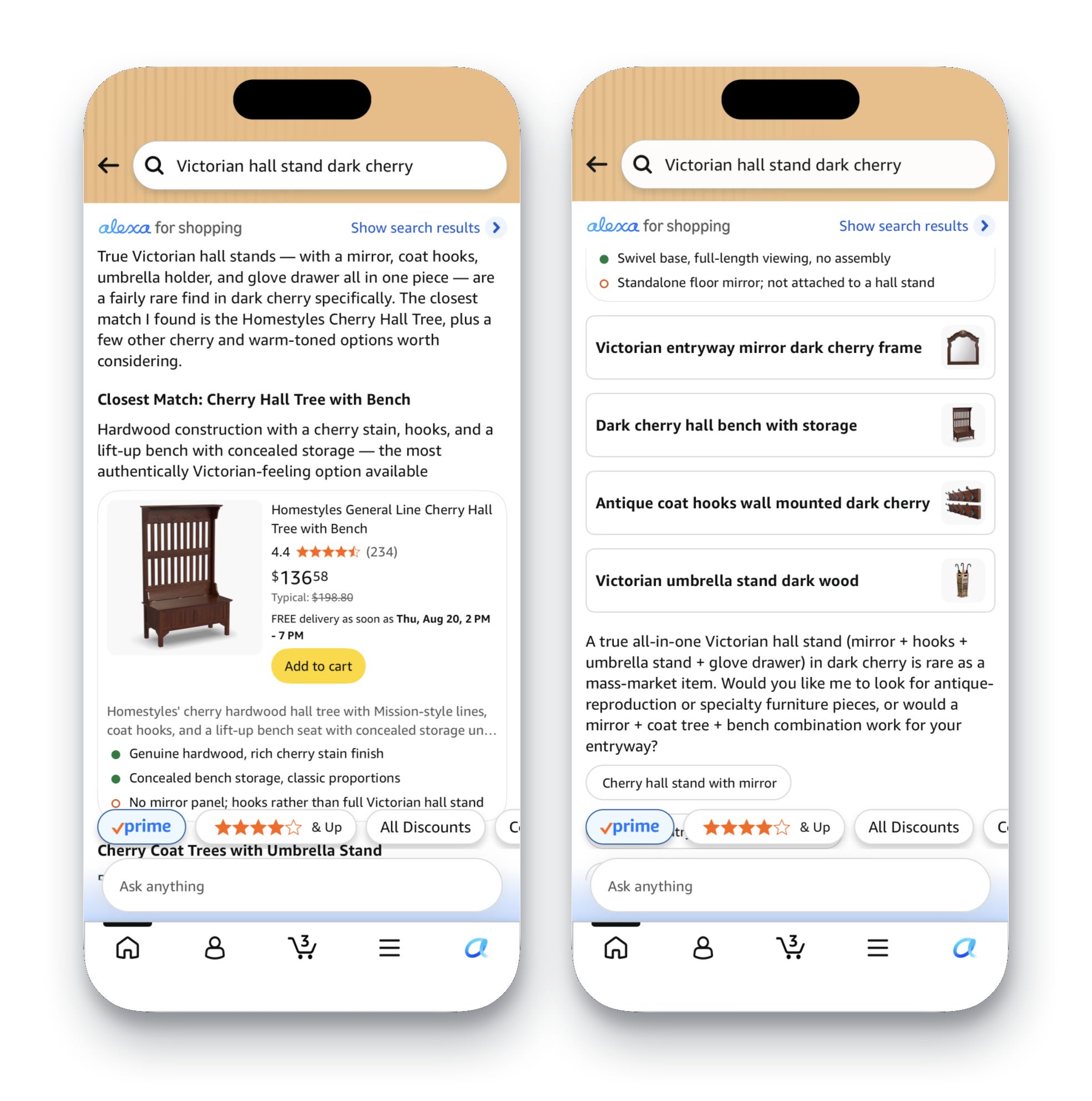
Figure 13: For a rare Victorian hall-stand request, Alexa discloses that the exact configuration is scarce, presents the closest defensible match, names the mismatch, and offers adjacent search paths instead of pretending the result is exact.
The Refrigerator Is the Final Step
Returning to my grandfather’s refrigerator, I now see the filter arriving as the final step rather than the core breakthrough. Before any autonomous purchase earns trust, Amazon must recognize the need, identify the appliance, verify compatibility, formulate searches, locate candidates, account for household preferences, evaluate price and availability, select the correct item, and explain the decision when necessary. The purchase itself is almost the least interesting part of the architecture.
Before Amazon acts at scale, every layer preceding the transaction has to work with sufficient accuracy. A wrong filter, mismatched model, stale attribute, unsupported compatibility claim, or incorrect pack size turns automation into frustration. The hardest problem is not initiating a purchase. It is assembling enough product and household intelligence to make the purchase dependable across the breadth of Amazon’s catalog.
Companies therefore do not need to wait for refrigerators to order their own filters before taking agentic commerce seriously. The movement is already visible inside Amazon’s most familiar box, where people can say more of what they mean instead of continually reformulating their needs into the words they believe Amazon wants. The old search habit will not vanish overnight, but the division of labor is already moving.
From Ranking to Selection
At the brand level, the central question grows larger than whether an ASIN ranks for one keyword. When Amazon interprets the buying objective, controls more of the search process, locates candidate products, verifies constraints, applies shopper context, evaluates the available support, and chooses which items deserve to appear, does it know enough about your product to select it confidently?
The problem RetailPlaybook was built to solve moves into Amazon’s primary shopping interface. Brands must make a product findable through proven search science while also making it interpretable, substantiated, and selectable when AI performs more of the searching on the shopper’s behalf.
Every screenshot in this piece is a brand’s product data being read aloud by a stranger who has never held the item. The three disciplines I have written about separately, the language, the routes, the verifiable facts, stop being separate the moment that happens.
Appendix: Additional Alexa for Shopping SERP Evidence
Explanation under scrutiny
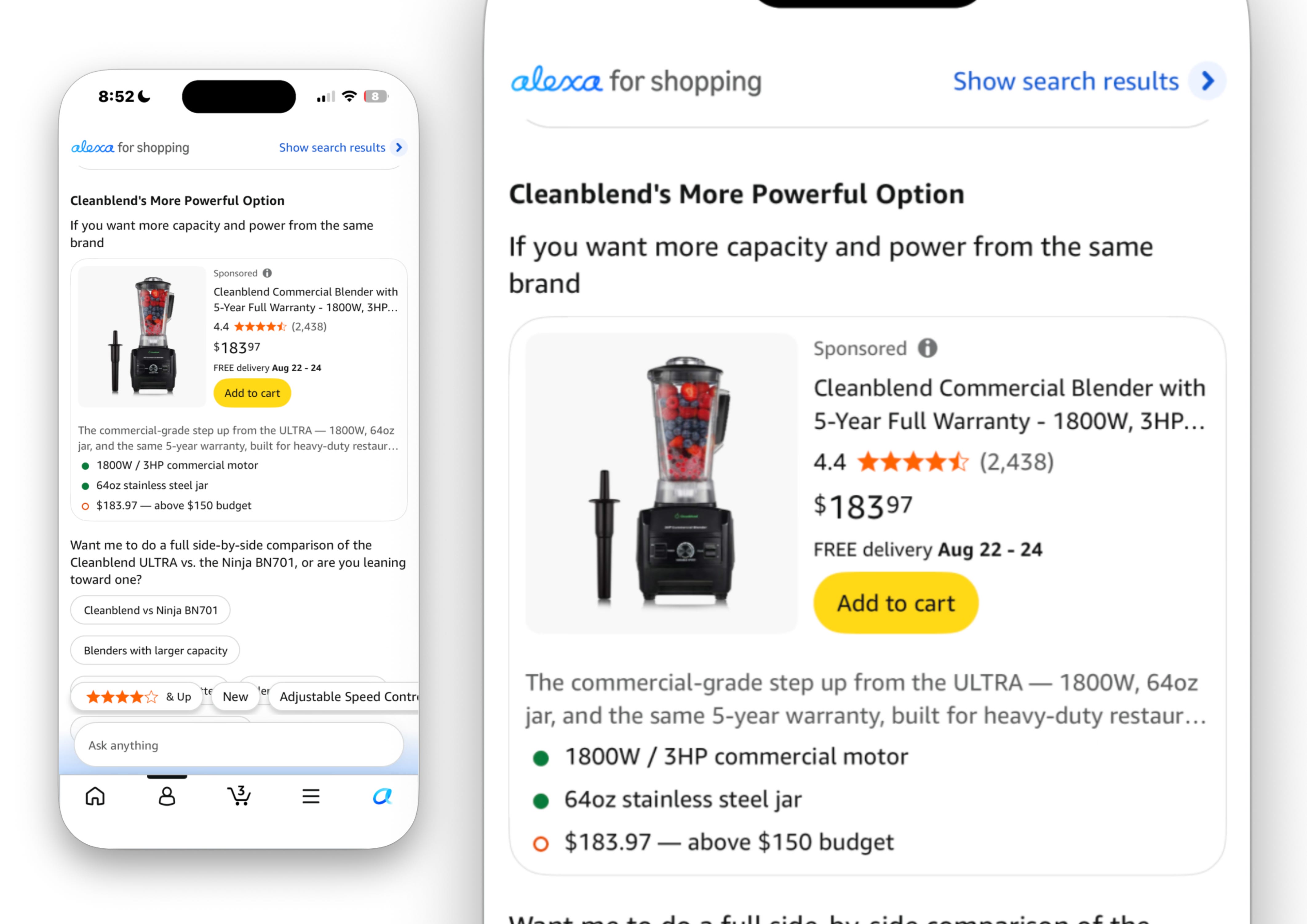
Appendix Figure A1: Alexa can surface a sponsored same-brand step-up, explain its decision factors, flag that it exceeds the stated budget, and retain an Add to cart action within the conversational SERP.
The Victorian hunt, extended
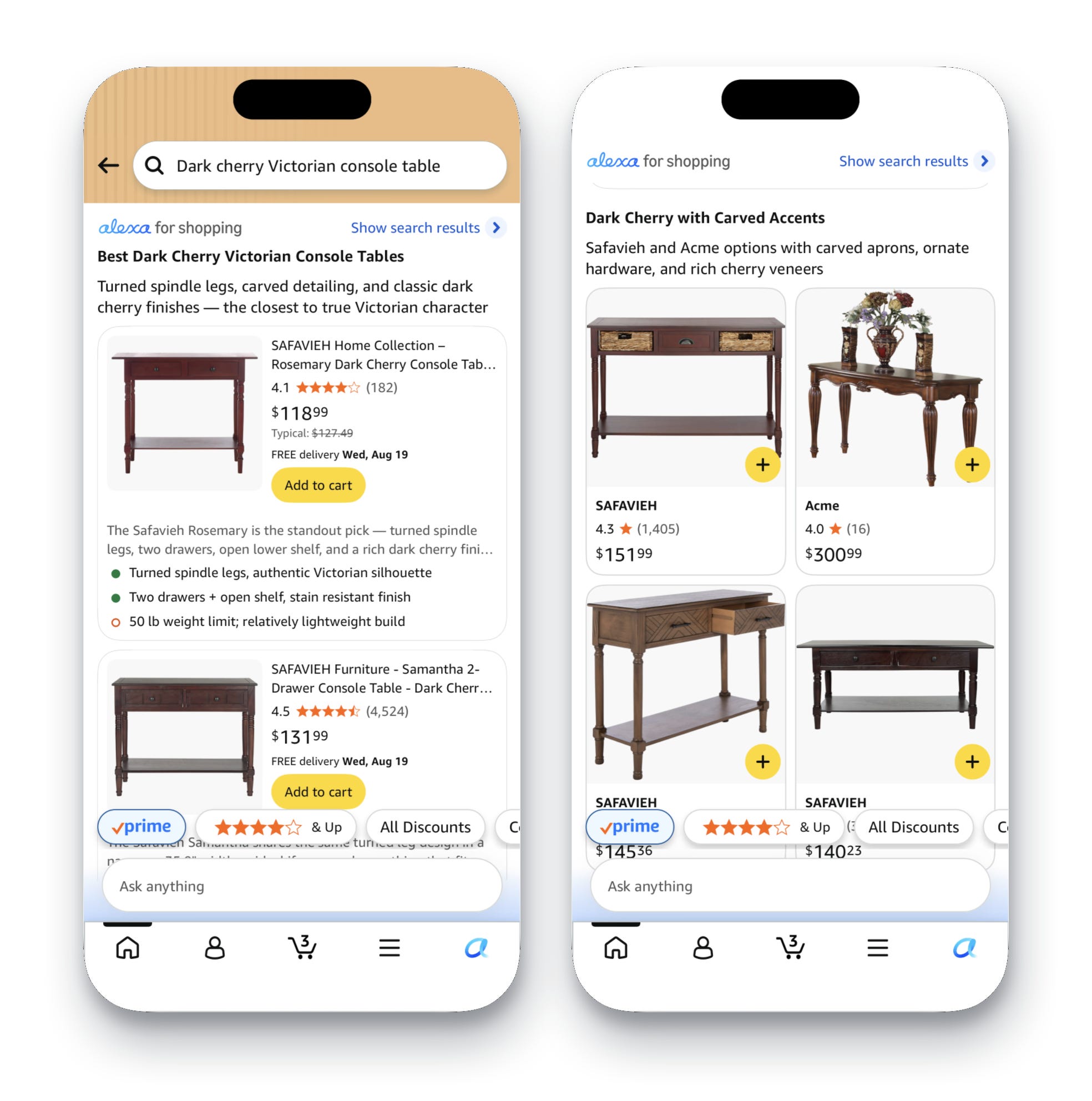
Appendix Figure A2: A narrower dark-cherry refinement produces a best-pick explanation and a broader comparison set, showing how the conversational SERP can deepen an already structured shopping path.
The wall-decor mission, extended
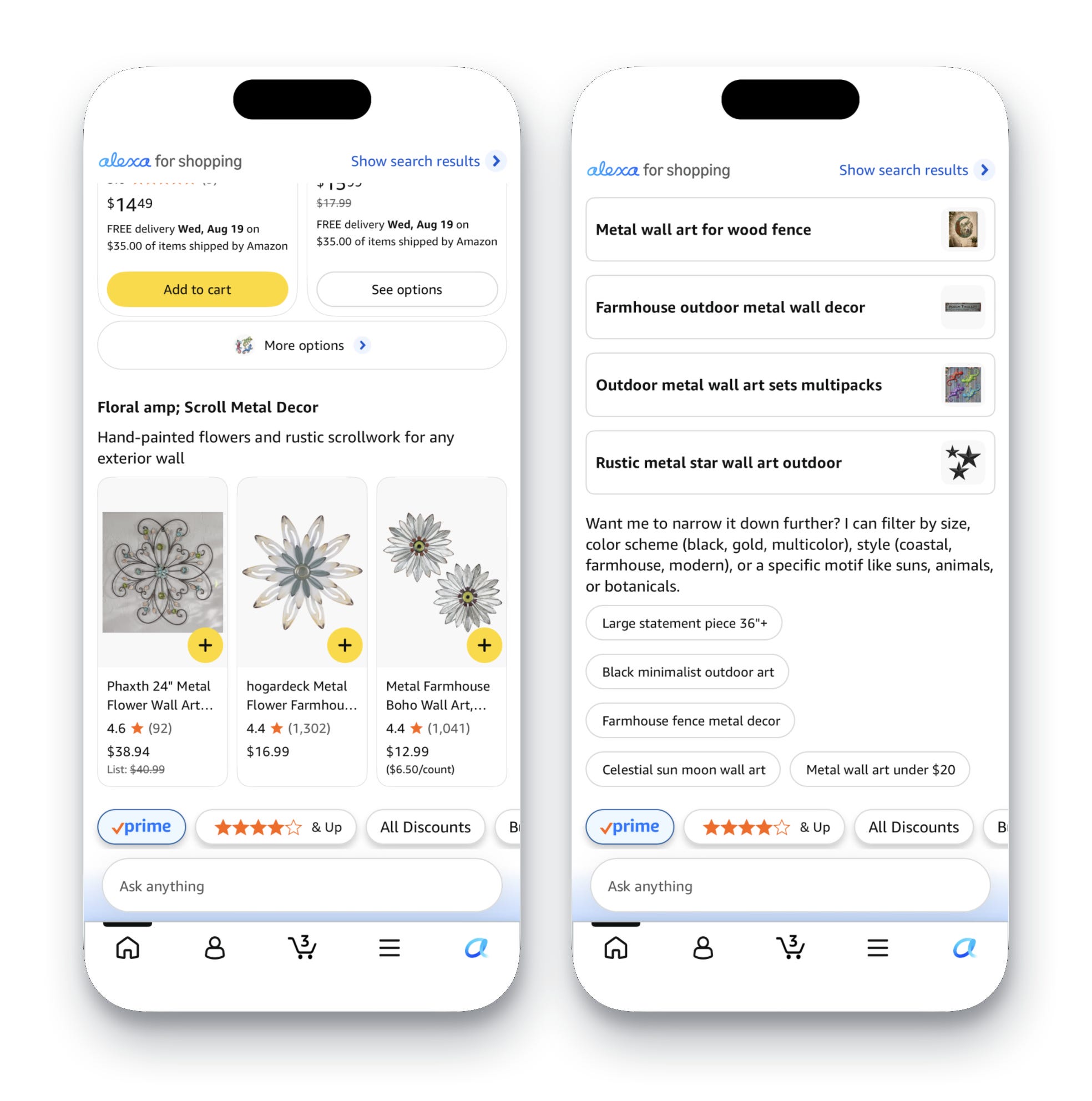
Appendix Figure A5: The outdoor metal-wall-art journey continues from product clusters into explicit follow-up queries and guided narrowing by size, color, style, motif, and price inside the Alexa for Shopping conversational SERP.
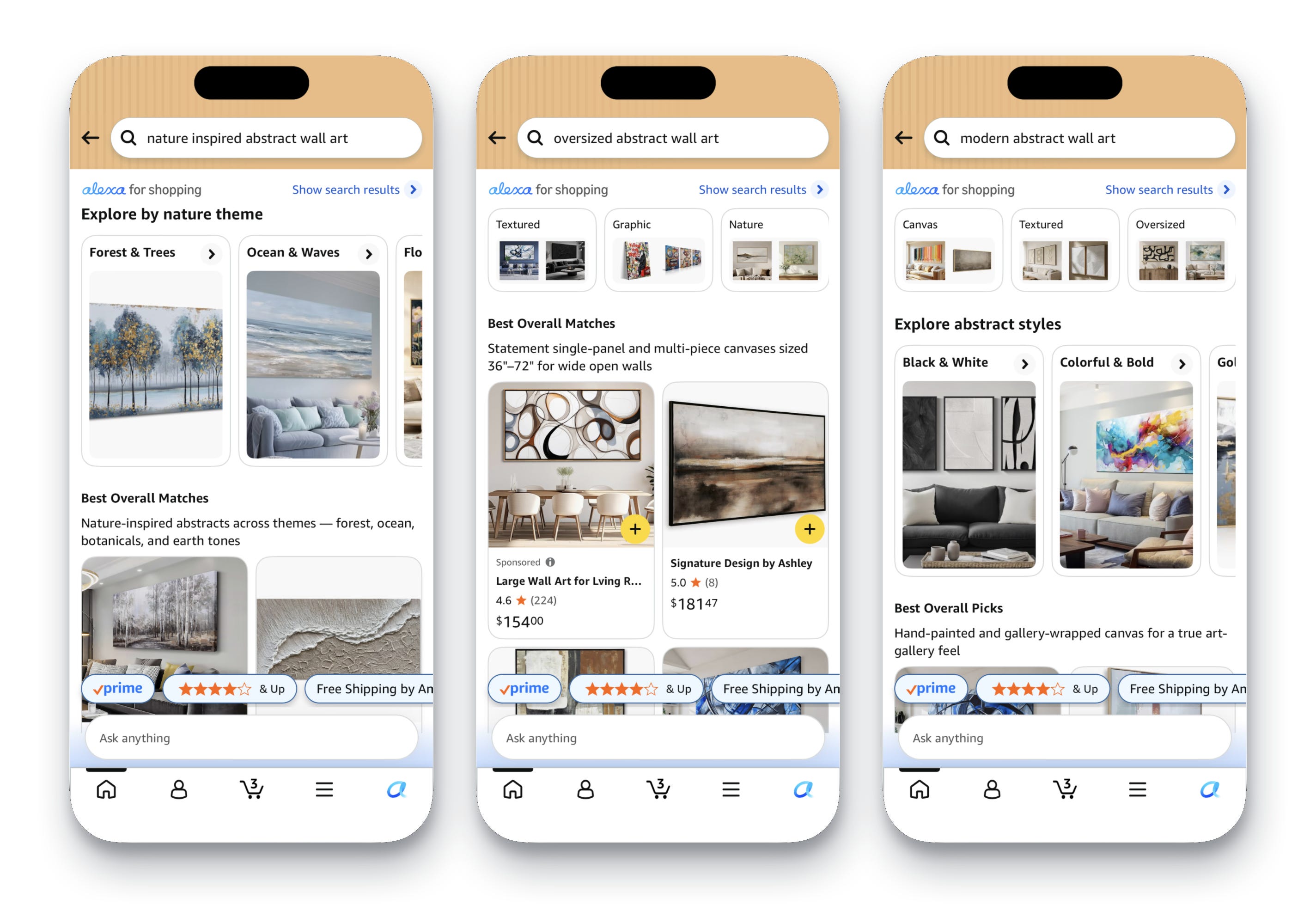
Appendix Figure A10: A general abstract-art mission branches into nature-inspired, oversized, and modern style routes, illustrating iterative refinement across theme, scale, and aesthetic.
The appliance buyer, extended
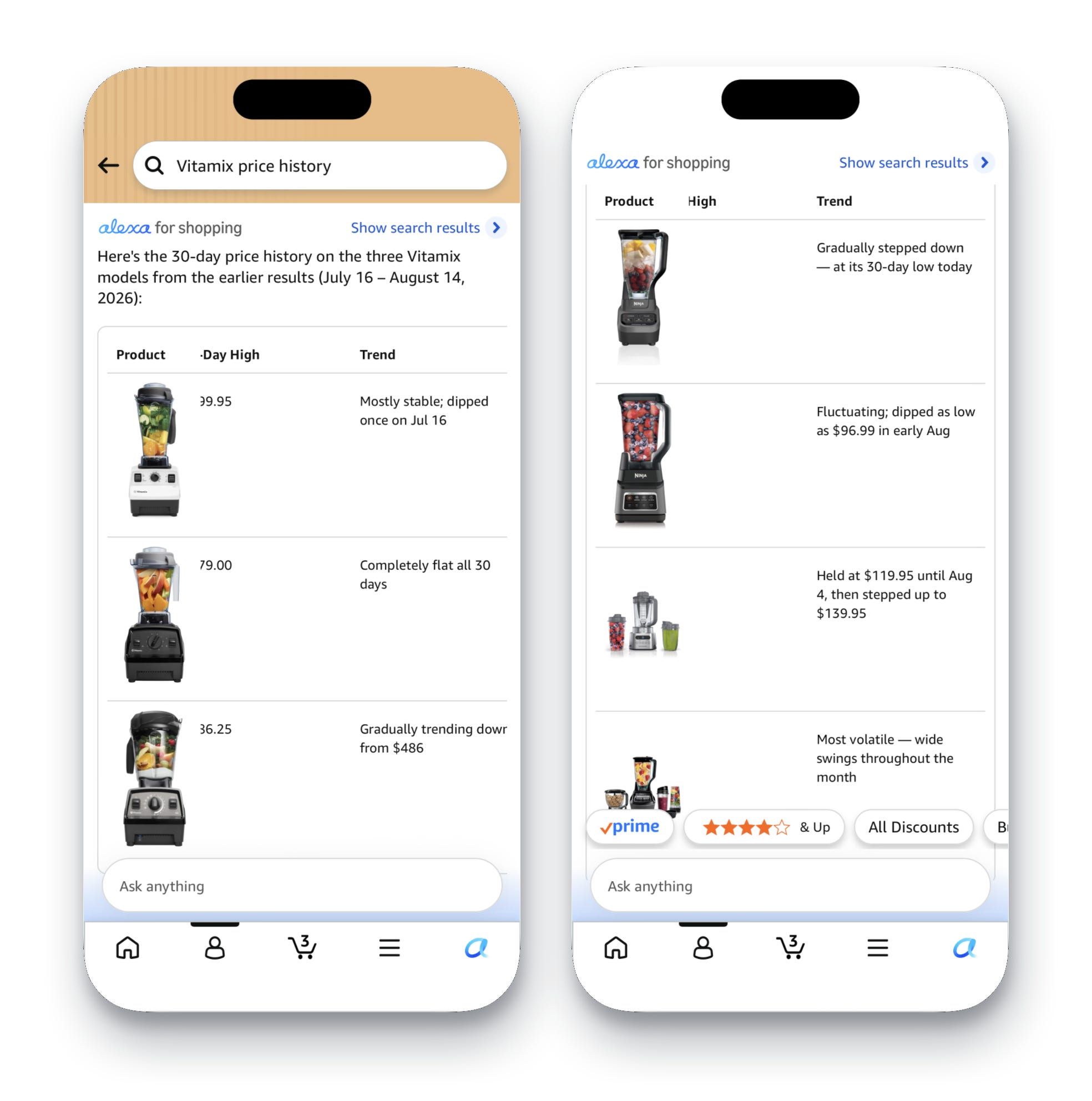
Appendix Figure A6: A price-history request invokes a dedicated comparison view across multiple blender models, showing how a specialized commerce agent can surface temporal price patterns inside the conversational SERP.
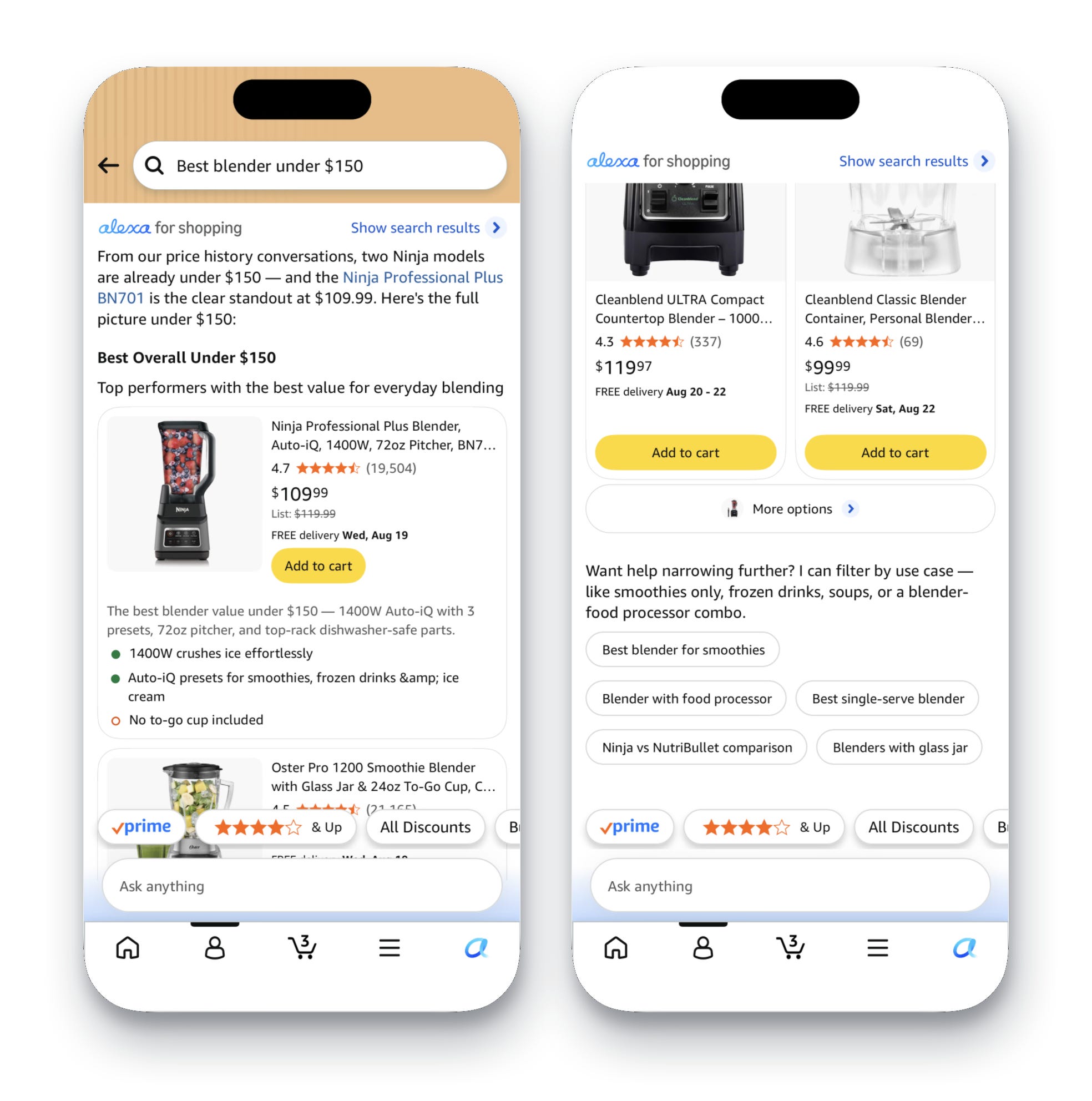
Appendix Figure A8: A hard budget constraint becomes a reasoned best pick, comparable alternatives, purchase actions, and guided follow-up routes without leaving the conversational SERP.
The jeans shopper, extended
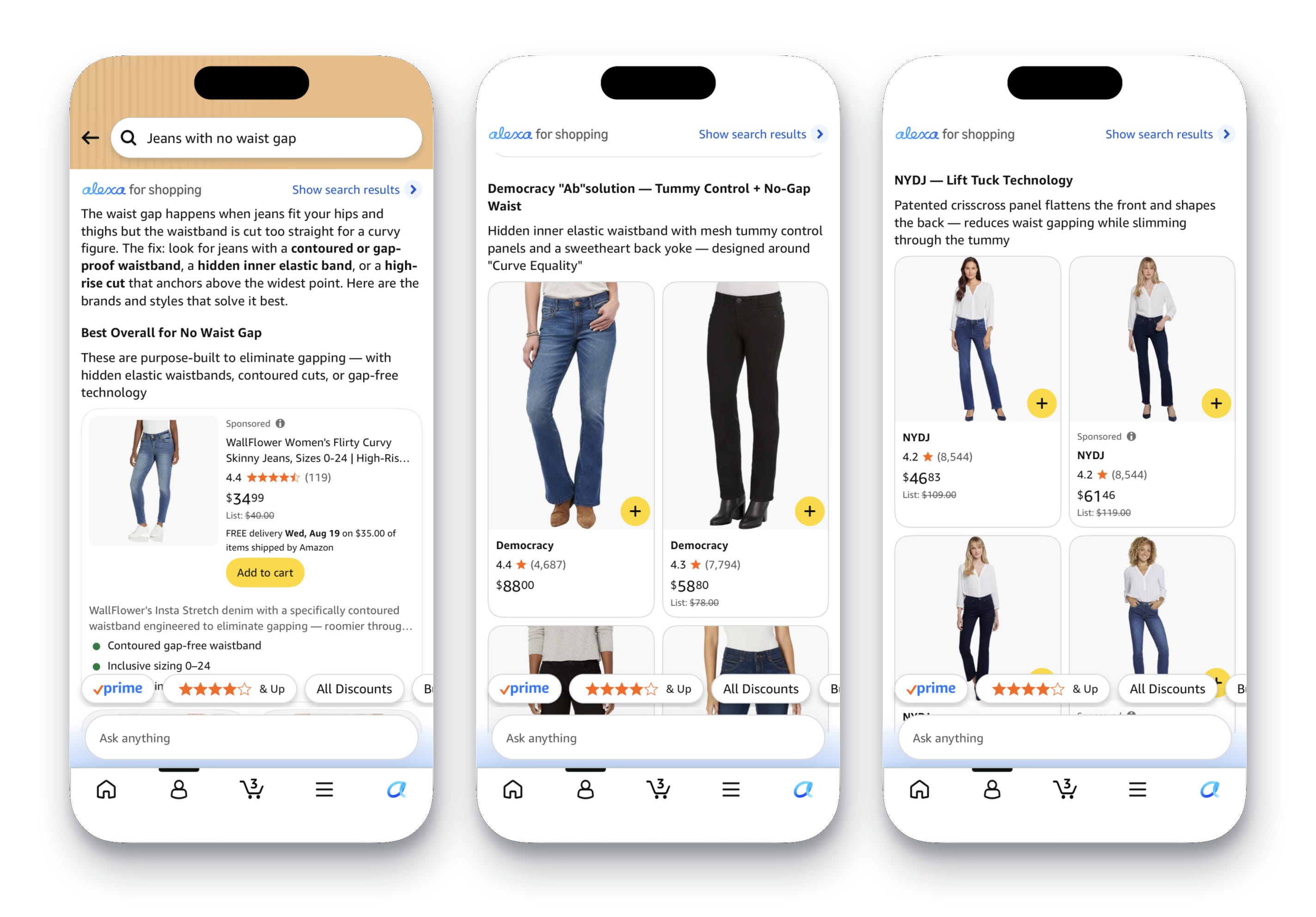
Appendix Figure A7: A human fit problem, jeans that gap at the waist, is translated into relevant construction criteria, targeted recommendations, and technology-specific alternatives.
Doug Herrington and Rajiv Mehta, Amazon Learn and Be Curious podcast transcript, discussion of future household replenishment and the possibility that a home may reorder regular supplies for itself, transcript lines 594–615.
Rajiv Mehta, Amazon Learn and Be Curious podcast transcript, discussion of customers knowing what to type and what not to type, customers typing whatever is on their minds, and Amazon opening the aperture on acceptable search-bar input, transcript lines 509–535.
Andrew Bell, “Amazon Taught Us What Not to Type: How 30 Years of Product Search Conditioned Shoppers to Compress Their Needs, and Why Alexa for Shopping Is Beginning to Reverse the Habit,” especially the opening, executive summary, and sections on Amazon-ese, behavioral conditioning, and the search bar as Amazon’s scaling interface.
Andrew Bell, “Amazon Taught Us What Not to Type: How 30 Years of Product Search Conditioned Shoppers to Compress Their Needs, and Why Alexa for Shopping Is Beginning to Reverse the Habit,” especially the opening, executive summary, and sections on Amazon-ese, behavioral conditioning, and the search bar as Amazon’s scaling interface. Andrew Bell, “Alexa for Shopping: The Playbook for Agentic Commerce Optimization on Amazon,” including the definitions of Amazon ACO, the dual discovery environment, shopping missions, Query Planning Optimization, Semantic Bridging, Inference Optimization, attributes, Product Page Coverage, and the relationship between search retrieval and Alexa selection.
Andrew Bell, “Alexa for Shopping: The Playbook for Agentic Commerce Optimization on Amazon,” including the definitions of Amazon ACO, the dual discovery environment, shopping missions, Query Planning Optimization, Semantic Bridging, Inference Optimization, attributes, Product Page Coverage, and the relationship between search retrieval and Alexa selection.
Rajiv Mehta, Amazon Learn and Be Curious podcast transcript, discussion of basic product question answering, examples involving batteries, bookshelf width, waterproofing, and perforated notebook pages, and the difficulty customers face locating information already present in the store or on the PDP, transcript lines 136–157.
Andrew Bell, “Alexa for Shopping: The Playbook for Agentic Commerce Optimization on Amazon,” including the definitions of Amazon ACO, the dual discovery environment, shopping missions, Query Planning Optimization, Semantic Bridging, Inference Optimization, attributes, Product Page Coverage, and the relationship between search retrieval and Alexa selection. Rajiv Mehta, Amazon Learn and Be Curious podcast transcript, discussion of basic product question answering, examples involving batteries, bookshelf width, waterproofing, and perforated notebook pages, and the difficulty customers face locating information already present in the store or on the PDP, transcript lines 136–157.
Rajiv Mehta, Amazon Learn and Be Curious podcast transcript, discussion of Alexa being embedded across the store, conversational responses appearing from the search bar, order-status interpretation, coffee-machine education, product recommendations, and personalization, transcript lines 336–383.
Doug Herrington, Amazon Learn and Be Curious podcast transcript, discussion of Amazon’s original shopping model, the catalog, customer reviews, and the ambition to build a model that knew shopping on Amazon better than other models, transcript lines 213–222.
Doug Herrington, Amazon Learn and Be Curious podcast transcript, discussion of Amazon’s original shopping model, the catalog, customer reviews, and the ambition to build a model that knew shopping on Amazon better than other models, transcript lines 213–222. Rajiv Mehta, Amazon Learn and Be Curious podcast transcript, discussion of Alexa learning preferences, remembering explicit information, inferring preferences from shopping behavior and conversations, and explaining the basis for personalized recommendations, transcript lines 290–333.
Rajiv Mehta, Amazon Learn and Be Curious podcast transcript, discussion of Amazon’s movement from one dedicated shopping model to a mixture of external and internal models, query-dependent intelligence, and a specialized model and agent for price history, transcript lines 252–278.
Rajiv Mehta, Amazon Learn and Be Curious podcast transcript, discussion of Alexa learning preferences, remembering explicit information, inferring preferences from shopping behavior and conversations, and explaining the basis for personalized recommendations, transcript lines 290–333.
Rajiv Mehta, Amazon Learn and Be Curious podcast transcript, discussion of Alexa being embedded across the store, conversational responses appearing from the search bar, order-status interpretation, coffee-machine education, product recommendations, and personalization, transcript lines 336–383. Rajiv Mehta, Amazon Learn and Be Curious podcast transcript, discussion of Alexa learning preferences, remembering explicit information, inferring preferences from shopping behavior and conversations, and explaining the basis for personalized recommendations, transcript lines 290–333.
Andrew Bell, “Alexa for Shopping: The Playbook for Agentic Commerce Optimization on Amazon,” including the definitions of Amazon ACO, the dual discovery environment, shopping missions, Query Planning Optimization, Semantic Bridging, Inference Optimization, attributes, Product Page Coverage, and the relationship between search retrieval and Alexa selection. Rajiv Mehta, Amazon Learn and Be Curious podcast transcript, discussion of Alexa learning preferences, remembering explicit information, inferring preferences from shopping behavior and conversations, and explaining the basis for personalized recommendations, transcript lines 290–333.
Rajiv Mehta, Amazon Learn and Be Curious podcast transcript, discussion of Amazon’s personalization and shopability advantages and the statement that products are available directly inside the conversation, transcript lines 481–502.
Doug Herrington and Rajiv Mehta, Amazon Learn and Be Curious podcast transcript, discussion of the scaling limits of catalogs, physical stores, traditional search bars, and search-result pages, followed by the analogy of Alexa as an expert salesperson operating across all products and categories, transcript lines 536–588.
Andrew Bell, “Alexa for Shopping: The Playbook for Agentic Commerce Optimization on Amazon,” including the definitions of Amazon ACO, the dual discovery environment, shopping missions, Query Planning Optimization, Semantic Bridging, Inference Optimization, attributes, Product Page Coverage, and the relationship between search retrieval and Alexa selection. Andrew Bell, “The Ultimate Guide to Noun Phrase Optimization: The Foundational Language for Amazon,” including the definitions of NPO, query-plan coverage, product-language structure, phrase evidence, COSMO’s relational implications, and the limits of direct optimization against Amazon’s internal relation graph.