


I have twin daughters, and watching them grow is a lesson in how fast a shopping list can expire. What held their attention in the spring is a shelf ornament by the fall. Keeping up with their development means finding the things that cultivate it, cultivating it means having the right things on hand when the skill is ready to be built, and having the right things on hand means somebody has to keep up with all of it. That somebody is usually a parent who is already behind on everything else. Everything is spinning too fast.
I legitimately enjoy Alexa for Shopping (ha! for shopping). Part of that enjoyment comes from watching her quietly absorb features Amazon launched piecemeal over the last few years, and the newest absorption is the one I have wanted most.
For a while now, Amazon has had an Interests feature: an AI construct buried deep in your profile, several taps into your account, that would occasionally surface on the home page as new items in your interests. It was a good idea living in a bad location. You had to remember it existed, go find it, and hope the home page decided to show you something that week. Inconsistent placement is a quiet way to kill a useful feature.
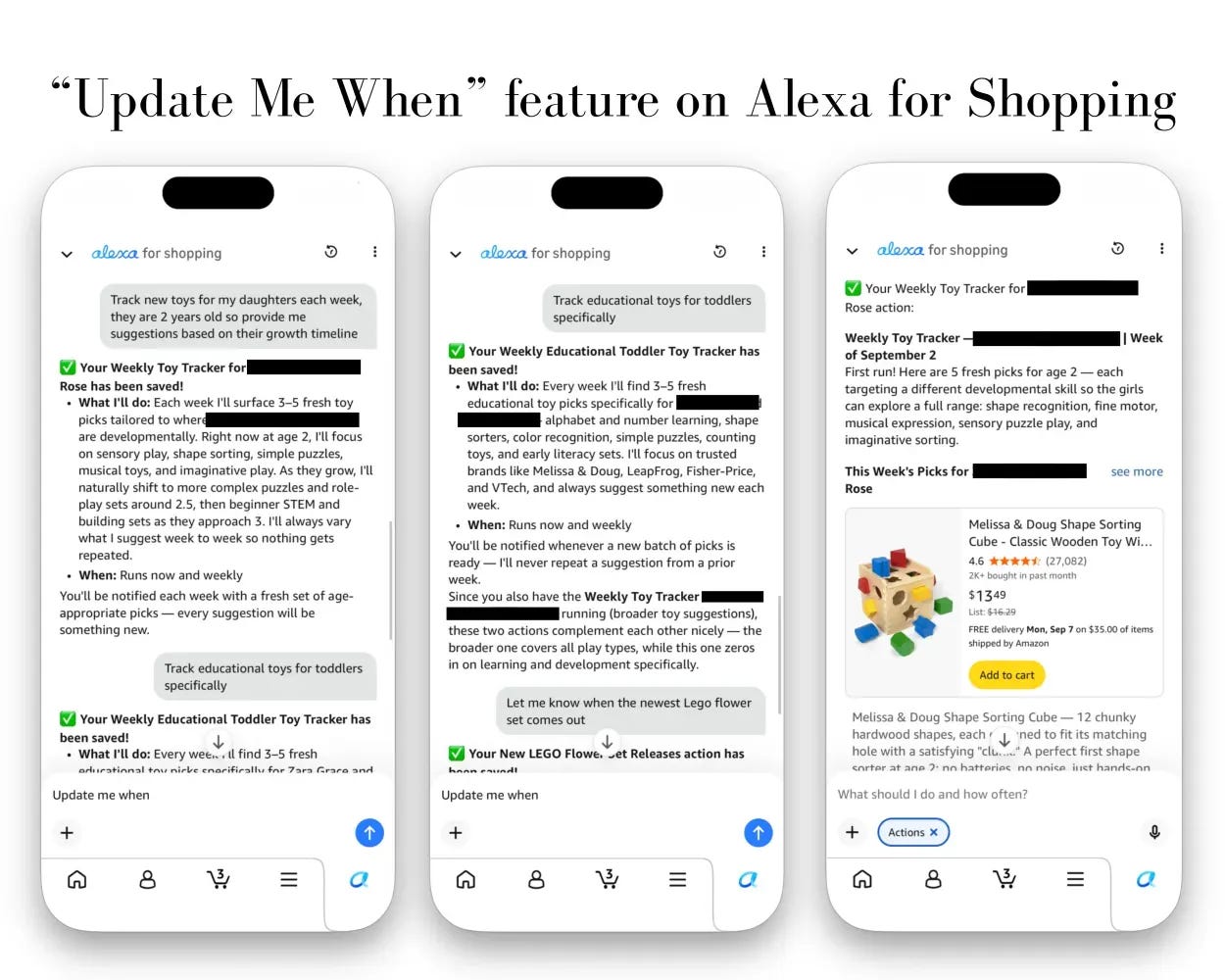
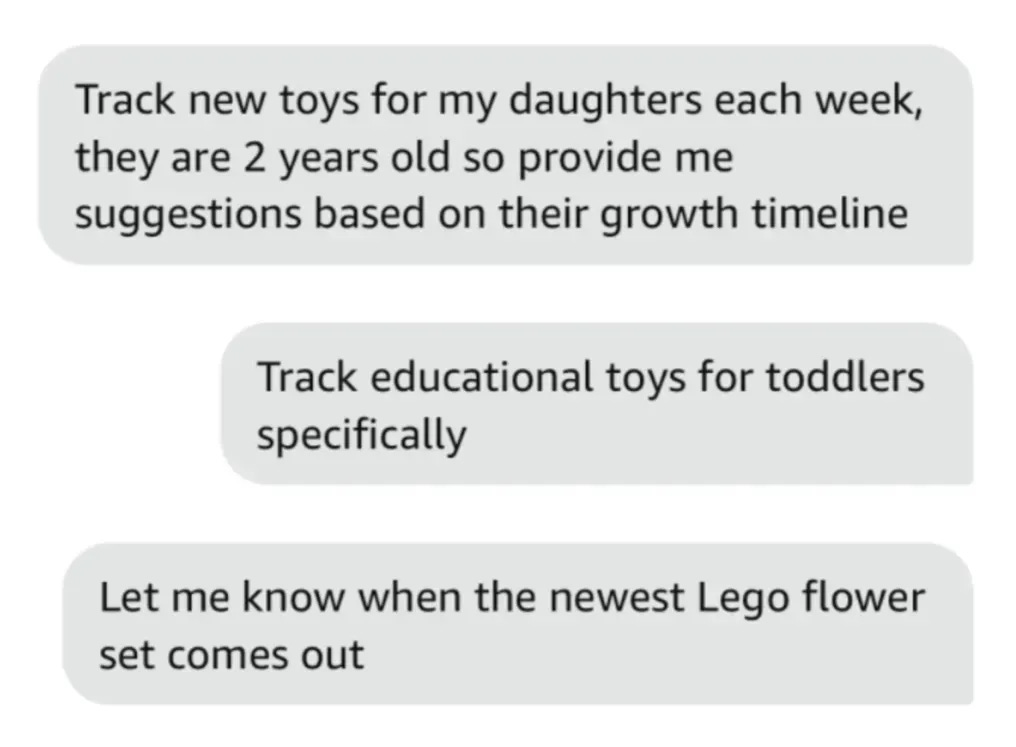
Instead of going to an interest, the interest comes to me, on a schedule I set, from the conversation I was already having. I told her the ages, the timeline, the developmental stage, and asked for suggestions every week or so as my daughters move through it. Then, naturally, I asked her to keep me current on the latest LEGO sets.
She noticed the overlap. She pointed out that the broader tracker covers all play types while the new one zeros in on learning and development, and that the two complement each other rather than collide. She was reasoning about my standing instructions as a set, not filing them as separate tickets. (I also asked her to tell me when the newest LEGO flower set comes out, because of course I did, but that one is the old kind of alert, and it is not the point.)
The tracker ran. Week of September 2, first run, five fresh picks for age two, and each one assigned to a different developmental skill: shape recognition, fine motor, musical expression, sensory puzzle play, imaginative play. She did not hand me a list of toys. She handed me a curriculum for the week with a product attached to each line. The first card was a Melissa & Doug shape sorting cube, twelve chunky hardwood shapes, rating, price, delivery date, and an Add to cart button sitting under it, with a one-paragraph explanation of why it fits a two-year-old right now. Nobody typed a query to produce that card. I stated a stage of life once, and the results now show up on their own, in the same conversation, and next week they will be different because my daughters will be a week further along. That is the whole design.
A distinction matters here, because the “update me” verb is not new. Alexa could already notify you when an item came back in stock, went out of stock, or changed price. Those are alerts about a product you already picked. What is new is the object of the update. A restock alert watches one ASIN. A scheduled interest watches a person, a stage of life, a category that has not settled yet, and comes back with candidates I did not know to ask for. One tracks availability, while the other tracks intent.
Here is the use case I usually give when I explain this to brands: the mom trying to keep up with her children’s interests, letting the assistant send her products ahead of gifting season so she is not starting from zero in December. I used to describe that mom as a hypothetical. She is now a fairly accurate description of my own account settings (my wife with twins).
When the assistant initiates the recommendation, on a cadence, against a stated stage of life, your listing is being evaluated while nobody is looking. No query exists to win. What exists is an age, a skill, an interest, and a set of products that appear to answer it. Whether your ASIN is one of them depends on how legibly your product data says who it is for and when.
The job postings call it AFS. I have read enough of them to notice the pattern: the shopping features that used to launch as separate experiments are converging on one assistant with one memory. Interests was the latest to fold in. It will not be the last.
My daughters will outgrow whatever she recommends this week. That is the point. She is scheduled to notice.