


TL;DR
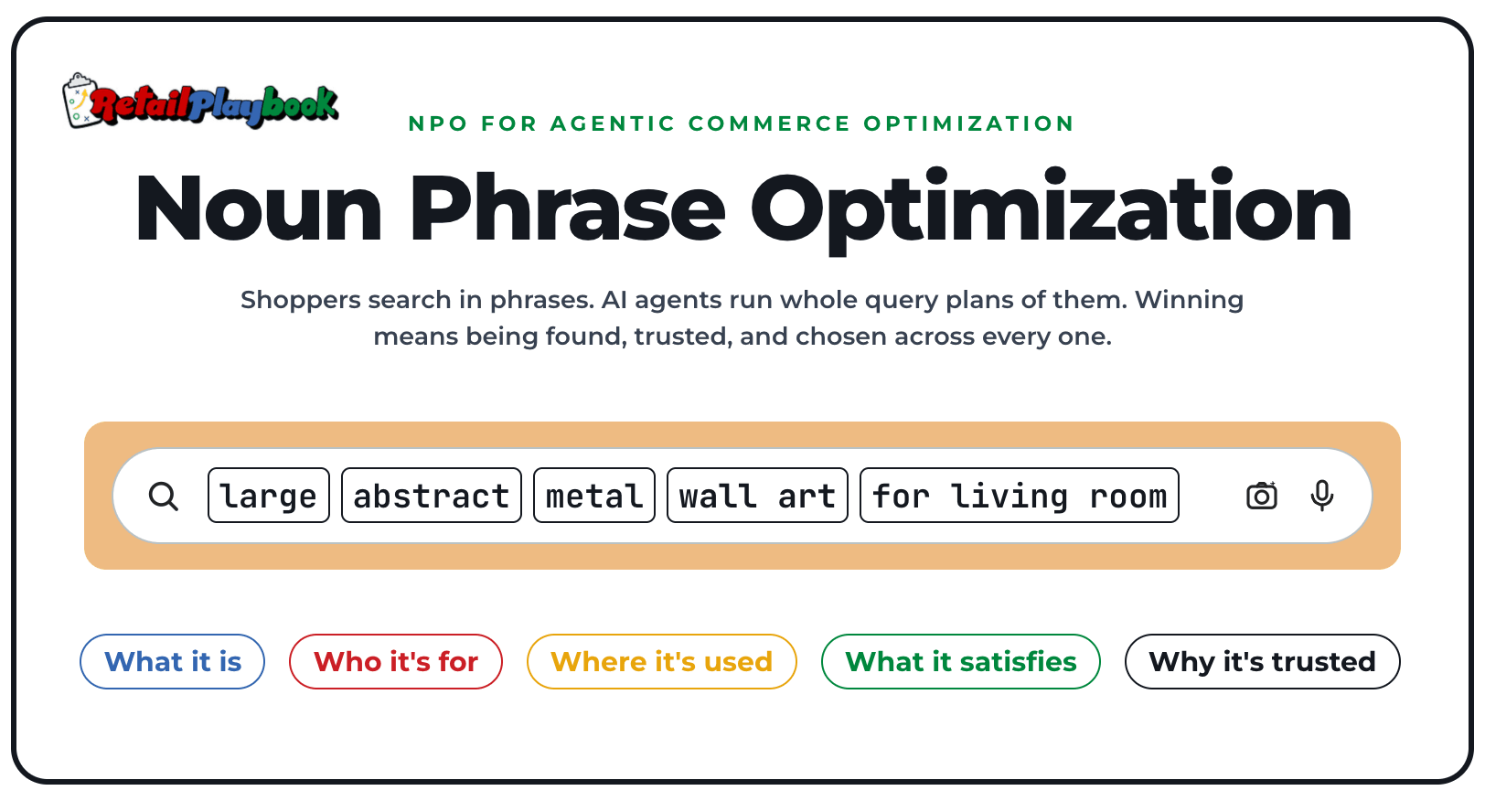
Noun Phrase Optimization is the practice of organizing product language and product evidence, around the complete product phrases that define what a product is, who it is for, where it is used, what constraints it satisfies, and why it can be trusted. Shoppers search in noun phrases, and AI shopping agents now expand one prompt into a broader family of related queries. The goal is no longer to rank for a keyword. The goal is query-plan coverage: being eligible, relevant, persuasive, trusted, and machine-legible across the search paths a shopper or agent may run inside a buying mission.
Why Noun Phrases Sit at the Center of Agentic Commerce Optimization
In my previous article, I laid out a clear definition of Amazon ACO
Amazon ACO is the practice of engineering an ASIN so it can be retrieved by keywords, interpreted through structured data, reasoned over through semantic context, trusted through evidence, and selected as the right component inside a shopper’s larger mission
I also laid out seven distinct strategies for putting it into practice.
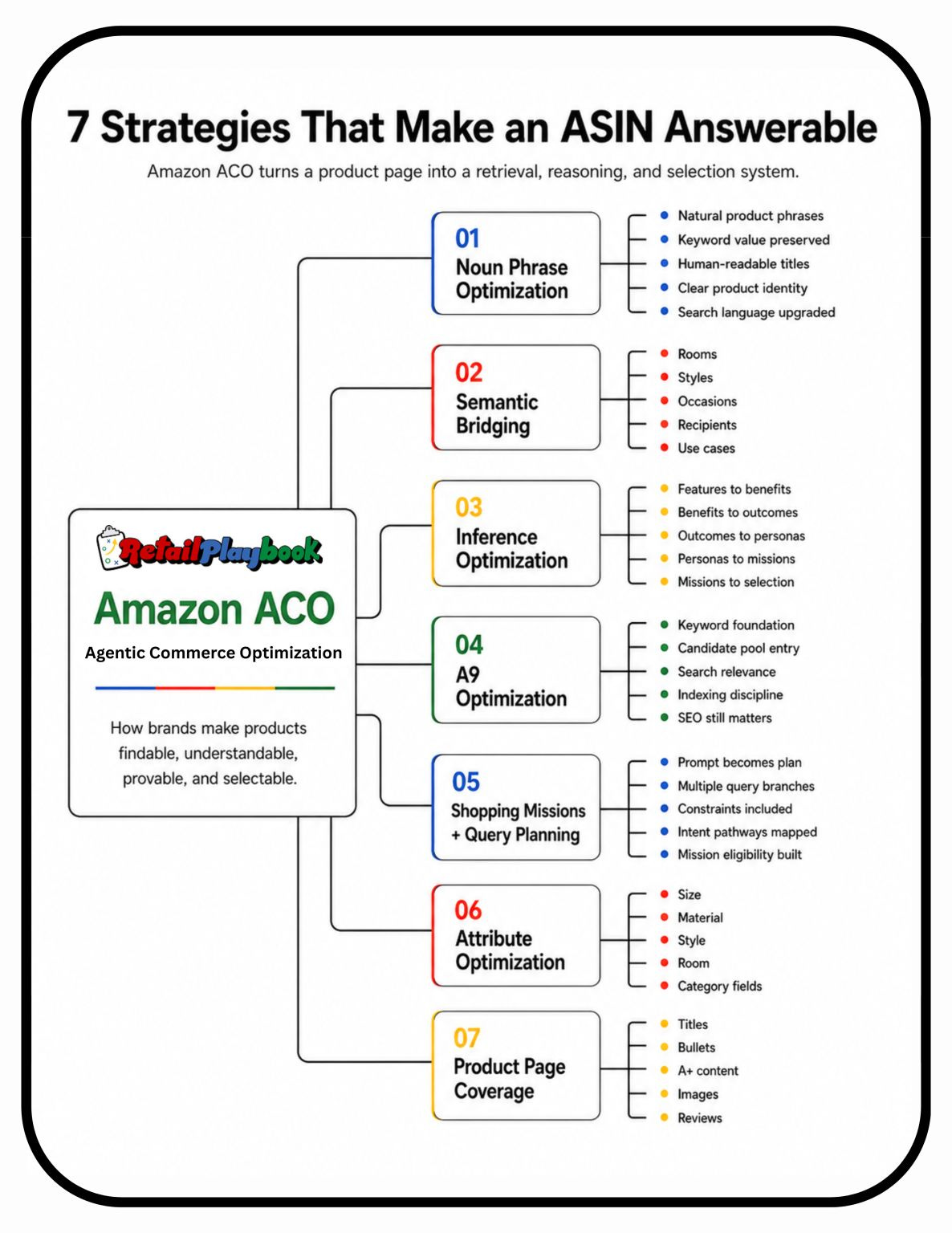
I argued, Amazon shopping now runs on two discovery systems working together. A9, the search algorithm that has powered Amazon’s marketplace for years, still decides whether a product can be found at all: it reads listing words and assembles the candidate pool a query pulls from. Sitting on top of that pool is Alexa for Shopping, powered by Rufus, which interprets what the shopper is actually trying to accomplish, reasons through their context and memory, applies constraints, weighs the evidence on each product page, personalizes the result, and selects the item that best fits the person, the occasion, the budget, and the moment. Agentic Commerce Optimization (ACO) is the practice of engineering an ASIN to succeed across both layers at once.
Good ACO is great SEO, but great SEO alone is not enough for ACO.
The new objective is to become eligible across the whole family of query pathways a shopper mission generates. A keyword is what a person types; a mission is what they are trying to get done. When someone asks an assistant to “find something for my kids and our home,” that one prompt can fan out into many searches by product type, room, style, use case, recipient, budget, material, size, and constraint. Query Planning Optimization (QPO) is the layer that asks a harder question than keyword coverage ever did: of all the queries this mission may generate, how many can my product be found by, and how many can it honestly win?
Noun Phrase Optimization enters here. If QPO predicts the query paths and ACO governs the structured data, evidence, and page proof that let a product be understood and selected, then noun phrases are the language layer that makes all of it retrievable. Public research and observable marketplace behavior both suggest that modern commerce search benefits from typed relationships between products and needs. A precise noun phrase gives the system and the shopper a stronger product meaning to work with. It preserves the proven value of keyword research while expressing what a product is, its material, its place, its audience, and its job, in the natural language shoppers and assistants both use. The more exactly a phrase describes its product, the more query branches a listing may be able to answer. Attributes create structured truth and context creates inference, but noun phrases create retrievable meaning. The rest of this playbook is about building them well.
Part I: Foundations
What Is a Noun Phrase?
A noun phrase is a group of words centered around a noun that functions as a single unit to identify, describe, or refer to a person, place, thing, idea, or concept. The noun serves as the head of the phrase, while surrounding words such as adjectives, determiners, numerals, or prepositional phrases provide additional meaning. Examples include wall art, metal wall art, large abstract metal wall art, and large abstract metal wall art for living room. Although these phrases vary in length and specificity, each functions as one complete noun phrase because it names a single, coherent concept.
Noun phrases are fundamental to human language because they allow meaning to become progressively more precise. Starting with a simple noun such as chair, additional words can narrow its meaning into office chair, ergonomic office chair, or ergonomic mesh office chair for home office. Each added modifier reduces ambiguity by introducing attributes such as material, size, color, style, function, audience, or context. Rather than creating separate ideas, these modifiers work together to refine the same underlying concept into a more specific and informative noun phrase.
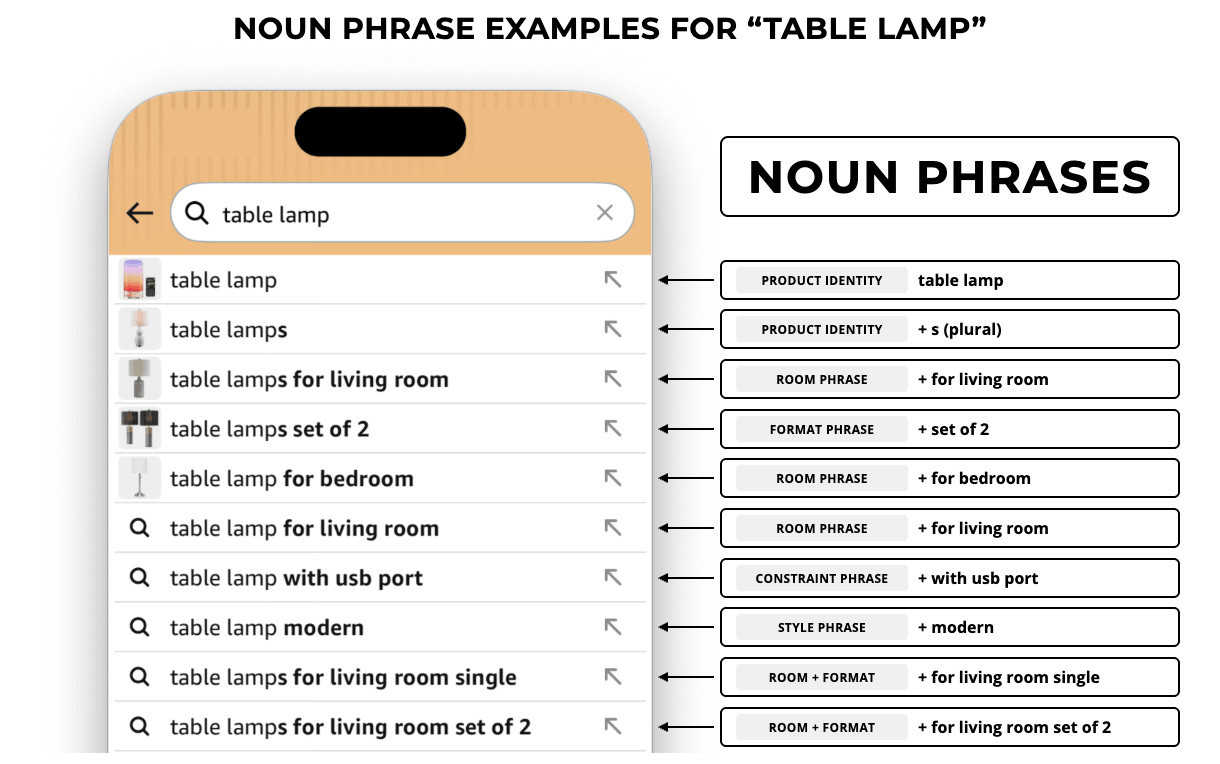
Figure 1. Amazon suggestions for table lamp show how a parent product concept can fan out into related phrases by room, format, constraint, and style. Each suggestion adds a modifier that makes the original concept more specific.
In commerce and information retrieval, noun phrases are especially important because they closely reflect how people search, think, and communicate about products. Shoppers rarely search using isolated keywords. Instead, they naturally use descriptive noun phrases such as stainless steel water bottle, modern farmhouse dining table, or organic tomato ketchup. Search engines, recommendation systems, and AI shopping assistants increasingly rely on these complete semantic units to understand intent, match products to customer needs, and distinguish one product from another. As a result, well-constructed noun phrases have become one of the foundational building blocks of modern search, semantic retrieval, and AI-driven commerce.
What Is Noun Phrase Optimization?
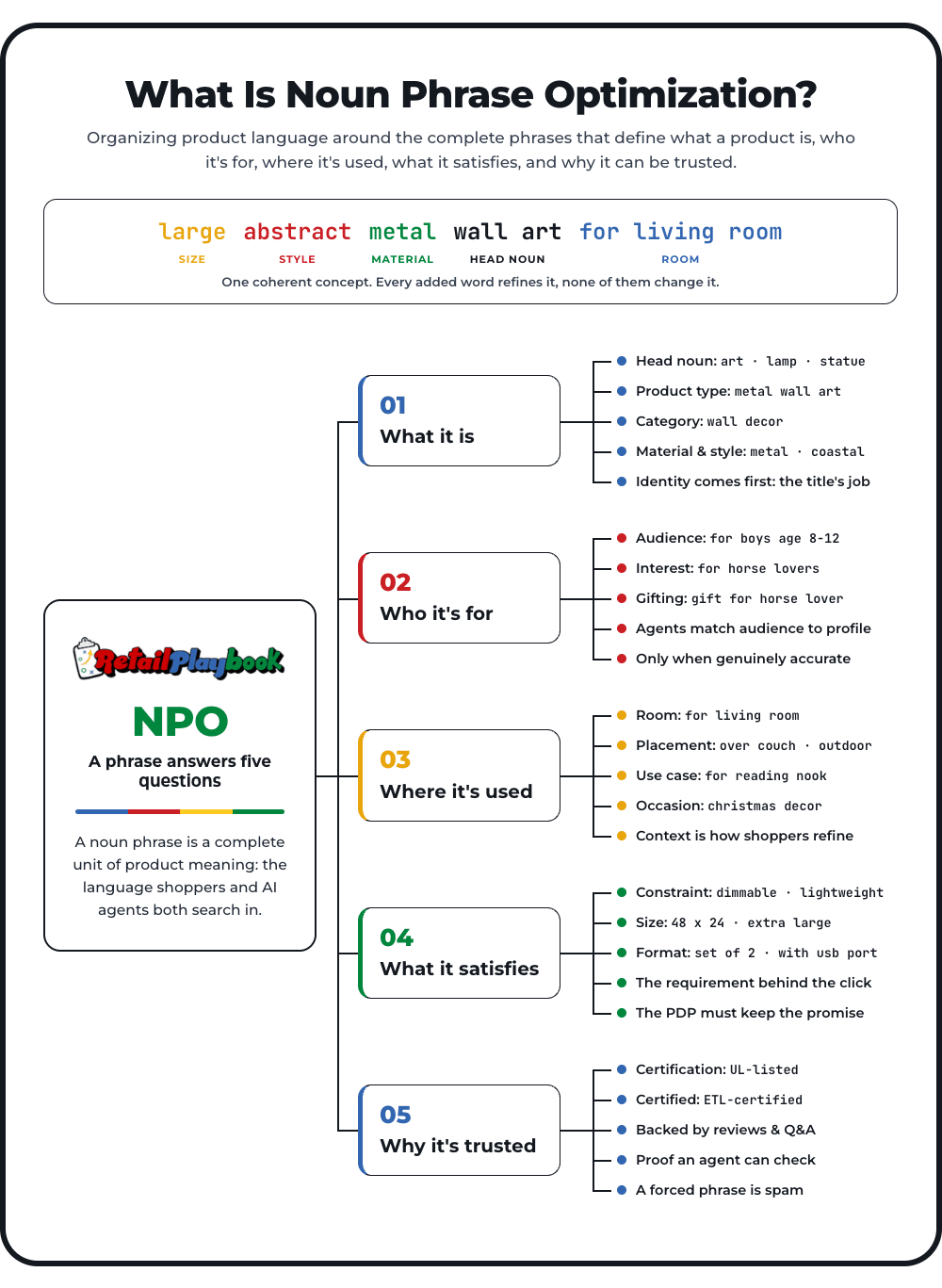
Noun Phrase Optimization is the process of organizing product language, product evidence, and brand-controlled content around the noun phrases that define what a product is, who it is for, where it is used, how it differs, what constraints it satisfies, and why it can be trusted.
Traditional keyword work asks, “Which search terms should the ASIN rank for?” That objective still holds, but within Alexa for Shopping a deeper strategy is required. Now, we ask,
Which query paths must the ASIN be eligible for, trusted for, compared within, selected from, and purchased through? Query plan coverage presupposes keyword coverage. If we do not show up in any of the keywords within the query plan, our efforts are in vain.
If Amazon search, Rufus, Alexa for Shopping, and Amazon Ads prompts rely on queries, products, catalog content, reviews, Q&A, attributes, prompts, and comparison behavior, then complete product phrases are more useful operational units than isolated keywords.
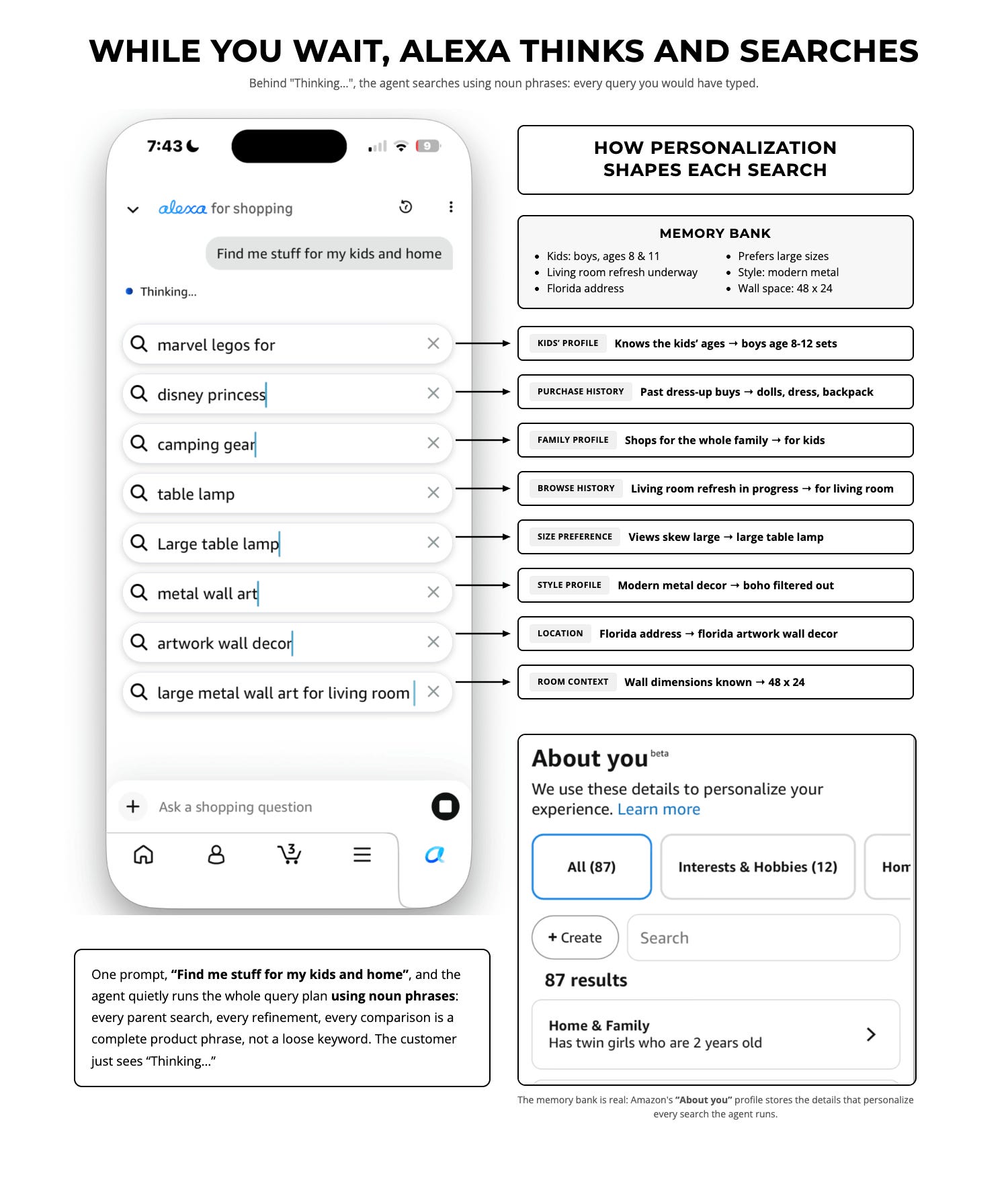
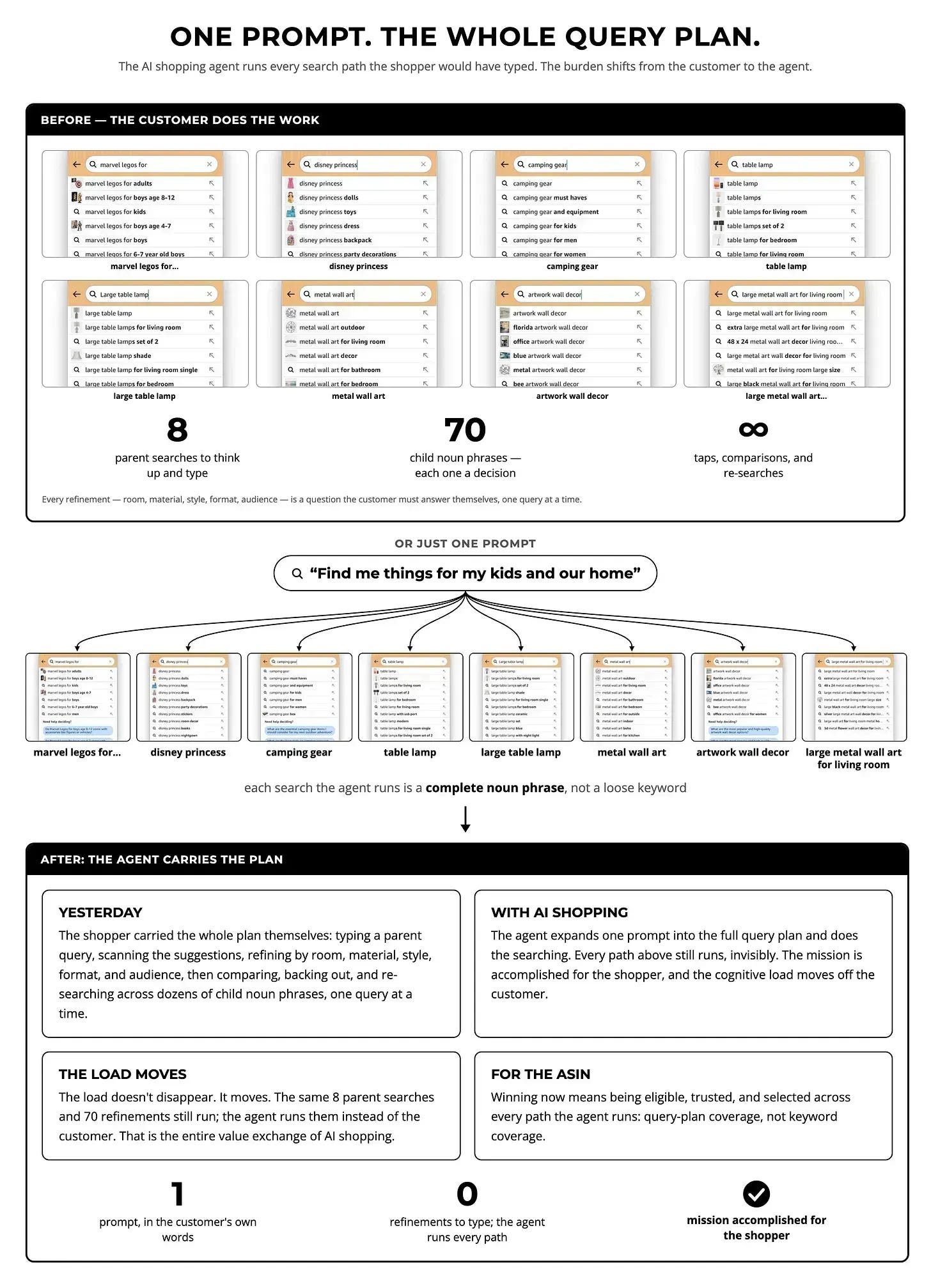
While You Wait, It Searches. Behind “Thinking…”, the agent searches using noun phrases: the kinds of queries a shopper may have typed manually. One prompt, such as “find me stuff for my kids and home,” can lead the agent into a broader family of related searches by product type, room, style, audience, use case, and constraint.
How personalization shapes each search. Household context, prior behavior, stated preferences, style signals, budget, location, and product constraints may all shape the assistant’s search path. The point is not that every shopping journey will use every possible signal. The point is that the search path is no longer limited to the exact words the shopper typed.
The Burden of Search. Without the agent, every one of these moves belongs to the customer, for every single item: (1) find the words, turning a vague need into a searchable phrase; (2) type the search, thumbing out the parent query; (3) scan the suggestions, reading autocomplete options and judging which child phrase fits the mission; (4) open and compare, weighing price, rating, size, style; (5) second-guess, hit back, start over; (6) refine the phrase, adding room, size, material; (7) repeat for the next item as the loop restarts; (8) settle or abandon. That whole loop can run again and again across a shopping mission. One prompt changes who carries the work.
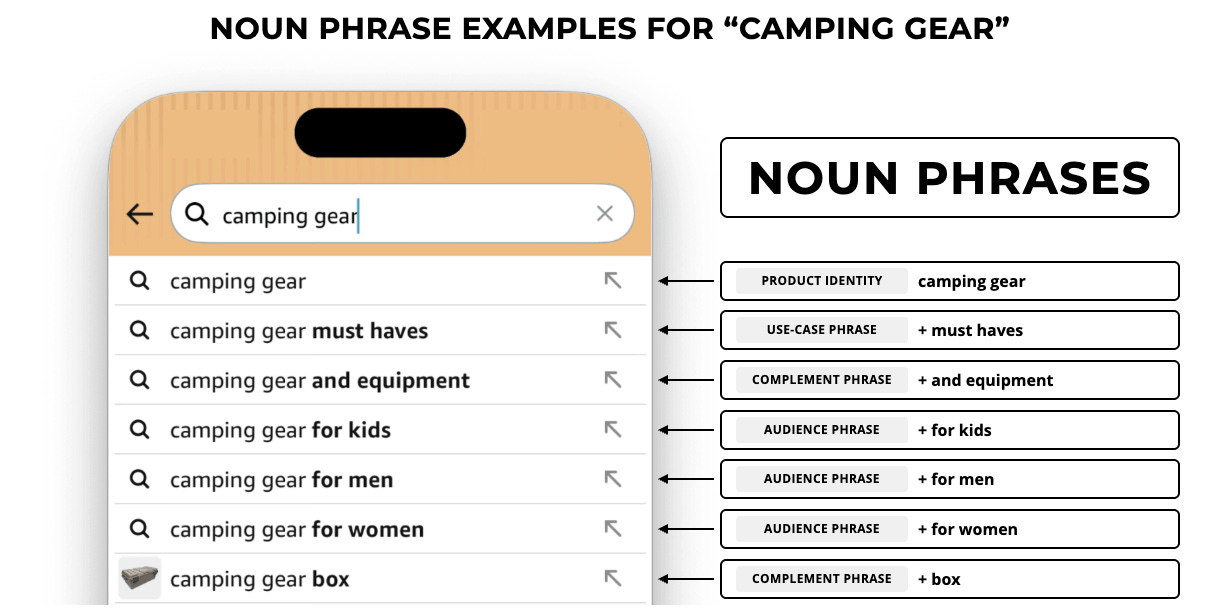
Figure 3. Amazon suggestions for camping gear show how a parent product concept can expand through audience, use case, and complementary-product language. The phrase environment around a parent query often reveals the broader mission behind it.“Need help deciding?” prompts show the query plan extending into AI-assisted paths.
Part II: The Noun Phrase System
The Anatomy of a Noun Phrase
A noun phrase can include:
Head noun: art, statue, lamp, ketchup.
Product type: wall art, horse statue, floor lamp, tomato ketchup.
Material: metal, bronze, brass.
Style or theme: coastal, equestrian, mid-century, industrial.
Use case: for living room, for reading nook, for bedside table.
Constraint: outdoor-safe, lightweight, dimmable, energy-efficient.
Audience: horse lover, interior designer, home decorator.
Proof layer: official seller, UL-listed, ETL-certified floor lamp.
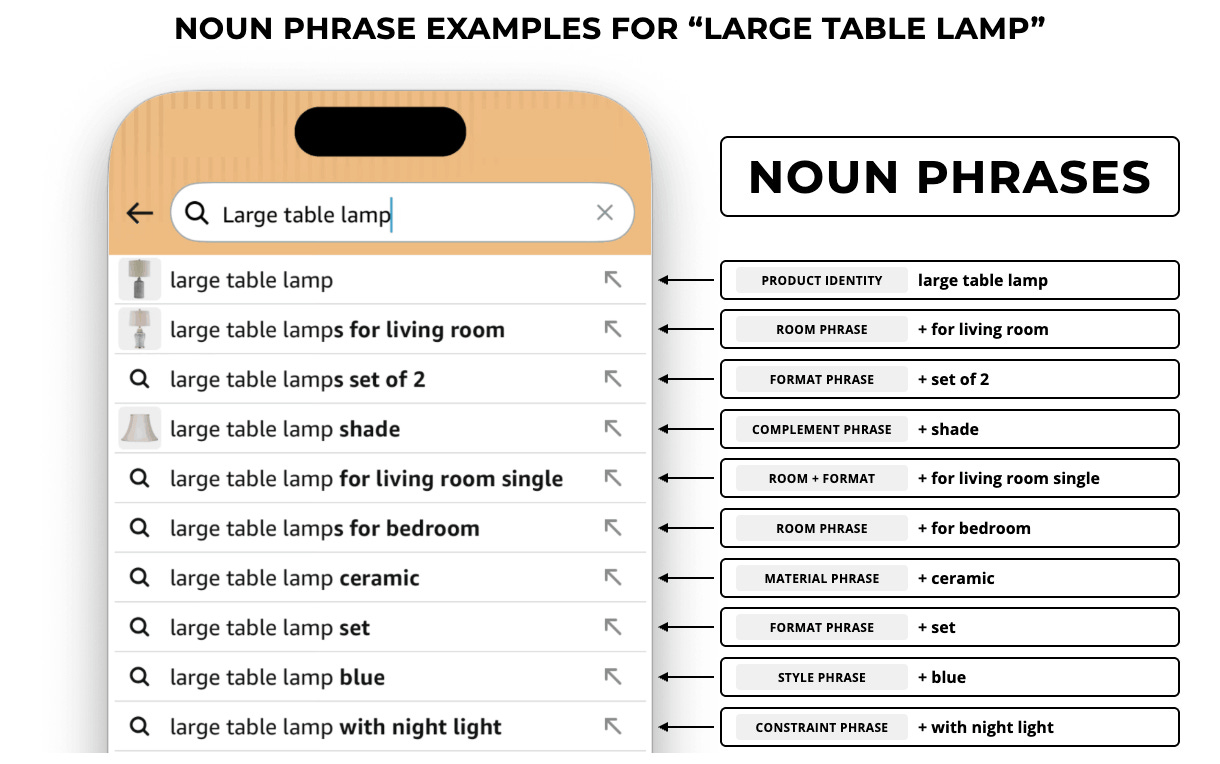
Figure 4. Amazon suggestions for large table lamp show noun phrase anatomy in the wild: room, format, material, style, and constraint all appear as natural refinements of the parent product concept.
The NPO Taxonomy for Amazon Listings
NPO needs a taxonomy because different phrases perform distinctly across categories, but broadly speaking, we can understood through six broad categories: identity, attributes, context, audience, constraints, and proof.
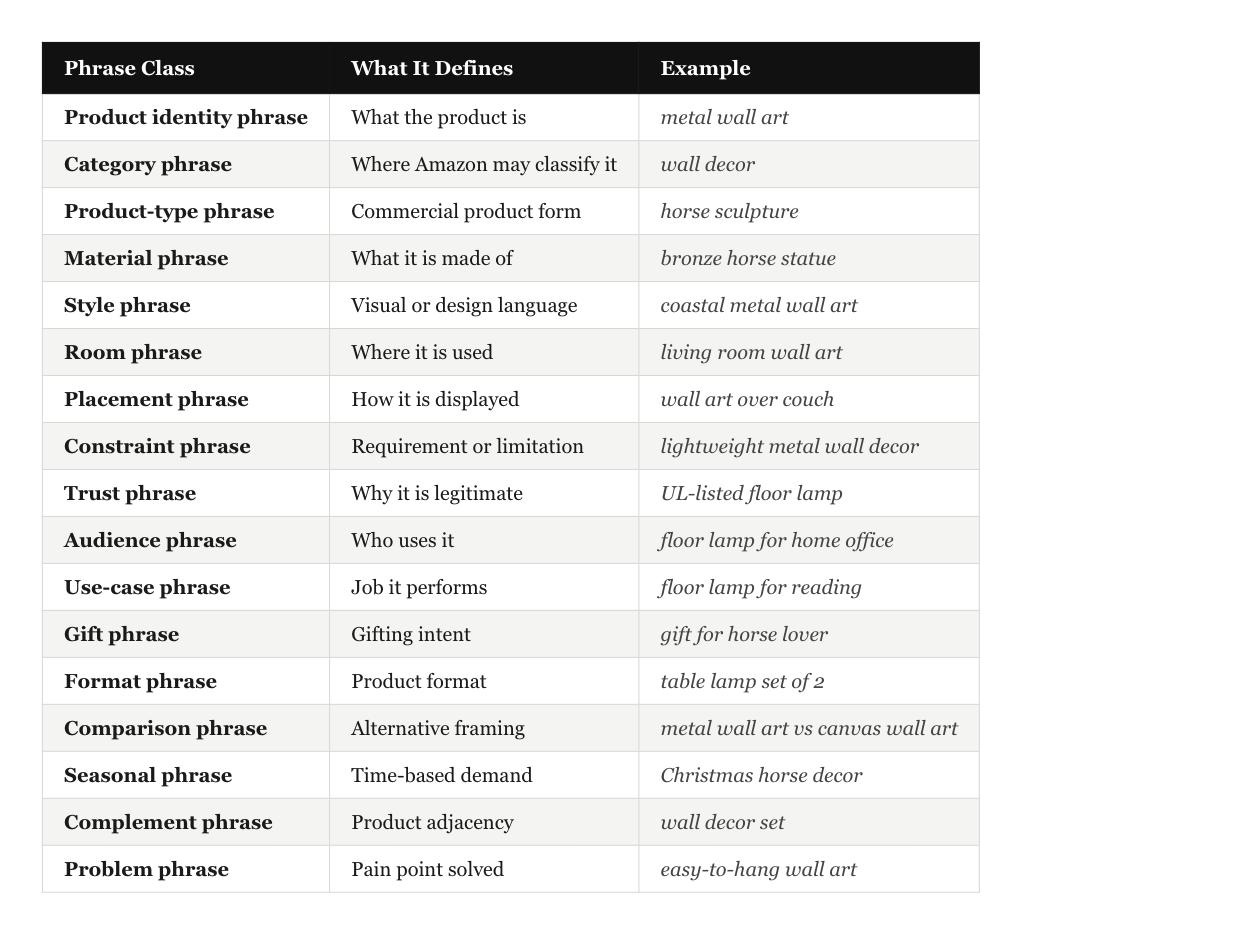
The taxonomy prevents messy optimization, helping the operator understand that not every phrase belongs everywhere, and not every phrase belongs on the product at all. Different content surfaces carry distinct evidentiary jobs. Some establish what the product is, clarify fit, reduce uncertainty, and support comparison. The discipline is not to force every phrase into every field, but to make the product’s real meaning easier to retrieve, understand, verify, and select.
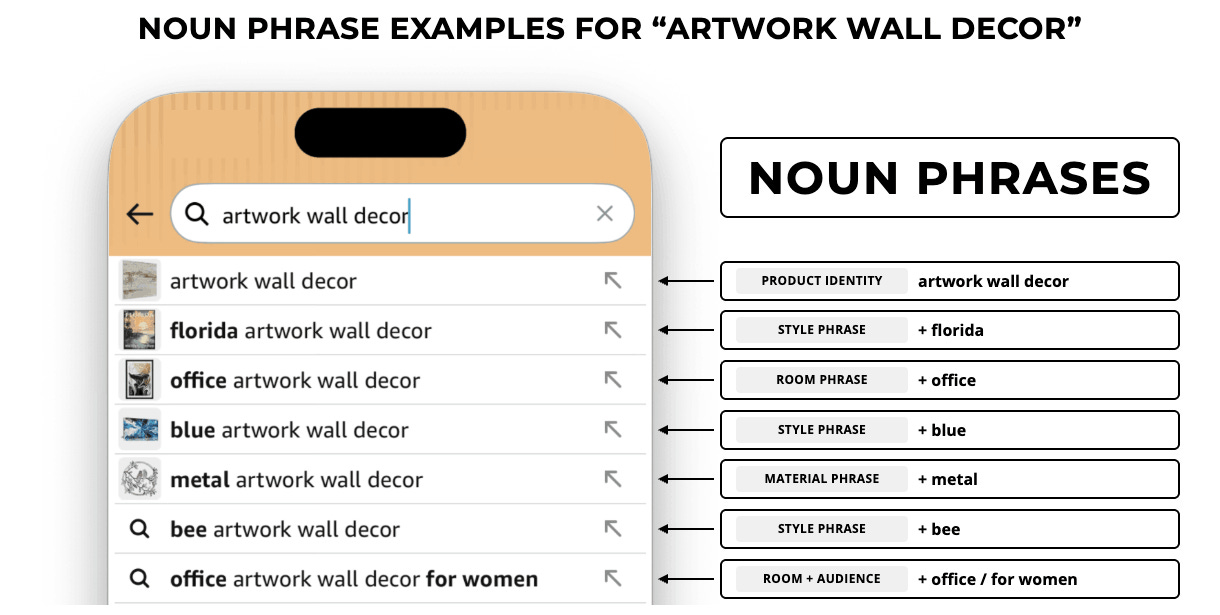
Figure 5. Amazon suggestions for artwork wall decor show how modifiers can attach before or after the head noun, refining the product concept by style, room, material, or audience.
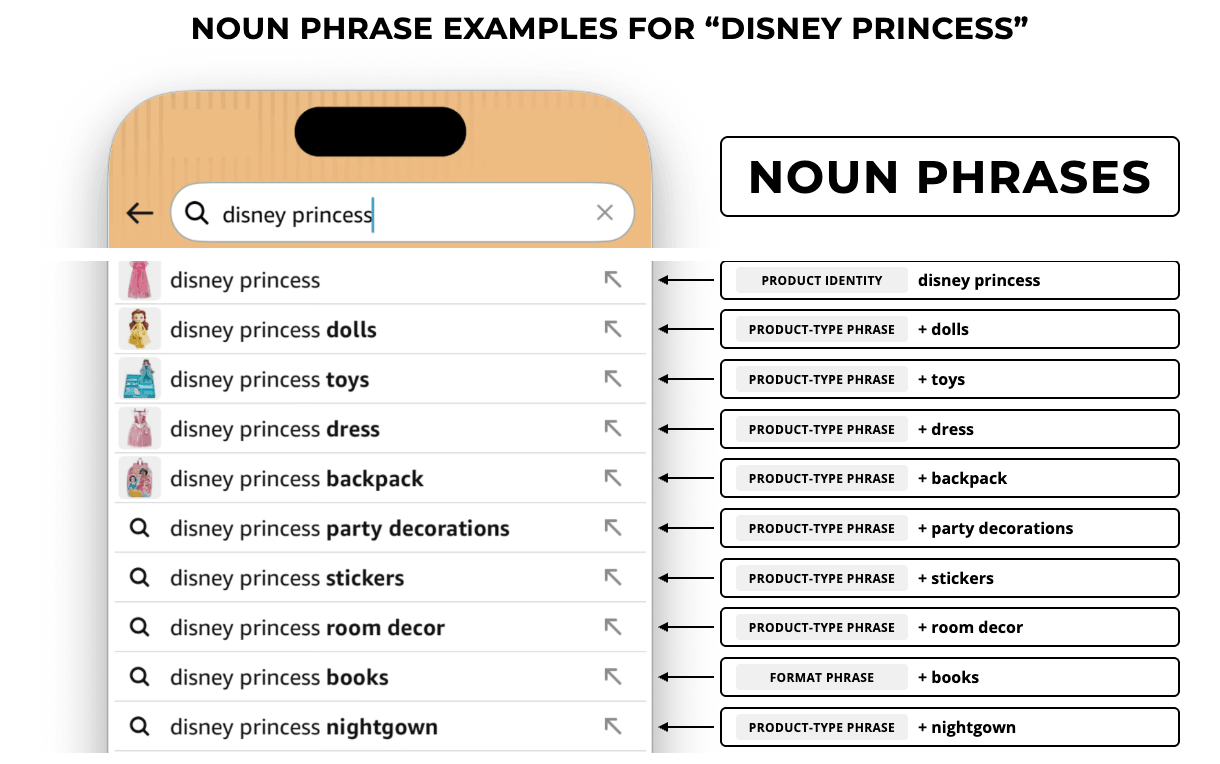
Figure 6. Amazon suggestions for disney princess show how a parent query can expand across commercial product forms. The same head concept can fan out across dolls, toys, apparel, decor, books, and other product categories.
How to Build Phrase Evidence
Operators should build phrase evidence from the market, not imagination. Useful phrase evidence can come from query behavior, advertising signals, product-page content, customer language, reviews, Q&A, catalog data, and brand-owned product facts.
Part III: Measuring & Mapping
How to Think About Signals
Marketplace reports do not all answer the same question. NPO requires operators to understand that different signals reveal different parts of the search and shopping journey.
Some signals speak to visibility. Some speak to attention. Some speak to shopper confidence. Some speak to product-page fit. Some speak to conversion. Some speak to competitive context. Some speak to whether the product’s language is becoming clearer across relevant demand clusters.
Different marketplace, catalog, advertising, and customer-language signals can help teams understand whether product language is improving visibility, attention, confidence, and conversion. No single report tells the whole story. The goal is not to imply perfect attribution from every phrase; it is to understand whether the product is becoming easier to find, understand and select.
How to Measure NPO Without Reducing It to One Metric
Measure NPO as a visibility and confidence system, not as a single content change. Across the improvement loop, operators should evaluate whether product language appears to improve across visibility, attention, confidence, product-page fit, conversion, demand capture, and learning from controlled changes.
Across the improvement loop, evaluate whether product language appears to improve across these areas:
Visibility: Is the ASIN being considered in relevant demand environments?
Attention: Is the product language earning the shopper’s interest?
Confidence: Does the product page reduce uncertainty?
Fit: Does the PDP satisfy the shopper’s constraint?
Conversion: Does the product complete the mission?
Demand capture: Is the brand or ASIN gaining strength across relevant demand clusters?
Learning: Do controlled content changes suggest measurable improvement?
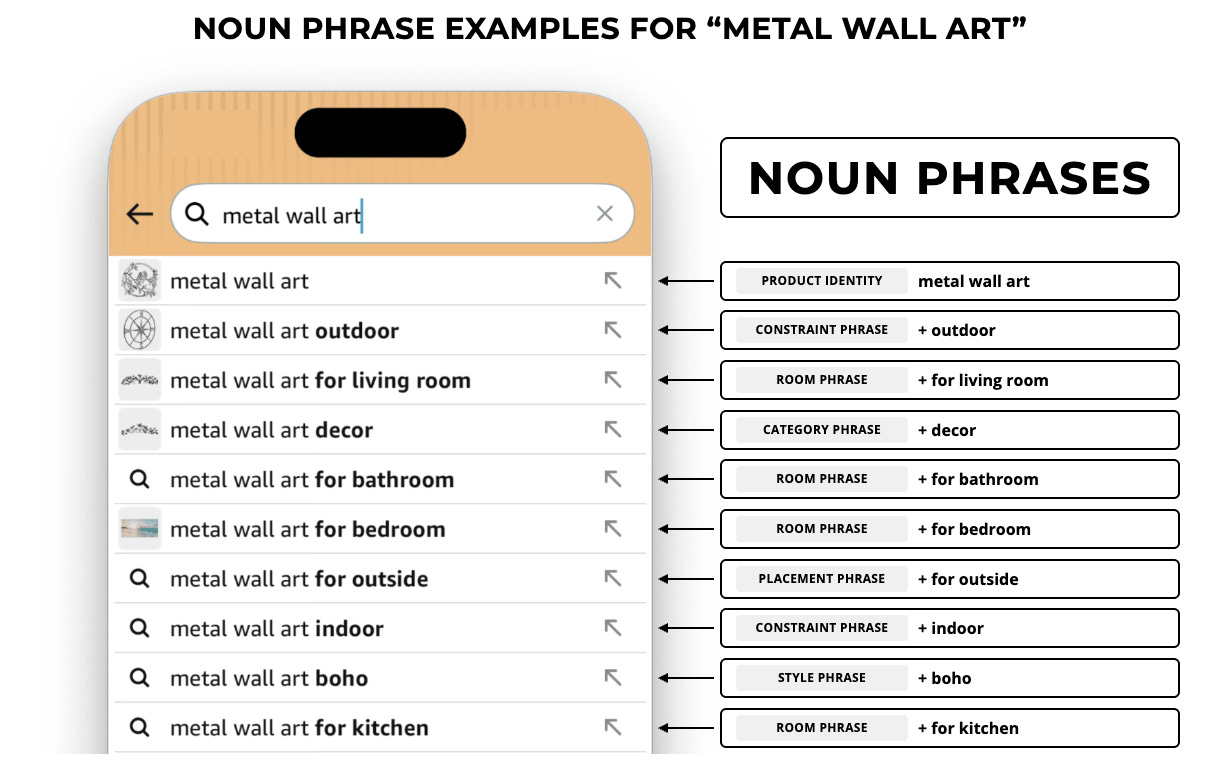
Figure 7. Amazon suggestions for metal wall art show that a parent query can refine into room, constraint, style, placement, and category language. The parent phrase matters, but much of the demand lives in the refinements beneath it.
Part IV: NPO in Practice
NPO Rules for Amazon Operators
Use accurate noun phrases.
Prioritize phrases that represent real product fit.
Do not force irrelevant terms.
Separate parent phrases from child phrases.
Use mega phrases only when natural.
Use noun stacks to organize meaning
Interpret organic and paid signals together, because they reveal distinct forms of demand, relevance, and content-market fit.
Understand where the product is already visible and where relevant demand may still be underrepresented.
State attribution carefully.
But not every phrase should be used. Horse memorial statue should only be used if memorial intent is genuinely accurate. NPO requires discipline. It does not force irrelevant phrases.
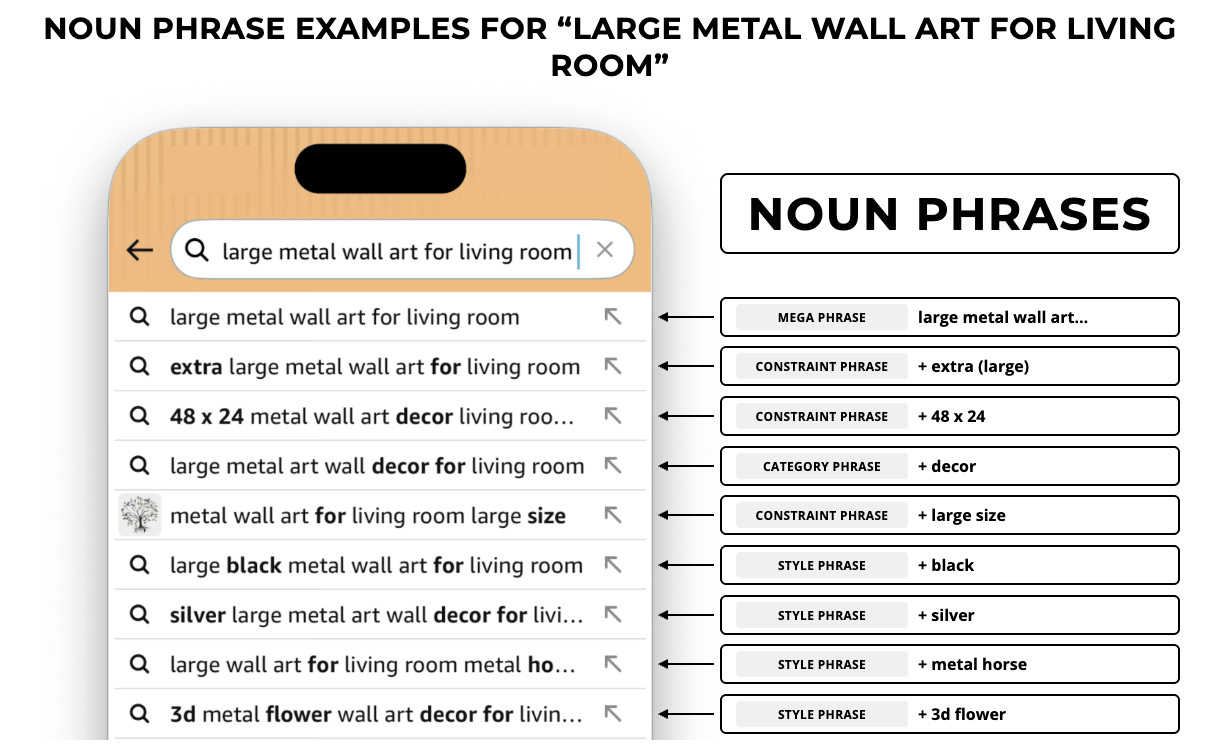
Figure 8. Amazon suggestions for large metal wall art for living room show that even a mega phrase is still a parent. Shoppers may keep refining by size, color, motif, and format. Mega phrases should be used only when natural.
Improve Product Language and Evidence
Teams should improve the product’s language, evidence, and presentation across the surfaces they control. The goal is not to stuff longer phrases into every available field; it is to make the product’s meaning easier to retrieve, compare, verify, and select.
NPO requires teams to connect product language, marketplace evidence, content quality, and performance signals into a disciplined improvement loop.
A traditional Amazon strategy might ask, “Do we rank for metal wall art?” QPO asks a better question: “What search paths would a shopper or AI shopping assistant likely use to satisfy the buying mission behind metal wall art?”
QPO identifies the paths. NPO builds the language and proof that allows the ASIN to win those paths. Operators can evaluate whether marketplace signals improve across relevant demand clusters
.
Figure 9. One prompt vs. the query plan: the searching still happens; the question is who carries the cognitive load. Before, the shopper has to think up, type, compare, refine, and re-search. After, the shopper gives the assistant the mission, an
d the assistant carries more of the search burden. The cognitive load doesn’t disappear; it moves off the customer and onto the agent.
Part V: COSMO and the Relational Layer
COSMO Relations, Noun Phrases, and the Incomplete Bridge Between Search Language and Product Meaning
Noun Phrase Optimization becomes much more important when viewed through the lens of Amazon’s COSMO research. COSMO is strategically useful because it shows that Amazon reads beyond product attributes, category labels, and product titles, extending to the commonsense relations that connect products to human intentions.
The COSMO paper states that existing ecommerce knowledge graphs often contain large volumes of concepts or product attributes but fail to discover user intentions. COSMO is presented as a system that mines user-centric commonsense knowledge from massive behaviors, including search-buy and co-buy behavior, to construct large-scale ecommerce knowledge graphs for downstream services such as search relevance, recommendation, and search navigation.
It matters for NPO because noun phrases often presuppose exactly the kinds of relations COSMO tries to model.
For example:
large coastal metal wall art for living room
carries the weight of a more specific keyword phrase and presupposes several relations at once: that the product is made of metal, has a coastal style, is sized large, and belongs in a living room.
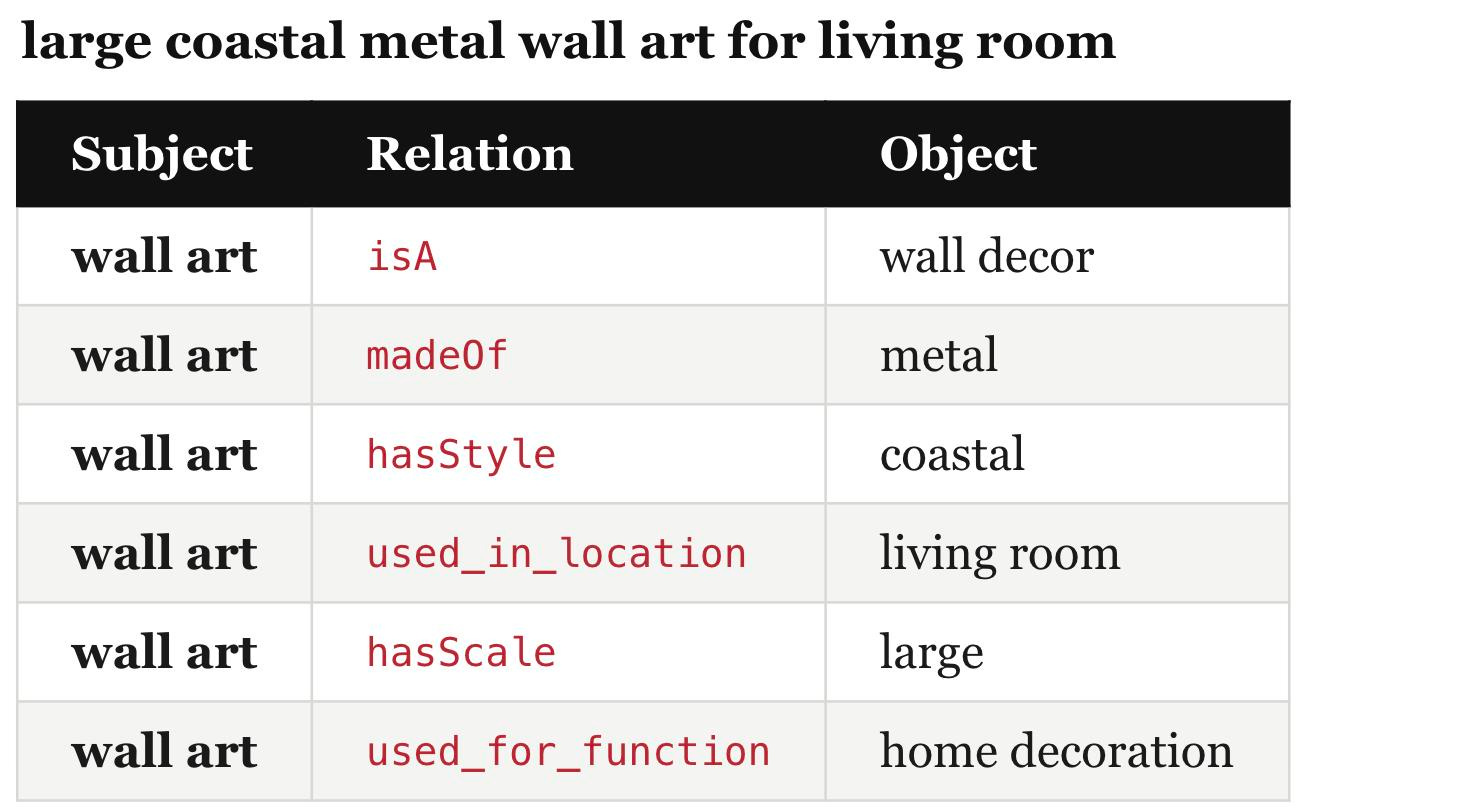
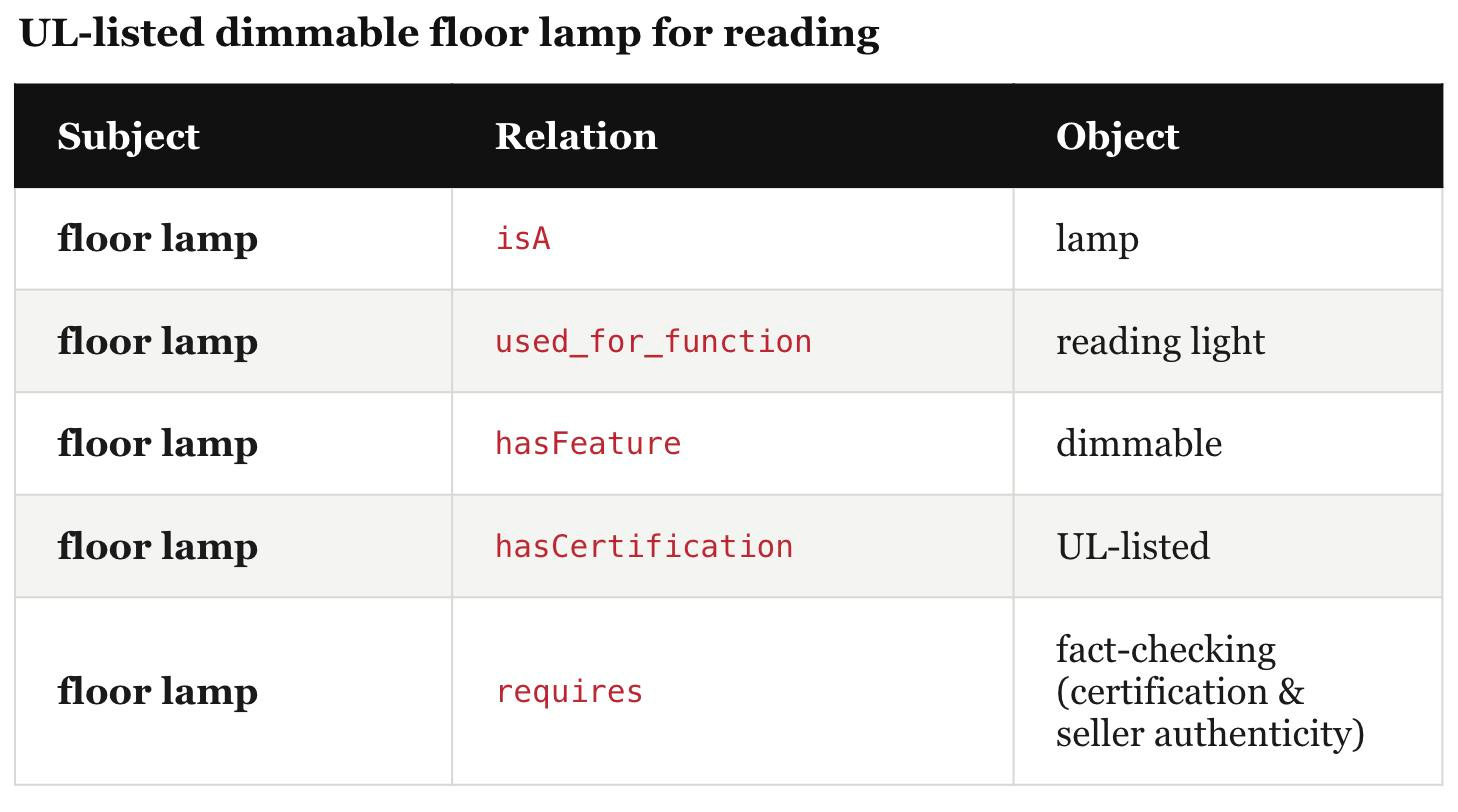
This is the deeper reason NPO is more than specificity or query expansion. A noun phrase is a compact relation statement. It expresses what the product is, what it is made of, where it belongs, who it is for, what function it serves, what event or situation it supports, and what proof must be checked before purchase.
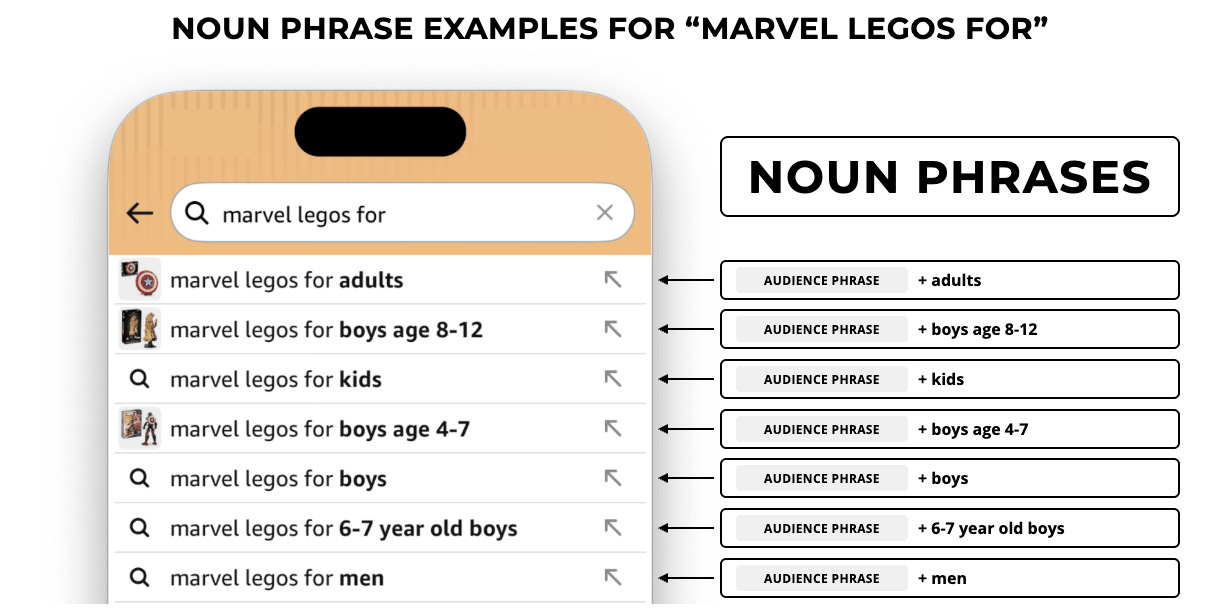
Figure 10. Amazon suggestions for marvel legos for show how a parent phrase can refine through audience language. That does not mean sellers can directly control Amazon’s internal relation graph, but it does show why audience, context, and product fit matter in AI-assisted commerce.
However, COSMO also shows why a purely COSMO-inspired optimization framework would be incomplete for operators.
The COSMO relation taxonomy is powerful, but it is not perfectly clean or categorically distinct. Multiple relation types can point toward similar commercial meanings, such as function, usage, audience, event, activity, time, or intent-like contexts. That means COSMO’s relations are useful as a signal of how ecommerce systems may organize intent, but they should not be treated as a final operator taxonomy.
One caveat matters here. NPO should not simply copy COSMO relation names and turn them into a listing checklist. The relation layer is messier than that. COSMO itself is built from behavior, generated knowledge, relation-aware prompts, human feedback, plausibility, typicality, filtering, instruction tuning, and downstream serving. The paper explicitly discusses noisy generations, generic or unfaithful knowledge, filtering, human annotation, and typicality judgments. In other words, even Amazon’s own research treats relation generation as a probabilistic, quality-controlled process. It behaves nothing like a simple deterministic catalog rule.
The right way to frame this is a balance of usefulness and limits:
COSMO makes NPO strategically useful because it confirms that ecommerce search and recommendation systems benefit from user-intention relations on top of product attributes. But COSMO also makes NPO operationally incomplete because sellers do not receive a COSMO relation report, cannot directly inspect Amazon’s internal relation graph, and cannot know with certainty which relations Amazon has inferred for a given ASIN.
That means NPO should be described as relation-aware product-language optimization. It stops short of direct COSMO optimization.
We cannot directly optimize COSMO.
But.. we can structure product content around noun phrases that presuppose commercially important relations, then evaluate whether marketplace signals improve across relevant demand clusters.
It gives operators a useful framework without overstating control. COSMO explains why noun phrases matter: they encode the relational logic of e-commerce intent. NPO turns that logic into controllable product language. QPO predicts where those relations may be tested by search paths, prompts, comparisons, and fact-checking. Marketplace signals then show the external traces of whether that language may be working.
Taken together, the layers stack cleanly:
COSMO reveals the relational layer of ecommerce search. QPO predicts the query paths where those relations may matter. NPO expresses those relations through accurate noun phrases in operator-controlled content (the product detail page). But because COSMO relations are overlapping, partially inferred, and not exposed directly to sellers, NPO remains an inference-based strategy rather than a complete control system.
That is why NPO is strategically useful now, but operationally incomplete. It gives Amazon operators a way to align content with the relational structure of modern ecommerce AI, while still respecting the limits of what marketplace data and public research can actually prove.
One Prompt. The Whole Query Plan. An AI shopping agent can run the search paths a shopper would have typed, shifting the burden from customer to agent. “Find me things for my kids and our home” can fan out into a broader family of product searches shaped by audience, room, style, use case, category, and constraint.
Yesterday, shoppers carried the whole plan themselves: typing a parent query, scanning suggestions, refining by room, material, style, format, and audience, then comparing, backing out, and re-searching across child noun phrases, one query at a time. With AI shopping, the agent expands one prompt into the broader query plan and does the searching. Every path still runs, invisibly. None of that work vanishes; it simply shifts off the customer and onto the agent, and that quiet handoff is what shoppers are really trading for when they hand a mission to an assistant. For the ASIN, winning now means being eligible, trusted, and selected across the paths the agent runs: query-plan coverage that goes beyond keyword coverage.
Figure 11. The full landscape: one prompt can expand into many related search paths, shifting the burden of refinement from the shopper to the assistant.
Noun Phrase Optimization is how Amazon operators translate product reality into the language of modern search, AI shopping, and retail media.
Query Planning Optimization predicts where the customer or agent may search. NPO ensures the product is named, described, shown, and proven in the noun phrases required to win those search paths.
Together, QPO and NPO create a practical system for understanding where a product is visible, where relevant demand may still be underrepresented, and how AI shopping visibility may improve without overclaiming what the data can prove.
The winning ASIN carries query-plan coverage: visible across the parent query, relevant across the child clusters, persuasive enough to earn clicks, clear enough to earn cart adds, trusted enough to earn purchases, and structured enough to be understood by both shoppers and AI shopping systems.