


My wife asked Alexa for jeans a few weeks ago, and she said almost nothing to get it: no size, no rise, no brand. Usually, it’s the same grind: search after search, cycling keywords. However, what came back was curvy fit, in her size, from a label she had bought twice before. She bought a pair without opening a single competing product page.
TL;DR
Amazon is starting to show us the machinery behind Alexa for Shopping personalization. Customer 360 appears to act as a shared memory layer that turns purchases, searches, conversations, browsing, lists, reviews, product details, and other signals into usable customer knowledge. We already know the same prompt can produce distinct product sets for different shoppers. What is new is that Amazon’s job postings and patents give us a clearer picture of how that can happen, including personalization potentially shaping the queries that get run, the products that get retrieved, which products qualify, how they are ranked, and how the final recommendation is explained. For brands, the practical implication is simple: you cannot optimize the shopper’s private memory, but you can make sure your product contains enough clear, structured evidence to satisfy the needs and preferences that memory may bring into the request.
Customer 360 is Amazon’s shared customer-memory layer, and Alexa for Shopping is one of the experiences that uses it.
Amazon can work with both explicit memories and inferred memories, so preferences may come from what a shopper says directly or from patterns in purchases, returns, ratings, lists, conversations, and product details.
We already know the same prompt can lead to different product sets for different shoppers. What is new is that Amazon’s patents give us a better idea of how that may happen, including changes to the entities identified, the queries run, the products retrieved, and the products ultimately kept.
The real question is where personalization enters the process. It may change the search before products are retrieved, filter products afterward, reorder them, change the explanation, or do several of those things together.
Amazon has also designed for individual versus household memory, including the problem of figuring out which person in a household is actually making the request.
For brands, product truth is the part you can control. Fit, size, materials, compatibility, use cases, variation data, attributes, and other clear product evidence determine whether an item can satisfy personalized conditions the brand itself cannot see.
None of this gives us Alexa’s live ranking formula. The sources show the memory infrastructure and the kinds of mechanisms Amazon has designed, but not the exact production weights, thresholds, or rules.
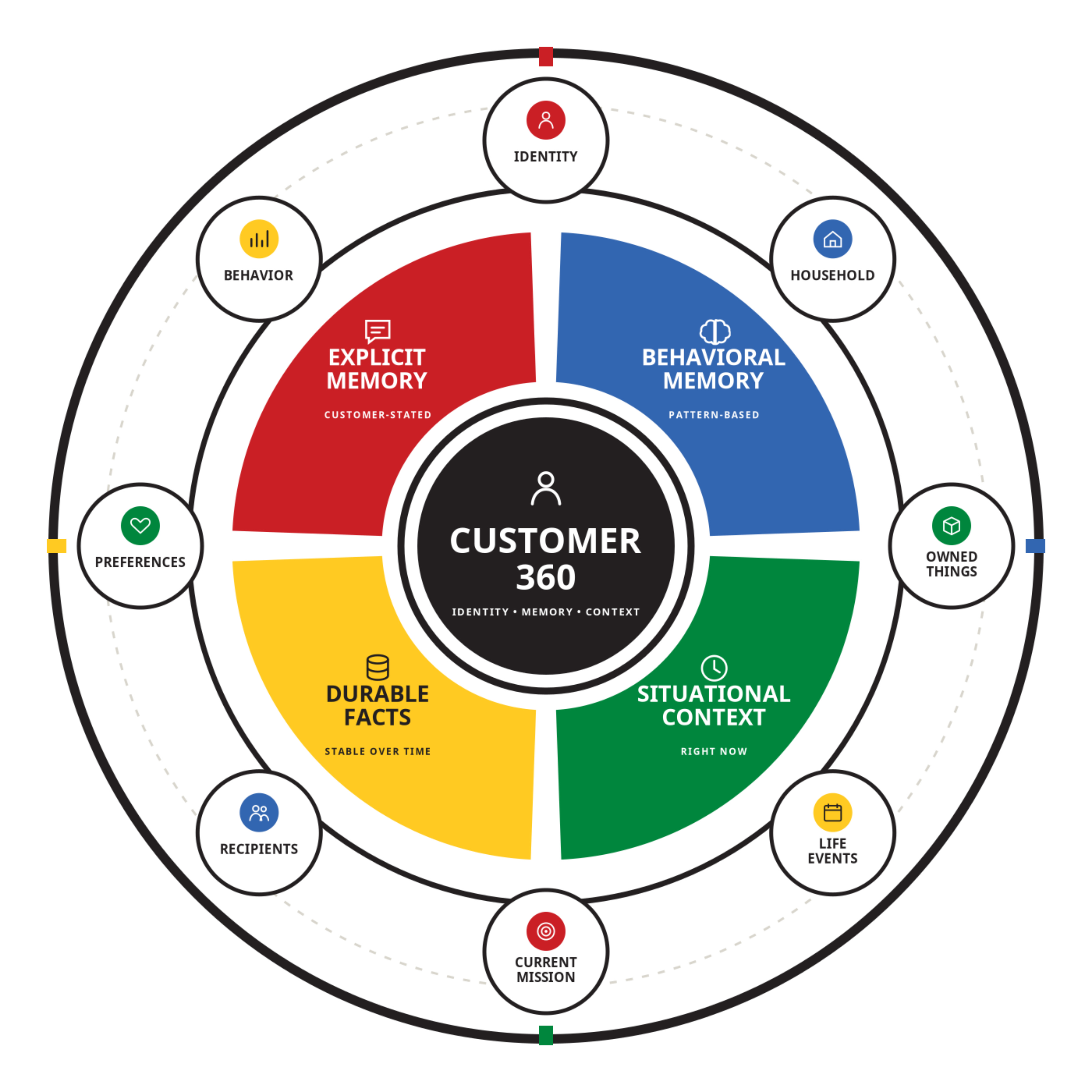
Amazon has said plainly that Alexa for Shopping draws on shopping history, preferences, conversations, purchases, searches, saved Lists, reviews, devices, and prior Alexa interactions. About You describes the same thing from the customer’s side. My own testing, and plenty of other people’s, has shown for months that the same prompt can produce different answers on different accounts. The existence of personalization is no longer the interesting question; the architecture underneath it is.12
What kind of machinery sits underneath that personalization? A recommendation engine that scores affinities is important. But a persistent, cross-business memory layer that maintains a working model of a person and her household, and hands the relevant piece of it to an AI agent mid-task, is something else entirely. For most of the past year I could not tell which one Amazon was building, because the public evidence stopped at the effect and never reached the architecture.
That has changed. A Customer 360 job posting and several patent filings let us see farther into the infrastructure. Together, they describe something deeper than a preference file or a knowledge base attached to an account.3
Here is how Amazon describes their Customer 360 team,
Customer 360 is Amazon’s central memory system. Our mission: when a customer interacts with any part of Amazon, every other part reflects that understanding immediately. We process signals from across Amazon — shopping, streaming, listening, reading, browsing, and conversations — and transform them into AI-ready memories that power personalized experiences for hundreds of millions of customers worldwide. Our memories fuel Amazon’s largest AI initiatives including Alexa+, Alexa for Shopping, Health AI, conversational assistants, generative recommendation systems, and personalized discovery across every major surface. We operate at massive scale. We are a team of builders who believe that understanding customers deeply — and remembering what matters to them — is the foundation of every great AI experience.
What the Job Posting Establishes
Amazon’s hiring language is the clearest new evidence here: a listing for a Sr. Software Development Manager on AI Memory Systems, Job ID 10505667. The posting calls Customer 360 “Amazon’s central memory system” and names Alexa+, Alexa for Shopping, Search, Homepage, Prime Video, Music, Audible, and Health AI among the experiences its memories support. It describes a pipeline from raw signals—including purchases, browsing, streaming, listening, reading, and conversations—to inference and real-time retrieval by AI agents.
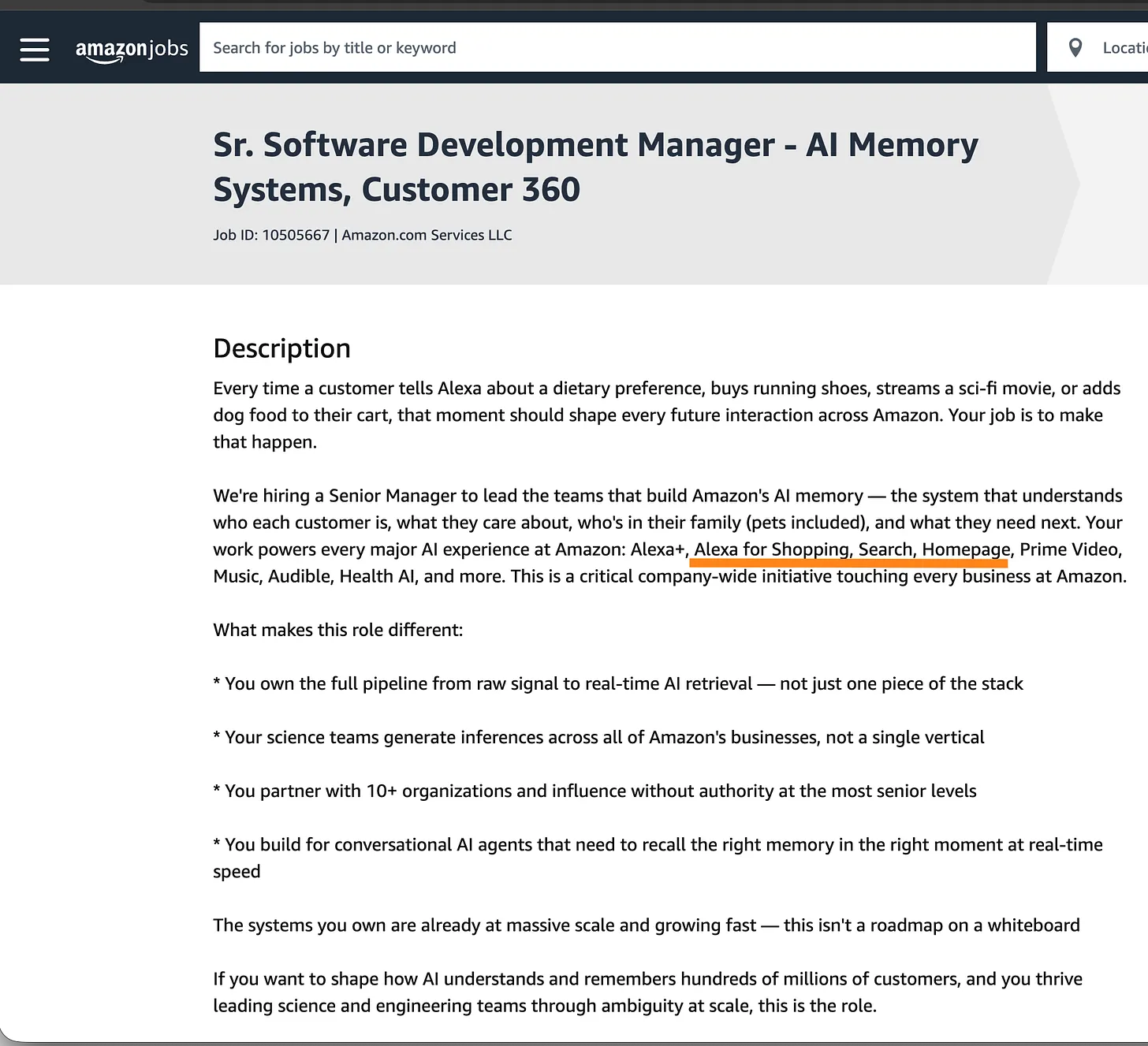
4 The posting places Alexa for Shopping among those downstream experiences rather than describing Customer 360 as a feature of one surface. Signals arrive from separate Amazon businesses, and the system creates both explicit and inferred memories. It is designed to reason about people, pets, and vehicles in a customer’s life, update those memories as evidence changes, and retrieve relevant context for downstream AI systems under tight latency requirements. That makes Customer 360 shared infrastructure, not a feature owned by one surface.
Put plainly, Customer 360 is a persistent customer-knowledge system: it gathers signals from across Amazon, works out which person or household they belong to, turns activity into facts and preferences, separates what customers said from what Amazon inferred, updates knowledge as evidence changes, and retrieves the relevant context for the experience serving the customer. The pieces appear across Amazon’s public hiring language and patent filings.
That is more than conventional recommendation personalization, which usually moves from past behavior to affinity to recommendation. The longer process Amazon describes could include continuous signals, identity resolution, persistent knowledge, explicit and inferred memory, household scope, contextual retrieval, agent reasoning, query formation, qualification, recommendation, action, and new memory from what the customer does next. No source confirms that every stage is live in Alexa for Shopping today. The disclosures make the broader architecture plausible, but they do not reveal the production weights or thresholds.5.
What the Patents Illuminate
A newly surfaced Amazon patent application, US20260087259A1, titled Personalizations for Artificial Intelligence Assistant System, describes creating and updating natural-language summaries of user knowledge from conversations and other data available to an AI assistant. The possible inputs include repeated purchases, purchase frequency, ratings or feedback on products, wish lists, shopping lists, device activity, and the product details associated with those activities. Among its examples of stored customer knowledge: “preferred brands.”6
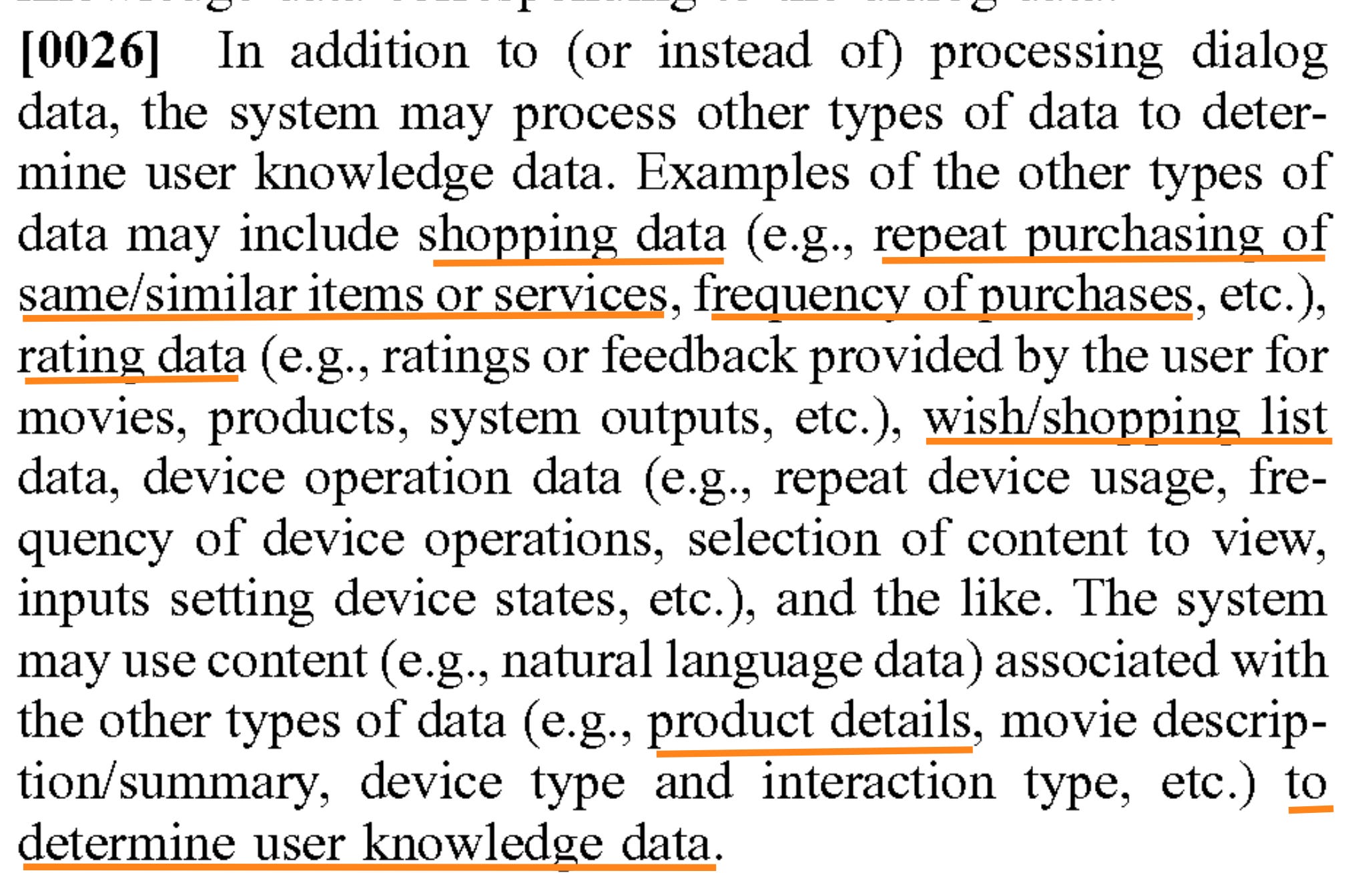
Hold that detail against my wife’s jeans story. In the patent’s architecture, the system does not have to remember only that my wife purchased ASIN A and ASIN B. The product details associated with those purchases could also help it infer something about the shopper. If both products were described as curvy fit, high rise, stretch denim, or a particular size, those attributes could become evidence about the person who bought them. Nothing in the filing says this produced her answer, and I am not claiming that it did. The filing does disclose a mechanism for turning shopping behavior and product information into reusable customer knowledge.7
Explicit Memory and Inferred Memory
8Amazon’s job posting explicitly distinguishes “explicit memories” from “inferred memories.” An explicit memory comes from a statement: I am vegetarian. My daughter wears a size six. Do not show me that brand. An inferred memory comes from behavior, such as repeatedly purchasing non-dairy milk, returning low-rise jeans, or reviewing hiking equipment positively. The quality of both types, per the posting, is evaluated through precision and recall targets.
Both routes appear in the personalization patent. Direct instruction appears, in the form of asking the assistant to remember something, and a language model may also detect an “opportunity to learn” from an ordinary conversation when no memory command was given. Shopping activity, product ratings, lists, device behavior, and associated product details can all be processed into user knowledge through the second route. A shopper does not necessarily have to announce a preference before Amazon can form one.
Curvy fit was probably inferred in my wife’s case; nobody in my house has formally announced a preferred rise to a voice assistant. Purchases, returns, browsing, size selections, product attributes, or some combination could have produced it. Which signal mattered is my inference, not Amazon’s disclosure. The threshold at which an inferred preference becomes reliable enough to influence retrieval or recommendation has not been published. That threshold—or more likely, a family of thresholds is the important unknown.
Update logic matters as much as formation in our case. Previously stored knowledge, per the patent, can be modified, negated, excluded, or removed when later information conflicts with it or makes it irrelevant, and timestamps can accompany stored knowledge. Correction and temporal management are therefore designed for. A universal decay function is not disclosed. I can now say Amazon has built mechanisms for conflict handling, negation, removal, and time metadata. I still cannot say how quickly an old size, brand preference, dietary restriction, or household relationship loses weight when the customer stops reinforcing it.
Whose Memory Is It
Households make the problem harder, as my own account demonstrates every week. The Customer 360 posting describes understanding the important people, pets, and vehicles in a customer’s life. The personalization patent goes further technically, distinguishing individual user profiles from group profiles, including household profiles. A household profile can carry preferences shared by the group, while each individual profile retains preferences that differ from everyone else in the house. One piece of knowledge can also be associated with multiple profile identifiers when it appears to be shared.
Those jeans were ordered through a shared household that also buys my running shoes, the dog’s food, and my daughters’ clothes. Sit with three sentences that a careless system would flatten into one. The account bought curvy-fit jeans. This person wears curvy-fit jeans. Someone else in the household wears curvy-fit jeans. Three different shopping lives follow from those statements, and only one of them is correct for the request in front of the system.
Nowhere does the patent assume Alexa knows who is speaking. It describes voice-profile comparison, facial recognition, device context, location context, an n-best list of candidate users, scored confidence values, and thresholds below which the system declines to name the speaker at all. Amazon has not published what Alexa for Shopping does when confidence falls short of those thresholds. What the architecture confirms is that Amazon has designed for the exact problem a shared Echo creates: working out which member of the household produced the request before retrieving the memories belonging to that person.
How Early Customer State Can Enter
Most discussion of AI personalization assumes memory arrives late, as a reranking feature applied to a candidate set that was assembled without it. I assumed that too. The strongest filing in this set suggests the assumption is too narrow.
US12406013B1 describes using user profile data, including past interaction data and user affinities, to determine entities. A language model can then generate a “set of queries based on the set of entities” for different content providers. In the patent’s explicit shopping example, the fact that a “user has an affinity for yoga” produces an Amazon Shopping query for yoga mats, then enriched searches for yoga mats associated with particular brands, and the retrieved products can subsequently be validated against the enriched request.910
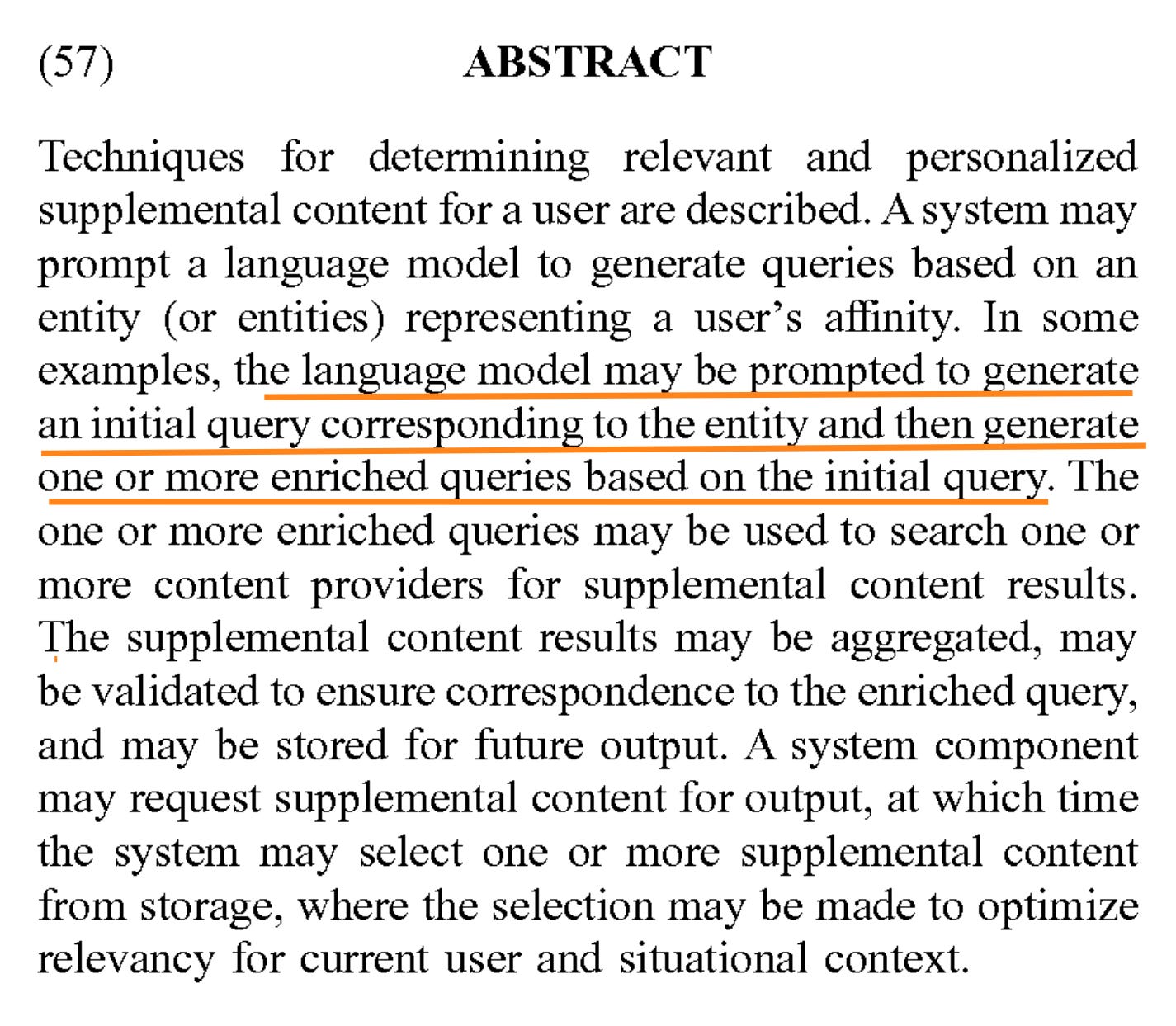
The implication is that customer state may enter the shopping process before product retrieval, not only after it (the patent itself points to that reality). Two people can type the same words and still travel through different retrieval paths before any reranker sees a product. The useful question is how early memory can enter the process: Memory most likely,
Changes the query or query fan-out the system runs
Alters which products are retrieved into the candidate set.
Operates as a qualification constraint, disqualifying otherwise relevant items.
Reranks a candidate set that would have been assembled anyway.
Changes only the explanation attached to an otherwise unchanged recommendation.
Several of these happen together in the same request.
Which of these occurs in Alexa for Shopping, and under what conditions, remains unknown. Those possibilities are not equivalent, and a study that cannot distinguish them cannot say much about personalized visibility.
Here is an example of how personalization affects Alexa for Shopping, from my article on Noun Phrase Optimization
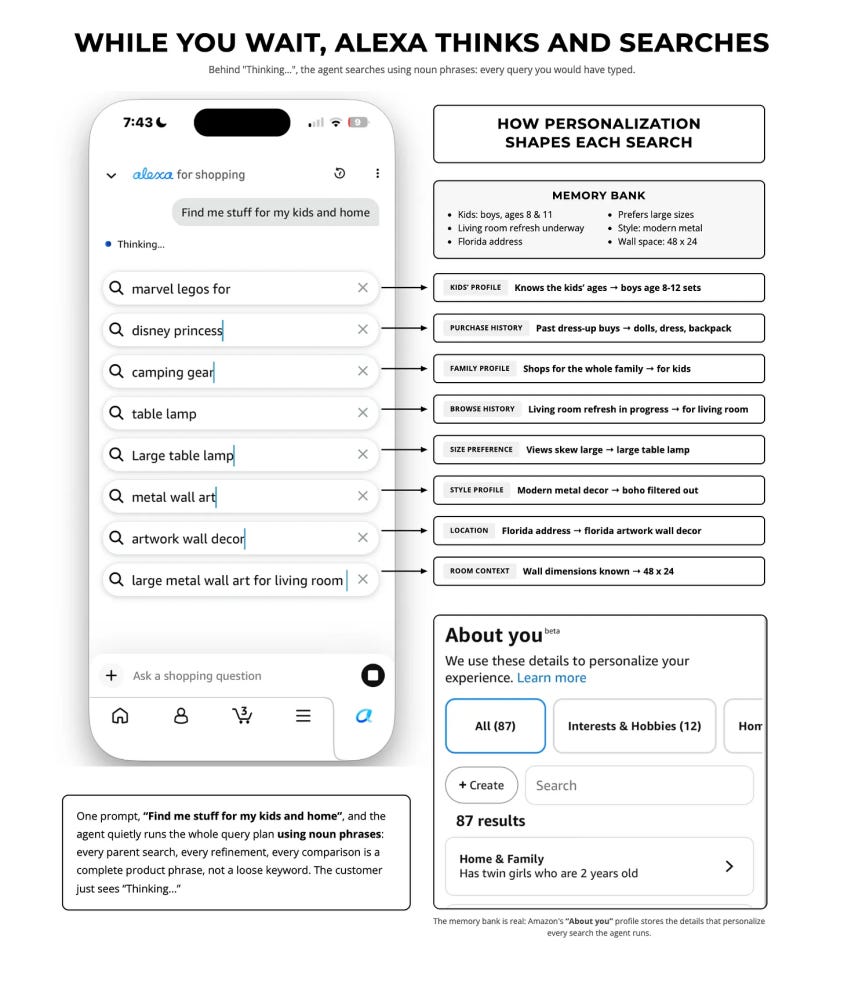
Broad relevance and personalized qualification come apart in the same yoga-mat example. A returned item can be a perfectly valid yoga mat and still fail the enriched request by not carrying the requested brand. In the validation example, the system assigns a positive indicator when the product matches the query and a negative indicator when the item is the right product type but does not specify the brand named in the enriched query. Translate the pattern into my wife’s request. A product can be relevant to “jeans” while failing the remembered shopper state because it does not support her size, fit, rise, stretch preference, delivery requirement, or trusted brand.
Another Amazon filing describes a recommender that “integrates user personalization with conversational relevancy,” ranking supplemental content using personalized context, historical interaction data, feedback, current interaction context, device context, and the present situation. The filing is broader than Alexa for Shopping and discloses no production formula for organic ASIN ordering. What it offers is a clean model for combining the person with the present conversation rather than treating either as sufficient alone. The prompt establishes the immediate mission. Customer memory supplies latent constraints, affinities, ownership facts, household relationships, prior decisions, and unresolved research. Product data supplies the evidence needed to connect an eligible product to both.11
Retrieval remains the stage I would watch closely, because storing memory is only one of the issues. One passage in the personalization patent describes semantically comparing the current dialog with stored user knowledge to determine the relevant portion, rather than placing an entire history into the model context. The passage appears in the knowledge-updating workflow, so I would not present it as evidence of a live retrieval ranker. It does show Amazon using semantic relevance to select a subset of customer knowledge, which supports the broader principle of selective recall. Ask for jeans and size, rise, fit, inseam, stretch preference, return history, and brand affinity may all earn their place. The dog food does not. The hard problem is deciding which small number of facts should condition this mission, at this moment, for this person.
Product Truth Includes Customer Memory
Here is where this lands for brands. Amazon may remember a preference, but it still has to find a product capable of satisfying it, and that second job belongs to the catalog and product detail page. Fit type, rise, inseam, stretch, size range, closure, material composition, model measurements, and compatibility need to exist as reliable machine-readable facts, not adjectives hidden in promotional copy. Customer 360 supplies the customer context; the catalog supplies the product truth.12
Stated as a loop, and stated plainly as author inference rather than a confirmed production formula: product truth, then interaction or purchase, then inferred customer knowledge, then future context retrieval, then future product qualification. Amazon has confirmed no such loop. The patents make it technically plausible in a way the job postings alone did not, which is a weaker claim than proof and a considerably stronger one than speculation.
Vague listings can therefore fail twice. They may fail to prove that the current product fits the mission, and they may give Amazon too little semantic material to understand what a prior purchase revealed about the customer. The optimization unit is the connection between customer memory, product evidence, and the shopping mission.
What Brands Can and Cannot Reach
An asymmetry in observability runs through this entire subject. The shopper can inspect and correct some of what Amazon knows through About You, and the Customer 360 role emphasizes consent, deletion promises, governance, and privacy by design. The brand can see none of it. No seller can view the customer memory used in a particular recommendation, inspect its confidence, or learn which inferred preference altered the query or the candidate set (unless its you, your family or friend).
That boundary should discipline what any of us promise. A brand cannot optimize a customer’s private memory state, and anyone selling that service is selling something they cannot deliver. What a brand can do is make its products machine-legible enough to qualify against a broader range of legitimate customer conditions: needs, preferences, ownership, compatibility, use cases, sizes, fits, audiences, and constraints. Accurate attributes, complete variation data, clear use cases, compatibility information, fit evidence, structured constraints, and review evidence are the levers. They work on the observable half of the join.
One more filing belongs here. An Amazon patent on explanations describes generating a natural-language explanation for a system determination using information associated with that determination, then checking whether the generated explanation corresponds to the system’s actual decision, with shopping recommendations among its examples. The architecture is structurally relevant to personalized recommendation rationales, though it does not prove every Alexa for Shopping blurb uses the patented system. The distinction matters for a practical reason: the explanation a shopper sees is not the complete decision state. Amazon may say a product matches a preferred brand, dietary need, prior purchase, or intended recipient without exposing every private signal, confidence score, query expansion, or rejected candidate behind the result. Explanation makes personalization legible without making the memory model observable.13
Where This Appears to Be Headed
Everything above rests on three levels of source, and they should not be treated as equal. Amazon’s job postings establish Customer 360 as a memory and inference system that serves Alexa for Shopping. Amazon’s consumer materials establish that Alexa for Shopping uses preferences, purchases, conversations, searches, lists, reviews, household information, and cross-device context. Amazon’s patents disclose technical architectures for deriving knowledge from behavior and product details, assigning it to individuals and households, retrieving relevant context, using profiles to generate enriched queries, validating results, ranking personalized content, and explaining recommendations. None of the three discloses the final production weights, thresholds, fallback rules, or organic ranking formula, and I would treat anyone claiming otherwise with suspicion.14
Taken together, the sources suggest a direction, not a finished ranking formula. Amazon is describing customer knowledge as infrastructure rather than a lightweight feature attached to a recommender: persistent, reusable, cross-surface, and available to an AI agent when the task calls for it. The implied endpoint is an assistant that works against a changing model of the person, household, relationships, owned products, preferences, recurring needs, past decisions, unresolved missions, and unstated constraints. How complete that system is today, nobody outside Amazon can say. But the direction is clearer than it was.
For brands, the strategic consequence is narrow and worth stating precisely. Nobody gets to optimize the memory. What changes is that product evidence now has to be complete enough to satisfy a request whose full meaning may extend well beyond the words the shopper typed. My wife asked for jeans. The request Amazon actually served was considerably longer than that, and every additional term in it was a term her listing had to satisfy without ever being told.
Which leaves the question I plan to explore in the next issue
We already knew Alexa for Shopping was personalized. Amazon’s hiring language and patent filings are now showing us the machinery underneath, and how far upstream customer state may reach.
Amazon, “Meet Alexa for Shopping, your personalized, agentic AI assistant on Amazon,” May 13, 2026.
Amazon, “Introducing Amazon’s About You,” May 13, 2026.
I want to be explicit about how much weight each source can carry, because this subject invites overreach and I would rather be tedious than misleading. Everything below sits in one of four categories, and I will name which one throughout. Confirmed Amazon disclosure is something Amazon states in its own hiring language, consumer materials, or public announcements. Patent-disclosed architecture is a mechanism Amazon has designed and sought to protect, which establishes technical capability and intent without establishing deployment. Author inference is my reading of what those two sources imply when read together. Unknown production implementation covers everything Amazon has not published, which includes most of what a seller would most like to know. Patents are the category most often abused in this industry. A filing is not a map of running code. It records what Amazon built, or intends to be able to build, rather than what executes when a customer opens the app. Read that way, the patents in this set are genuinely useful, because they answer a question the job posting alone cannot, namely what kinds of technical mechanisms exist that could support the behavior Customer 360 describes.
Amazon, “Sr. Software Development Manager, AI Memory Systems, Customer 360,” Job ID 10505667.
Worth noting what the earlier evidence could not do. Previous Customer 360 postings described persistent memory in convincing detail, but several directed the work toward internal Amazon builders and internal AI systems, which proved a serious investment in memory without proving the memory reached a shopper. I treated the connection as a strong hypothesis for months, and I said so in writing. The AI Memory Systems posting closes it by naming Alexa for Shopping outright.
Amazon Technologies, US20260087259A1, “Personalizations for Artificial Intelligence Assistant System.”
Across the set, the patents illuminate plausible mechanisms for most of the stages Customer 360 describes at a higher level: forming customer knowledge from conversation and behavior, inferring preferences from product information, separating explicit from inferred memory, associating knowledge with an individual or a household, resolving identity with a confidence value rather than a binary answer, modifying or negating prior knowledge, attaching timestamps, selectively retrieving the relevant subset, using profile information to determine entities, generating and enriching queries, validating retrieved candidates, combining conversational relevance with personalization, and generating explanations tied to a system determination.
The job posting and the consumer announcements establish that Alexa for Shopping uses Customer 360 memory. The patents establish that Amazon has designed technical machinery capable of supporting it.
We will discuss this further a few articles from now where I break down the 5th strategy in our Amazon ASIN optimization strategy. However, I did write about this already too in my opening article. https://www.retailplaybook.ai/p/alexa-for-shopping-the-new-playbook
Amazon Technologies, US12406013B1, “Determining Supplemental Content for Output.”
Amazon Technologies, US12445687B1, “Supplemental Content Recommender.”
Look at the same evidence from the product side too, attributes help Amazon determine whether the current product satisfies a remembered preference. Product attributes attached to prior behavior may also help Amazon infer what the shopper tends to prefer in the first place. A structured curvy-fit attribute on the first purchase helps Amazon understand the item; repeated purchases of items carrying that attribute could then contribute to an inference that the attribute matters to the person buying them.
Amazon Technologies, US12562162B1, “Explanation of System Determination.”
Important here, there is a growing number of people asking Alexa for shopping how it ranks things (for example on Tik Tok) as if these are gospel disclosures, revealed from the heavens of Amazon. Be on the look out for fabrications