


If you have noticed overlap among the strategies I have been developing in RetailPlaybook, you are noticing how the work fits together. A product’s dimensions can inform a structured attribute, support a placement claim, answer a follow-up question, and determine whether the product belongs in a recommendation. Each strategy examines one of the responsibilities carried by that product information.
In the last major issue, Inference Optimization examined the connections between features, benefits, outcomes, customer circumstances, and product selection. Say the things that go without saying, then supply the facts that make those connections defensible. On the product detail page (PDP), the task is to give Alexa for Shopping enough support to explain what the product does, where that matters, and which requirements it can satisfy.
Even a well-explained product leaves a commercial decision unresolved: which customer needs and related searches deserve the brand’s attention? A mirror might suit several rooms, styles, and placement needs, each with its own language and competing products. Query Planning Optimization (QPO) helps organize that investigation, working forward from a shopping mission and backward from the search demand available to the brand.
TL;DR
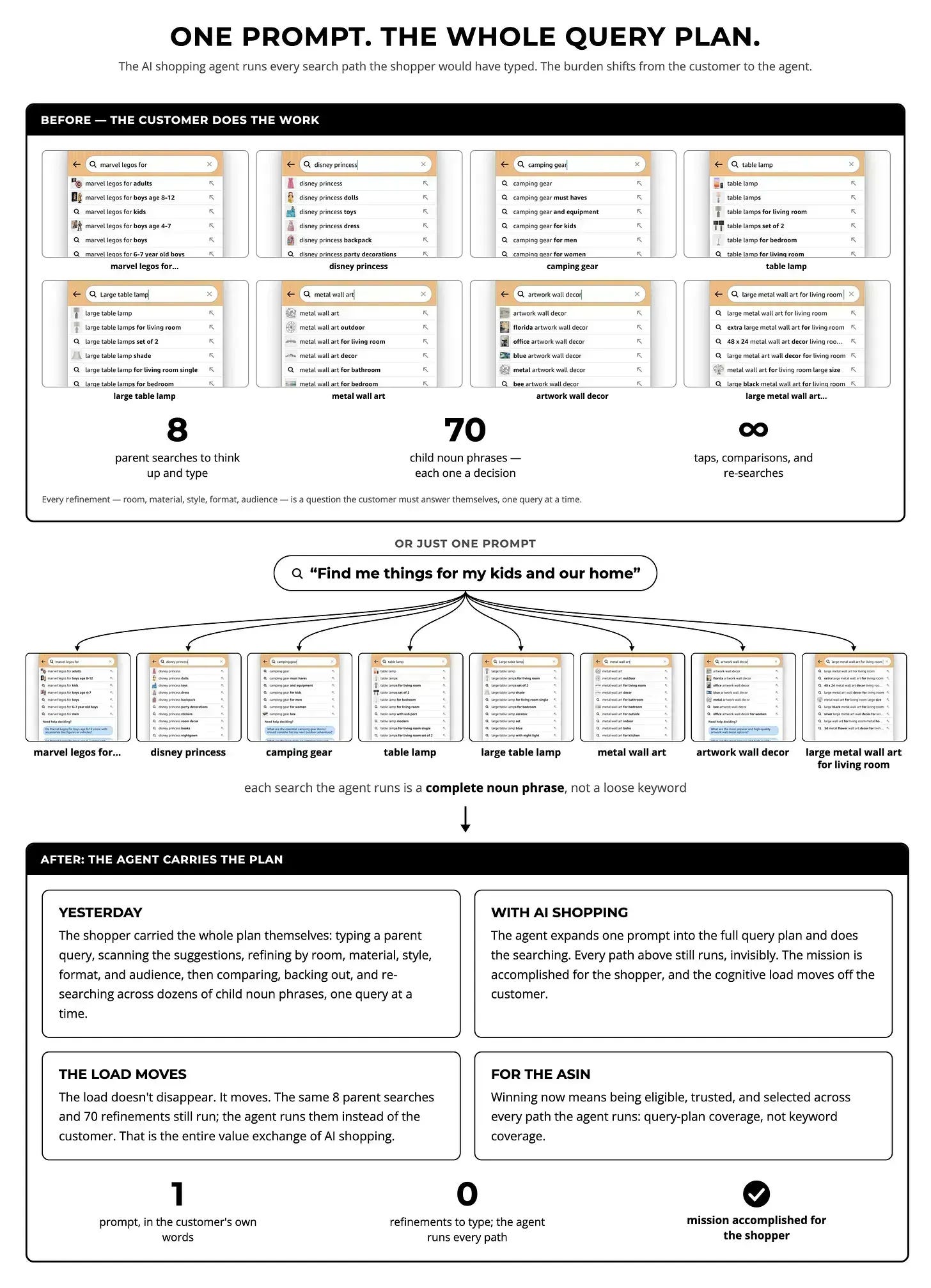
In conversational shopping, one customer request can lead to several product searches. Those searches may explore different aspects of the need, while the products they retrieve still require evaluation against the broader request. QPO gives brands a way to connect that mission-level question to search clusters, product information, and commercial priorities. Working forward develops possible searches from a proposed mission; working backward examines search language for related requirements and develops mission hypotheses to test against the assortment. Amazon’s conventional search environment remains foundational wherever product-search branches supply candidates, so the work includes protecting established demand while examining additional needs the product can truthfully meet.
A shopping mission can span a family of searches. A query may express a product type, a style, a constraint, or a combination of requirements. The brand needs to understand which relationships connect those searches and what remains to be established about the product.
Forward and backward QPO begin with different evidence. A proposed mission supplies requirements from which to develop search clusters. Aggregated query data supplies language and commercial activity from which to investigate possible customer needs, without reconstructing an individual shopper’s history.
QPO and A9 Optimization have complementary jobs. QPO organizes the relevant search family and its product requirements. A9 Optimization examines how the brand and its ASINs participate within those searches, including exposure, response to the offer, and purchases.
The analysis must reach a product decision. Related queries may expose a shared omission in titles, bullets, attributes, descriptions, or images. They may also reveal that the assortment lacks a product capable of meeting the combined need.
Broader coverage needs commercial evaluation. Preserve the searches already contributing purchases, verify the facts supporting an expansion, and measure both participation and suitability. Correctly excluding a product after a disqualifying requirement appears is part of a useful recommendation.
Preserve the need as the searches change
A parent choosing a building set and someone shopping for curvy jeans are dealing with different products, but both decisions depend on relationships that a short search phrase can leave unresolved. “Ages 6 to 8” says little about whether the child can finish the set independently, how much adult help is expected, or whether the parent wants a shared activity. “High waist” and “wide leg” identify characteristics of jeans without establishing whether the cut accommodates the waist-to-hip relationship behind a request for curvy fit.
For either purchase, matching one characteristic leaves the rest of the request to be answered. A building set can carry the right age range and still require more assistance than the parent intended to provide. A pair of jeans can have the requested rise and leg shape while leaving the original fit problem unresolved.
Amazon’s Language Model Alignment for Conversational Shopping at Amazon describes a recommendation approach that generates different aspects of a request and calls the search engine for products corresponding to each direction. Its example expands “best headphones” into searches involving noise cancellation, budget wireless options, and workout use. Product selection then evaluates candidates against both the original query and the generated aspect. Alignment paper, §3.2, pp. 4316–4317
The jeans example makes that relationship easier to inspect. A search for wide-leg jeans could supply candidates, but the requested curvy fit would still need supporting product information. Phrases such as “curvy fit wide leg jeans” and “high waisted curvy jeans” carry the fit requirement into searches organized around leg shape or rise.
I use shopping mission to mean the outcome a customer is trying to achieve, together with the requirements and circumstances that determine which products can serve it. A mission may involve one product, complementary products, or several alternative ways to solve the same problem. When the available products cannot meet the requirements, the appropriate decision may be to defer the purchase.
Give the search family an operating purpose
Query Planning Optimization is the discipline of anticipating the family of searches a shopping mission may generate and improving an ASIN’s coverage of the relevant search clusters. A mission map connects the proposed need to requirements, related query language, and the product facts needed to support participation. In this article, I extend the investigation backward, using available search language to identify requirement relationships and develop bounded mission hypotheses.
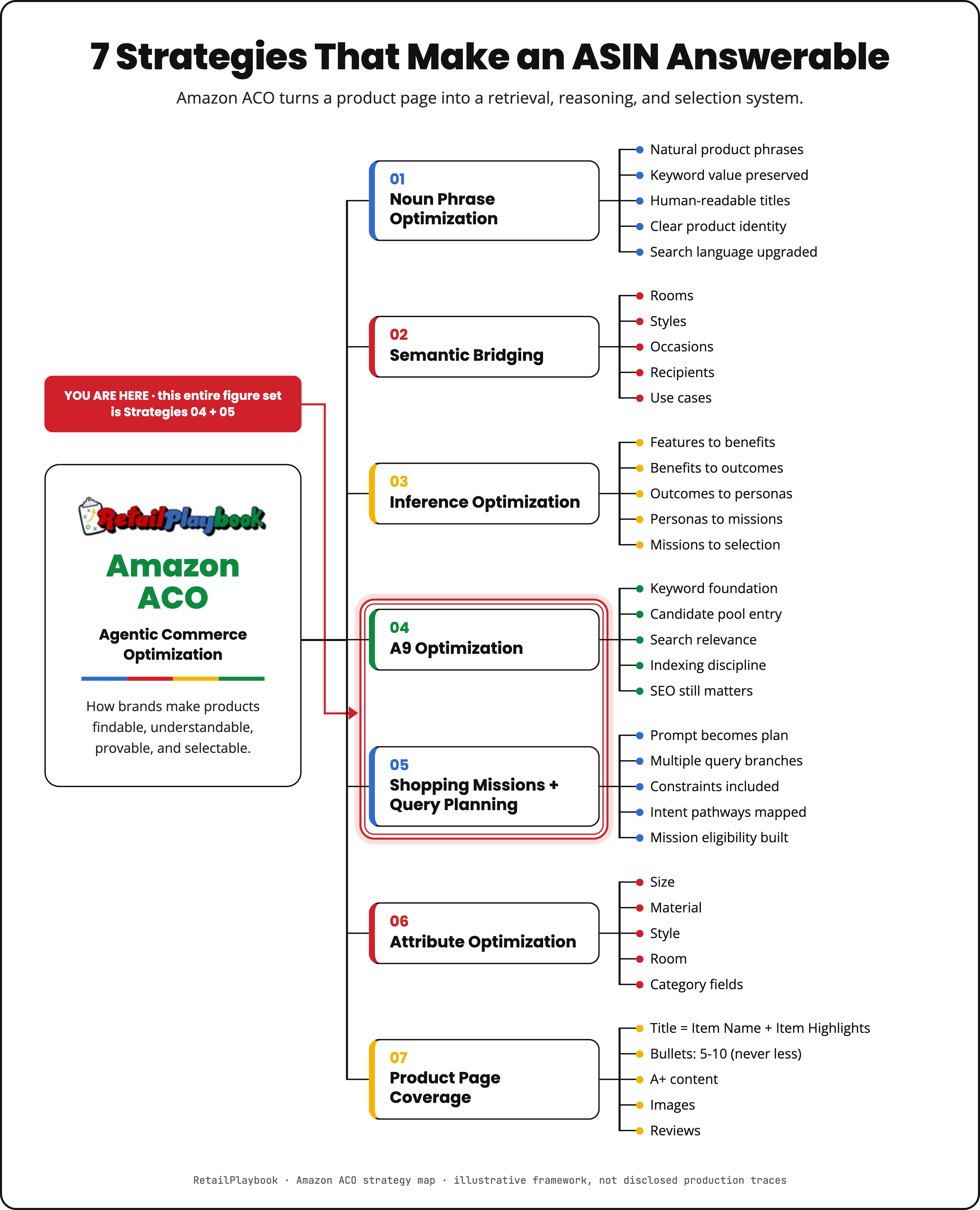
Within Amazon Agentic Commerce Optimization (ACO), that gives QPO a specific responsibility. Noun Phrase Optimization (NPO) organizes the language identifying the product, Semantic Bridging connects verified product facts to relevant needs, and Inference Optimization examines the judgments those facts support. QPO helps determine which of those relationships deserve investigation by connecting the proposed mission to search demand.
A9 Optimization carries that investigation into the individual searches: whether an ASIN appears, how customers respond to its offer, and where purchases occur. I use the term for work within Amazon’s conventional search, indexing, retrieval, and ranking environment, without implying that one unchanged algorithm governs every result. Mapping additional demand addresses an overlooked search family, while diagnosing performance addresses weak participation in a query already being monitored.
Amazon’s Building a Production Shopping Agent at Scale includes product search among the agent’s available tools and describes parallel execution of independent tools, with results informing subsequent actions. That architecture supports an investigation that develops as information returns. The search families in this article are analytical models for brand work, rather than captured execution traces or a claim that every proposed query runs concurrently. Production shopping-agent paper, §§2–3, p. 4791
Work forward from the household request
The NPO guide considers the household request, “Find me things for my kids and our home.” A building set might answer one part, with a lamp or wall art serving another. Before selecting a product, the conversation needs to establish who it is for, what it should accomplish, and which conditions govern the choice.
Suppose the shopper narrows the home request to wall art for a modern bedroom under $100. “Bedroom wall decor” expresses the room and product category, while a search emphasizing modern style approaches another part of the need. Products retrieved through either direction still have to satisfy the stated room, style, and budget requirements.
A preference for metal would introduce another relevant search direction. For size, the available wall space and the product’s dimensions must be considered together before a large piece can be recommended for the placement. Working forward means developing the search family as those requirements become explicit, keeping the complete request available for product evaluation.
Sometimes an answer introduces a product concept before the shopper names it. Amazon’s patent application on recommendations from questions and answers describes extracting and ranking noun phrases from an answer, then using selected phrases to search for products. Advice about decorating a narrow entryway could, hypothetically, introduce an arched wall mirror, making dimensions and mounting requirements relevant to the next decision. US20240331004A1, Figures 3 and 9
The branch can also cross categories. A bedroom workspace that must be cleared each evening might be served by a folding desk, a rolling workstation, or a wall-mounted surface. Storage space and installation permission help determine which alternative can fulfill the objective, giving the brand concrete conditions against which to compare those solutions.
Work backward from the requirements inside queries
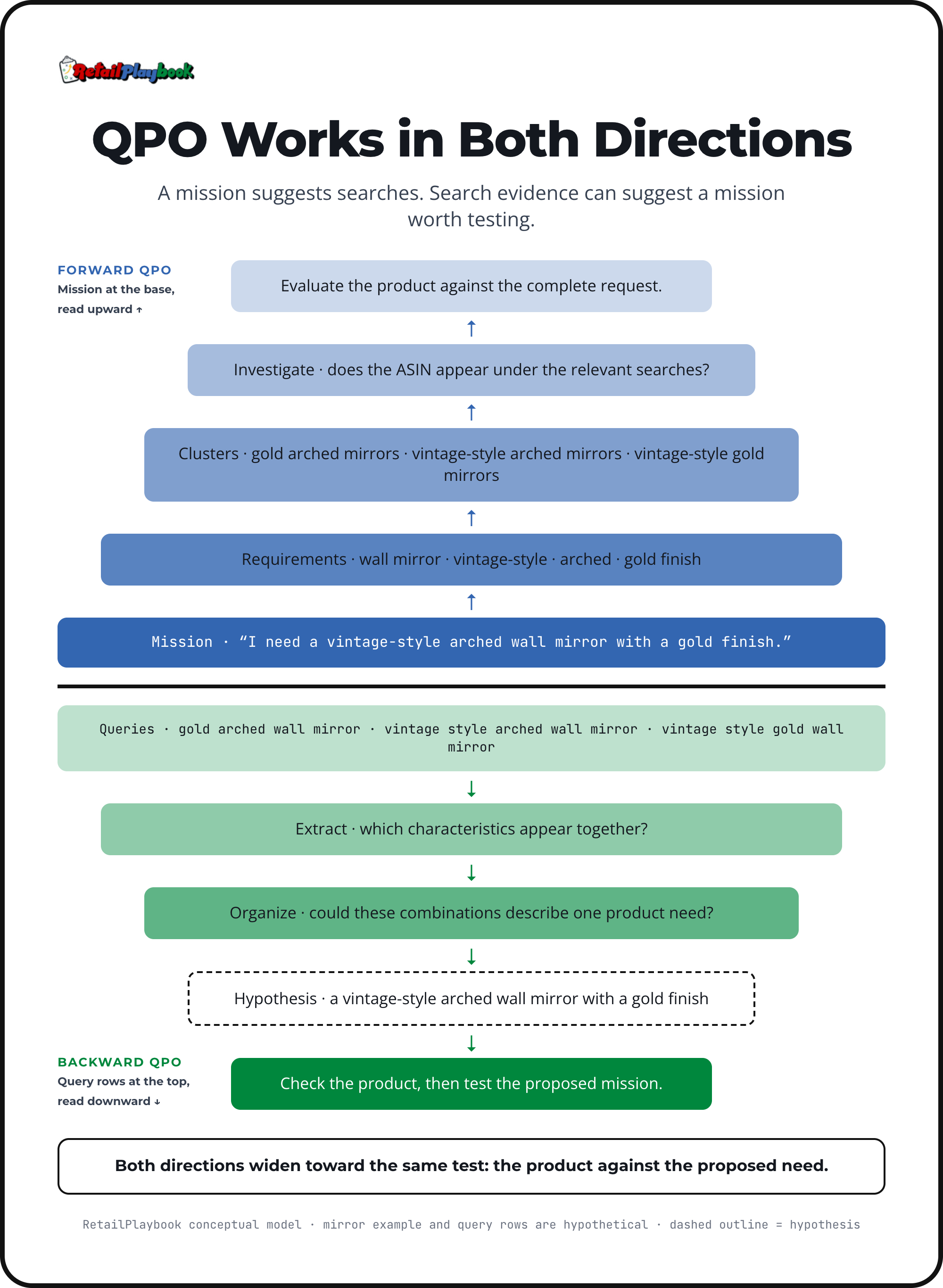
The reverse investigation begins with search language available to the brand. Amazon describes Brand Analytics as aggregated customer search and purchase data, which means related rows do not establish that one customer made those searches or combined their requirements. I treat the combined need as a mission hypothesis, then examine whether the assortment contains a product that could satisfy it. Amazon Brand Analytics
I like vintage mirrors, and the word “vintage” creates a useful problem for this exercise. It can describe age, appearance, or both, while an arch describes shape and a gold finish describes color. Before combining the searches, I want to preserve what each phrase actually asks of the product.
Arched wall mirrors
Example query language: “arched wall mirror” / “wall mirror with arched top”
Requirement expressed: Arched shapeVintage-style wall mirrors
Example query language: “vintage style wall mirror” / “vintage inspired wall mirror”
Requirement expressed: Vintage appearance to clarifyGold wall mirrors
Example query language: “gold wall mirror” / “gold finish wall mirror”
Requirement expressed: Gold-colored finishVintage-style arched wall mirrors
Example query language: “vintage style arched wall mirror”
Requirement expressed: Style and shape togetherGold arched wall mirrors
Example query language: “gold arched wall mirror”
Requirement expressed: Finish and shape togetherVintage-style gold wall mirrors
Example query language: “vintage style gold wall mirror”
Requirement expressed: Style and finish together
Within “gold arched wall mirror,” “mirror” names the product, “wall” indicates placement, and the modifiers specify finish and shape. Adding “vintage style” introduces an appearance requirement the shorter phrase leaves open. Replacing “gold finish” with “solid brass frame” would introduce a material requirement, changing what the product must establish.
A rectangular mirror could satisfy “vintage style gold wall mirror.” Following an arched design through the analysis does not make an arch a condition of that query. Keeping the distinction intact allows the brand to investigate a combined mission while recognizing other products that legitimately serve its component searches.
Across the rows, the appearance, shape, and finish requirements suggest a possible request for a vintage-style arched wall mirror with a gold finish. A newly manufactured design could satisfy the appearance requirement through period-inspired ornamentation, with its age described accurately. Room, dimensions, and budget remain open until the shopper supplies them.
If the shopper then specifies an antiqued gold finish, that treatment becomes an additional requirement. The earlier gold queries have helped locate a relevant search family, while product inspection must now establish both the desired ornamentation and the finish treatment. A useful backward map creates a question that can be investigated; subsequent clarification determines how precisely the product must answer it.
Protect the demand already contributing purchases
My starting point for prioritization is the search activity already contributing business. Search Query Performance (SQP) reports query-level impressions, clicks, cart adds, and purchases, including the brand’s participation, with Brand View and ASIN View supporting different levels of investigation. A narrower phrase contributing purchases deserves attention even when a comparison of search counts makes it look less prominent. Amazon’s SQP overview
Consider the following hypothetical Brand View rows from the same marketplace and reporting period. All counts, Mirror A specifications, copy excerpts, and response outcomes in this worked example are invented. The comparison gives us a defined starting point for examining the difference between the established gold arched query and the two vintage-style combinations.
gold arched wall mirror
Total query purchases: 120
Brand purchases: 36
Brand purchase share: 30%vintage style arched wall mirror
Total query purchases: 80
Brand purchases: 4
Brand purchase share: 5%vintage style gold wall mirror
Total query purchases: 40
Brand purchases: 2
Brand purchase share: 5%
The gold arched query contributes 36 purchases to the brand, compared with four and two from the vintage-style queries. Both weaker branches express a vintage appearance requirement, giving the investigation a shared product characteristic to examine. A product combining that appearance with an arch and gold finish could be relevant to all three queries.
At this point, the data concerns the brand. Before assigning the performance problem to one mirror, move into ASIN View and examine which products participate in the relevant queries, including the intended variation. That handoff separates a brand-level opportunity from the evidence needed to assess a particular product’s exposure and response.
Assume the assortment includes Mirror A, a newly manufactured wall mirror with an arched top, period-inspired frame ornamentation, and an antiqued gold finish. It measures 32 inches high by 24 inches wide overall and is offered only in that size. Its page currently says “Gold arched wall mirror with decorative frame,” with the overall dimensions missing from both the description and the sizing image.
The page inspection establishes omissions the brand can correct independently of the performance diagnosis. “Decorative frame” leaves the intended vintage appearance for the shopper to interpret, while the missing measurements leave placement unresolved. Whether those omissions explain weak query participation still requires examination alongside availability, competing offers, and the ASIN-level results.
Top Search Terms can extend this investigation through popular marketplace language and leading clicked products. Search Frequency Rank indicates relative query popularity, while SQP’s purchase measures help assess the brand’s participation in reported activity. Together, those sources help identify additional requirements to inspect without allowing popularity alone to determine the priority. Amazon’s keyword-research guidance, Amazon Analytics Reports
Carry the shared requirement into the product page
For Mirror A, the same description gap affects two vintage-style search families. An NPO revision could read, “Vintage-style arched wall mirror with an antiqued gold finish, 32 inches high by 24 inches wide overall.” The following sentence could explain that it is newly manufactured with period-inspired frame ornamentation, preserving the appearance while making the age clear.
The revision keeps the arch and gold finish central to the product’s identity. It adds a supported description of the frame and measurements the brand already possesses. That follows the search-protection principle developed in Semantic Bridging: expand the product’s relevant explanation while retaining the established language through which customers find it.
Attribute Completeness places the relevant dimensions, finish, and mounting facts in the available category fields. The sizing image should show measurements between the outer edges of the frame and identify the offered model, with the description using the same figures. Glass width, packaging dimensions, or specifications belonging to another variation would answer different questions.
Product Page Coverage extends the explanation into installation and placement. Bullets can introduce the mounting requirements, while supporting images, instructions, and A+ content can clarify details that a short product phrase cannot carry. Once the shopper supplies an available width, the verified overall measurement supports the placement judgment examined through Inference Optimization.
An installation question may also require a different source from a product search. Amazon’s streaming patent describes a planner selecting information sources, including reviews and community answers, for questions such as installation. The brand’s contribution is precise mounting documentation that agrees with the offered product, making the relevant facts available wherever that question is answered. US12517954B1, Figure 4
Let new context change the investigation
A mirror shopper might compare arched and rectangular forms, settle on an arch, and then measure the wall. Once the available space is known, an overall measurement including the frame answers a more immediate question than another comparison of shapes. The purchase objective continues while the information needed to complete it changes.
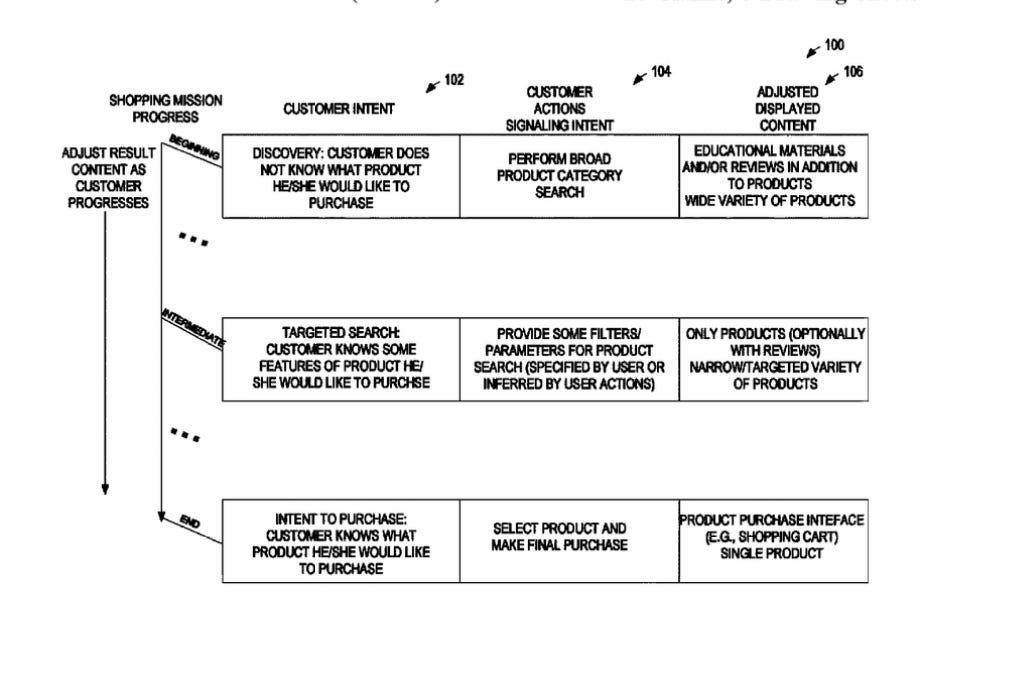
Amazon’s patent Modification of presented content based on historical data in a shopping mission connects estimated shopping progress with changes in the displayed content. Its description permits movement backward between stages, so I would not assign a shopper a fixed position from query specificity alone. A detailed phrase may belong to an unresolved comparison, while a broad phrase may come from someone whose requirements are already settled. US11386456B1, Figure 1 and accompanying description
The production shopping-agent paper makes a related distinction between surfaces. Section 5.3 describes generating search-page refinements using query category, specificity, and inferred shopping stage, then using retrieved product information to identify questions on product pages. For the mirror brand, finish, style, and placement questions each point toward a particular description, specification, or supporting image. Production shopping-agent paper, §5.3, p. 4793
Context can also precede the current query. The production paper describes assembling conversation history, recent-search signals, and long-term personalization, with the originating page informing the request. Amazon’s account-memory description separately explains that customers can add or correct remembered information, giving us another reason to record the context surrounding an observed recommendation. Production shopping-agent paper, §2, p. 4791, Amazon’s account-memory description
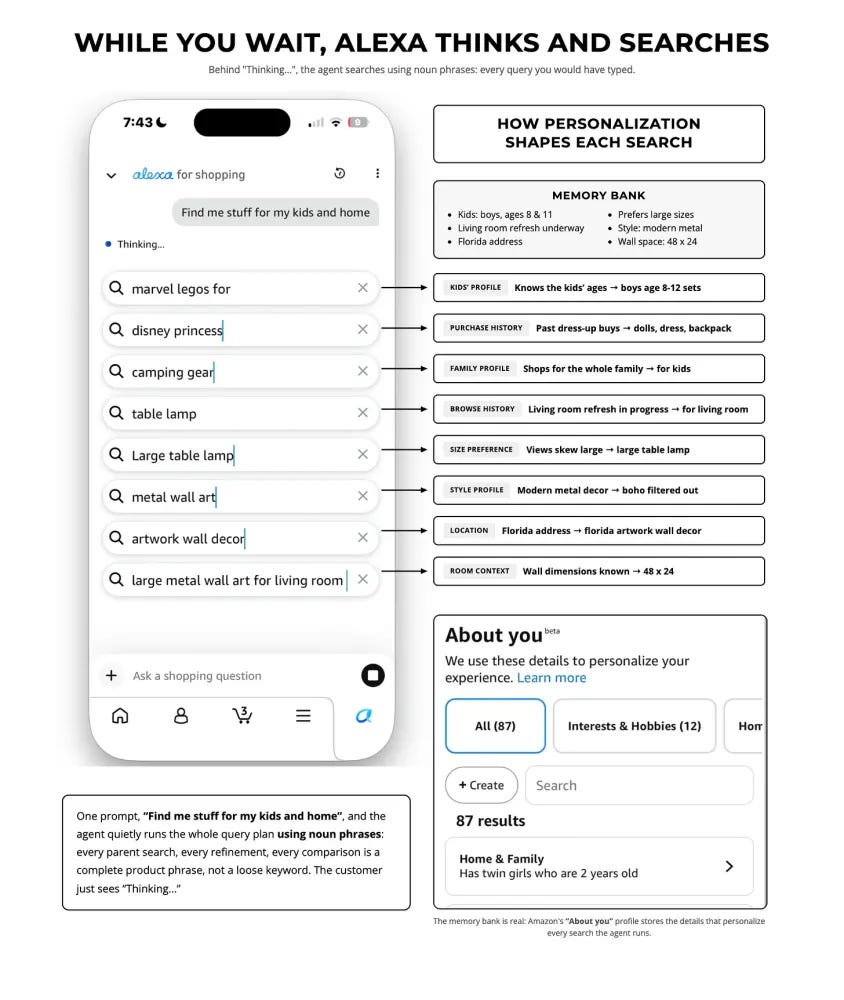
Two shoppers can use identical wall-art phrases after supplying different placement conditions. One may have specified an available width, and another a restriction on mounting. The brand can support both decisions through dimensions, weight, orientation, material, and mounting information.
A Florida address provides no basis by itself for recommending Florida-themed artwork. A previous purchase of large wall art likewise leaves the dimensions of the next placement unresolved. Semantic Bridging should connect the product to circumstances its verified facts support, allowing actual customer context to determine whether that relationship matters.
Keep named-brand demand visible on its own
An explicit request for a brand’s arched mirror carries a selection condition absent from a generic request. I keep those query groups distinguishable because strong participation in named-brand searches can conceal weaker discovery among customers who specify only product requirements. An exact model name narrows the investigation further, though size, finish, availability, or the offered variation may still require a decision.
The alignment paper’s recommendation work also discusses branded search generation. Its authors associate refinement through Direct Preference Optimization, which trains models using preferred and rejected responses, with a reduction in the missing-best-products defect from 66% for the production model to 24.8% for Gamma. That is a model-evaluation result, with seller visibility and commercial effects remaining separate measurement questions. Alignment paper, §3.2 and Table 3
For the mirror analysis, the practical task is to preserve the distinction between customers who already named the brand and those searching for a combination of style, shape, and finish. Both groups can contribute purchases, but they answer different questions about discovery. Combining them too early can obscure where a product explanation or search family needs further work.
A narrower space changes the recommendation
Suppose the shopper adds, “The entire mirror, including its frame, must be no more than 20 inches wide, and I still want the antiqued gold finish.” Mirror A exceeds that maximum by four inches. Its ornamentation and finish continue to fit the appearance request, but its only offered size fails the placement requirement.
Before examining the response, I would specify the outcome the test needs to assess. Any description of Mirror A must preserve its verified dimensions, and the product must be excluded as a suitable option once the 20-inch maximum is introduced. The shopper’s prompt should state the need and constraints, leaving Alexa to choose the products and organize her answer.
In an illustrative post-edit response, Alexa initially includes Mirror A and accurately describes its design, finish, and overall dimensions. After the follow-up, she removes it and explains that the complete frame exceeds the limit. I count that exclusion as a correct outcome because the information has made the mismatch visible.
The explanation identifies the condition that changed the decision. An unexplained disappearance could reflect a different candidate set, while an accurate width explanation shows how the recommendation accounted for the added requirement. Preserving the antiqued gold finish in any alternatives also matters, since a narrower mirror with the wrong finish would satisfy only part of the revised request.
Clarification appears in §3.1 of the alignment paper, where broad requests are refined to inform subsequent recommendations. The same paper reports declines in context carryover and anaphora accuracy for Gamma in Table 1, alongside improvements on other measures. A follow-up about “those options” requires retaining the products under discussion as well as the new condition, making the complete conversation relevant to evaluation. Alignment paper, §§2.2–3.1 and Table 1
Measure participation and suitability separately
A response can state Mirror A’s 24-inch width accurately and still recommend it for a space limited to 20 inches. Counting the appearance would miss that failure, and checking the factual description alone would miss it too. Amazon’s production evaluation similarly assesses recommendations against customer intent and reports missed explicit and implicit intent. Production shopping-agent paper, §§4.1–4.4, p. 4792
For a brand running this analysis, I would keep three records connected to the same ASIN and reporting period. The first tracks participation in the established and proposed query families, the second records whether product facts and shopper requirements are handled correctly, and the third records relevant changes in the offer or testing context. That separation keeps a rise in exposure from being mistaken for correct qualification or commercial improvement.
Missing evidence requires its own response. If the shopper names a wall type the mounting documentation does not address, compatibility remains unresolved until the brand obtains the necessary information. Confirmed compatibility can support inclusion, while a confirmed restriction can establish another reason to exclude the product.
A manual search records which products appear under a query, while a shopping conversation shows how a recommendation handles the request. Availability, competing offers, search formulation, and customer context can affect the results, so an improvement after a description edit does not by itself establish that the edit caused it. Record the change, compare relevant periods and conditions, and preserve the distinction between an observed gain and an explanation for that gain.
The established gold arched mirror business remains part of the evaluation. More participation in vintage-style searches may provide little benefit if it attracts unsuitable demand or coincides with weaker results in the searches already contributing purchases. Evaluate the proposed expansion alongside that existing business before deciding which gains are worth preserving.
QPO must also justify the additional analysis it asks the brand to perform. Reviewing each query individually might uncover the same missing description and lead to the same revision. Connecting the searches earns its place when it changes the priority of an edit, reveals a shared requirement, or exposes an assortment gap the separate reviews missed.
When the answer belongs to the assortment
Mirror A gives the brand two findings. Its period-inspired ornamentation and antiqued gold finish support a fuller description across the vintage-style search families. Its 24-inch width establishes a limit that the page needs to communicate clearly.
Repeated evidence of demand for a narrower version would create a product-development question. Before commissioning that version, the brand would need to investigate how often the size requirement appears, what customers currently choose, and whether the opportunity supports a viable offer. The mission map has then helped identify a need the current assortment leaves unanswered.
The parent choosing a building set still needs to know whether the child can manage it, and a recommendation for my wife still needs to preserve the curvy fit behind her search. Following the searches forward or backward brings us back to those requirements and the facts needed to answer them. The brand should leave the analysis knowing what to explain more clearly, which searches deserve further work, and which customer need its product cannot yet meet.