


Over the last several issues, I have been building Amazon Agentic Commerce Optimization one layer at a time.
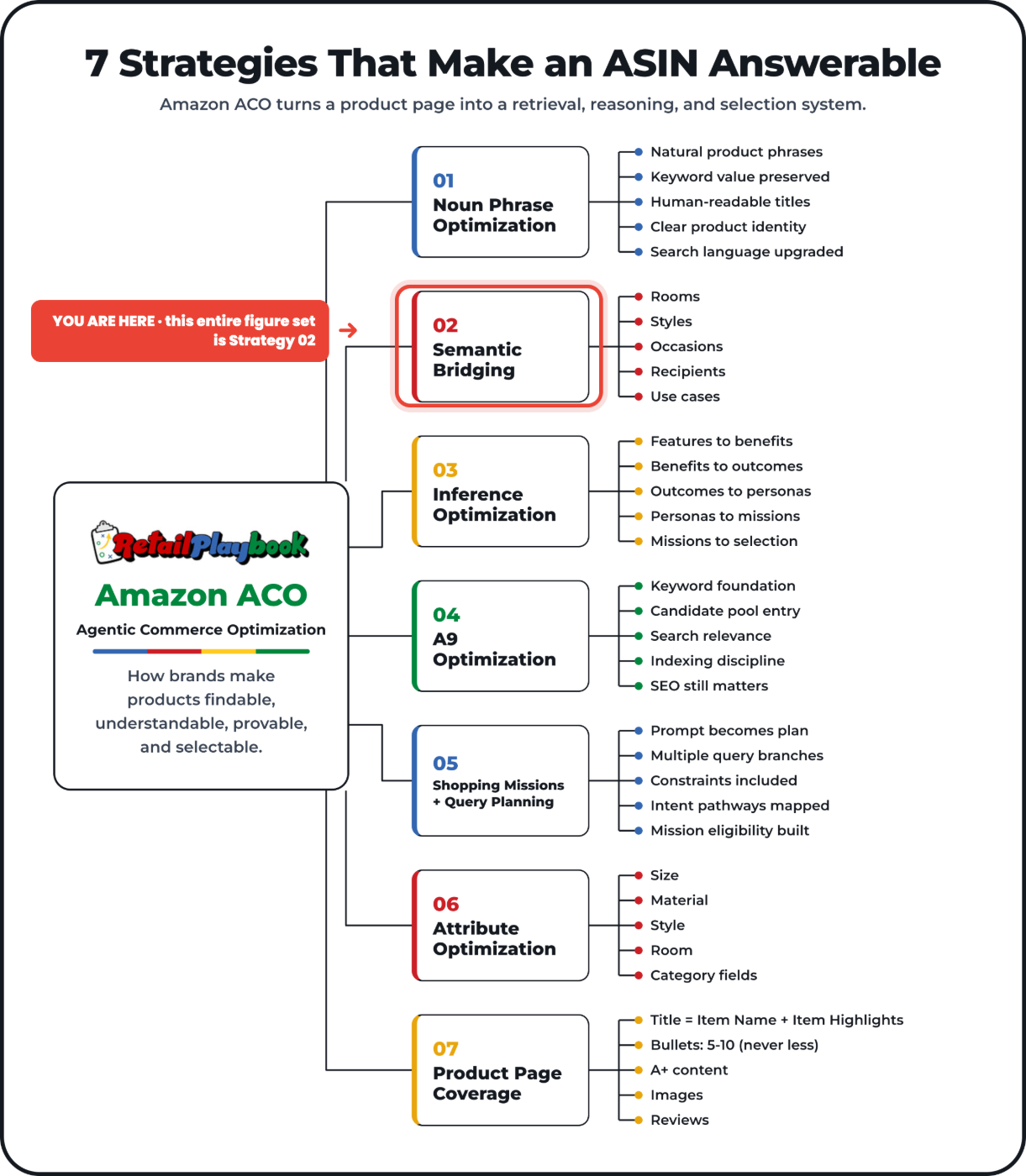
First, I laid out the complete playbook: seven strategies for engineering an ASIN so it can be retrieved, interpreted, reasoned over, trusted, and ultimately selected inside a shopper’s larger mission.
In the last issue, I went deeper into the first of those strategies: Noun Phrase Optimization.
Noun phrases are the foundational language of product discovery. They organize keywords, attributes, contexts, audiences, constraints, and product identity into complete units of meaning. Instead of treating “metal,” “wall,” “art,” “living room,” and “modern” as disconnected keywords, NPO brings them together into a coherent product concept: “large modern metal wall art for living room.”
But this creates the next question.
Once Amazon understands the noun phrase, how does it connect that phrase to the wider world of meanings surrounding the product?
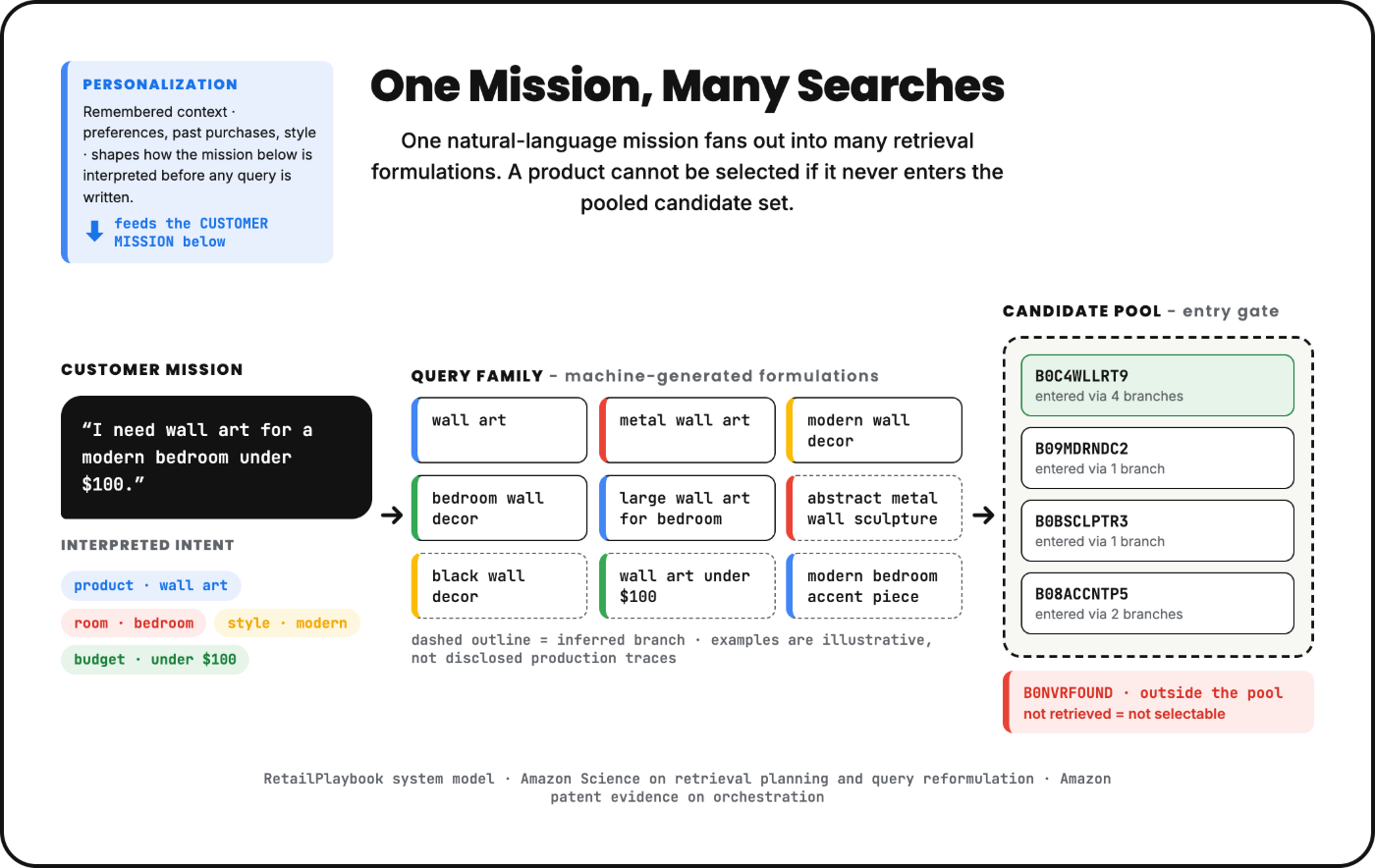
A shopper may never type the product’s exact noun phrase. They may describe a room, an occasion, a recipient, a design problem, a desired outcome, or a partially formed intent. Someone may ask for something to fill the blank wall above a couch, a housewarming gift for a couple with a modern home, or a statement piece that makes a large living room feel finished. The customer may never say “large modern metal wall art,” even when that is precisely the product that could satisfy the mission.
Noun Phrase Optimization establishes the product’s retrievable identity. Semantic Bridging connects that identity to the adjacent meanings Amazon may infer from the shopper’s request.
Semantic Bridging is the practice of creating truthful connections between a product and the rooms, styles, activities, occasions, recipients, problems, outcomes, and use cases it legitimately serves. It helps close the distance between the language used on the product page and the language a shopper, search system, or AI shopping assistant may use when approaching the same need from another direction.
The product does not change. The number of meaningful pathways leading to it does.
This is the next layer of the playbook.
Part I: The Concept
1. What Semantic Bridging Is
We must begin to understand semantic bridging by distinguishing what it is on several fronts and what it is not.
Semantic Bridging is not the replacement of high-volume keywords with conversational language. It is the disciplined expansion of product meaning around a protected search foundation.
Semantic Bridging is the process through which an ecommerce system connects the way customers express needs with the way products are described, structured, understood, retrieved, compared, and recommended.
For brands, Semantic Bridging is the discipline of strengthening those connections across product language, structured data, visual evidence, customer questions, reviews, product relationships, and commercially relevant need states.
Stated as a formal definition:
Semantic Bridging is the discipline of creating accurate, evidence-supported connections between a product’s established identity and the adjacent customer meanings for which that product is legitimately relevant.
Its objective is not to replace keyword relevance. It is to extend a product’s eligibility from the narrow language of what the product is into the wider network of why, where, when, how, and for whom the product may be relevant.
Traditional Search Visibility + Conversational and Semantic Visibility = Expanded Amazon Demand Capture
Our earlier Agentic Commerce Optimization and Noun Phrase Optimization work establishes the foundation: retrieval remains essential, but a product also needs sufficient meaning and evidence to be understood and selected inside a broader shopping mission. Attributes create structured truth, noun phrases create retrievable product meaning, and context creates the conditions for inference (let me not get ahead of myself though)
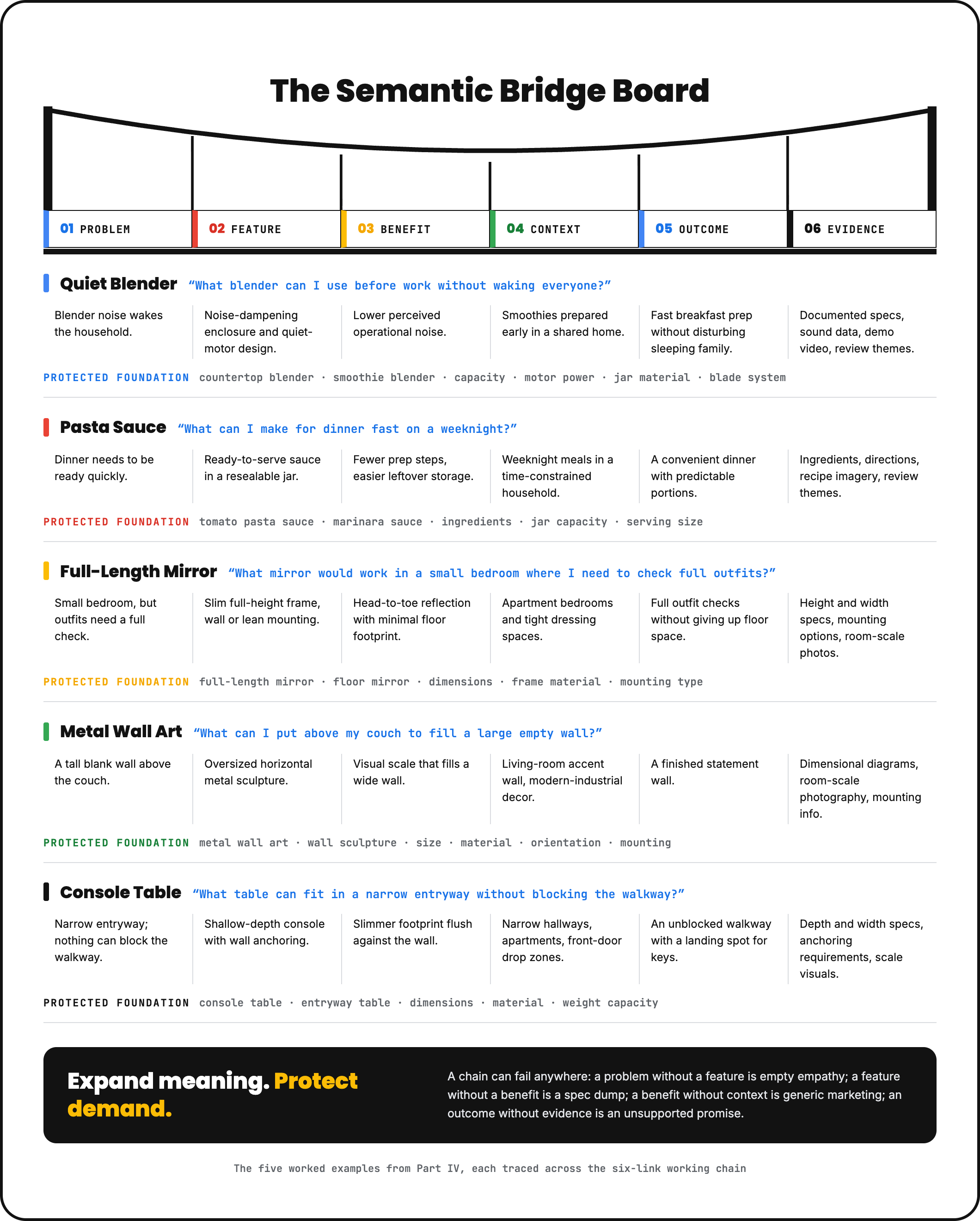
Figure 1. The Semantic Bridge Board: five products traced across the six-link working chain. Each row is unpacked in Part IV, and a blank fill-in version appears at the end of this piece.
The adjacent meanings
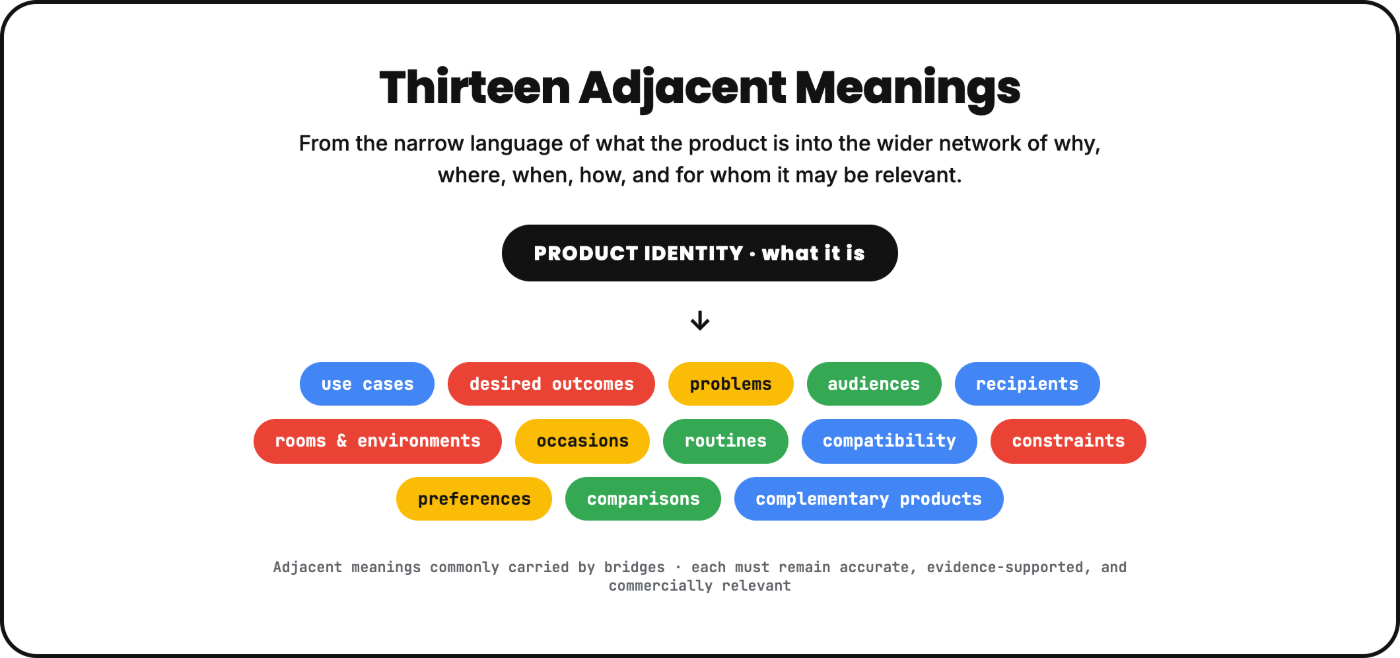
Those adjacent meanings commonly include:
use cases;
desired outcomes;
problems;
audiences;
recipients;
rooms or environments;
occasions;
routines;
compatibility;
constraints;
preferences;
comparisons;
complementary products.
One product, many ways to approach the need
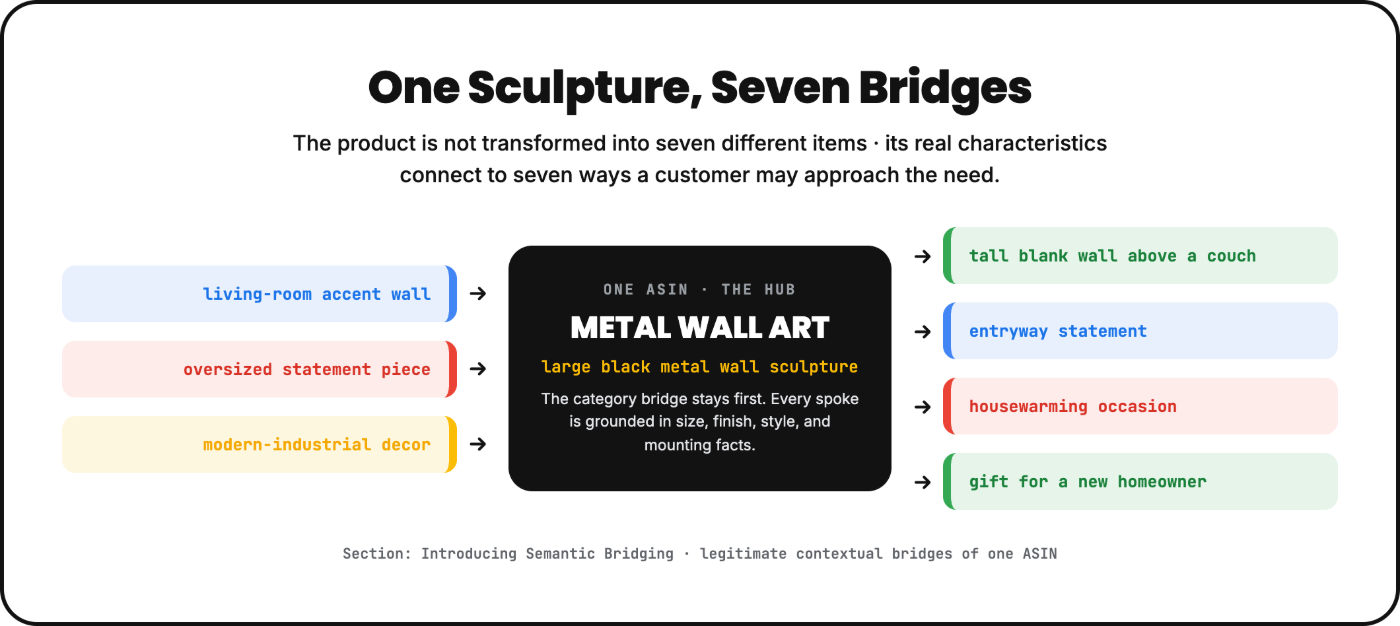
A large black metal wall sculpture may have “metal wall art” as its category bridge. It may also have legitimate contextual bridges to:
a living-room accent wall;
an entryway;
modern-industrial decor;
a housewarming occasion;
an oversized statement piece;
a gift for a new homeowner;
a tall blank wall above a couch.
The product is not being transformed into seven different items. Its real characteristics are being connected to seven different ways a customer may approach the need.
The distinction matters because Semantic Bridging is not permission to invent relevance. It is a method for making true relevance legible.
2. Two Questions, Two Kinds of Matching
Traditional search optimization asks:
What queries should this ASIN rank for?
Semantic Bridging adds a second question:
What customer meanings should Amazon be able to connect to this ASIN, and what evidence supports each connection?
Semantic product-search research likewise distinguishes literal matching from meaning-based matching. Amazon researchers describe dense semantic matching as a way to address limitations of lexical matching, and report improvements in retrieving exact and substitute products through large-scale semantic models. Another Amazon Science paper evaluates high-precision query-product semantic similarity as a relevance metric, reranking feature, and training objective.
What did you just say, Andrew? That’s Greek to me.
Good thing I studied ancient Greek.
In plain English: Amazon now runs two kinds of matching at once. Word-for-word search matches the words a customer types against the words on a product page. Meaning-for-meaning search matches what the customer is trying to accomplish against what the product actually is, does, and fits. Alexa for Shopping draws on both. Semantic Bridging is the work of making a product legible to both, without weakening the first to chase the second.
3. The Governing Principle
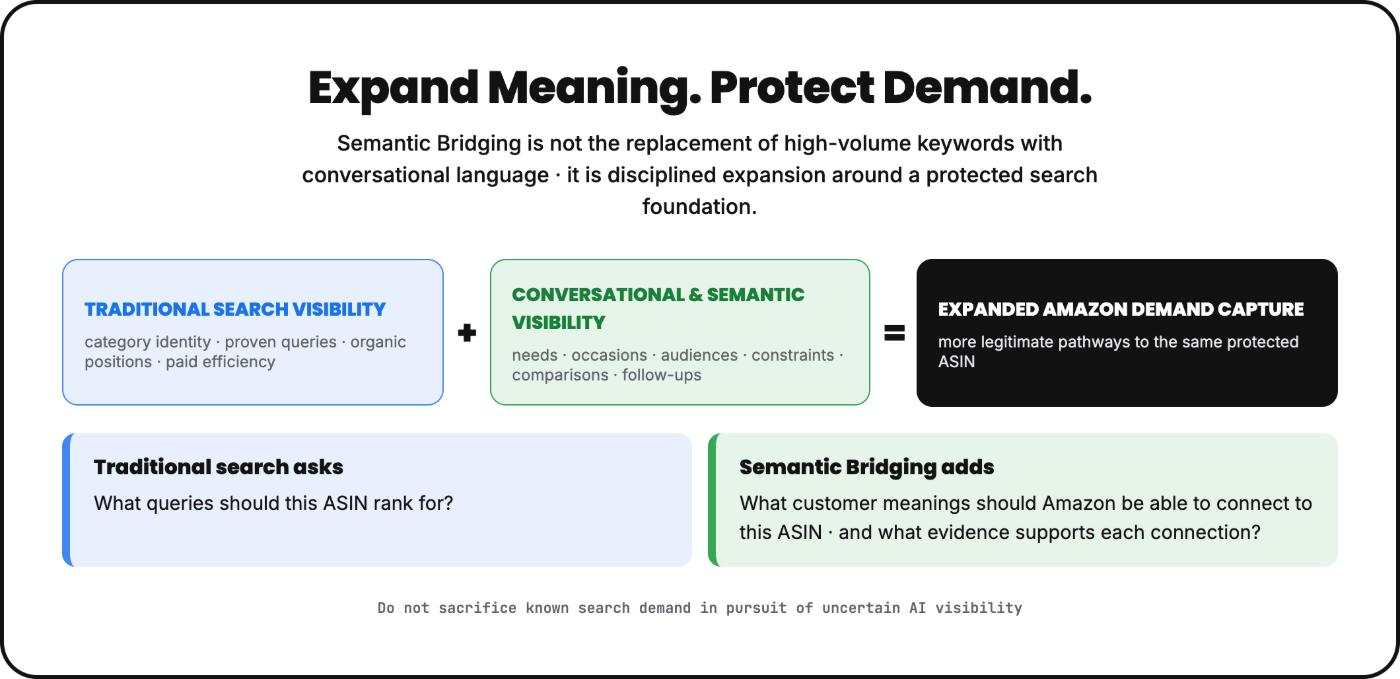
Do not sacrifice known search demand in pursuit of uncertain AI visibility.
Protect the product’s category identity, major attributes, proven query language, organic positions, paid efficiency, and conversion assets. Then expand semantic coverage through the surfaces best suited to carry it: structured attributes, bullets, images, A+ content, video, comparisons, reviews, questions, answers, and portfolio organization.
Done correctly, two things happen at the same time:
The brand becomes visible for more relevant needs, occasions, audiences, constraints, comparisons, and follow-up questions.
The brand preserves or improves performance across the search-query portfolio already responsible for traffic and sales.
The non-negotiable control is Search-Volume Protection:
Semantic expansion must not come at the expense of proven demand capture.
Fortune 500 brands should not sacrifice known Amazon demand in pursuit of uncertain AI visibility. They should preserve the search foundations already generating traffic and sales while systematically increasing the number of legitimate customer needs for which Amazon can understand, qualify, and recommend their products.
That is Semantic Bridging’s governing principle:
Expand meaning. Protect demand.
Part II: The Mechanism
4. The Semantic Bridge Chain
A semantic bridge is strongest when the brand can trace it from the customer’s situation to the evidence on the product page.
The compact form of the chain (how the system reads a bridge) contains five parts:
Customer expression → interpreted need → product fact → supporting evidence → commercial eligibility
For example:
“What blender can I use before work without waking everyone?”
→ need for low operational noise in a shared, early-morning household
→ noise-dampening enclosure and quiet-motor design
→ documented specifications, demonstration video, and consistent review themes
→ eligibility for a quiet early-morning blender recommendation.
The working form of the chain (how a brand builds a bridge) expands the middle links of that same bridge:
Customer Problem or Intent → Product Feature → Functional Benefit → Customer Context → Desired Outcome → Supporting Evidence
The blender bridge, expanded
Customer Problem: Blender noise wakes the household.
Product Feature: Noise-dampening enclosure and quiet-motor design.
Functional Benefit: Lower perceived operational noise.
Customer Context: Smoothies prepared early in a shared home.
Desired Outcome: Fast breakfast preparation without disturbing sleeping family members.
Supporting Evidence: documented feature, credible sound data if available, demonstration video, lifestyle image, review themes, Q&A, and comparison information.
What each link does
Each link performs a different job:
the problem creates relevance;
the feature creates factual grounding;
the benefit explains why the feature matters;
the context identifies when it matters;
the outcome aligns with the customer’s goal;
the evidence creates confidence.
A chain can fail anywhere. A problem without a feature becomes empty empathy. A feature without a benefit becomes a specification dump. A benefit without context becomes generic marketing. An outcome without evidence becomes an unsupported promise.
Pasta sauce example
Problem: Dinner needs to be ready quickly.
Feature: Ready-to-serve tomato sauce in a resealable jar.
Benefit: Fewer preparation steps and easier storage of leftovers.
Context: Weeknight meals for a time-constrained household.
Outcome: A convenient dinner with predictable portions.
Evidence: ingredients, serving size, jar capacity, preparation directions, recipe imagery, storage instructions, and review themes.
The title can remain anchored in tomato pasta sauce or marinara sauce. The weeknight-meal bridge belongs in bullets, imagery, native A+, recipes, and prompt testing.
The chain as a claim-control system
Before publishing a bridge, ask:
Is the customer problem commercially meaningful?
Is the feature accurate for this ASIN and every included variation?
Does the benefit logically follow?
Is the context typical enough to deserve content space?
Is the outcome proportionate and compliant?
Can the relationship be shown or proven?
What evidence would weaken it?
Which surface should carry it?
The objective is not to connect a product to every imaginable use. It is to connect it to the high-value situations where fit is real, evidence exists, and retrieval behavior is plausible.
5. The Semantic Bridge Portfolio
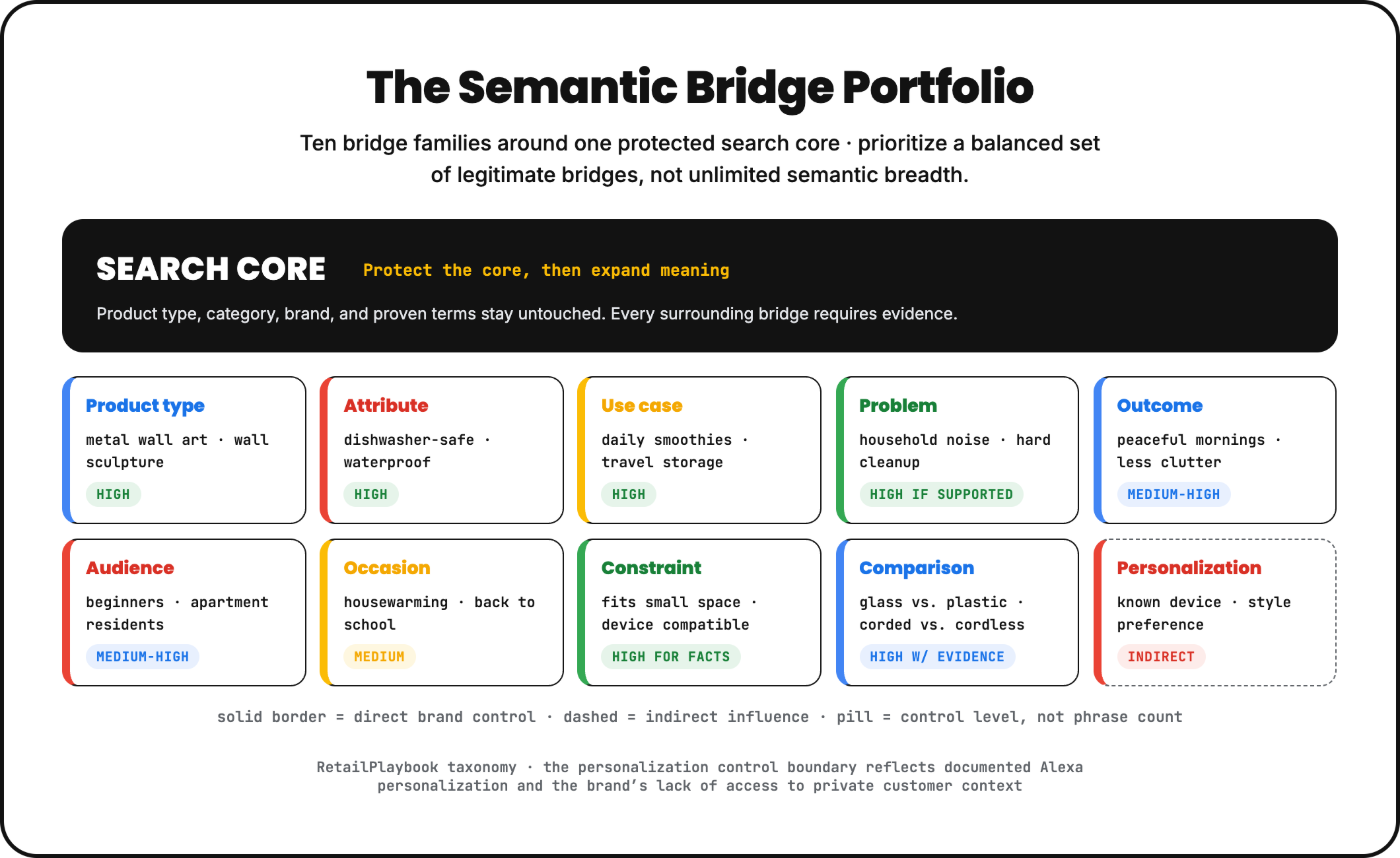
One ASIN can support several bridge types. A taxonomy prevents breadth from becoming clutter.
Product type: anchors the ASIN to core category language such as wall art, metal wall art, or wall sculpture. Brand control is high, and the main risk is drifting into an adjacent category.
Attribute: grounds the product in factual characteristics such as black, stainless steel, fragrance-free, or waterproof. Control is high but constrained by truth, and the risk is missing or contradictory values.
Use case: maps the product to how it is used, such as smoothies, meal prep, travel storage, or above-couch placement. Control is medium-high, and the risk is treating an unusual use as an intended use.
Problem: matches the product to a frustration such as noise, difficult cleanup, dryness, pet hair, or a blank wall. Control is medium, and the risk is unsupported or regulated claims.
Outcome: ties the product to a desired result such as peaceful mornings, reduced clutter, or faster preparation. Control is medium, and the risk is vague aspiration or overclaiming.
Audience: aligns the product with a suitable user or recipient such as beginners, families, travelers, or large-breed owners. Control is medium, and the risk is stereotyping or unsupported suitability.
Occasion: situates the product in a moment or event such as a housewarming, back to school, gifting, or travel. Control is medium, and the risk is generic seasonal language or a delivery mismatch.
Constraint: tests the product against a qualifying requirement such as under $100, small-space fit, an excluded ingredient, or device compatibility. Control is mixed, and the risk is stale price, delivery, or variation data.
Comparison: positions the product within a tradeoff such as glass vs. plastic, corded vs. cordless, or budget vs. premium. Control is medium, and the risk is false superiority or unlike comparisons.
Personalization: relates the product to remembered customer context such as preferred brands, existing devices, pet size, or style. Direct control is low and influence is indirect, and the risk is mistaking one personalized result for a universal rule.
The portfolio has three layers:
Search foundation: product type and essential attributes.
Mission expansion: uses, problems, outcomes, audiences, occasions, constraints, and comparisons.
Contextual selection: personalization and live commercial conditions.
Brands directly control much of the first layer, influence the second through data and evidence, and only indirectly participate in the third. Amazon publicly says Alexa for Shopping can use preferences, past purchases, conversations, and account context.[4][5] The brand can improve the product information matched against that context; it cannot control the customer’s private memory graph or Amazon’s final logic.
A useful portfolio is selective. “Great for every room, every person, and every occasion” creates weak relevance everywhere. The goal is not maximum bridge count. It is a small set of commercially important, category-appropriate, well-proven connections.
6. The Semantic Gap
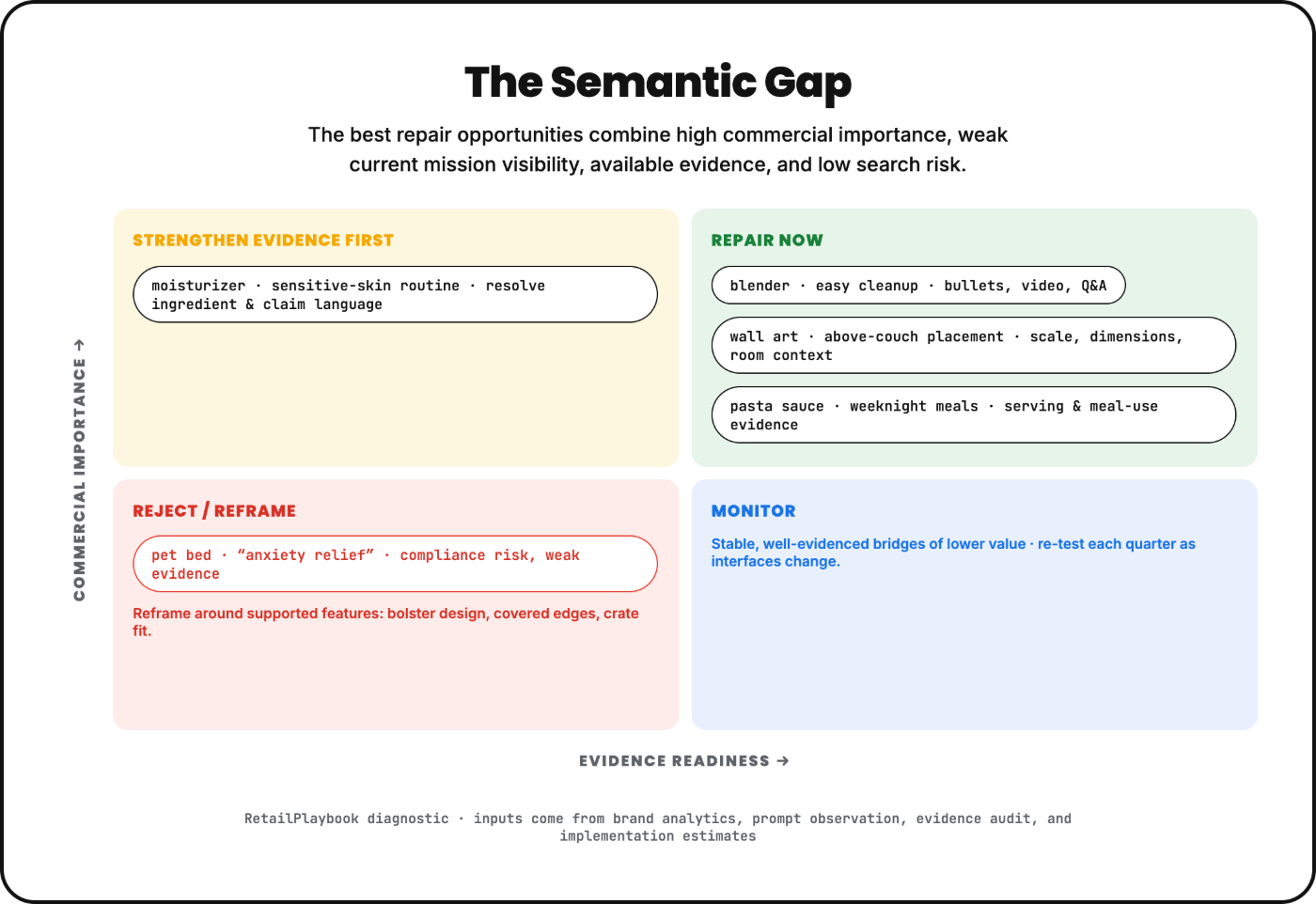
A Semantic Gap exists when a product is legitimately relevant to a customer need, but Amazon lacks enough language, structure, or evidence to connect them confidently.
Common gaps include:
a use case exists but is never expressed;
an important attribute is missing from structured fields;
a benefit is claimed without its supporting feature;
reviews repeatedly describe an outcome the brand never mentions;
images show a use that text never contextualizes;
internal marketing language differs from customer language;
the title captures the category but the page does not explain fit;
conversational phrases obscure the actual product type;
compatibility exists only in Q&A;
variation data contradicts shared content.
Four gap types help diagnose the correction:
Language Gap: customers and the brand describe the need differently.
Structure Gap: the fact exists, but not in catalog fields.
Evidence Gap: the relationship is stated but weakly proved.
Coverage Gap: the page answers the broad question but fails under follow-up.
Part III: The Discipline
7. Semantic Expansion Without Dilution
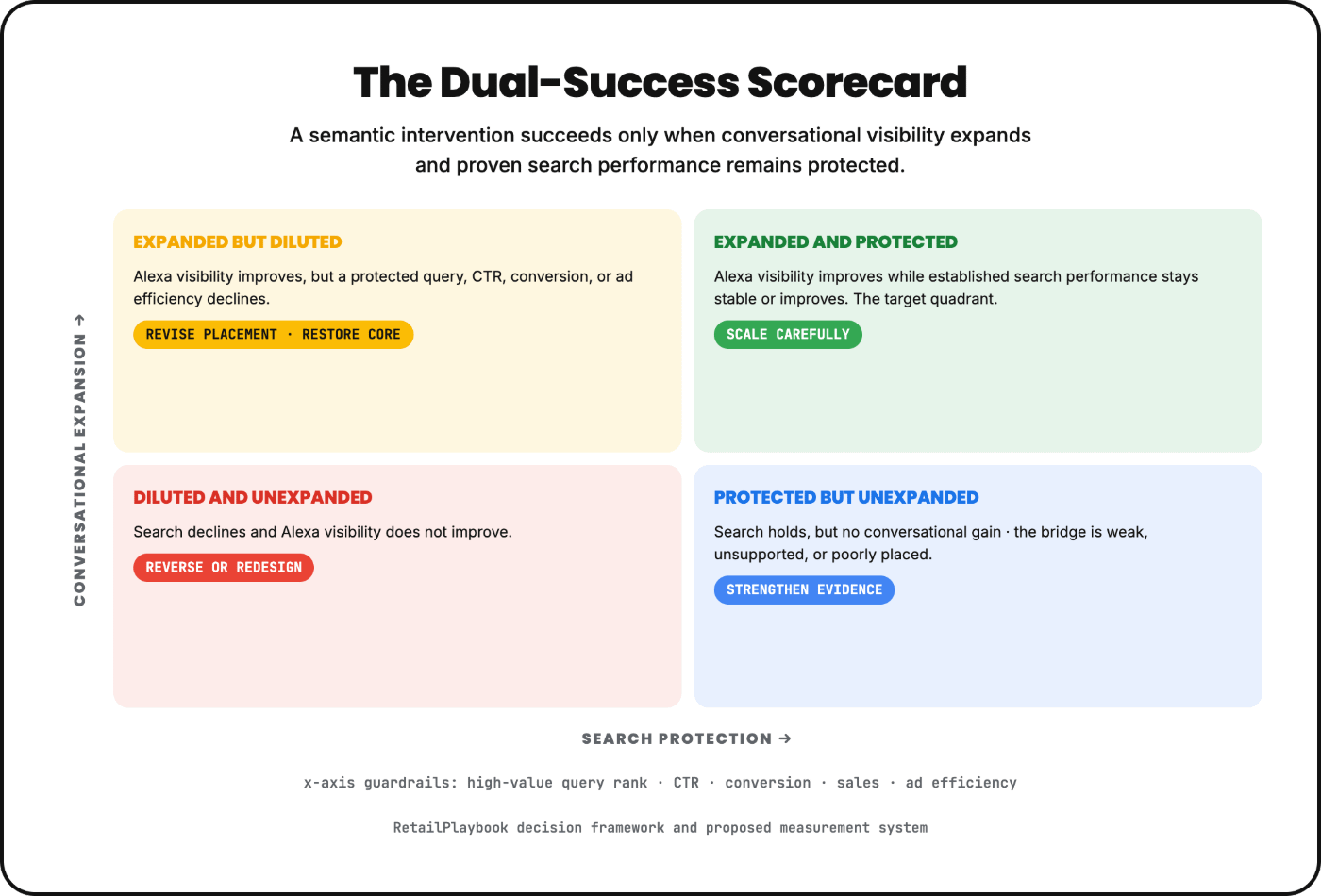
The Semantic Expansion Without Dilution framework gives enterprise brands a disciplined sequence for increasing semantic coverage:
Preserve the proven search foundation.
Enrich the factual product record.
Connect product facts with legitimate customer relevance.
Prove those connections through credible evidence.
Test expansion and protection at the same time.
Layer 1: Preserve
Protect the product’s established search foundations.
Preserve:
product type;
primary category language;
brand identity;
major differentiating attributes;
validated high-volume terms;
commercially important long-tail terms;
and immediate product clarity.
The output of this layer should be a Search Protection Register containing:
protected queries and query clusters;
their relative commercial value;
current organic visibility;
impression, click, cart-add, and purchase performance;
paid coverage;
conversion;
and any title or content elements believed to support them.
“Protected” does not mean “never change.” It means “do not change casually.”
A title that already performs strongly should not become the first testing ground for speculative conversational language.
Layer 2: Enrich
Increase the factual completeness of the product record without displacing core search terms.
Enrichment includes:
ingredients;
materials;
dimensions;
formats;
sizes;
pack counts;
compatibility;
certifications;
usage instructions;
flavor or finish;
and category-specific characteristics.
This is often the lowest-risk semantic work because the brand is not inventing adjacent meaning. It is making product truth more explicit.
A coffee listing, for example, may already rank for “dark roast coffee.” Enrichment might clarify:
ground versus whole bean;
roast level;
flavor notes;
bag size;
brewing compatibility;
origin;
certifications;
and preparation guidance.
Those facts can support both filtering and later conversational interpretation.
Amazon Science research presented at SIGIR 2026 describes category-aware attribute graphs that extract structured attributes from product text and use them to improve retrieval and ranking. That paper is not a disclosure of Alexa’s production stack, but it reinforces an important operational principle: category-specific attributes provide a more precise product representation than generic copy alone.
Layer 3: Connect
Connect product facts to customer relevance.
This is where many listings remain incomplete.
A fact does not explain its own commercial meaning.
A bridge may connect:
feature to benefit;
benefit to outcome;
ingredient to preference;
bottle design to ease of use;
product size to household context;
format to occasion;
material to durability;
compatibility to routine;
or certification to a purchase constraint.
For example:
Shallow console-table depth
→ a slimmer footprint against the wall
→ an unblocked walkway
→ relevant to narrow entryways, hallways, and apartment living.
Or:
Low-acid coffee profile, where factually supported
→ different taste experience
→ relevant to shoppers concerned about bitterness or harshness.
The connection must be specific enough to matter but cautious enough to remain defensible.
“Designed for busy mornings” may be legitimate when a single-serve format and rapid preparation support the claim.
“Guaranteed to improve your morning” is not.
Layer 4: Prove
A semantic relationship is only as strong as the evidence behind it.
Proof may come from:
structured attributes;
ingredient and material declarations;
packaging;
certifications;
product images;
preparation or application demonstrations;
usage instructions;
comparison charts;
size and scale visuals;
review patterns;
customer questions;
and clearly governed claims.
Proof should be assessed on four dimensions:
Truth: Is the underlying fact accurate?
Specificity: Does the evidence support this exact relationship?
Consistency: Do the title, attributes, bullets, images, and A+ agree?
Recency: Does the evidence reflect the current product formulation, packaging, and variation?
Reviews can strengthen a bridge by revealing repeated real-world use. They should not be used to justify a brand claim the product cannot independently substantiate.
Customer language is valuable because it can reveal bridges the brand did not anticipate:
unexpected uses;
common objections;
sensory descriptions;
audience contexts;
compatibility issues;
and limitations.
But customer-generated content is not brand-controlled and may contradict brand messaging. That contradiction is itself important evidence.
Layer 5: Test
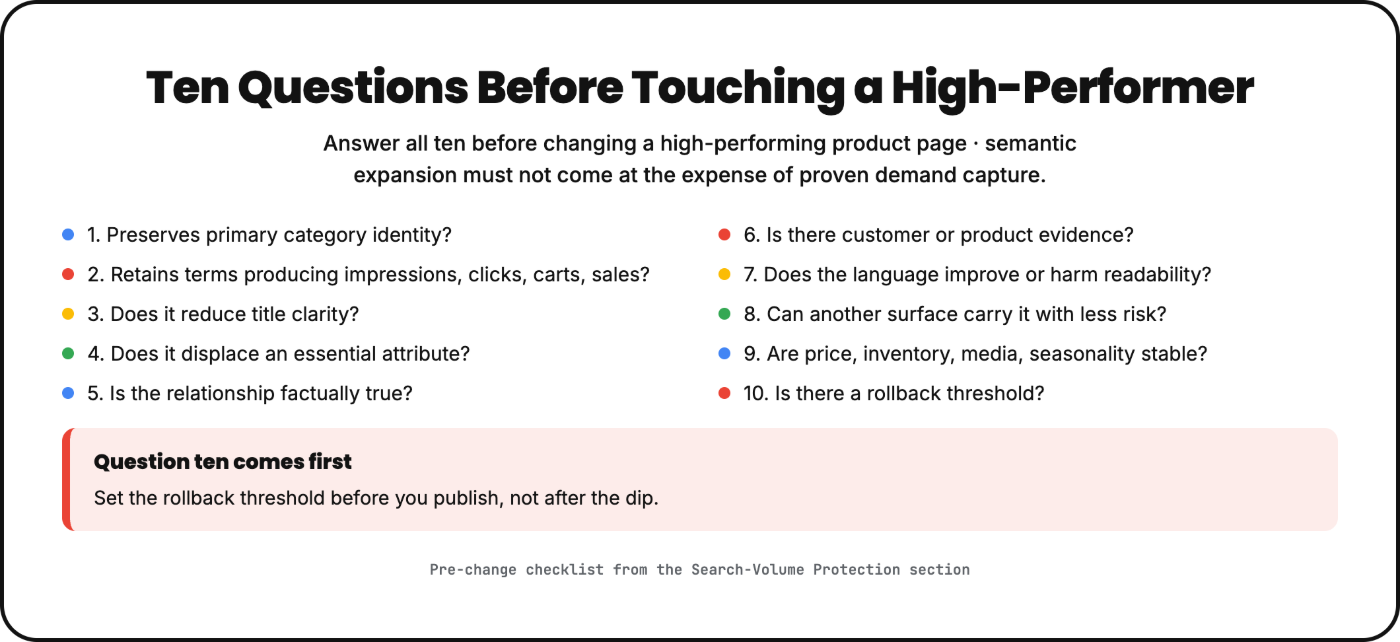
Test expansion and protection at the same time.
Before changing a high-performing product page, the brand should answer:
Does the proposed content preserve primary category identity?
Does it retain the terms producing meaningful impressions, clicks, carts, purchases, or paid sales?
Does it reduce title clarity?
Does it displace an essential product attribute?
Is the proposed semantic relationship factually true?
Is there customer or product evidence for it?
Does the language improve or harm readability?
Can the bridge be expressed more effectively in an attribute, bullet, image, A+ module, video, comparison, or answer?
Are price, inventory, media, and seasonality stable enough to evaluate the change?
Is there a rollback threshold?
Success must then be measured in two directions.
The brand must ask:
Expansion: Did visibility improve across Alexa for Shopping prompts, need states, use cases, occasions, audiences, comparisons, or outcomes?
Protection: Did established query visibility, traffic, conversion, advertising performance, and sales remain stable or improve?
A project that gains conversational visibility while losing high-value search demand is not successful. It is expanded but diluted.
The ideal outcome is expanded and protected: Alexa visibility improves while traditional search performance remains within guardrails or becomes stronger.
8. Where to Expand First
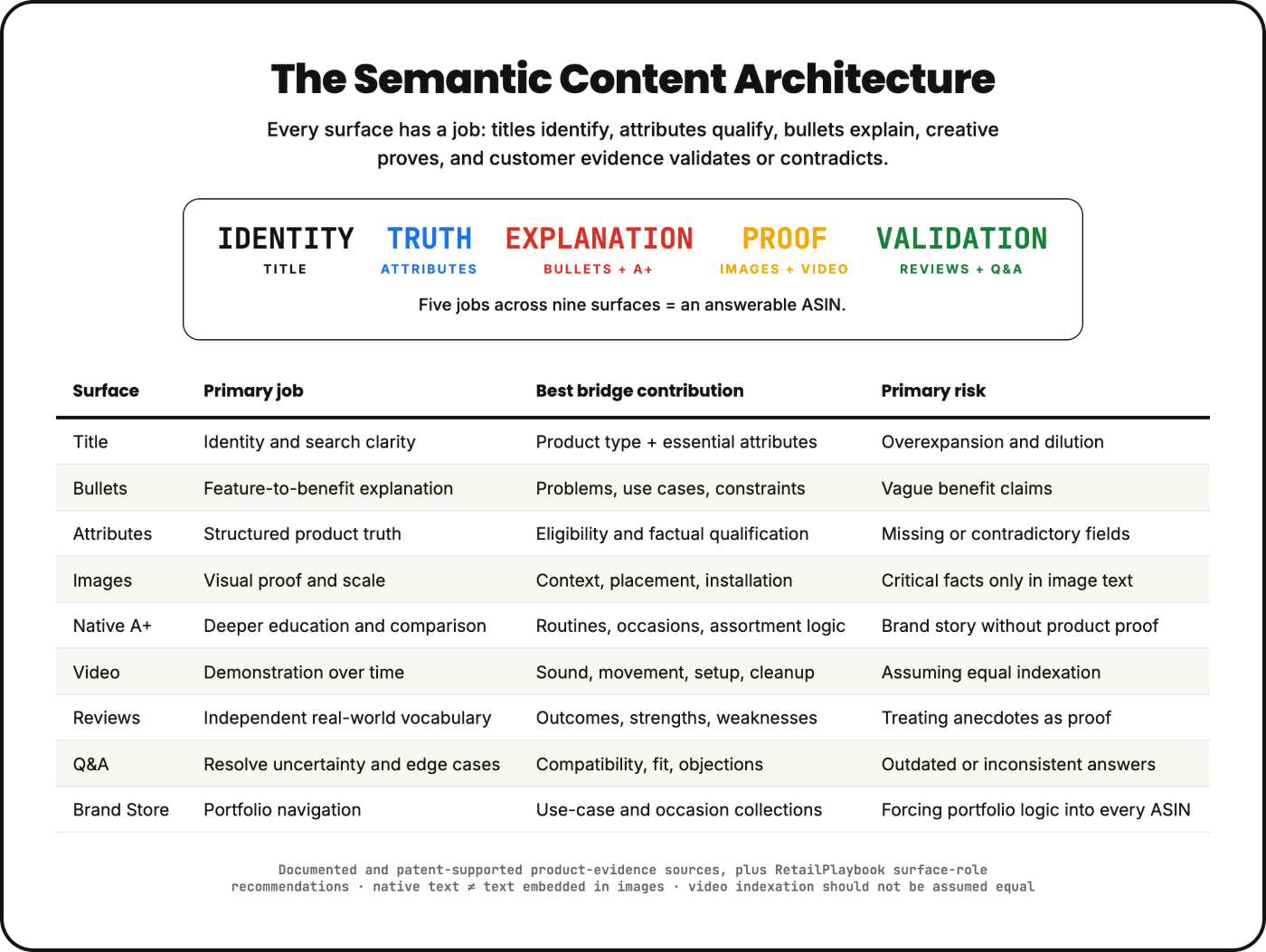
A prudent enterprise sequence is:
Complete factual structured attributes.
Correct contradictions across the product-information ecosystem.
Strengthen bullets that connect attributes to relevant benefits.
Add visual proof and scale.
Address recurrent questions and constraints.
Develop use cases, routines, and comparisons in A+ or video.
Change title language only when evidence justifies it and demand protection is in place.
This is additive optimization, not a rewrite contest.
The safest default is not “never change the title.” The safest default is:
Do not make the title carry semantic work that another surface can perform with less commercial risk.
The title’s first responsibility is product identity and high-priority relevance. A title should not become a compressed FAQ, audience map, occasion calendar, or collection of speculative lifestyle terms.
Not every use case belongs in the title. Not every customer phrase belongs in a bullet. Not every claim should be made simply because a prompt exists.
Part IV: The Framework in Practice
9. Five Semantic Bridging Examples
These examples illustrate the RetailPlaybook framework. They should be presented as legitimate product-to-need relationships that brands can clarify and test, not as confirmed Alexa for Shopping ranking factors.
1. Full-Length Mirror
Protected search foundation: full-length mirror, floor mirror, wall mirror, accurate dimensions, frame material, color, mounting type, and orientation.
Semantic opportunity: The same mirror may connect to bedroom dressing, entryway preparation, apartment living, outfit checking, room-brightening, or making a small space feel more open.
A shopper might ask:
“What mirror would work in a small bedroom where I need to check full outfits?”
The semantic bridge connects the customer’s room, space constraint, and desired outcome to factual product characteristics such as height, width, mounting options, floor footprint, orientation, and reflective surface.
A mirror should not be described as suitable for a small room merely because it is decorative. The dimensions, installation requirements, and available wall or floor placement must support that use.
2. Quiet Countertop Blender
Protected search foundation: countertop blender, smoothie blender, accurate capacity, motor power, jar material, blade system, controls, and included accessories.
Semantic opportunity: If supported by the product, the blender may connect to early-morning smoothies, apartment living, small kitchens, frequent meal preparation, easy cleanup, or beginner use.
A shopper might ask:
“What blender can I use before work without waking everyone?”
A legitimate bridge could follow this pathway:
Documented noise-reduction feature
→ lower operational noise
→ less household disruption
→ better fit for early-morning use.
The product page should support this relationship with accurate specifications, demonstrations, comparisons, or other credible evidence. A standard blender should not be called quiet simply because quiet operation is a desirable customer outcome.
The blender example is already established in the RetailPlaybook framework as a product whose category identity can expand through audience, environment, use case, and constraint language.
3. Dimmable Floor Lamp
Protected search foundation: floor lamp, standing lamp, reading lamp where accurate, shade type, bulb compatibility, height, finish, switch type, and power source.
Semantic opportunity: The lamp may connect to a reading nook, apartment lighting, bedroom ambience, home-office task lighting, dark corners, or rooms without overhead fixtures.
A shopper might ask:
“What lamp would give me softer light for reading beside a chair?”
The semantic bridge connects the customer’s activity and lighting preference to product facts such as brightness range, dimming capability, bulb compatibility, shade design, lamp height, and light direction.
A lamp should not be positioned as ideal for reading unless its illumination, adjustability, placement, and bulb specifications support that purpose. Likewise, “soft light” should connect to dimming, shade diffusion, color temperature, or compatible bulb selection rather than vague decorative language.
The project’s Noun Phrase Optimization framework identifies floor lamps and their room, constraint, function, and proof language as natural semantic refinements of the core product concept.
4. Large Metal Wall Art
Protected search foundation: metal wall art, wall sculpture, accurate size, color, material, design style, orientation, and mounting requirements.
Semantic opportunity: The artwork may also connect to an above-couch placement, an entryway, a bedroom accent wall, a tall blank wall, a modern entertaining space, or a housewarming occasion.
A shopper might ask:
“What can I put above my couch to fill a large empty wall?”
The bridge connects the decorating problem to verified characteristics such as width, height, orientation, visual scale, finish, style, weight, and installation method.
The strongest evidence may come from dimensional diagrams, room-scale photography, mounting information, and accurate style language. The listing should not claim universal room fit. A piece that works above one couch may be too narrow, too heavy, or incorrectly oriented for another space.
Metal wall art is the clearest recurring example in the existing RetailPlaybook materials because it demonstrates how one core category phrase can expand through room, placement, style, occasion, audience, and desired visual outcome.
5. Narrow Console Table
Protected search foundation: console table, entryway table, sofa table where accurate, dimensions, material, finish, shelf count, drawer count, weight capacity, and assembly requirements.
Semantic opportunity: The table may connect to a narrow hallway, small entryway, behind-sofa placement, apartment storage, key organization, decorative display, or a drop zone near the front door.
A shopper might ask:
“What table can fit in a narrow entryway without blocking the walkway?”
The semantic bridge connects the space problem to measurable product facts such as depth, width, height, leg placement, shelf configuration, drawer clearance, and wall anchoring requirements.
The phrase “small-space console table” is only credible when the actual dimensions support constrained placement. Similarly, a product should not be positioned as an organizational solution unless its drawers, shelves, hooks, or surface area genuinely support that use.
This example also shows why Semantic Bridging should not replace category language. Console table remains the primary product identity. Narrow entryway, behind a sofa, and small-space storage are adjacent meanings that help explain where and why the product may fit.
The Pattern Across All Five
Each example follows the same chain:
Customer expression → interpreted need → product fact → supporting evidence → legitimate product fit
The product does not become relevant merely because the brand mentions a room, audience, or outcome. The bridge becomes credible when the proposed need is connected to accurate dimensions, materials, functions, attributes, instructions, visual proof, or other product evidence.
The safest formulation is:
Semantic Bridging makes legitimate product-to-need relationships clearer, more complete, and easier to evaluate across Amazon search and Alexa for Shopping.
It should not be framed as proof that every room, occasion, placement, or use-case phrase automatically creates a new retrieval pathway. The relationship must remain accurate, evidence-supported, commercially relevant, and measurable.
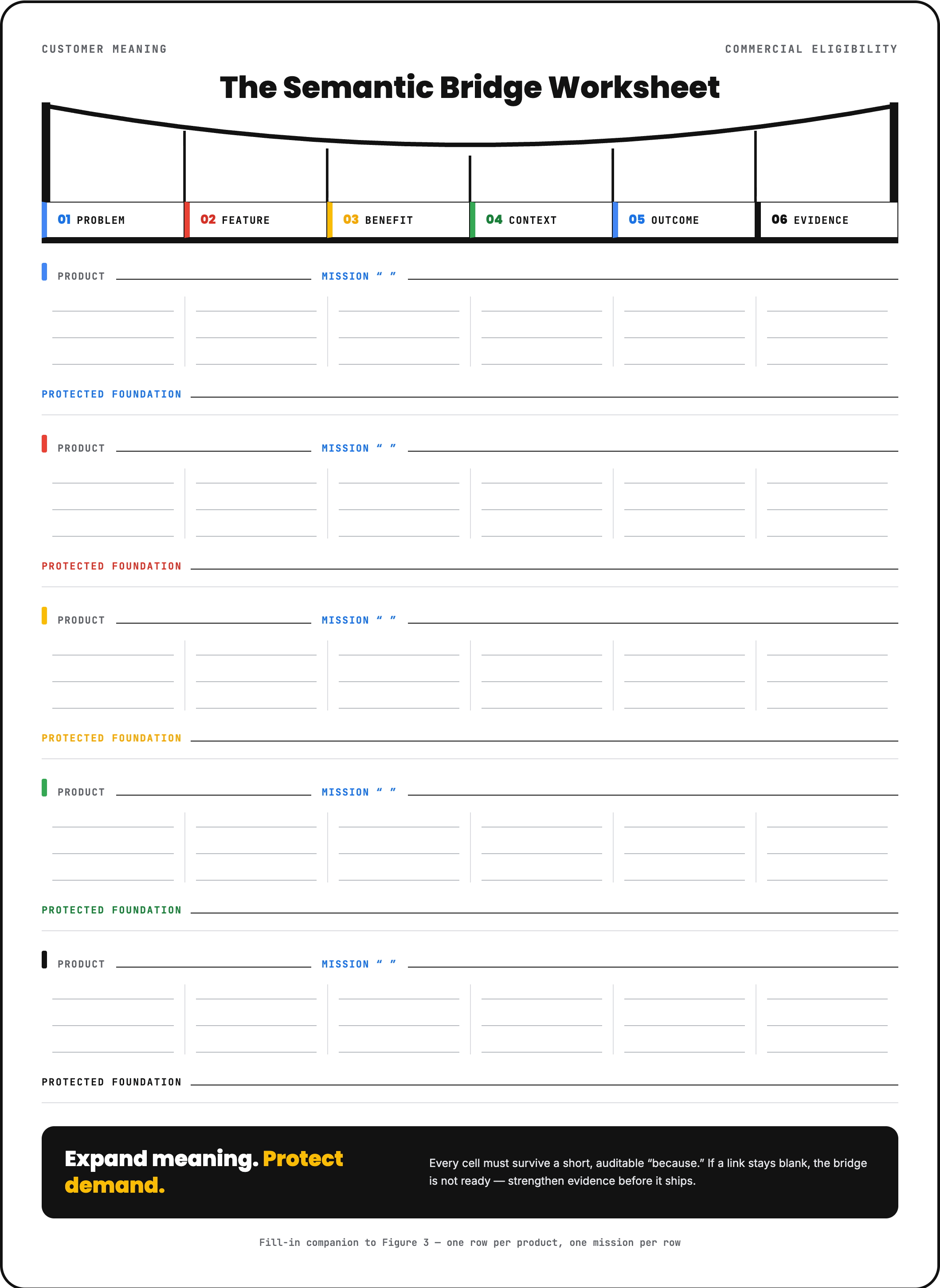
Figure 2. The Semantic Bridge Worksheet: a blank fill-in companion to Figure 1. One row per product, one mission per row.