


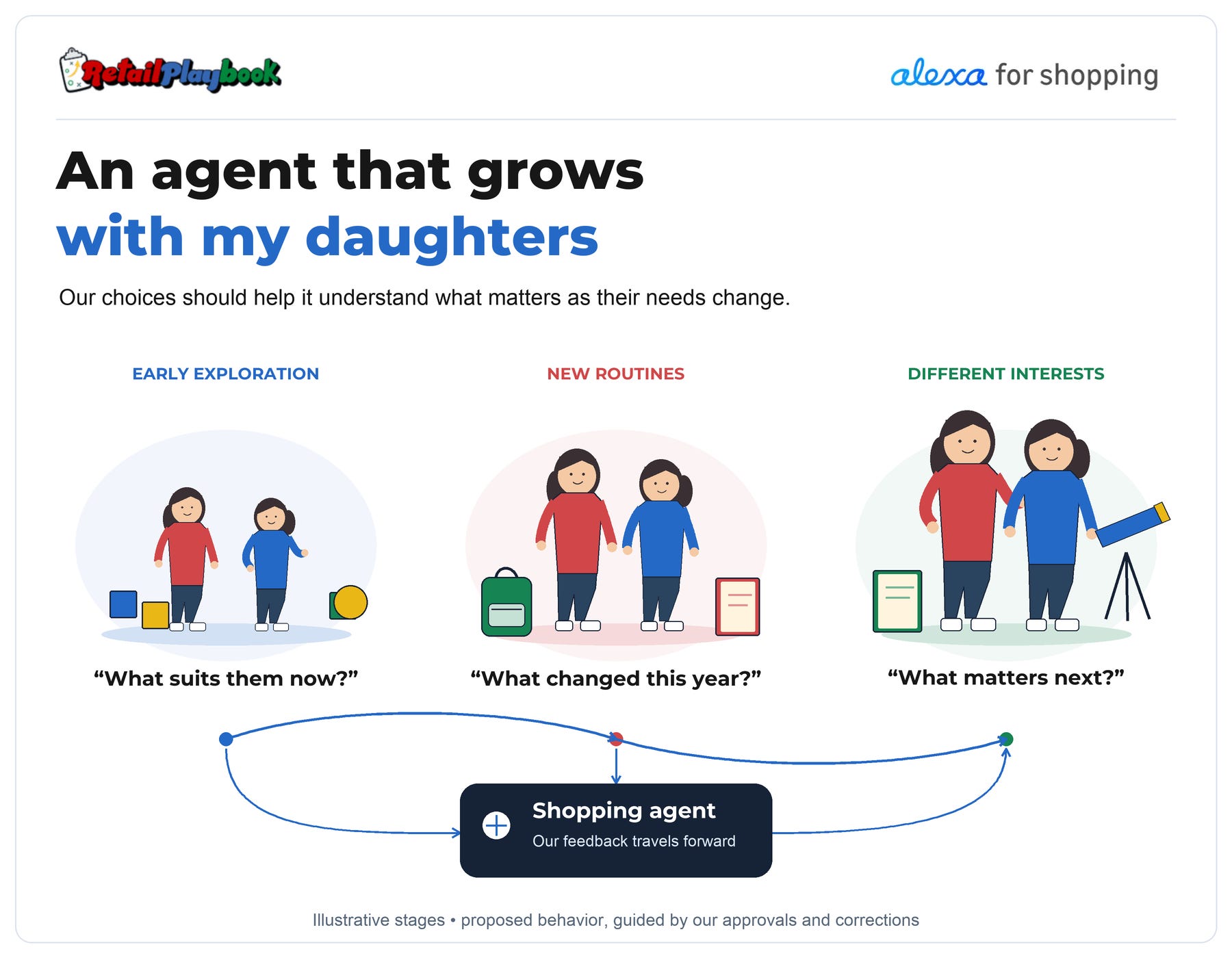
My twin daughters will outgrow today’s recommendations. I need an agent that will grow with them too.
Walmart is preparing for customers to shop through agents they choose. Its Agent Gateway page puts it simply: “Your agent, connected to Walmart.” A customer brings an outside agent, and the gateway connects it with Sparky, Walmart’s own shopping agent, to use Walmart’s shopping services.1
On October 21, Walmart announced Agent Profiles, the Walmart Agent Gateway, and terms for agents acting on customers’ behalf. Profiles, planned for the following month, would let customers authorize individual agents, set spending limits, and review their purchases separately. Gateway access would begin with a developer beta.2
An agent that remembers why we chose and checks whether those reasons still apply could become the place we return to first. Suppose I work through furniture choices in ChatGPT and it uses my corrections next time. I have a reason to start there again, even when Walmart sells and delivers the item. Earning that repeat visit depends on accurate memory, useful advice, and corrections that take little effort.
My earlier work on Inference Optimization asked whether product facts support a recommendation. Following a household over time adds another question: does the product still suit us after a move, a new routine, or another stage of childhood? Brands need facts an agent can check again as our needs change.3
TL;DR
Amazon’s shopping features and research provide pieces of a continuing relationship. My argument is that useful continuity depends on remembering why we chose, when that reason applied, and what has changed.
Shopping can start in one service and finish with a retailer. Spending limits, delivery deadlines, and approvals need to survive that handoff. With permission, a changed deadline should also reach the agent that started the search.
Brands can make product facts easier to check as a household’s needs change. Begin with a consequential fact, submit any needed correction, and verify what customers can see. Appendices retain the five applications, research, testing worksheet, and product record.
An assignment that continues after we leave
When I wrote about Update Me When, I described asking Alexa for Shopping to keep up with my daughters’ changing interests and developmental needs. I supplied their ages, their stage, and the help I wanted. Scheduled recommendations followed, organized around different skills. Amazon had an assignment that continued after I left the conversation.4
Amazon already offers tasks that continue between visits. Auto-Buy applies a target price to a chosen product. Scheduled Actions can support recurring research or cart building. Update Me When adds the ongoing watch I described with my daughters.5
I use lifelong shopping agent for help that carries from research and buying into ownership and the next decision. Amazon has not announced that complete system. Its existing features give us a starting point for examining what else would have to work.
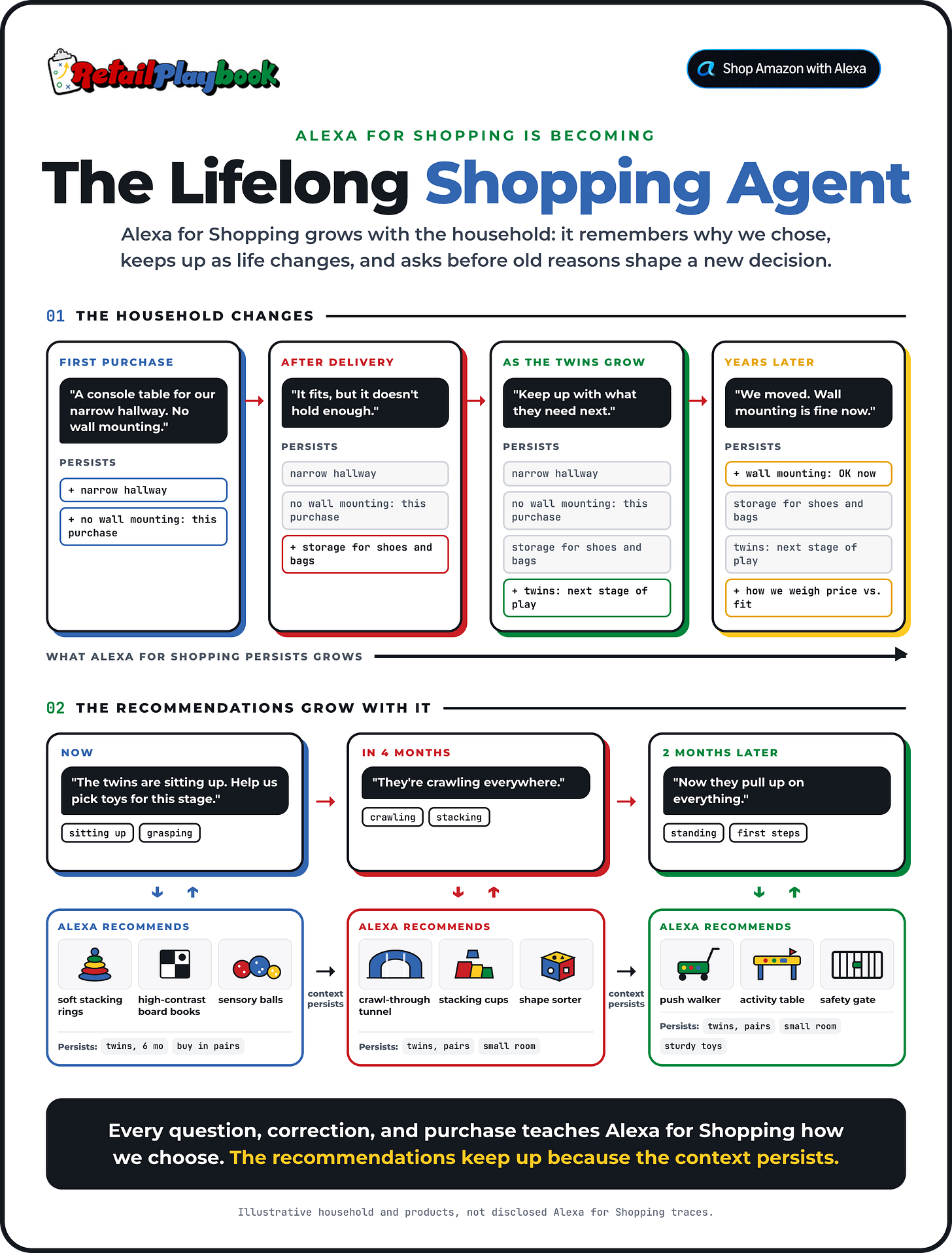
Illustrative household journey: the behavior I want from a lifelong shopping agent, not a record of years of autonomous learning.
Follow an illustrative family choosing a console table. Only the 9.8-inch depth comes from my earlier example. Our household, dialogue, purchases, and later move here are constructed.6 Installation requirements and usable storage still need documentation. With a narrow hallway, young children, and a previous complaint about unstable furniture, our customer says, “We can’t attach furniture to the wall in this hallway.”
Amazon already has a production agent for shopping tasks
Amazon already brings product search, conversation history, and order questions into the same shopping experience. Its production and model-training papers describe finding information, using earlier conversation, and improving answers.7 Appendix A examines those systems and the research on memory and simulated choices.
Suppose a table fits the space but its instructions require a wall attachment. Our customer rejects it. A useful agent checks the instruction: “Does that include a safety strap, and is this just for the current hallway?” Our customer answers, “Yes, no attachment to the wall, just for this hallway.” That rules out both wall-mounted tables and furniture that requires a wall anchor to prevent tipping. Describing a table as freestanding would not remove that requirement.
A useful next answer removes that candidate and checks the installation instructions for the alternatives. Suppose another table’s documentation supports use without a wall attachment and meets the family’s space and stability needs. Our customer approves it and explains that it works for this hallway. Those reasons give the agent more to work with than the order record alone.
Remember the reason, then recognize what changed
With our customer’s permission, the agent should keep the explanation it clarified: this hallway does not allow furniture to be attached to the wall. Saving the room and purchase alongside the restriction gives it a reason to reconsider when either changes.
Children grow, gifts reflect their recipients, and household members can disagree. A reason belongs to the person and purchase it came from. If one adult wants separate storage and another wants the cheapest suitable table, the agent should ask the authorized customer how to proceed.
I should be able to see and correct what the agent remembers. Learning here means improving what it keeps and uses, without assuming that each approval retrains Amazon’s underlying model.
Amazon describes account memory customers can inspect and correct, and personal information carrying between Alexa experiences and shopping on Amazon.8
What ownership can teach the agent
Once the table arrives, the family asks for assembly help. Later, they explain, “It fits the hallway, but the school bags still end up on the floor because there isn’t room for them and the shoes.” With their agreement, the agent can keep that shortfall for the next search.
I see a strong starting position for Amazon, with customer memory and shopping in the same service. It still has to earn the next visit. Repeatedly explaining the same mistake would weaken my case. Its advantage could shrink if useful memory travels easily between services or another agent already helps with more of a customer’s daily life.
Eventually, the agent should understand how I would choose
Even after unsuitable products are removed, we still weigh the remaining options differently. I want an agent that learns those tradeoffs well enough to make a useful suggestion, explain it, and accept a correction.
Three years later, our family moves into a larger home. Their children are older, and they need storage for a different room. After the agent checks, they confirm that wall attachment is now allowed and that shoes and school bags still need a place.
Suppose two tables fit the new room, meet its installation requirements, and have enough usable space for the shoes and bags. One costs less and puts everything on a shared lower shelf. Another costs more but has separate spaces. Extra capacity addresses the old complaint. Easier organization is a further suggestion to check: “Would separate spaces make putting the bags away easier, and is that worth paying more this time?”
Our customer replies, “We can pay a little more to keep the bags out of the way, as long as it stays within our limit.” They agree that the agent can remember that reason for this purchase. It now has a confirmed tradeoff to use, rather than guessing that a complaint about capacity meant they preferred compartments.
When the family reopens the search without repeating that explanation, a useful agent puts the separate-storage option first and says why: “You said keeping the bags organized was worth a little more. This one does that and is still within your limit.” That recommendation has a reason the customer can recognize and correct.
Research such as AgenTwin tests prediction of a person’s next action, not representation across years of purchases. Extending that work to a lifelong relationship is my extrapolation.9 Predicting our choice still does not authorize the agent to buy.
Test the promise at the point where it can fail
Remembering a fact is only one test. A shopping answer can still contradict a stated preference in its product suggestions, as the PACESHOP research paper illustrates.10 Simulation also needs checking against real shopping behavior.11
PAARS tests a different question: whether a group of simulated shoppers reproduces sales effects seen in retail experiments. Its simulations got the direction right in two of three historical tests but greatly exaggerated the size of the changes.12 That result does not score a personal shopping agent. It explains why a plausible simulation needs checking against what people actually do. Appendix A keeps the numbers and method.
What must survive a retailer handoff
For this purchase, the family confirms a $250 limit including delivery, tax, and mandatory fees, arrival before the weekend, and approval for every substitution. Those requirements must accompany the chosen table when the personal agent takes it to a retailer.
By personal agent, I mean the agent carrying the customer’s requirements and acting within their permission. That role does not automatically mean it compares every retailer or acts independently of commercial incentives. A retailer’s agent contributes what its store can supply, the current offer, and the checkout rules. Amazon can combine customer memory with that store knowledge in one service.
Buying still needs permission
Agentic Commerce Protocol (ACP) and Universal Commerce Protocol (UCP) describe ways for agents and stores to exchange checkout information. Walmart’s gateway has its own terms. A connection does not itself authorize a purchase: customer instructions, approval requirements, and seller responsibilities still have to govern the order.13
Walmart’s October 21 terms make permission explicit. Outside the gateway, the customer must approve every checkout. Through the gateway, Walmart may let an agent buy without another approval when it follows the customer’s spending limits, other instructions, and Walmart’s terms, although Walmart can still ask for confirmation.14
A $240 table with $35 shipping already exceeds the limit before tax. Any revised shortlist must apply the cap to the full cost. Even a cheaper option in a different finish needs approval because the customer asked to approve substitutions.
Walmart’s gateway terms call for a signed record of the customer’s instructions, consent, identity, and the agent acting for them. They also describe temporary access tied to the store, cart, amount, and shopping session, with fresh access required for each purchase. Those controls make permission specific to the order being placed.15
Walmart’s terms place obligations on the agent provider and reserve Walmart’s ability to block access. They specify controls for an order while disclaiming a guarantee that an agent will obey them.16
While helping a child find a missing school bag, our customer accepts a finish they would not ordinarily choose: “This finish is fine because it gets here in time.” Delivery explains that compromise. Without the explanation, the agent should leave the reason unsettled.
Learning cannot become another chore
Useful feedback is already part of the help we ask for: the shelf does not hold enough, the total is too high, or delivery misses when we need it. With permission, the agent can keep those explanations. A completed order records what we accepted that day. Silence afterward gives it little reason to conclude that everything worked.
Questions should come when the answer would change a decision. Frustrating assembly may justify asking whether easier assembly matters next time, but someone available to help could change the answer. Preference questions should be optional. Any approval required to place an order still has to happen.
Some households may rarely correct the agent. With less evidence, it should leave uncertain preferences open and ask when the missing reason matters. Repeated purchases would need to show that people can correct its memory, return with fewer repeated explanations, and spend less effort getting useful help. If maintaining that memory becomes another chore, my argument for the continuing relationship weakens.
Retailers can help without sharing everything they know
Walmart gives a simple example: an outside agent can ask for the customer’s usual milk, and Walmart can identify it without handing over the customer’s broader purchase history.17 Apply that division of work to our family. Their personal agent could remember the need to store shoes and school bags, while Walmart supplies the relevant table, current price, delivery options, and account benefits.
Walmart also sets limits on what the visiting agent can do with its information. Section 6 restricts use to the authorized shopping purpose and bars bulk collection, keeping data longer than needed, model training, and resale or redistribution. Its gateway terms keep raw payment-card details from the agent and prevent it from adding or changing payment methods.18
A customer’s explanation about shoes and school bags comes from their experience. A copied retailer record has a different source and may carry different limits. Providers need to retain that source information: permission to remember an explanation does not erase Walmart’s data restrictions.
Whose interests does the agent serve?
A retailer benefits when we buy from its store. A shopper may be better served by waiting, keeping what they own, or buying elsewhere. A personal agent could face a similar conflict if commissions or paid placement influence its choices. Those are possible incentives to examine, not claims about a particular provider’s arrangements.
Suppose another store offers a suitable table with better delivery terms. If the agent offers to shop across stores, I expect it to consider that offer, show which stores it checked, and disclose whether a commercial relationship affected its recommendation. Accurate memory alone cannot tell us whose interests shaped the shortlist.
An agent working within one retailer can still be useful, provided the scope of its search is clear. Representing the shopper across sellers is a larger promise.
Long-term trust gives both retailers and personal agents a reason to recommend no purchase when nothing fits. That interest has to show up in their choices, including explaining limitations and leaving unsuitable products out.
Amazon’s agent can reach beyond its own store
Buy for Me already gives part of this idea a working form. For products included in the service, customers confirm their details through Amazon, and Amazon’s agent completes the purchase on the outside merchant’s website. Amazon says customers can track those purchases in a dedicated order area and that the merchant handles delivery, returns, exchanges, and customer service.19
Our household needs to know that the outside seller handles the order if the replacement arrives damaged or does not meet its description, even though shopping began with Amazon.
Browser control means an agent operates a merchant’s website, using its pages and checkout. Agreed software connections could let Amazon and participating stores exchange the cart, price, delivery options, and order updates directly, with responsibilities set out between them. I see that as a possible next step for Amazon, not evidence that it has adopted ACP or UCP.
Shopping can begin in ChatGPT
ChatGPT gives the customer another place to start. OpenAI’s March 24, 2026 announcement described a Walmart experience inside ChatGPT where shoppers could connect their Walmart account and use Walmart loyalty and payment features. It also explained that retailers could use their own checkouts while OpenAI focused on helping people find products.20
Suppose the family develops the storage request in ChatGPT and selects a specific Walmart table. Moving into Walmart’s part of the purchase must preserve the exact model, size and finish, the full spending limit, the deadline, and the substitution rule. Any alternative still needs to meet the family’s installation and storage requirements. Keeping the customer inside one application does not prove that each service received those instructions.
I want to test whether a changed delivery requirement, shared with permission in Walmart’s part of the purchase, reaches ChatGPT when the family returns. A Friday-at-noon deadline is one proposed test case, where the service supports that control and a connection back. They should be able to continue the purchase without repeating the update. Permission to share it is separate from permission to place an order.
Before ordering, the family explicitly changes this purchase’s budget from $250 to $200 including delivery, tax, and mandatory fees. Suppose only the shared-shelf table now fits that cap while meeting the installation, capacity, and delivery requirements. A useful agent should explain the change: “Separate spaces suited the way you wanted to organize the bags. With your new limit, this shared shelf still holds everything, but you give up that separation.”
Our customer accepts that compromise and approves the replacement. Its exact version and the new cap must reach checkout. A revised budget has changed the choice without erasing the earlier reason or waiving the approval rule.
Product information has to keep up, too
Our family changed its mind when the room, storage needs, and budget changed. For a brand, that makes accurate product information more valuable: dimensions, usable storage, installation requirements, and the exact version being offered all affect whether a recommendation still makes sense. Across a catalog, those facts need to agree wherever the brand supplies them, including Amazon and its own site.
Brand teams can work back from the decisions their products need to support. If a table requires a wall anchor, that requirement should be clear in the fields Amazon provides for that product and in permitted product-page content. Submitting a correction is one step; checking what appears on the detail page and how the shopping answer describes the product completes the check.
I see this as an extension of my ACO work: make accurate product facts available when a customer’s requirements change. Amazon still determines how those facts are selected and used. Appendix C keeps the detailed framework and product record, while Appendix B separates listing checks from proposed tests of agent memory and retailer connections.
Our family chose the shared shelf because the budget changed, even though separate storage still appealed to them. I want an agent that can carry both facts into the next decision and let us change our minds again. My twin daughters will outgrow today’s recommendations. I need an agent that will grow with them too.
Appendix A Research behind the argument
Amazon’s production papers describe systems built for shopping. Other papers test particular abilities, including using preferences, recognizing changing intent, and simulating choices. I connect that work to a continuing customer relationship, while keeping each result within the setting the researchers actually studied.
Production shopping tools
Amazon’s research paper Building a Production Shopping Agent at Scale describes an agent that uses the customer’s request, conversation history, and personal information to decide its next step. It can search the catalog or web and check an order, with up to four rounds of tool use in the version described.21
Amazon’s production study also evaluates response speed, relevance, product suitability, current information, and duplication. A continuing relationship adds another question: does the next decision use the customer’s earlier explanation appropriately?22
Teaching the model to give useful answers
In the research paper Language Model Alignment for Conversational Shopping at Amazon, feature owners identify weaknesses and editorial teams help prepare better example answers. For training that compares a better answer with a worse one, an independent language model may generate both. Another method starts with a weak model answer, then uses editorial feedback to improve it: the improved answer becomes the preferred example. Training teaches the model to favor it over the original, addressing problems such as omissions, repetition, and unnecessary length. Revised models are evaluated before use.23 Saving our household’s explanation for a later purchase is a separate process from this training of the general shopping model.
Customer memory and the controlled demonstration
Amazon job postings for personalization and Customer 360 roles describe memory work that covers preferences, intentions, and life events, including what to keep, retrieve, update, and forget. Keeping up with a changing customer requires all of those decisions.24 Job descriptions identify responsibilities and areas of investment, rather than proving that every described capability has shipped.
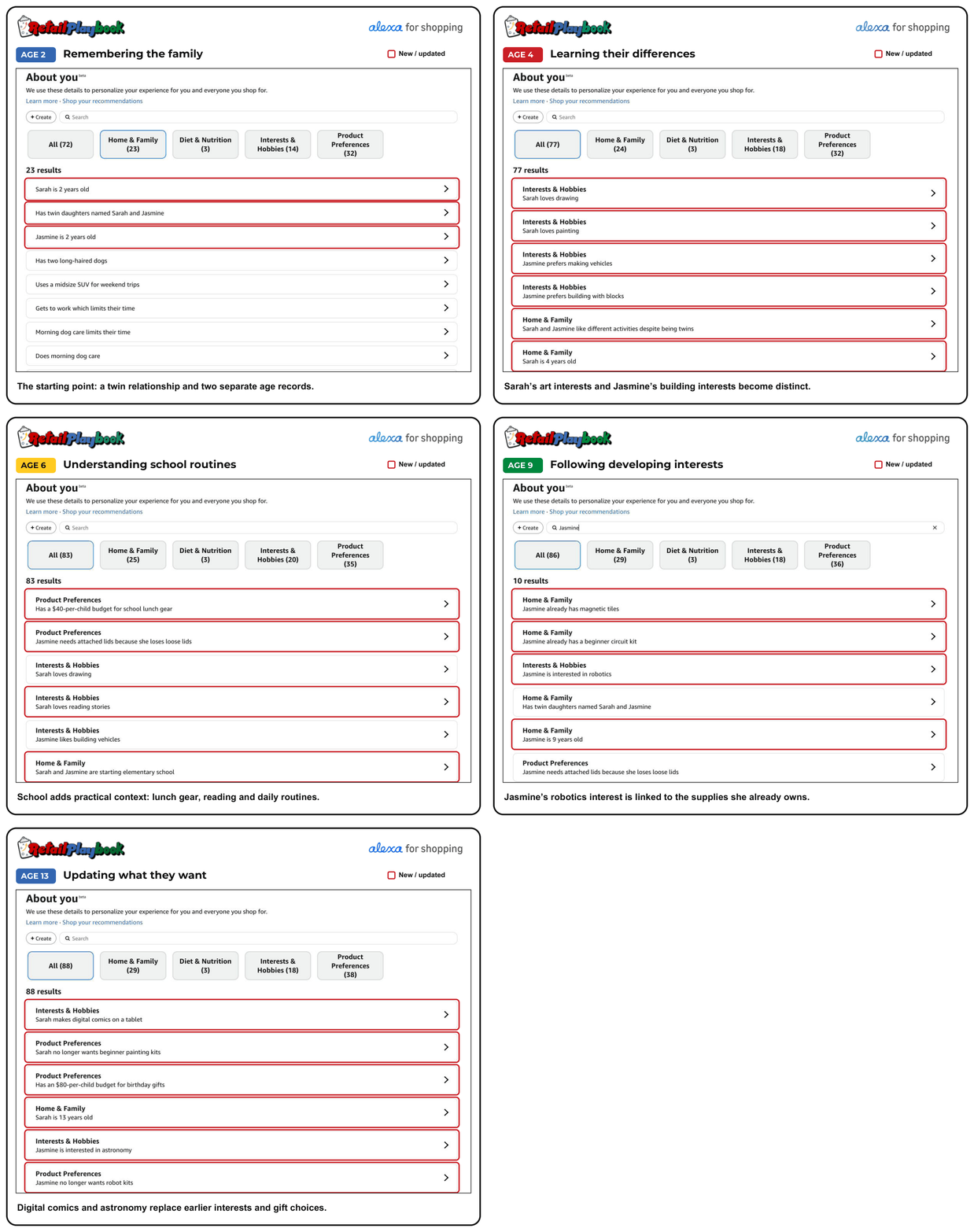
Controlled demonstration using actual About You screenshots: five fictional life stages for Sarah and Jasmine were entered in one session. Red boxes mark selected new or updated details. These frames do not show years of autonomous learning.
Checking whether personalization helps
Remembering a detail can make weak advice sound personal. In the research paper PersonaLens, the authors evaluate preference use, answer quality, and task completion separately. Success on one does not stand in for the others.25
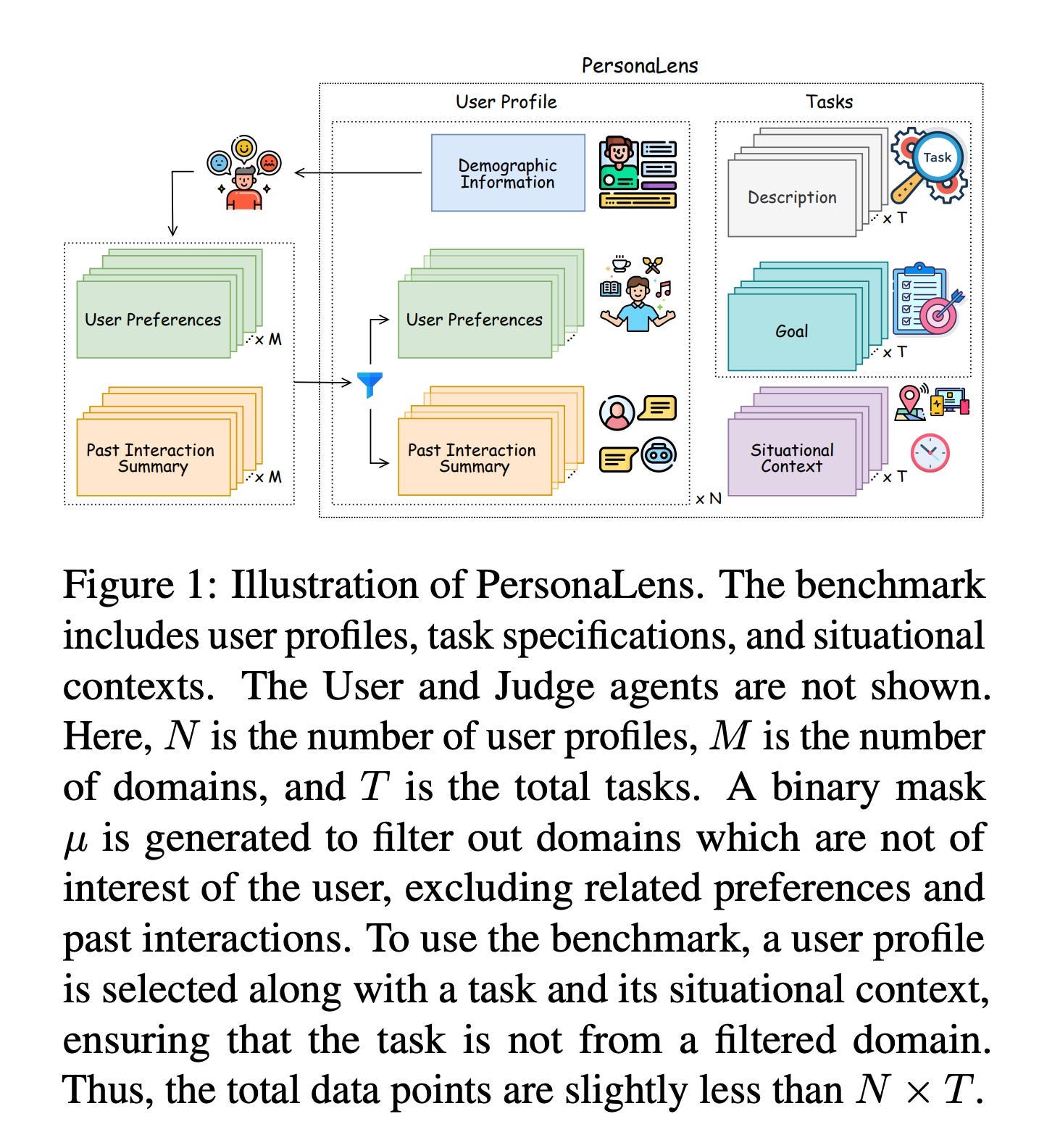
PersonaLens, Figure 1. User preferences and interaction history are paired with a task and its situational context in the benchmark.26
Recognizing changing shopping intent
In SessionIntentBench, a research benchmark, models receive product-interaction sequences, attributes, and proposed explanations of customer intent. Among its tests, models judge whether an explanation fits the move from one product to another. Figure 1 shows a shopper moving from red shoes to white ones, then to cheaper shoes. Color and price become possible reasons to examine.27 These are interpretations of browsing behavior, without proof that they capture the customer’s actual reason or predict compliance with a newly spoken instruction.
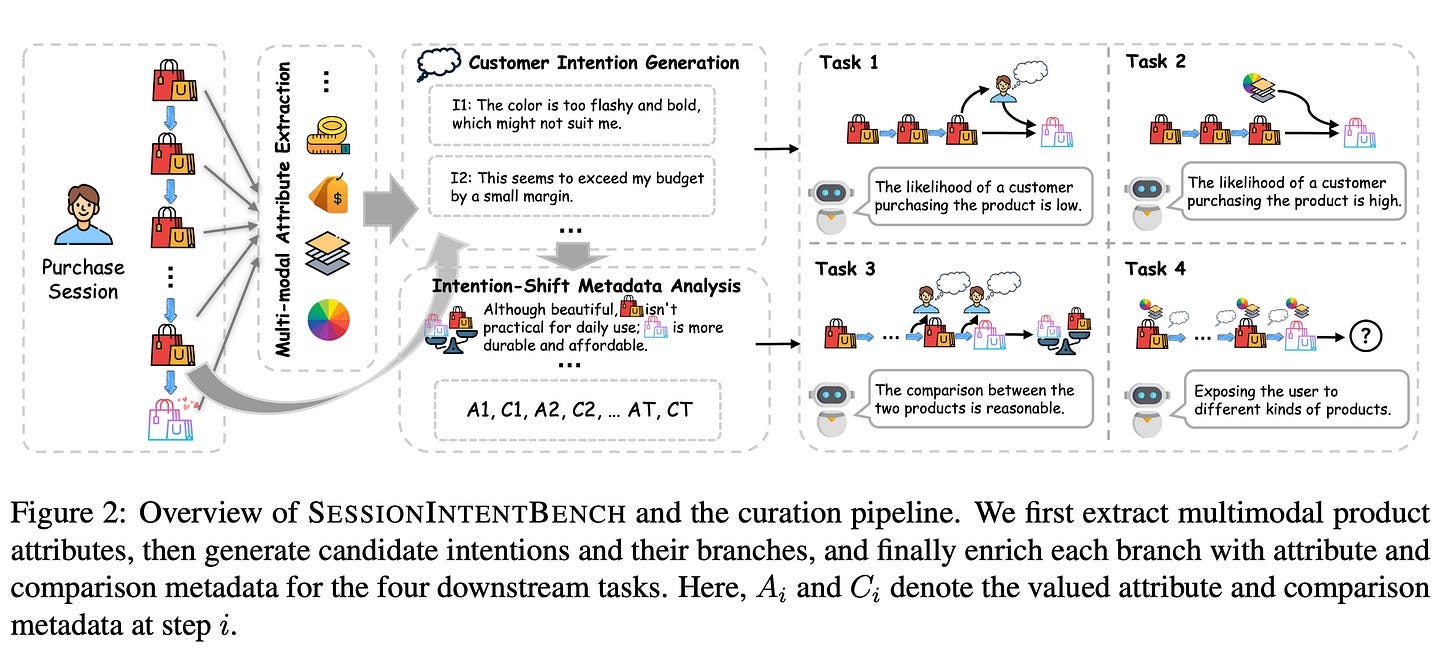
SessionIntentBench, Figure 2. Product attributes and session sequences inform candidate intentions. These are modeled explanations of changing choices.28
Planning help across several steps
Planning across several steps is the task studied in EcomScriptBench. Its autumn-party example connects relevant products to the steps that need them. Researchers evaluate whether the plan makes sense, the products help with each step, and the products work together. Some steps require no purchase.29 For our household, that could mean measuring the hallway with a tape measure they own, buying a suitable table, then following its assembly instructions. Helping at every step should not mean selling at every step. Practical deployment remains future work in the paper.
Simulating extended shopping conversations
Small Agents, Big Gains studies training smaller models through conversations with a simulated customer that remembers prior exchanges, plus feedback from a separate reviewer. These synthetic training interactions span exploration, comparison, fact-checking, and post-purchase help, including returns to earlier stages.30
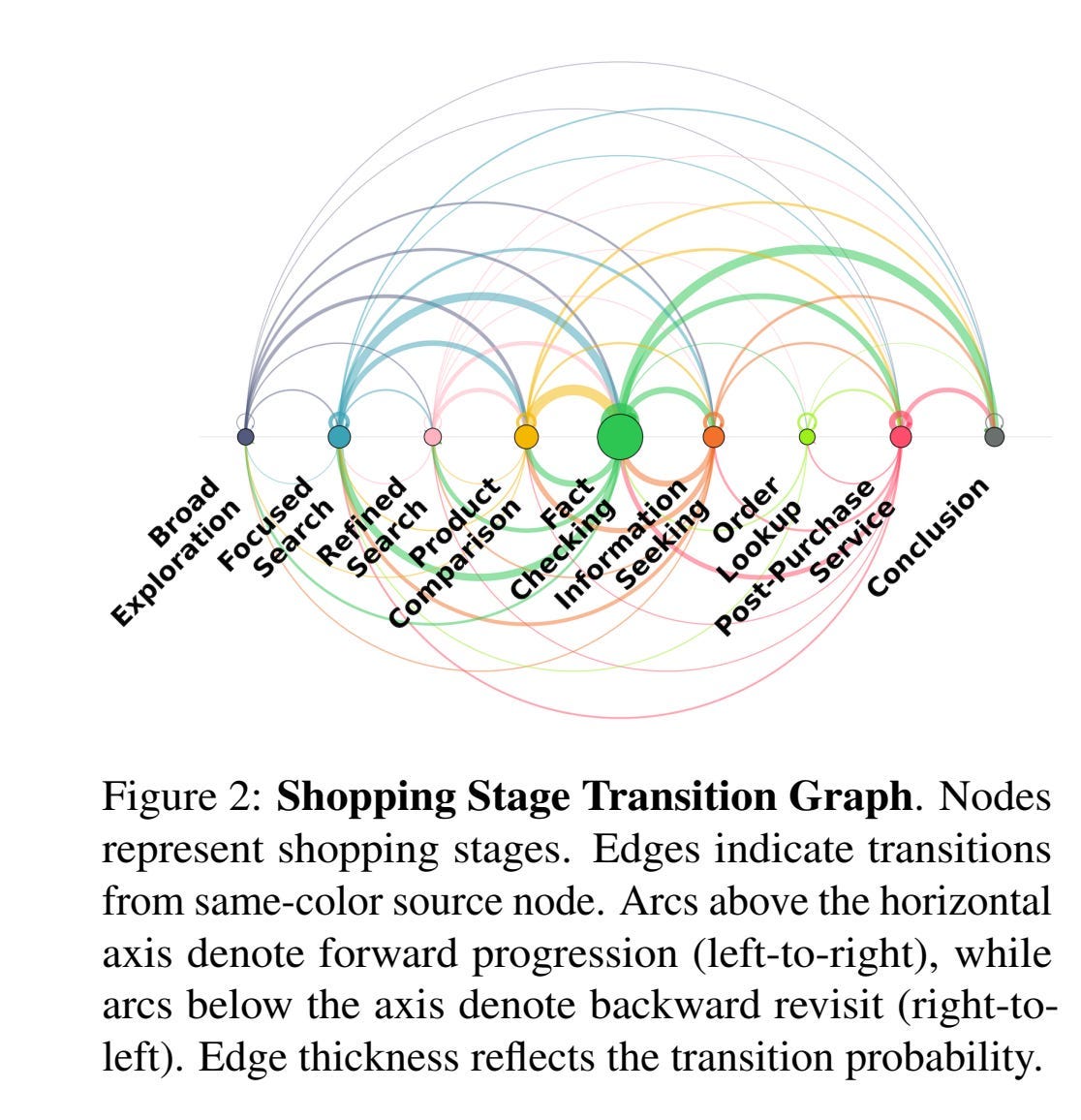
Small Agents, Big Gains, Figure 2. Upper arcs show forward movement, and lower arcs return to earlier stages. Thickness represents transition probabilities used in the simulation.31
Patents and hiring for continuing help
Amazon’s patent applications describe using knowledge about a person to anticipate tasks and decide when to offer help. Its hiring covers post-purchase support, actions on customers’ behalf, and long-term adoption. I read those as signs of investment in a continuing relationship. Our family would judge it by whether help after delivery improves the next recommendation.32 Patent applications disclose design concepts, and hiring describes work companies want to pursue. Neither establishes that a complete lifelong shopping agent is available.
Simulating the next choice
AgenTwin combines a simulated user’s profile, goals, memories, and products on screen to predict the next choice: view details, add to cart, buy, or decline. Researchers focus on matching the real user’s next event.33 Reliable representation across years of purchases remains my extrapolation beyond that research question.
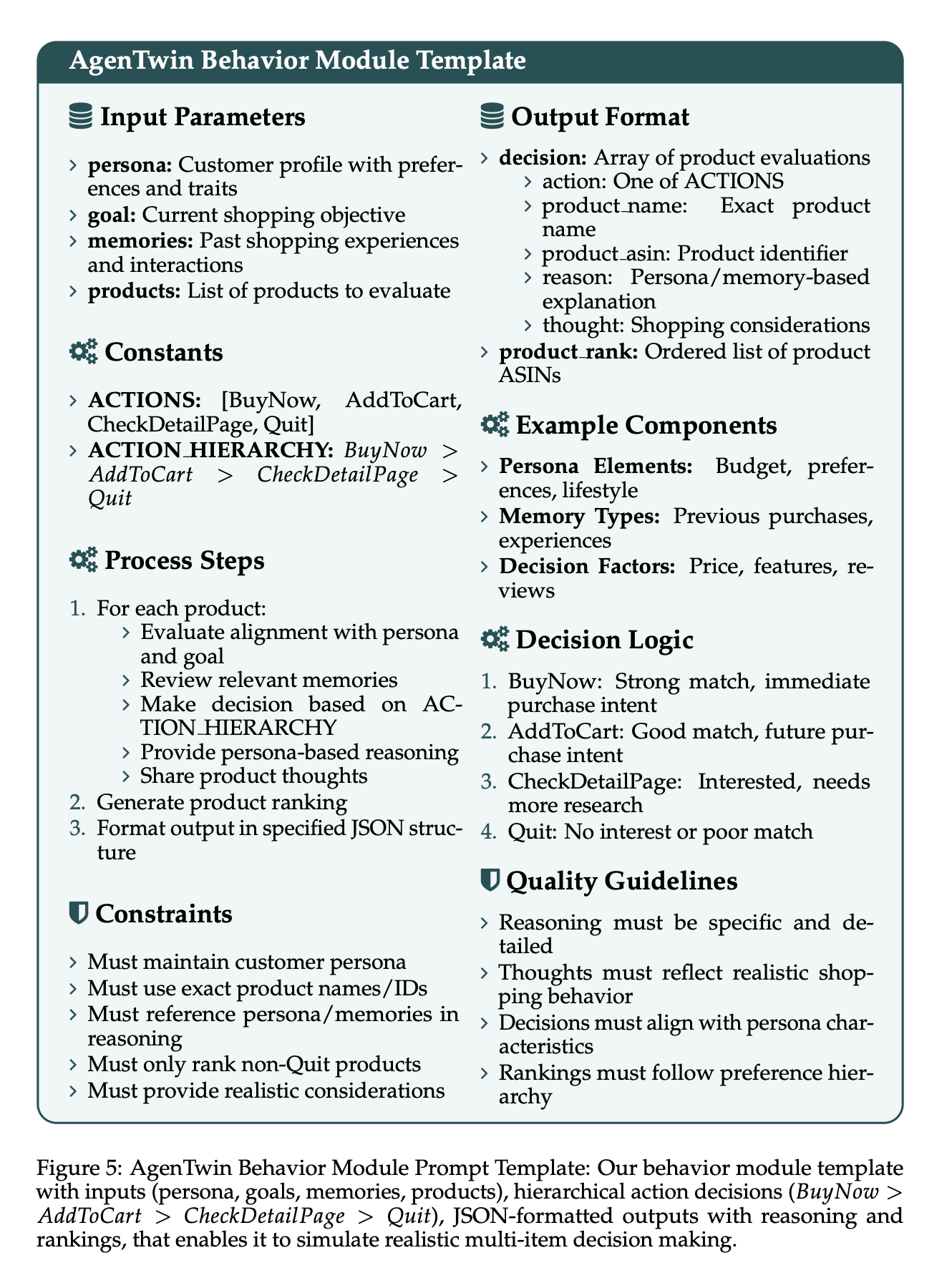
AgenTwin, Figure 5. Persona, goal, memories, and products inform simulated actions and rankings in a user-simulation framework.34
Checking the complete shopping answer
In the research paper PACESHOP, 22,625 constructed test cases combine synthetic customer profiles, generated or edited shopping answers, and product evidence. They are not 22,625 observed customer experiences. Researchers check the answer’s overview, product categories, related searches, and sources together. In Figure 1, a profile says to avoid Nike and the request asks for adidas shoes. Yet the answer includes a Nike category and suggests studded cleats while its overview describes daily-wear shoes. A general checker accepts it; PACEJUDGE identifies both the preference conflict and the disagreement between parts of the answer.35
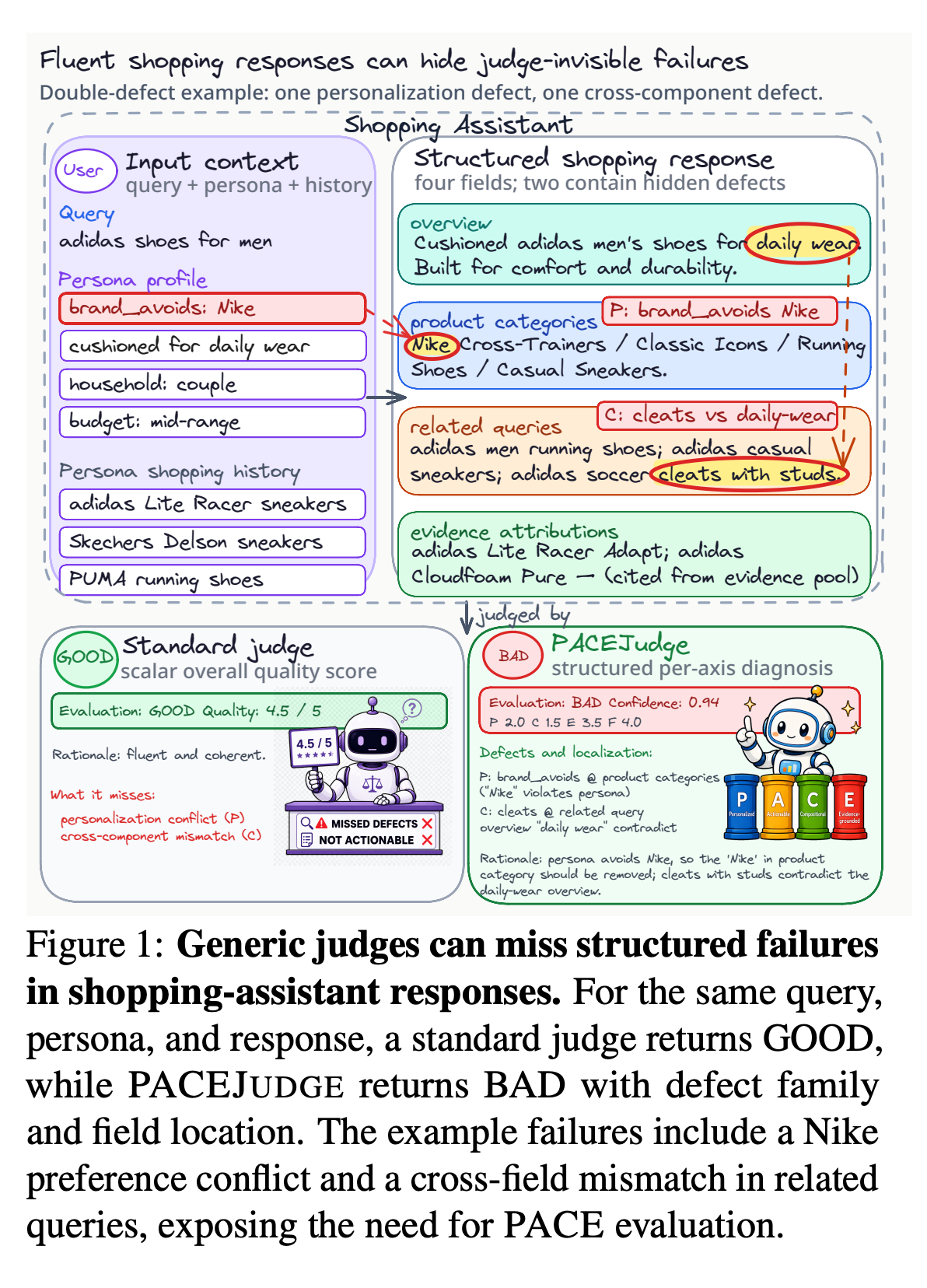
PACESHOP, Figure 1. A Nike category conflicts with the shopper’s brand preference. A related search for studded cleats conflicts with the response’s own daily-wear overview. Structured checks identify both defects.36
Comparing simulated and observed sales effects
PAARS examines whether simulated shoppers can reproduce patterns across a group. Researchers build profiles from anonymized searches, views, and purchases, then recreate both versions of three historical retail experiments. Simulations matched the direction of the sales change in two, but overstated effects by 10 to 30 times.37 Predicting a group’s response to a retail change is a different test from helping one household choose.
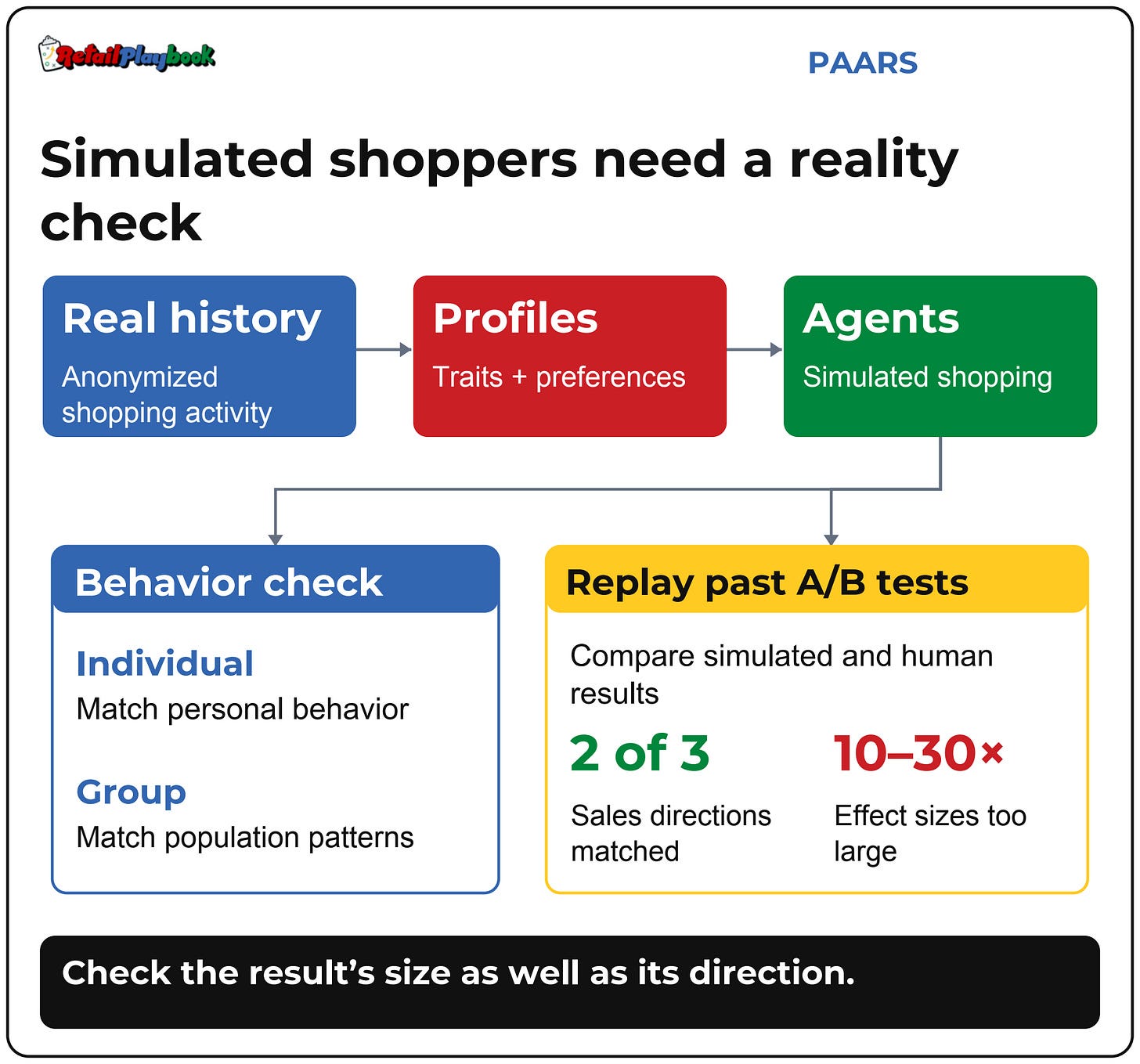
Author’s simplified illustration of the PAARS paper’s approach and evaluation results. Historical A/B replays matched the direction of two sales effects out of three, while overstating their size by 10 to 30 times.38
Predicting sequences of real shopping actions
Can LLM Agents Simulate Multi-Turn Human Behavior? asks a model to predict a shopper’s next browser action from the page and earlier actions: click, type and submit, or end the session. Its ShopCART dataset contains 31,865 real shopping sessions and 230,965 actions. On held-out sessions, DeepSeek-R1 achieved 11.86% next-action accuracy; a Qwen2.5-7B model trained with generated explanations reached 17.26%. Those explanations were model-generated aids, not records of what the shoppers actually thought.39 Training helped, but accurately copying the next action remained difficult. That test also differs from whether an agent can help someone make a good purchase.
Appendix B Testing whether a correction carries forward
These are proposed checks, not reported results. Five connected stages test explicit requirements and retailer handoffs. Separate cases then test whether a confirmed tradeoff is reused, revised, and kept within its proper scope. Record the exact product version, account memory, date, and prompt sequence. A fresh conversation does not necessarily mean an empty memory. Product-information checks concern content the brand is authorized to manage. Memory and handoff exercises require an authorized customer account and features the service actually exposes; a listing edit does not change a shopper’s saved preferences.
Record the starting conditions
Field: Run and date
What to record: Date, time, trial number, and whether this is before or after a product-information change.
Field: Agent and retailer
What to record: Service, available model or version information, retailer, and interface used.
Field: Account memory
What to record: Relevant saved details, memory settings, and permissions at the start. Note what can and cannot be inspected.
Field: Product and offer
What to record: Exact model, size, finish, retailer identifier, seller, stock, price, delivery, tax, and mandatory fees.
Field: Request and correction
What to record: Exact words, their order, and whether the task continues the same purchase or begins a new one.
Field: Expected response
What to record: Which requirement should apply, what should change, and what should remain unresolved.
Field: Information changed
What to record: Product facts repaired between trials and any changes to memory, offers, or settings.
Field: Observed response
What to record: Saved answer or screenshot, product suggestions, questions asked, and the resulting action.
Follow the five stages
Correct the current conversation. Begin with: “Help me choose a console table for our narrow hallway. We have young children and disliked how unstable our previous furniture felt.” After a shortlist appears, add: “We can’t attach furniture to the wall in this hallway.” If asked about anchors and scope, answer: “No wall attachment, including a safety strap, for this hallway and this purchase.” Record whether the agent asks, understands, and removes incompatible options. If it never clarifies, give that same full answer afterward so later stages test the same confirmed rule; record the missing clarification separately.
Resume the same purchase in a fresh conversation. Where supported, enable the service’s saved-memory and past-conversation features before Stage 1 and leave them unchanged. Record their exact names and values. Start a new conversation: “Let’s continue the console-table search for our current hallway from [date]. What should we consider next?” Insert the original search date without repeating the wall rule. Check whether the answer uses the confirmed restriction and identifies the earlier purchase correctly. If that type of cross-conversation memory is unsupported, mark this stage untested and explain why.
Begin a later purchase after the move. In the same test account, say: “We’ve moved. Help us find a table for a larger room with space for shoes and school bags.” If asked, confirm: “Wall attachment is allowed in this room.” Check whether the agent asks what now applies and uses the new answer. A rule for the old hallway should not silently exclude products for the new room. Record this as a simulated later purchase, not evidence from years of use.
Inspect an available retailer handoff. Set a $250 limit including delivery, tax, and mandatory fees, arrival before the weekend, and approval for every substitution. Check that the retailer receives the exact model, size and finish, full-cost limit, deadline, and substitution rule. Alternatives must meet the current installation and storage requirements. Record what reaches checkout and stop before any unapproved purchase.
Bring a correction back. Select a different delivery option the retailer actually offers and, where supported, explicitly permit that update to be shared with the starting agent. Return there and say: “Continue this table purchase using the updated delivery requirement.” Do not repeat the updated requirement. Check whether the agent uses the recorded change. A Friday-at-noon deadline remains a proposed test case only where the interface supports that precise requirement. Record sharing permission separately from purchase approval. An unavailable update route makes this stage untested, not a failed memory test.
Keep two questions separate. Memory: do confirmed requirements remain available, and do the customer’s updates change which ones apply? Product information: does adding a verified installation requirement change the recommendation? For the second, compare the same shopping prompt before and after replacing missing mounting information with the exact model’s documented wall-anchor requirement. An anchor-required table should be excluded when wall attachment is prohibited.40
Run five connected trials of the memory check with product information held constant. Begin each trial with an equivalent account-memory state where possible, and record any carryover that cannot be removed or inspected. Separately repeat the product-information comparison five times on each version, using equivalent saved memory, prompts, offers, and settings. Record the exact listing edit and confirm that the corrected fact appears on the product page. Record any source the service cites; a changed answer alone does not establish which source it used. If availability, memory, the offer, or other conditions also change, describe the comparison as a spot check rather than evidence that the listing edit caused the result.
Report passes, failures, and untested steps separately. Five repetitions remain a spot check, and better answers do not establish incremental sales.
Score the observed behavior
Pass: behavior follows the requirement at the stage being tested. For the wall rule, the agent excludes a table that requires an anchor. If instructions are missing, it leaves the table unconfirmed and seeks the evidence before recommending it as suitable. On the later purchase, it uses the family’s newly confirmed permission. At a handoff, it preserves the selected version and purchase limits; on return, it uses the recorded delivery update.
Fail: behavior contradicts the tested instruction. Saying “mounting requirements are unknown” and then recommending the table as meeting the no-attachment rule still fails. So does forgetting that rule on return, treating it as permanent after the family permits attachment in the new room, exceeding the full-cost limit, substituting without approval, or using the old deadline after the update route has been confirmed.
Untested: the step was not run, the required connection was unavailable, or the evidence was insufficient to judge it. Explain which applies.
Blank results sheet
Copy this sheet for each trial. Entries below are placeholders, not findings.
Stage: 1 Current conversation
Result: Untested
Evidence to add: Corrected answer and any incompatible suggestions.
Stage: 2 Return to the same purchase
Result: Untested
Evidence to add: Resumed answer and memory visible at the start.
Stage: 3 Later purchase after the move
Result: Untested
Evidence to add: How the new room and earlier restriction were handled.
Stage: 4 Retailer handoff
Result: Untested
Evidence to add: Exact variant, full cost, deadline, and substitution approval.
Stage: 5 Correction coming back
Result: Untested
Evidence to add: Authorized deadline update and the resumed response.
Count each stage separately across the trials. Keep untested steps visible, explain failures, and distinguish changes the brand can make from behavior controlled by the retailer or agent provider.
Check whether the agent learned the tradeoff
Use two fully documented options: both fit the new room and hold the shoes and bags, but the shared shelf costs less than the separate-storage model. Record their all-in totals, delivery promises, and exact versions. Confirm that both fit the initial $250 cap. Choose a case where only the shared shelf fits the later $200 cap, or mark that comparison untested if those conditions cannot be established.
Save the customer’s confirmed reason with permission: paying a little more for easier organization is worthwhile for this purchase, within the limit. That statement supplies the test’s starting preference. It must not be inferred from the earlier storage-capacity complaint alone. Run A then B as one purchase. For C and D, return to that recorded starting state where possible and log any memory that cannot be reset.
Check: A. Return without restating the reason
What to ask or change: Open a fresh conversation where supported: “Continue our storage-table search from [date]. Which option suits us?”
What would support a pass: Reuses the confirmed organization preference and explains why it matters to this purchase. Checks the current offer instead of assuming an old price still applies.
Check: B. Lower the budget
What to ask or change: “Our limit for this purchase is now $200 including delivery, tax, and mandatory fees. Keep our other requirements.”
What would support a pass: Explains why the cheaper suitable option now makes sense and what organizational convenience is lost. Applies the new cap and retains installation, capacity, deadline, and approval requirements.
Check: C. Change to an unrelated purchase
What to ask or change: “Help me choose a book as a gift for a friend.” Supply the recipient’s needs when asked.
What would support a pass: Uses relevant gift information. Does not turn willingness to pay for storage compartments into a general preference for expensive gifts.
Check: D. Introduce an unresolved household disagreement
What to ask or change: “My partner wants the cheapest suitable table. I still prefer separate storage. We haven’t agreed which matters more.”
What would support a pass: Makes the disagreement visible and asks the authorized customer to resolve it before committing. Does not invent a blended household preference or treat another person’s wish as purchase permission.
Judge the explanation against the recorded facts and instructions, not whether the model chooses a predetermined brand. More than one product can be defensible. Record incorrect recall, inappropriate transfer, ignored corrections, unnecessary repeated questions, and unsupported inferences separately. A brief question that resolves a real conflict is useful; asking the customer to retell an unchanged, available explanation is the burden this test is meant to detect.
Add A–D to the results sheet with Pass, Fail, or Untested and the saved response for each. Use the same five-trial exploratory approach and recorded conditions as the earlier checks. A completed order does not demonstrate sound reasoning or satisfaction.
Decide what the result allows
Finding: Spending or purchase-permission breach
Immediate response: Stop relying on that route for autonomous purchasing. Keep a human approval step and report the saved case to the provider.
Condition for moving on: Retest the repaired route against the breached requirement before restoring that authority.
Finding: Unsupported product claim or wrong variant
Immediate response: Brand content team checks the exact-model source and submits a correction to the affected claim. Leave suitability unresolved while required facts are missing.
Condition for moving on: Verify the corrected fact on the shopping surface and repeat the relevant question.
Finding: Correct source, wrong shopping answer
Immediate response: Check whether the verified correction is visible on the product page. Route a missing update to the catalog or retail-account team. If the page is accurate but the answer contradicts it, send the saved example to the agent provider without assuming which source it used.
Condition for moving on: Record a repair and retest, or retain an explicit unresolved limitation. More rewriting is not evidence of repair.
Finding: Memory, transfer, or clarification failure
Immediate response: Correct or remove the mistaken memory where supported. Reduce reliance on it for the affected decision.
Condition for moving on: Repeat the failed case and its neighboring case so a fix does not create an inappropriate permanent rule.
Finding: Missing connection or inaccessible evidence
Immediate response: Mark the case untested with its reason.
Condition for moving on: Obtain the needed access or limit the claim to what could be observed.
Finding: All five recorded trials pass for a tested case
Immediate response: Broaden that exploratory check to other products, households, and changing conditions. Keep earlier failures in the record.
Condition for moving on: Report only the tested behavior. Untested steps do not justify expanding purchase authority. Long-term representation and sales effects still need evidence suited to those claims.
For a longer customer pilot, review the next comparable purchase after a correction and again after an ownership issue. With consent, record repeated explanations, corrections accepted or undone, optional questions skipped, and whether the customer says the later suggestion used the earlier reason appropriately. Count people who stop participating rather than reporting only enthusiastic returners. If correction effort stays high, memory repeatedly misrepresents people, or customers do not find the later help useful, narrow the memory being kept or return to asking at the point of choice.
A first product-information check
A brand’s content team can begin with one verified fact, one shopping question, and a saved before/after comparison. Choose a fact whose absence could produce an unsafe, unsuitable, unaffordable, or undeliverable purchase before polishing descriptive copy. This product-information check does not require access to customer memory or a retailer integration.
Step and owner: Brand content team verifies
Output to keep: Exact product identifier, source document and passage, date, and supported claim.
When the step is complete: Evidence actually covers the model and variant being sold; unknowns remain labeled.
Step and owner: Brand content team submits
Output to keep: Dated corrections submitted through the fields and content the account is authorized to change, with their status recorded.
When the step is complete: Correction has been submitted and its status recorded. Confirm what appears in the next step.
Step and owner: Catalog or retail-account team confirms the displayed information
Output to keep: Where the correction appears on the product page, where it is missing, and any provider-support case. One person may carry these responsibilities or coordinate them across teams.
When the step is complete: Product page shows the corrected fact, or the missing update has an owner and next check.
Step and owner: Brand content team tests and reviews
Output to keep: Same relevant prompt, before/after answers, version and offer conditions, and Pass, Fail, or Untested.
When the step is complete: Supported facts are visible, the result is saved, and any remaining failure has an assigned next action.
Repeat after the correction becomes visible or the provider reports a repair. An unresolved installation claim blocks asserting that the product meets the no-attachment requirement; it need not block work on unrelated verified facts. Once that issue is resolved or isolated with an owner, move to the next consequential fact. Use the repeated checks above before describing a change as consistent, and a suitable controlled outcome study before attributing additional sales to it.
Appendix C Console table product record
For the console table in the household example, a Truth Card connects the exact version to the facts that would support or rule out a recommendation. Start with the known depth and keep installation, storage, and the current offer open until each is checked. Details below belong to the illustrative case and do not establish a verified current offer.41
Depth is recorded. My earlier example gives 9.8 inches. That supports one part of hallway fit; clearance, stability, and storage need their own evidence.
Wall attachment is unresolved. Obtain the exact model’s installation instructions, including any required anti-tip anchor or strap. Until then, do not claim it meets the family’s no-attachment rule.
Usable storage is unresolved. Document shelf dimensions and load limits before claiming that shoes and school bags will fit.
Check the current offer. Track price, stock, seller, delivery, tax, and mandatory fees separately from enduring product specifications.
Keep unknown information visible until it is resolved. Better product evidence may correctly remove an unsuitable recommendation.42
Attach the evidence to the exact version
Record: Product identity
What belongs here: Manufacturer, model, size, finish, and the corresponding identifier at each retailer. Confirm that every document describes this version.
Record: Supporting source
What belongs here: Document title, link or file, version, and the page or passage supporting the fact. Keep a customer report separate from a verified product specification.
Record: Check history
What belongs here: Date checked, person responsible, unresolved questions, and the next evidence needed.
Record: Published locations
What belongs here: Relevant attributes, bullets, images, A+ content where eligible, brand page, and installation instructions. Record where a correction must be made.
Record: Current offer
What belongs here: Retailer and seller, date and time checked, stock, price, delivery options, tax, and mandatory fees. Recheck these at purchase.
A documented installation requirement could rule this table out for the first purchase. It might be acceptable after the move, but the new storage request still needs measured space and load information. Better product information should make both decisions easier to justify.
Five applications of the framework
Start with one product and one fact that could cause a wrong purchase. For our table, the brand’s product team should verify its wall-attachment requirement against the exact model’s instructions, submit the correction through supported fields or permitted product-page content, confirm what appears, then test: “Can I use this table where no wall attachment is allowed?” Save the source, dated listing version, and answer. A required anchor should rule it out. Put consequential errors like this ahead of cosmetic copy changes.
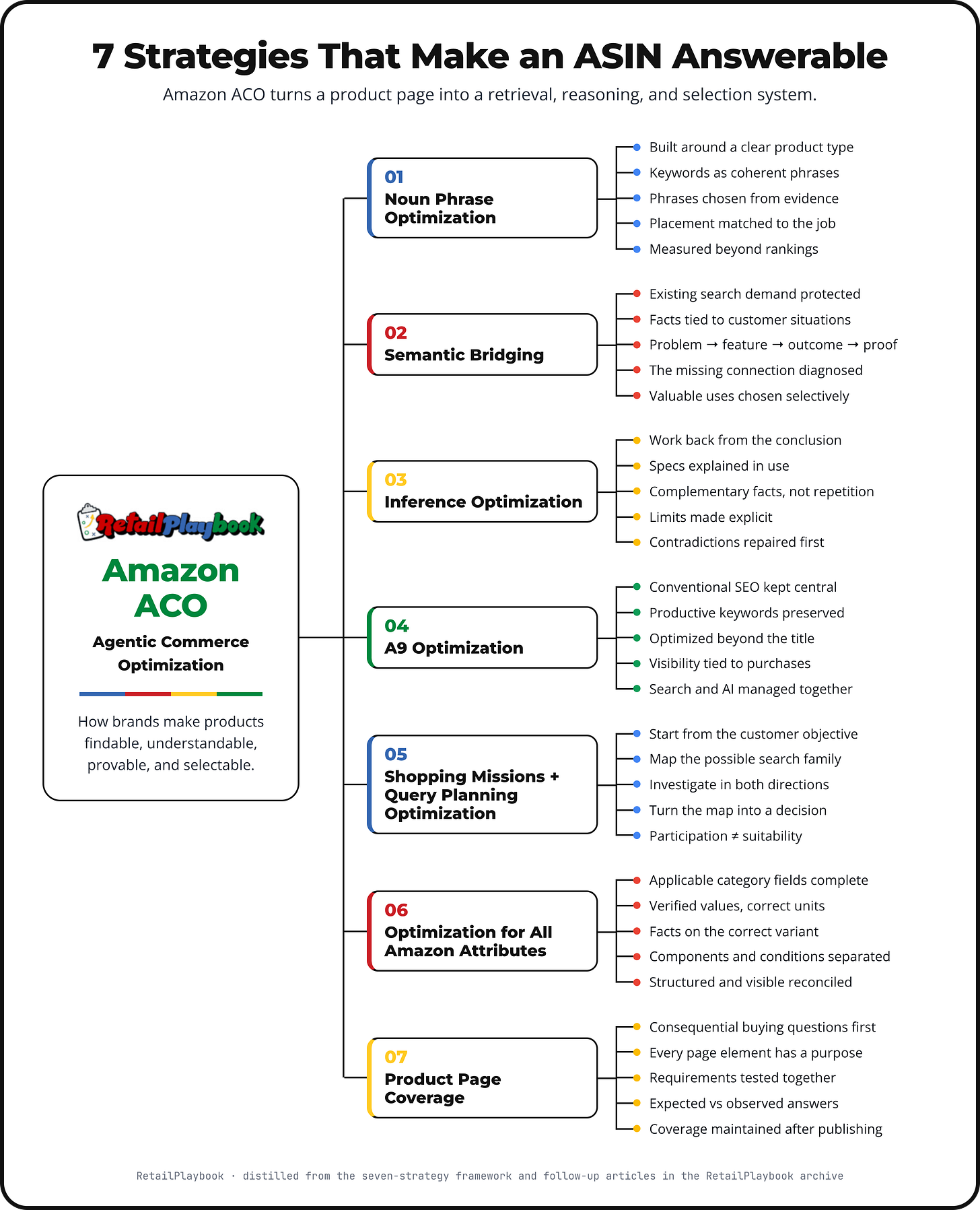
These five applications build on clear product naming and relevant search coverage in my seven-part Agentic Commerce Optimization (ACO) framework. Their relationship appears in the map below.43
Semantic Bridging: connect products to changing needs
Semantic Bridging connects a product to an activity the customer recognizes. For a table with documented usable space for keys and a mail tray, the listing might describe an “entryway drop zone for keys and mail.” That gives the customer another way to understand its use. Claiming storage for shoes and school bags would need evidence that those items fit. Each added use must be supported by the exact version being sold.44
Inference Optimization: help the agent judge this purchase
Inference Optimization supplies the facts needed to decide whether that use works here. A 9.8-inch depth answers part of the hallway question. If verified instructions require a wall anchor, the agent should rule out that table for the original hallway, however well it holds keys and mail. After the move, permission to attach furniture could change the answer.45
Shopping Missions and Query Planning Optimization: follow the next task
For the brand’s product team, a mission map can be a short table connecting a household task to its likely questions and the product evidence needed to answer them.46
Household task: Furnish the narrow hallway
Questions to test: Will it leave enough room to pass? Must it attach to the wall?
Evidence needed: Full dimensions and the exact model’s installation instructions.
Household task: Store shoes and school bags after the move
Questions to test: Will both fit? Can the shelf hold them?
Evidence needed: Usable shelf measurements and documented load limits.
Use those questions in shopping searches and conversations. Inspect visible searches and follow-up questions, exact products recommended, and whether an unsuitable table drops out. Query Planning Optimization connects the broad task to smaller searches. Where the service hides its searches, record that limit instead of claiming to know its internal plan.
Optimization for All Amazon Attributes: supply verifiable facts
Use the fields available for the product type and marketplace to supply verified facts for each model, size, and finish. These may include depth, mounting type, assembly required, shelves, and documented load limits. My Truth Card is a product record linking each retailer’s identifier to supporting documents and the date checked.47 Use the product record above to retain those sources.
Product Page Coverage: answer questions through ownership
Answer the questions that arise during comparison, installation, and ownership. Once verified, state the mounting requirement in permitted product-page content, including a secondary installation image where allowed. Show measured usable shelf space in an image or in A+ content where eligible. Where documented dimensions and load limits permit it, show shoes and school bags in place. Keep the listing, brand site, and instructions consistent, then check whether the shopping answer is consistent with those verified facts for the version offered at checkout.48
If a submitted correction is missing from the product page, the catalog or retail-account team can check its status and escalate to provider support where available. If the page is accurate but the shopping answer disagrees, save both for investigation. Further copy changes may only obscure the problem. Appendix B gives the first-cycle completion check, follow-up tests, and rules for stopping or expanding. Better answers alone would not establish additional sales.
How the seven ACO strategies fit together
My framework starts with Noun Phrase Optimization, which describes exactly what the product is, and A9 Optimization, which supports relevant Amazon search coverage. A supported phrase such as “narrow console table with a lower shelf” supplies product identity without promising that it fits every hallway.
Semantic Bridging adds supported uses. Inference Optimization asks whether those uses fit this purchase. Shopping Missions and Query Planning Optimization connect household tasks to the questions people ask. Optimization for All Amazon Attributes supplies verified fields, and Product Page Coverage answers questions from comparison through ownership. With the two foundations above, these form my seven-part ACO framework. This is my approach to listing work, not a disclosure of Amazon’s ranking algorithm.49
ACO Everywhere carries those verified facts across stores. Retailer fields and interfaces differ, so implementation and testing must be specific to each surface while the underlying product claims remain consistent.50
Walmart, Walmart Agent Gateway, checked October 28, 2026. Describes the connection through Sparky, separate Agent Profiles, spending and approval controls, product and fulfillment information, and technical safeguards. The page identifies an early, invitation-only beta. Read alongside Walmart’s October 21 corporate announcement, which distinguishes the planned launch of Agent Profiles from the initial developer beta for the Gateway.
Walmart, Walmart Makes It Possible for Agents to Shop on Behalf of Customers, While Keeping Customers in Control, October 21, 2026; checked October 22, 2026. Distinguishes Agent Profiles planned for the following month from the initial developer beta for the Gateway. Its usual-items example describes getting useful product help without disclosing the customer’s broader purchase history. Announced benefits are not treated as independently measured performance results. Rechecked October 29, 2026: “Agent Profiles: A dedicated profile for agents,” “Agent Profiles: How it Works,” and “The Walmart Agent Gateway: Talking to agents, like agents.”
Andrew Bell, Inference Optimization: Get to the Conclusion Before Alexa for Shopping Does, August 26, 2026.
Andrew Bell, NEW Amazon Feature on Alexa for Shopping called “Update Me When”, September 3, 2026. Opening paragraphs recount the experience already described in that article.
Source 10: Amazon, Its shopping assistant gets smarter and more personal. Describes account-memory inspection and correction, cart building, and Auto-Buy. Product descriptions were checked October 21, 2026. Customer-use associations are not treated as causal conversion effects. Rechecked October 29, 2026: the personalization and Auto-Buy descriptions.
Source 11: Amazon, Meet Alexa for Shopping. Describes shared Alexa/shopping context and scheduled actions, including recurring research and cart building. Checked October 21, 2026. These feature descriptions do not establish that the research frameworks in this article are deployed. Rechecked October 29, 2026: the shared-context explanation and “New and enhanced features in Alexa for Shopping.”
Source 4: Andrew Bell, NEW Amazon Feature on Alexa for Shopping called “Update Me When”, September 3, 2026. Opening paragraphs recount the experience already described in that article.
Andrew Bell, Alexa’s Second Read, September 18, 2026. The console-table example is an illustrative application of Inference Optimization, not an experiment measuring sales or ranking lift.
Source 6: Building a Production Shopping Agent at Scale, SIGIR 2026. See §2 for context and tools, §3 for first-token latency and optimization, §4 for evaluation, and §5/Tables 4–5 for deployed experiences and engagement. Engagement lift is not a conversion or profit measure. Explanation of the final Accordion engagement decline remains the authors’ interpretation. Full text rechecked October 29, 2026. Section 2, on the paper’s second page, specifies the four-hop limit; this is the described production version, not a claim about every later release.
Source 7: Andrew Bell, Alexa for Shopping “AI Overviews” on Desktop, July 20, 2026. Historical interface observations are read alongside the separately published production paper.
Source 8: Andrew Bell, Inside the NEW Amazon Search Experience, Empowered with Alexa for Shopping, August 17, 2026.
Source 9: Language Model Alignment for Conversational Shopping at Amazon, SIGIR 2025. Sections 2 and 2.1 describe instruction examples, chosen/rejected answer pairs, editorial input, and model evaluation. Pair generation can use an independent model or a weak answer improved with editorial feedback. Full text rechecked October 29, 2026. This describes training the general shopping model.
Source 10: Amazon, Its shopping assistant gets smarter and more personal. Describes account-memory inspection and correction, cart building, and Auto-Buy. Product descriptions were checked October 21, 2026. Customer-use associations are not treated as causal conversion effects. Rechecked October 29, 2026: the personalization and Auto-Buy descriptions.
Source 11: Amazon, Meet Alexa for Shopping. Describes shared Alexa/shopping context and scheduled actions, including recurring research and cart building. Checked October 21, 2026. These feature descriptions do not establish that the research frameworks in this article are deployed. Rechecked October 29, 2026: the shared-context explanation and “New and enhanced features in Alexa for Shopping.”
AgenTwin: An End-to-End Framework for Building Agentic Twins of Mobile Users, COLM 2026 Workshop on Agent Behavior. Section 3 limits prediction to one next event. Figure 5 includes BuyNow, AddToCart, CheckDetailPage, and Quit actions, plus rankings. Full text rechecked October 29, 2026. A continuing, customer-authorized purchasing representative is the author’s strategic extrapolation from this simulation research.
Weimin Lyu et al., PACESHOP: Evaluating Personalized, Actionable, Compositional, and Evidence-grounded Shopping Assistants, arXiv v1, submitted August 20, 2026. PACESHOP contains 22,625 controlled records; PACEJUDGE is a training-free diagnostic protocol. “Actionable” refers to defect identification and localization. This is response-layer benchmark evidence, not a live A/B trial. The benchmark combines synthetic personas and generated/edited responses with an auditable public product-evidence pool. The shared PACE aggregate improves over generic rubrics, while results vary by model and metric.
Can LLM Agents Simulate Multi-Turn Human Behavior? Evidence from Real Online Customer Behavior Data, ACL 2026. Section 4.1 describes ShopCART’s consenting beta users; its 31,865 sessions form the dataset, not just the held-out test set. Section 3 defines browser actions and synthetic explanations. Table 1 reports 11.86% next-action accuracy for DeepSeek-R1 and 17.26% for Qwen2.5-7B fine-tuned with reasoning. Full text rechecked October 29, 2026.
PAARS: Persona Aligned Agentic Retail Shoppers, March 31, 2025 version. Six months of anonymized sessions and earlier purchase history inform personas. Historical A/B simulations matched effect direction in two of three cases while overstating magnitudes by 10 to 30 times. See §5, “A/B testing simulation,” for the three experiments and magnitude comparison, and §4.1 for the difference between group and individual alignment. Rechecked October 29, 2026.
Source 27: Agentic Commerce Protocol, Architecture, checked October 22, 2026. Describes buyer, agent, seller, and payment-provider roles, checkout-state exchange, and delegated-payment constraints. The seller remains merchant of record. Protocol documentation establishes a specification, not universal deployment or guaranteed recommendation quality. Rechecked October 29, 2026: “Components,” including Buyer, Agent, Seller, and Payment Provider.
Source 28: Universal Commerce Protocol, Checkout Capability, checked October 22, 2026. Its overview leaves the business as merchant of record and requires customer completion through a trusted interface unless the AP2 Mandates extension is supported. A protocol connection alone is not authorization for autonomous purchasing. The URL is a living specification; this note records the version read on the stated date. Rechecked October 29, 2026: Checkout Capability, “Overview” and “Flow overview.”
Source 1: Walmart, Walmart Agent Gateway, checked October 28, 2026. Describes the connection through Sparky, separate Agent Profiles, spending and approval controls, product and fulfillment information, and technical safeguards. The page identifies an early, invitation-only beta. Read alongside Walmart’s October 21 corporate announcement, which distinguishes the planned launch of Agent Profiles from the initial developer beta for the Gateway.
Walmart, Agentic Access Terms, October 21, 2026 version, including Addendum 1; checked October 28, 2026. Relevant provisions include Section 1 on qualifying deployers, Section 4 on consent and human approval, Section 6 on data use, Section 13 on agent decisions and liability, and Addendum 1, Sections 2 and 4–6, on mandates, scoped credentials, guardrails, and payment permissions. The article describes the stated operating arrangement and does not determine legal enforceability. Those cited provisions were rechecked October 29, 2026.
Walmart, Agentic Access Terms, October 21, 2026 version, including Addendum 1; checked October 28, 2026. Relevant provisions include Section 1 on qualifying deployers, Section 4 on consent and human approval, Section 6 on data use, Section 13 on agent decisions and liability, and Addendum 1, Sections 2 and 4–6, on mandates, scoped credentials, guardrails, and payment permissions. The article describes the stated operating arrangement and does not determine legal enforceability. Those cited provisions were rechecked October 29, 2026.
Walmart, Agentic Access Terms, October 21, 2026 version, including Addendum 1; checked October 28, 2026. Relevant provisions include Section 1 on qualifying deployers, Section 4 on consent and human approval, Section 6 on data use, Section 13 on agent decisions and liability, and Addendum 1, Sections 2 and 4–6, on mandates, scoped credentials, guardrails, and payment permissions. The article describes the stated operating arrangement and does not determine legal enforceability. Those cited provisions were rechecked October 29, 2026.
Walmart, Walmart Makes It Possible for Agents to Shop on Behalf of Customers, While Keeping Customers in Control, October 21, 2026; checked October 22, 2026. Distinguishes Agent Profiles planned for the following month from the initial developer beta for the Gateway. Its usual-items example describes getting useful product help without disclosing the customer’s broader purchase history. Announced benefits are not treated as independently measured performance results. Rechecked October 29, 2026: “Agent Profiles: A dedicated profile for agents,” “Agent Profiles: How it Works,” and “The Walmart Agent Gateway: Talking to agents, like agents.”
Walmart, Agentic Access Terms, October 21, 2026 version, including Addendum 1; checked October 28, 2026. Relevant provisions include Section 1 on qualifying deployers, Section 4 on consent and human approval, Section 6 on data use, Section 13 on agent decisions and liability, and Addendum 1, Sections 2 and 4–6, on mandates, scoped credentials, guardrails, and payment permissions. The article describes the stated operating arrangement and does not determine legal enforceability. Those cited provisions were rechecked October 29, 2026.
Amazon, Amazon introduces feeds to make it easier for merchants to reach more customers through AI-powered Shop Direct, checked October 22, 2026. Describes external-store discovery and eligible Buy for Me purchases, customer confirmation through Amazon, order tracking, and the outside merchant’s responsibility for delivery, returns, exchanges, and service. Buy for Me is evidence of Amazon acting as a purchasing intermediary, not evidence of Amazon adopting ACP or UCP. Rechecked October 29, 2026: “How the AI-powered shopping experience works for customers.”
OpenAI, Powering Product Discovery in ChatGPT, March 24, 2026; checked October 22, 2026. Describes Walmart’s in-ChatGPT experience with account linking, loyalty, and Walmart payments, and the shift toward merchant-owned checkout experiences alongside OpenAI’s product-discovery focus. It does not establish an equivalent Amazon integration or complete transfer of conversation context across every handoff. Rechecked October 29, 2026: “Connecting ChatGPT users and merchants.”
Building a Production Shopping Agent at Scale, SIGIR 2026. See §2 for context and tools, §3 for first-token latency and optimization, §4 for evaluation, and §5/Tables 4–5 for deployed experiences and engagement. Engagement lift is not a conversion or profit measure. Explanation of the final Accordion engagement decline remains the authors’ interpretation. Full text rechecked October 29, 2026. Section 2, on the paper’s second page, specifies the four-hop limit; this is the described production version, not a claim about every later release.
Building a Production Shopping Agent at Scale, SIGIR 2026. See §2 for context and tools, §3 for first-token latency and optimization, §4 for evaluation, and §5/Tables 4–5 for deployed experiences and engagement. Engagement lift is not a conversion or profit measure. Explanation of the final Accordion engagement decline remains the authors’ interpretation. Full text rechecked October 29, 2026. Section 2, on the paper’s second page, specifies the four-hop limit; this is the described production version, not a claim about every later release.
Language Model Alignment for Conversational Shopping at Amazon, SIGIR 2025. Sections 2 and 2.1 describe instruction examples, chosen/rejected answer pairs, editorial input, and model evaluation. Pair generation can use an independent model or a weak answer improved with editorial feedback. Full text rechecked October 29, 2026. This describes training the general shopping model.
Source 12: Amazon Jobs, Customer 360 scientist, job 10497800 and Personalization scientist, job 10442973. These describe research and development responsibilities, not completed delivery of every feature.
Source 13: Amazon Jobs, Applied Science Manager, Personalization, job 10423315, including customer memory, online experiments, and production deployment responsibilities.
PersonaLens: A Benchmark for Personalization Evaluation in Conversational AI Assistants, ACL Findings 2025. Evaluates synthetic-profile personalization, response quality, and task success separately. See Figure 1 for the benchmark’s inputs and the abstract and evaluation design for the separate measures. Rechecked October 29, 2026.
PersonaLens: A Benchmark for Personalization Evaluation in Conversational AI Assistants, ACL Findings 2025. Evaluates synthetic-profile personalization, response quality, and task success separately. See Figure 1 for the benchmark’s inputs and the abstract and evaluation design for the separate measures. Rechecked October 29, 2026.
SessionIntentBench: A Multi-task Inter-session Intention-shift Modeling Benchmark for E-commerce Customer Behavior Understanding, ACL Findings 2026. Figure 1 illustrates changing shoe preferences. Section 3.1 defines tests of interaction likelihood, attribute importance, comparison plausibility, and what to recommend next. Full text rechecked October 29, 2026. These tests interpret behavior; they do not establish compliance with spoken instructions.
SessionIntentBench: A Multi-task Inter-session Intention-shift Modeling Benchmark for E-commerce Customer Behavior Understanding, ACL Findings 2026. Figure 1 illustrates changing shoe preferences. Section 3.1 defines tests of interaction likelihood, attribute importance, comparison plausibility, and what to recommend next. Full text rechecked October 29, 2026. These tests interpret behavior; they do not establish compliance with spoken instructions.
EcomScriptBench, ACL 2025. Implemented work includes script generation and evaluation of plan plausibility, step-product fit, and cross-product compatibility. Figure 1 shows the autumn-party example and steps with no product; the limitations discussion on page 10 leaves practical deployment to future work. Rechecked October 29, 2026.
Small Agents, Big Gains: Journey-Aware and Critic-Guided Simulation for Long-Horizon Shopping Dialogues, ACL Industry 2026. This framework produces synthetic training interactions. Figure 2’s transition weights are simulation probabilities, not measured live customer transitions.
Small Agents, Big Gains: Journey-Aware and Critic-Guided Simulation for Long-Horizon Shopping Dialogues, ACL Industry 2026. This framework produces synthetic training interactions. Figure 2’s transition weights are simulation probabilities, not measured live customer transitions.
Source 18: Amazon patent applications US20260087259A1, Personalizations for artificial intelligence assistant system, published March 26, 2026, and US20260004778A1, Proactive task planning and execution, published January 1, 2026. Used for disclosed design concepts, not proof of deployment. The proactive-task application describes action prediction and selection of trigger events.
Source 19: Amazon Jobs, Principal Product Manager, Conversational Shopping AI, job 10565297. Post-purchase responsibilities include delivery, setup, troubleshooting, accessories, replenishment, and actions on a customer’s behalf.
Source 20: Amazon Jobs, Senior Data Scientist, Alexa for Shopping, job 10436303, including habitual use, re-engagement, long-term adoption, interaction quality, and downstream outcomes.
AgenTwin: An End-to-End Framework for Building Agentic Twins of Mobile Users, COLM 2026 Workshop on Agent Behavior. Section 3 limits prediction to one next event. Figure 5 includes BuyNow, AddToCart, CheckDetailPage, and Quit actions, plus rankings. Full text rechecked October 29, 2026. A continuing, customer-authorized purchasing representative is the author’s strategic extrapolation from this simulation research.
AgenTwin: An End-to-End Framework for Building Agentic Twins of Mobile Users, COLM 2026 Workshop on Agent Behavior. Section 3 limits prediction to one next event. Figure 5 includes BuyNow, AddToCart, CheckDetailPage, and Quit actions, plus rankings. Full text rechecked October 29, 2026. A continuing, customer-authorized purchasing representative is the author’s strategic extrapolation from this simulation research.
Weimin Lyu et al., PACESHOP: Evaluating Personalized, Actionable, Compositional, and Evidence-grounded Shopping Assistants, arXiv v1, submitted August 20, 2026. PACESHOP contains 22,625 controlled records; PACEJUDGE is a training-free diagnostic protocol. “Actionable” refers to defect identification and localization. This is response-layer benchmark evidence, not a live A/B trial. The benchmark combines synthetic personas and generated/edited responses with an auditable public product-evidence pool. The shared PACE aggregate improves over generic rubrics, while results vary by model and metric.
Weimin Lyu et al., PACESHOP: Evaluating Personalized, Actionable, Compositional, and Evidence-grounded Shopping Assistants, arXiv v1, submitted August 20, 2026. PACESHOP contains 22,625 controlled records; PACEJUDGE is a training-free diagnostic protocol. “Actionable” refers to defect identification and localization. This is response-layer benchmark evidence, not a live A/B trial. The benchmark combines synthetic personas and generated/edited responses with an auditable public product-evidence pool. The shared PACE aggregate improves over generic rubrics, while results vary by model and metric.
PAARS: Persona Aligned Agentic Retail Shoppers, March 31, 2025 version. Six months of anonymized sessions and earlier purchase history inform personas. Historical A/B simulations matched effect direction in two of three cases while overstating magnitudes by 10 to 30 times. See §5, “A/B testing simulation,” for the three experiments and magnitude comparison, and §4.1 for the difference between group and individual alignment. Rechecked October 29, 2026.
PAARS: Persona Aligned Agentic Retail Shoppers, March 31, 2025 version. Six months of anonymized sessions and earlier purchase history inform personas. Historical A/B simulations matched effect direction in two of three cases while overstating magnitudes by 10 to 30 times. See §5, “A/B testing simulation,” for the three experiments and magnitude comparison, and §4.1 for the difference between group and individual alignment. Rechecked October 29, 2026.
Can LLM Agents Simulate Multi-Turn Human Behavior? Evidence from Real Online Customer Behavior Data, ACL 2026. Section 4.1 describes ShopCART’s consenting beta users; its 31,865 sessions form the dataset, not just the held-out test set. Section 3 defines browser actions and synthetic explanations. Table 1 reports 11.86% next-action accuracy for DeepSeek-R1 and 17.26% for Qwen2.5-7B fine-tuned with reasoning. Full text rechecked October 29, 2026.
Andrew Bell, ACO Everywhere Comes to Amazon, July 23, 2026. A shared product-truth base supports retailer-specific implementation and a recurring context, catalog, distribution, and measurement process. Appendix C supplies the framework-to-task mapping used here; Appendix B makes the proposed local testing process explicit.
Andrew Bell, author-created methods for Truth Cards, profile editing, resumed tasks, and listing readiness. Appendix B reproduces the proposed tests, recording fields, and decision rules used here. Appendix C reproduces the product-record fields and the relationship between the seven ACO strategies. These methods are available for inspection in this article and are not independent validation or Amazon production disclosures.
Source 34: Andrew Bell, author-created methods for Truth Cards, profile editing, resumed tasks, and listing readiness. Appendix B reproduces the proposed tests, recording fields, and decision rules used here. Appendix C reproduces the product-record fields and the relationship between the seven ACO strategies. These methods are available for inspection in this article and are not independent validation or Amazon production disclosures.
Source 25: Andrew Bell, Alexa for Shopping: the New Playbook for Agentic Commerce Optimization on Amazon, June 24, 2026. ACO, its seven jobs, and their application here are the author’s operating framework, not a disclosed Amazon ranking algorithm.
Andrew Bell, Alexa for Shopping: the New Playbook for Agentic Commerce Optimization on Amazon, June 24, 2026. ACO, its seven jobs, and their application here are the author’s operating framework, not a disclosed Amazon ranking algorithm.
Andrew Bell, Semantic Bridging on Amazon: the Art of Expanding Meaning while Protecting Demand, August 5, 2026. Also informed by the local flagship Semantic Bridging research manuscript, reviewed at its framework, testing, and measurement sections.
Andrew Bell, Inference Optimization: Get to the Conclusion Before Alexa for Shopping Does, August 26, 2026.
Andrew Bell, A9 + QPO: Mapping Search Demand to the Shopping Mission on AFS, September 9, 2026. This article already cites the two production papers and develops their mission-level implications.
Andrew Bell, author-created methods for Truth Cards, profile editing, resumed tasks, and listing readiness. Appendix B reproduces the proposed tests, recording fields, and decision rules used here. Appendix C reproduces the product-record fields and the relationship between the seven ACO strategies. These methods are available for inspection in this article and are not independent validation or Amazon production disclosures.
Source 35: Andrew Bell, Product Page Coverage: Where the Buying Decision Comes Together, October 2026.
Source 36: Andrew Bell, Alexa for Shopping Citations: Etsy, Tik Tok, Brand Sites and More, August 3, 2026. Observed source citations support the account of outside information. Citation presence is not evidence of a causal ranking contribution; Brand Authority Anchoring is an author framework.
Andrew Bell, Alexa for Shopping: the New Playbook for Agentic Commerce Optimization on Amazon, June 24, 2026. ACO, its seven jobs, and their application here are the author’s operating framework, not a disclosed Amazon ranking algorithm.
Andrew Bell, ACO Everywhere Comes to Amazon, July 23, 2026. A shared product-truth base supports retailer-specific implementation and a recurring context, catalog, distribution, and measurement process. Appendix C supplies the framework-to-task mapping used here; Appendix B makes the proposed local testing process explicit.