


TL;DR
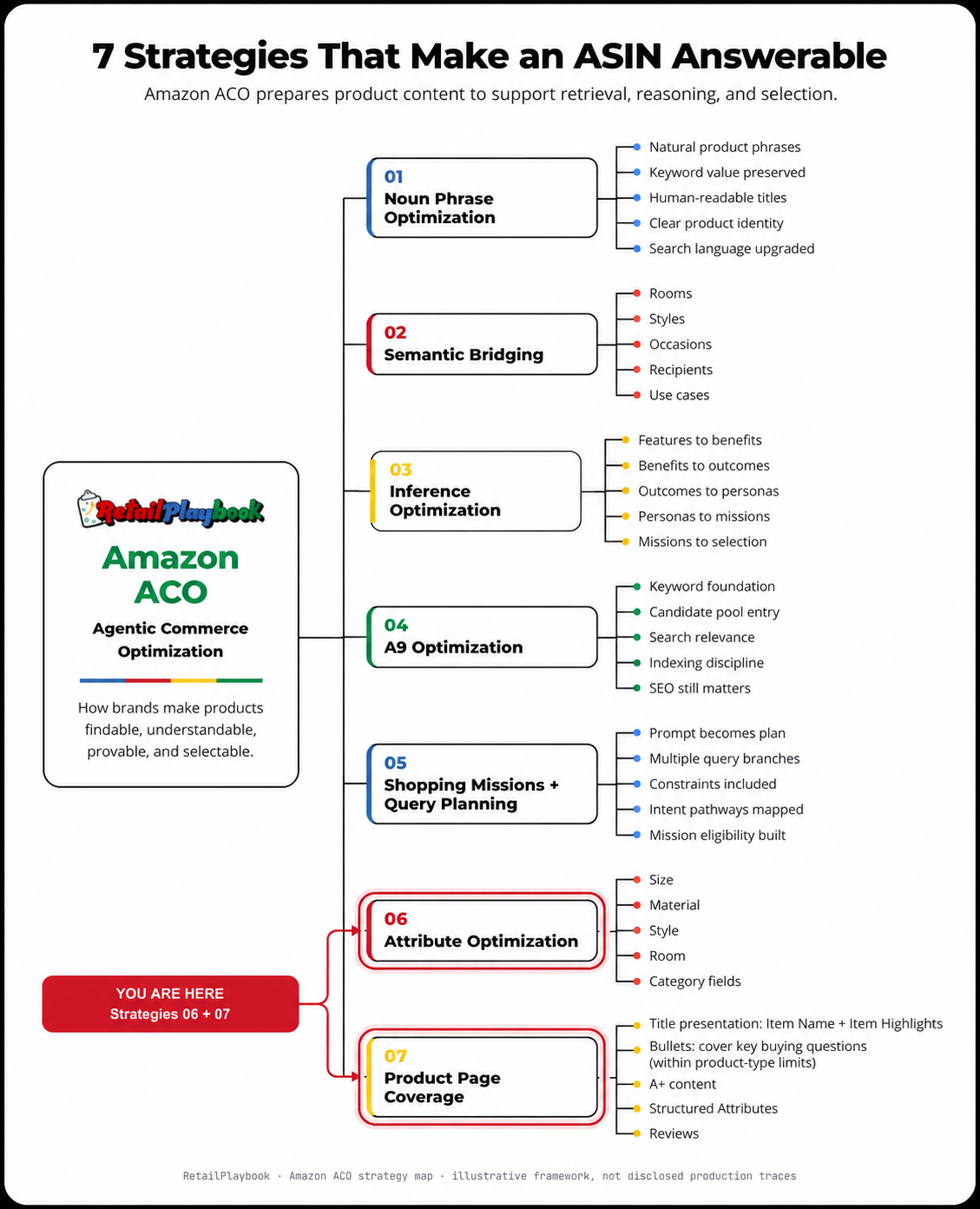
Product Page Coverage asks whether the page answers the questions that could change a customer’s buying decision. Attribute Completeness supplies verified facts for the selected version; Coverage tests whether the page explains their implications and limits clearly enough to support the choice for the AGENT and the CUSTOMER
Start with the questions that could change the purchase. Use shopping missions, search data, customer-service conversations, reviews, and observed Alexa prompts. Prioritize consequences as well as frequency.
Tie every consequential claim to the offered version. Verify dimensions, compatibility, contents, and care. Distinguish missing product facts from missing customer context, and resolve contradictions before writing.
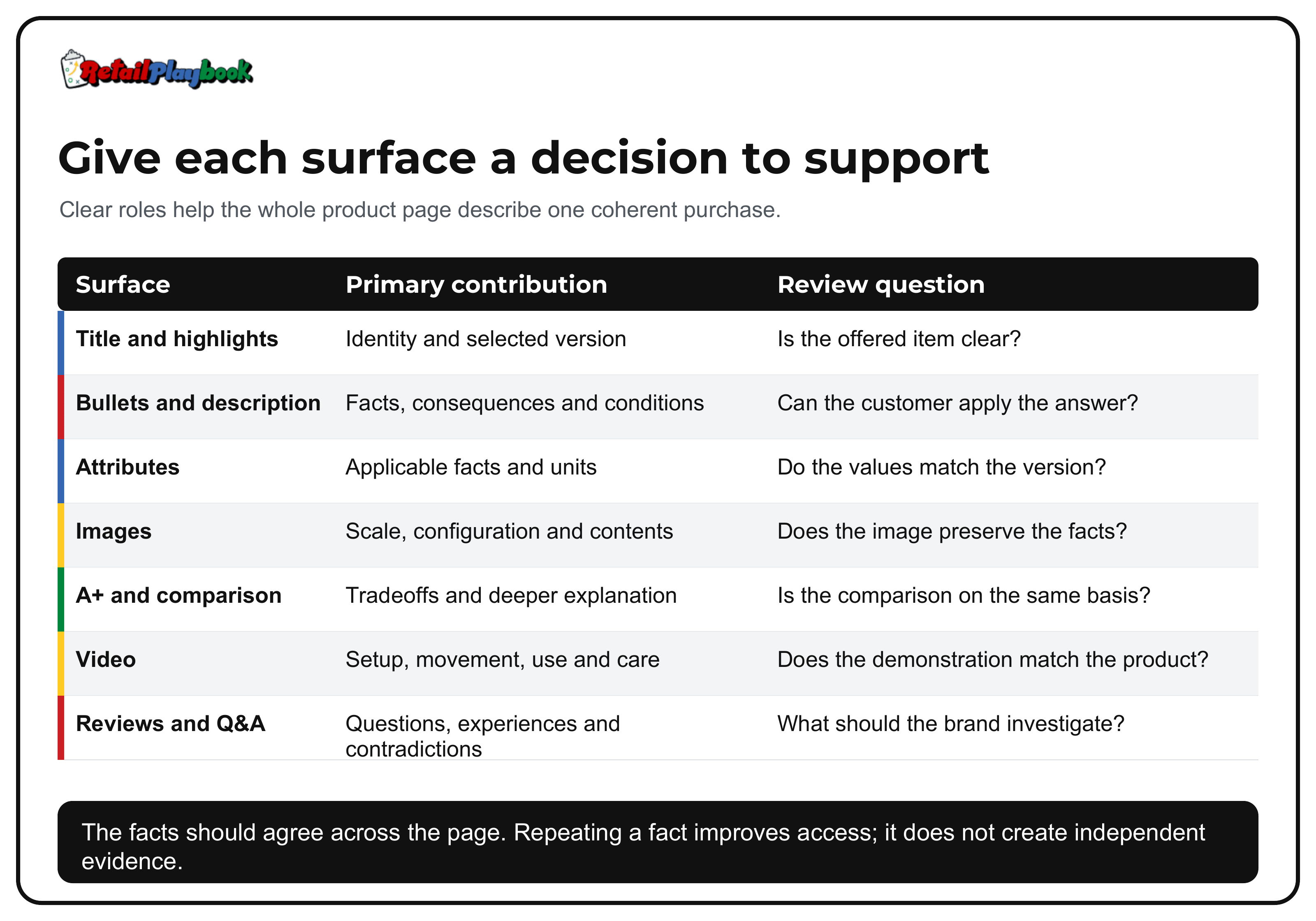
Give each page element a clear responsibility. Use names and highlights for identity and differences; use bullets, attributes, images, A+, and video to explain suitability, tradeoffs, setup, and ownership.
Test the requirements together. Check fit, capacity, setup, and care in combination. Include cases that require a qualified yes, a no, or more customer context.
Approve the page before evaluating Alexa’s response. Establish expected answers from evidence, inspect the displayed page, then compare Alexa’s response while preserving the exact prompt, selected version, and relevant conversation.
Protect demand and keep the explanation current. Record search and commercial baselines, investigate performance changes in context, and update affected explanations when the product, package, or offer changes.
A household wants a 64-ounce blender that can stay assembled beneath kitchen cabinets with 18 inches of clearance. The Vitamix 5200 has the capacity, but its 20.5-inch height rules out that storage arrangement. Removing the container or moving the blender would change the routine the customer wanted. Vitamix 5200 specifications.
Capacity information can be correct even when the customer leaves with the wrong expectation. Before buying, the customer needs to locate the height, understand its implications for assembled storage, then consider capacity within that constraint.
In closing Inference Optimization, I raised the difficulty of observing what Alexa concludes from a product presentation.1 We can inspect what we provide, then compare it with what Alexa says, but the relationship between them still requires investigation. Before judging its response, the brand needs to establish whether its own presentation supports the complete decision it is asking Alexa to help make.
1. Bring the earlier work through the whole purchase
In the original Agentic Commerce Optimization (ACO) playbook, discoverability was connected to product understanding, with evidence supporting selection.2 Findings from the 100K prompt study returned attention to the role of attributes in coverage.3 Product Page Coverage brings that preparation to the selected ASIN to ask whether the presentation answers the questions that could change the purchase.
Product Page Coverage is the extent to which the product presentation supplies consistent, verified information and appropriate evidence for the important decisions involved in identifying, qualifying, comparing, purchasing, and using the offered product.
Attribute Completeness establishes verified values for the applicable fields of the offered version. Product Page Coverage examines whether those facts, their relationships, and the available evidence support the complete decision. Coverage tests whether individual answers still hold together when the customer adds a requirement, changes the intended use, or compares versions.
Each earlier framework contributes its own part of that work. Query Planning Optimization connects relevant demand to possible search paths. Noun Phrase Optimization establishes precise product language that Semantic Bridging connects to supported uses. Inference Optimization develops defensible conclusions from product facts, which Coverage tests across the selected version’s required configuration and ownership conditions.
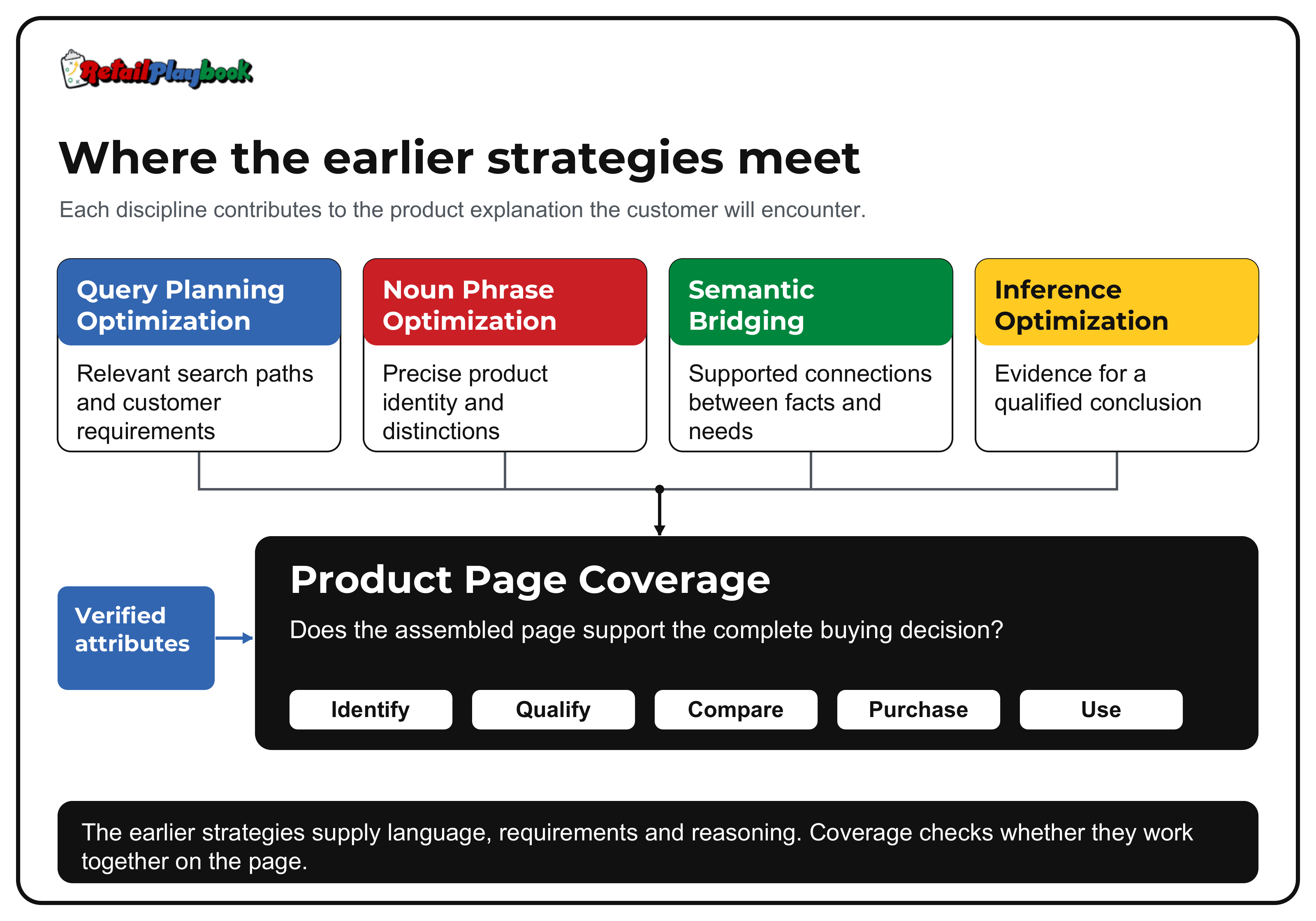
QPO, NPO, Semantic Bridging, and Inference Optimization contribute to the complete product-page review. Good ACO is great SEO. Preserve useful search language as the explanation becomes more complete.
2. Decide which questions the page owes the customer
Start with the shopping missions the product can genuinely satisfy. I use mission to mean the customer’s intended outcome, subject to the requirements that determine whether a product can serve it in those circumstances. Translate that mission into the page brief, identifying what would let the customer choose responsibly, including information that could rule the product out.
Query Planning Optimization (QPO) gives the investigation two directions.4 From the mission, the team can identify requirements before investigating relevant search paths. Search activity can also suggest a combined need to check against the assortment: demand for “64 ounce blender” alongside “blender for small kitchen,” for example, creates questions about capacity within limited space.
Brand Analytics reports aggregated activity, so those rows do not establish that one customer combined the requirements. Search Query Performance can identify participating ASINs for closer inspection. Missing dimensions warrant correction, though their contribution to weak query performance requires separate investigation.
Customer-service conversations, reviews, existing Q&A, comparison behavior, category knowledge, and observed Alexa prompts supply other questions. Record where each came from so recurring setup complaints remain distinguishable from untested possibilities. Frequency helps identify common problems, but consequence can make uncommon compatibility failures more important than another explanation of benefits already understood. For each important mission, I want the team to be able to answer six questions:
What exactly is being offered in the selected version’s configuration?
Can it meet the requirements the customer has supplied?
Why choose this version over relevant alternatives?
What arrives in the package, as distinct from items the customer must obtain separately?
What does ownership require, from setup through regular use?
What would make the product unsuitable or require more information before deciding?
Specific questions tell production teams what to make. If setup depends on separately purchased components, the explanation needs to state that requirement beside an accurate contents view. Space constraints call for verified measurements explained in relation to the intended location.
Separate missing customer information from missing product knowledge
When the customer has not measured the available space, the page can supply the verified fit rule, identifying what needs checking. When the brand has not established the required clearance, the product fact needed for that rule is missing. Four findings keep those situations distinct:
Covered: Verified product information supports the answer through an explanation consistently stated across the relevant surfaces. Retain its evidence for review when the product or context changes.
Covered, conditional answer: The product rule is known, but applying it requires further customer context. Explain the condition, identifying the missing information.
Unresolved: Necessary product facts, evidence sources, or explanations are missing or unverified. Obtain or publish what is needed before approving that part of the decision.
Contradicted: Applicable sources or page surfaces give incompatible answers. Correct the affected presentation once the applicable fact is established.
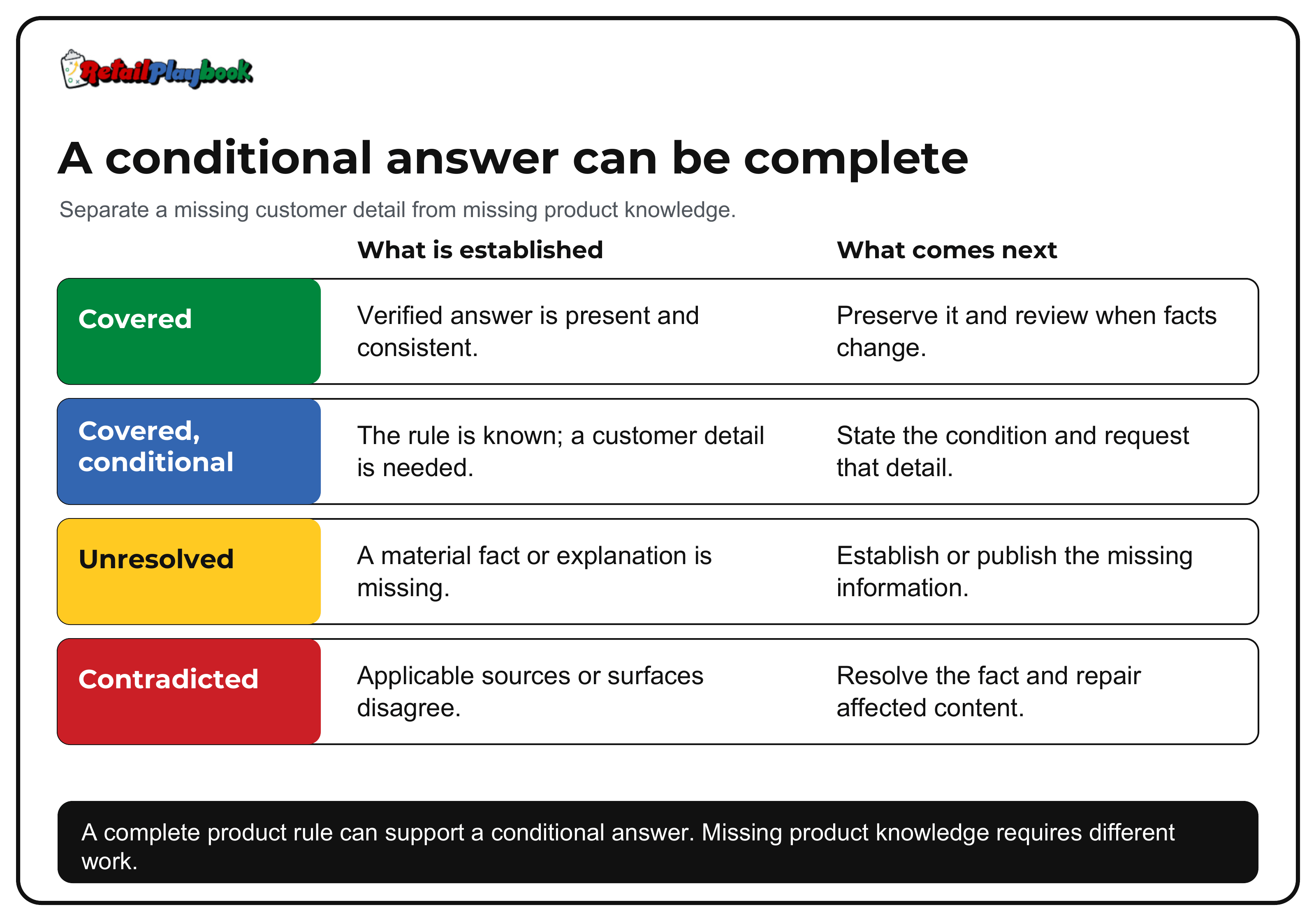
Known product facts allow conditional coverage when the answer depends on missing shopper context. If the verified rule requires 70 cm of clear width, the page can explain how the measurement determines suitability. Suitability remains conditional until the available width is known. If the required clearance itself is unverified, directing the customer to measure the space leaves the original product question unanswered. I would withhold full suitability claims while decisive product requirements remained unresolved. Narrower statements can still be supported if their scope is clear.
3. Establish which product each claim describes
Descriptions of individual versions can each be accurate without applying to the same purchase. Greater capacity may belong to the larger version, the narrower footprint to the smaller one, the included accessory to the older package. Combining those advantages can describe something the customer cannot actually order.
Each consequential fact needs a working record tied to its version, with the source stating applicable conditions. Identify the person who can settle disputes about it. Distinguish unknown, unverified, not applicable, and confirmed absent. Production can turn an empty accessory field into “included,” an untested combination into “compatible,” or a missing measurement into a plausible value.
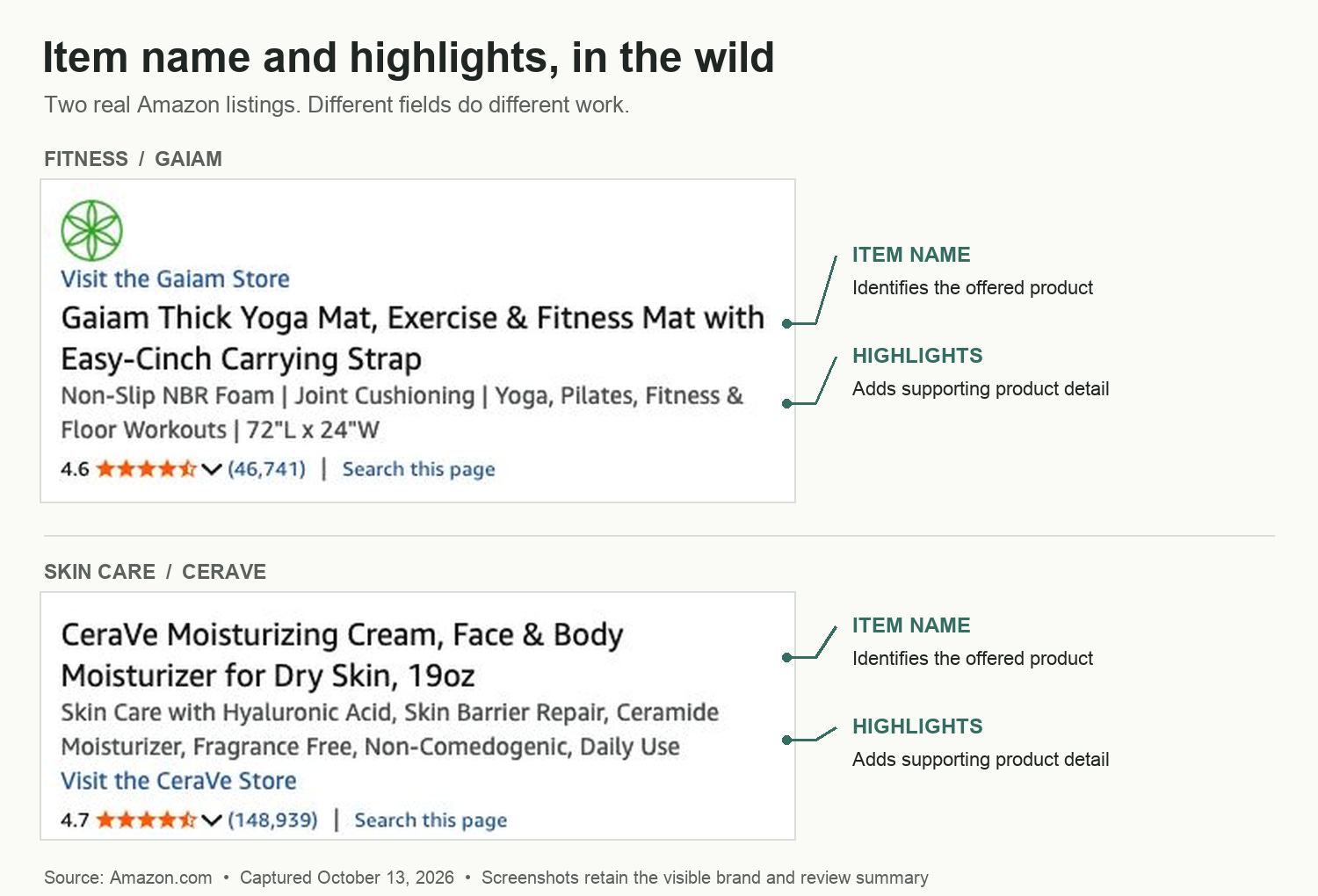
Noun Phrase Optimization (NPO) carries that responsibility into the language customers see.5 Richer language remains useful only while the noun phrase identifies the offered item accurately through its product type and relevant modifiers, as the title examples illustrate.6 Every other surface needs to explain the same item the title invites the customer to consider.
When the packing record conflicts with the image brief about an included component, the product owner must establish which record applies to the units being offered. Clearer prose cannot settle that dispute.
Make attribute completeness part of the decision
Applicable fields need verified values in the correct units, scoped to the offered variant, consistent with the visible page. Amazon’s Product Type Definitions provide schemas for product-type requirements, including relevant marketplace, selling-partner, and variation context, so implementation needs to begin with the fields available to the actual product.
Consider the ONOAYO projector table below. Native resolution appears separately from maximum display resolution. Its longer “Built-In Media” entry explains that 4K video is displayed at native 1080p, then identifies package contents, including a remote supplied without batteries. Each detail resolves a different question about what the customer is buying or needs to use it. Omitting an applicable field can remove a premise the customer needs for that decision.
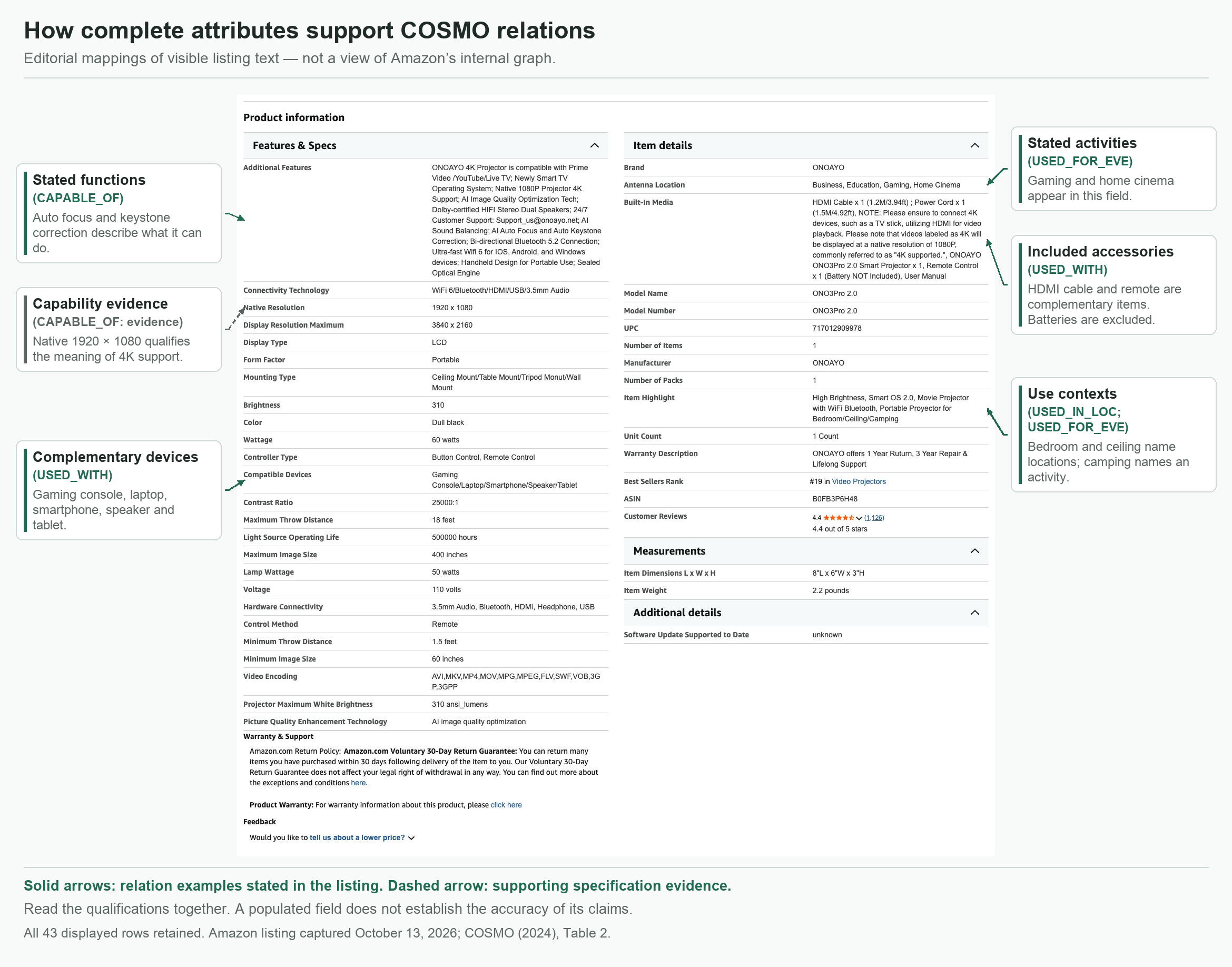
Passing submission checks does not establish that the submitted value is true or that the customer’s question has been answered. Even if the template offers only one width field, physical width remains distinct from required operating space. Use the attribute for its intended fact, explaining the additional requirement where customers can find it.
Build the review around each category’s requirements
COSMO’s relation types provide useful ways to describe connections among products, uses, audiences, and complementary items. A relation can include detailed conditions, but its label does not establish that every material attribute has been supplied or verified. Category specialists must identify which measurements, comparisons, compatibility rules, and ownership requirements matter. The team can then judge whether the necessary attributes are complete.
On the SEHMUA camera page, the connectivity field specifies 2.4 GHz Wi-Fi only, with 5 GHz unsupported. Associating the camera with a router leaves its required network band unresolved unless the relationship preserves that condition. For a shopper whose available network is 5 GHz only, the listed limitation changes whether the camera can be used there.
Pampers Swaddlers identifies a different set of purchase facts: Size 1, an 8–14 lb weight range, and 198 diapers in the selected offer. Weight range addresses intended fit, while count establishes quantity for comparing offers. Identifying the audience as babies leaves both questions unanswered.
The Fiskars pruning-shear listing adds another requirement through its 0.63-inch cutting-width field. Describing the function as pruning does not settle the size of material the tool is specified to cut.
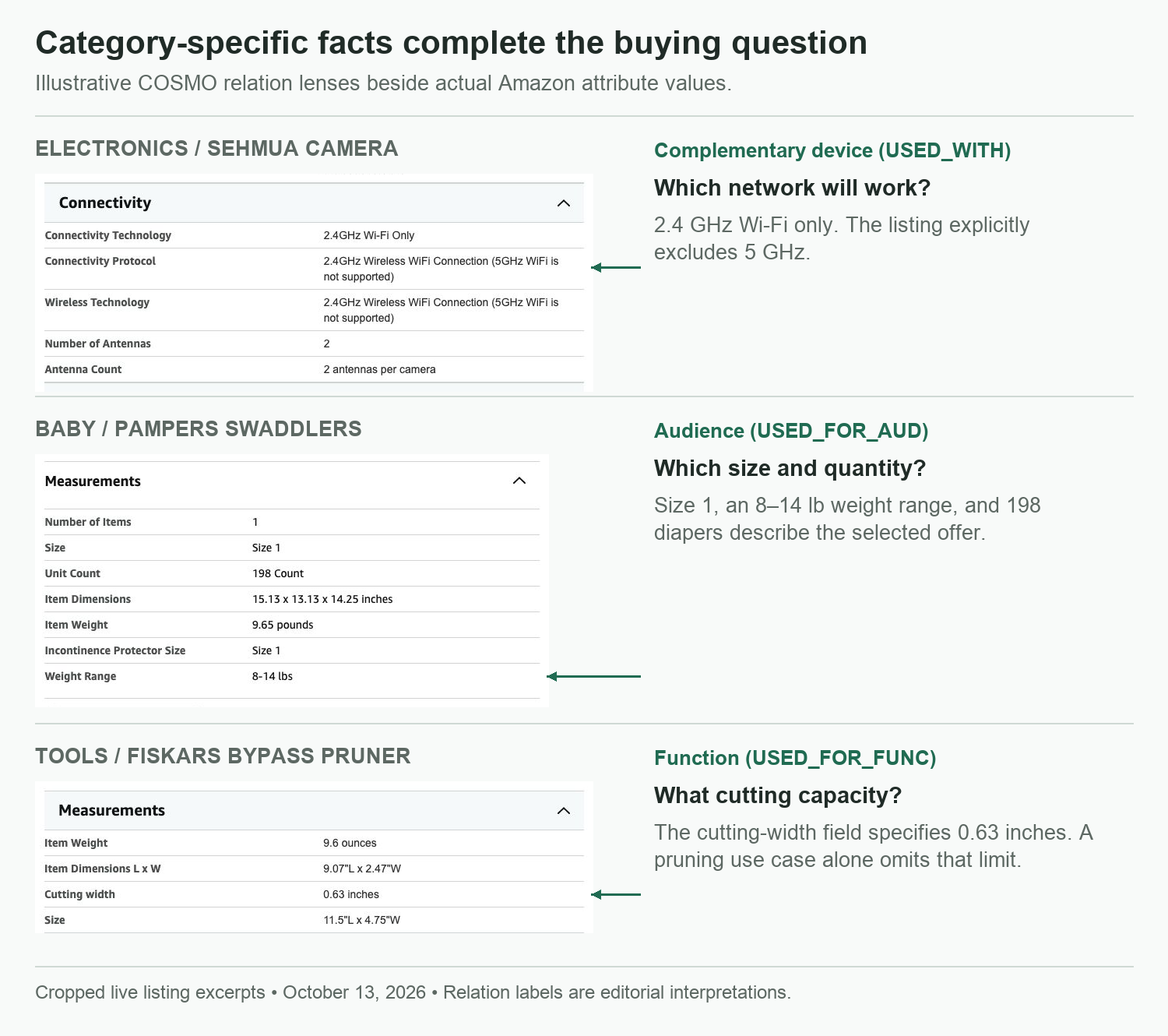
Treat a fact as essential when omitting it could change the answer to an important question about the selected product. Build the review around those questions, then use verified attributes and their relationships to answer them.
4. Make each surface carry part of the decision
Allocate the established answers across the page. Repeat consequential facts where different entry points require it, while keeping each claim tied to its source. Amazon’s applicable category and content requirements still apply. Within those limits, use the following allocation to decide which buying questions each available page surface should answer:
Title (Item Name + Item Highlights): Identify the item through the selected version’s decisive supported differences. Preserve useful query language within that product identity so the customer can recognize what the rest of the page describes.
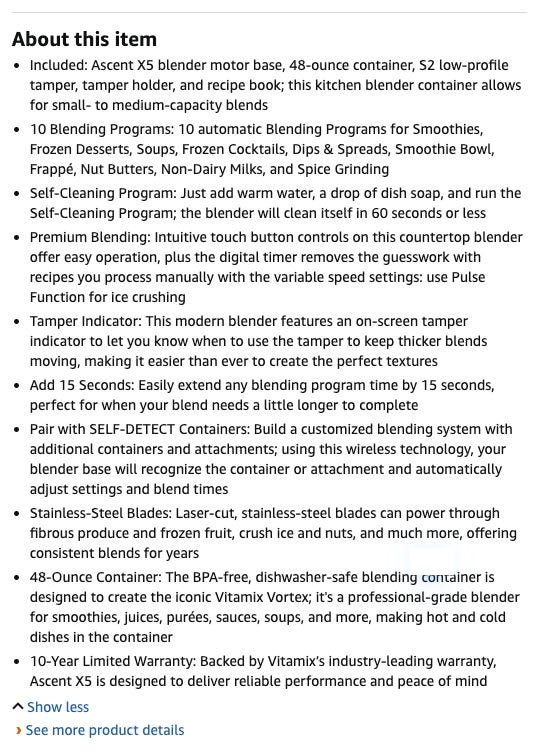
Bullets and description: Connect consequential facts to benefits, prerequisites, and limitations. Keep the condition close enough to the benefit that the statement remains accurate when encountered on its own.
Structured attributes: Supply applicable, version-specific facts with accurate units. Check the values against the selected product’s visible explanation.
Images: Show scale through views that make construction, configuration, contents, and operating conditions explicit. Label anything that could otherwise create false expectations about the purchase.
A+ and comparison content: Explain tradeoffs, relationships, or ownership processes that need more room. Compare alternatives on a common measurement or test basis.
Video: Demonstrate relevant setup, movement, operation, or care. Match the offered configuration under its stated conditions, while retaining decisive purchase conditions in accessible text.
Reviews and existing Q&A supply customer language, objections, and possible contradictions to investigate. They can reveal omissions from the controlled presentation, but anecdotal experience does not establish universal product facts.
Give creative work an evidentiary purpose
Each page surface supports a particular part of the purchasing decision. Every image brief should name the question it will answer. Dimension images need defined measurement endpoints to distinguish physical size from required operating space. Contents views identify delivered items separately from props and additional purchases.
To support small-space use claims, show how actual dimensions fit the location under the required operating conditions. That application of Semantic Bridging gives the use claim an explicit foundation without asking the title to carry the entire explanation.7
Carry verified product facts from the source record through the approved brief, using the repeatable creative process.8 Authority over color and composition is incomplete if the brand cannot account for the configuration being depicted. Review the attractive shot against the written explanation, checking whether both answer the same questions about scale, contents, and operating conditions.
Information outside the main page needs the same review. ACO across marketplaces requires each presentation to preserve the meaning of product facts within the correct version scope, even as the format changes.9 Manuals develop the setup procedures summarized in bullets. Brand pages explain the assortment without assigning one version another version’s capability.
Sources outside Amazon can appear in shopping explanations, giving brands reason to reconcile the information they control.10 An outside citation does not disclose the weight the system assigned it. Conflicting measurements or package claims still identify concrete defects to repair wherever the brand publishes them.
5. Test the decision when a requirement changes
Say you have a scenario with two versions of the same product: Compact and Wide. Compact needs less horizontal space, while Wide supports greater static loads. In this scenario, the product owner has confirmed the following requirements:
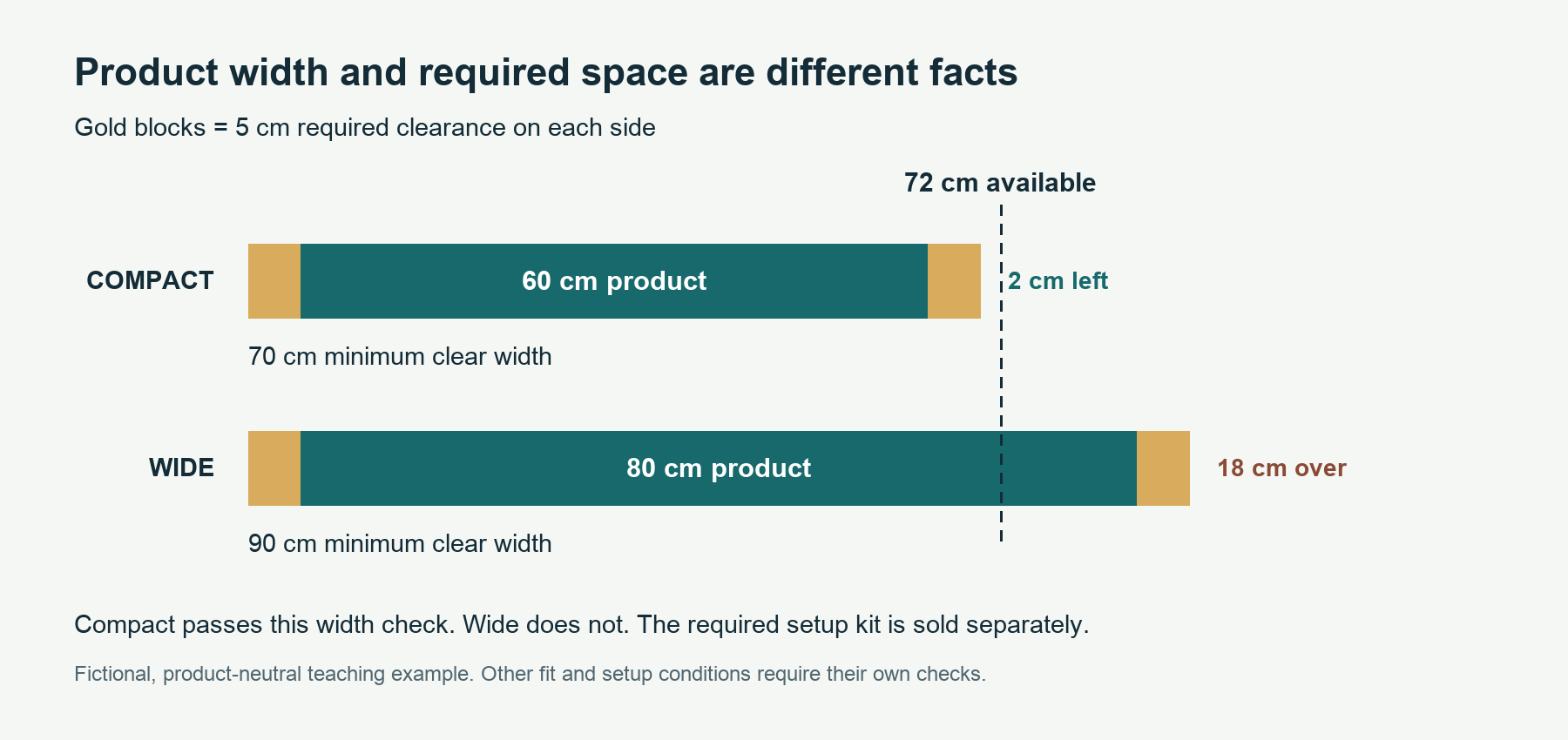
Width and clearance: Compact is 60 cm wide and Wide is 80 cm. Each needs 5 cm of free space on either side, making their minimum clear widths during use 70 cm and 90 cm respectively.
Load: Compact supports a maximum evenly distributed static load of 10 kg; Wide supports 18 kg. Both ratings require complete assembly according to the instructions, using Kit K2 on a level supporting surface.
Setup and contents: Setup requires current Kit K2, sold separately. Older Kit K1 is incompatible. Each package contains the selected product with its removable cover, excluding K2.
Care: Hand wash the detached cover. Wipe the main assembly clean without immersing it.
These requirements expose the unfinished explanations on the initial product page. It calls Compact “ideal for small spaces,” describes Wide as the higher-capacity option, and lists physical widths without the operating clearance. A setup illustration shows K2 beneath an old “everything needed to get started” claim, while “washable” leaves the applicable component unspecified.
Carry the answer from evidence to presentation
Record the customer question alongside its premises, source, page treatment, expected answer, and the condition that changes the result. For live products, identify the applicable revision of the controlled document or test record.
Consider the K2 illustration. Once the product owner confirms that the packing record excludes K2, the writer states the separate-purchase requirement. The designer labels the pictured kit after removing the obsolete contents claim. Review both treatments against the selected version, then ask, “Does the pictured kit come in the box?”
“No, it is required and sold separately” is the expected answer. Keeping that question attached to the correction lets the team verify whether the finished explanation resolves the original misunderstanding. Fit, load, and care can follow the same method without requiring a separate production process for every fact.
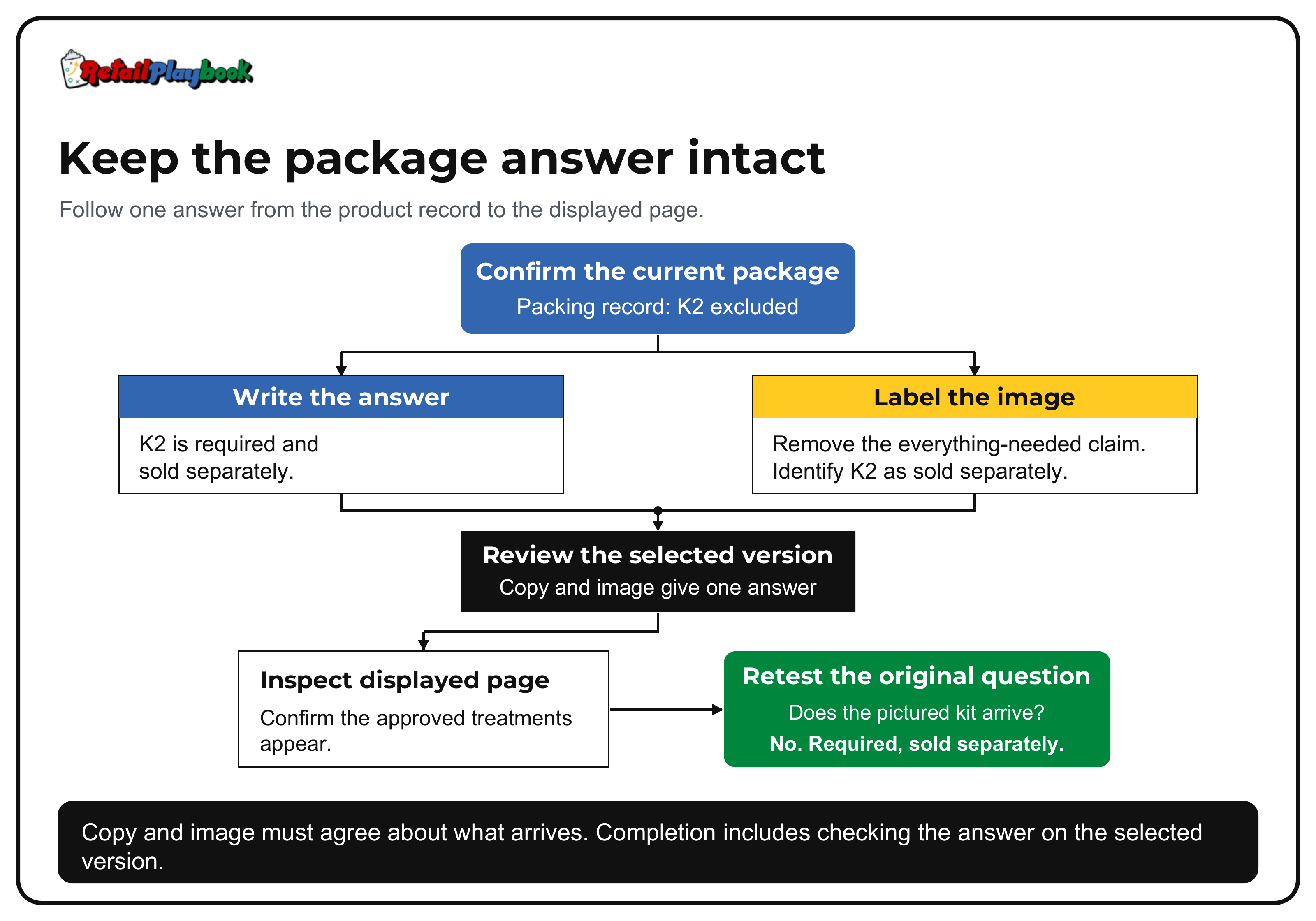
The K2 answer follows the verified packing record through copy, imagery, review, and retesting. Compact’s fit bullet can give its 60 cm physical width, then require 5 cm of free space on either side during use. Together those measurements establish a 70 cm minimum clear width. Its capacity statement can give the 10 kg limit with the static-load and setup conditions, then identify Wide’s 18 kg limit alongside its 90 cm space requirement. Placing those figures together lets the customer judge the additional capacity against the space it requires.
In the dimensional image, Compact’s physical width remains 60 cm. Replacing that attribute with 70 cm would make the catalog fact wrong in an attempt to communicate clearance. Show required free space separately from the object, preserving that distinction across the specification, diagram, and fit explanation. Gold areas represent required clearance. The same 72 cm space accommodates Compact’s 70 cm width requirement and cannot accommodate Wide’s 90 cm requirement.
Follow three different outcomes from the same facts
In the next three cases, assume an evenly distributed static load, the required K2 setup, and the documented operating conditions. Only the available space or required load changes between cases.
72 cm of clear width and an 8 kg load: Compact meets both thresholds. Wide fails the width requirement, so Compact is the supported choice between these versions for the stated space and load.
72 cm of clear width and a 14 kg load: Compact fits but cannot support the required load. Wide supports the load but cannot fit, so neither version qualifies.
100 cm of clear width and a 14 kg load: Wide now meets both thresholds. Compact still fails the load requirement, making Wide the supported choice for the changed circumstances.
I would keep the second case in the review even though it rules out both products. Separate answers about width or load can still lead to recommending a version that fails one requirement. Testing only successful matches would miss that failure to preserve the relationship between the answers.
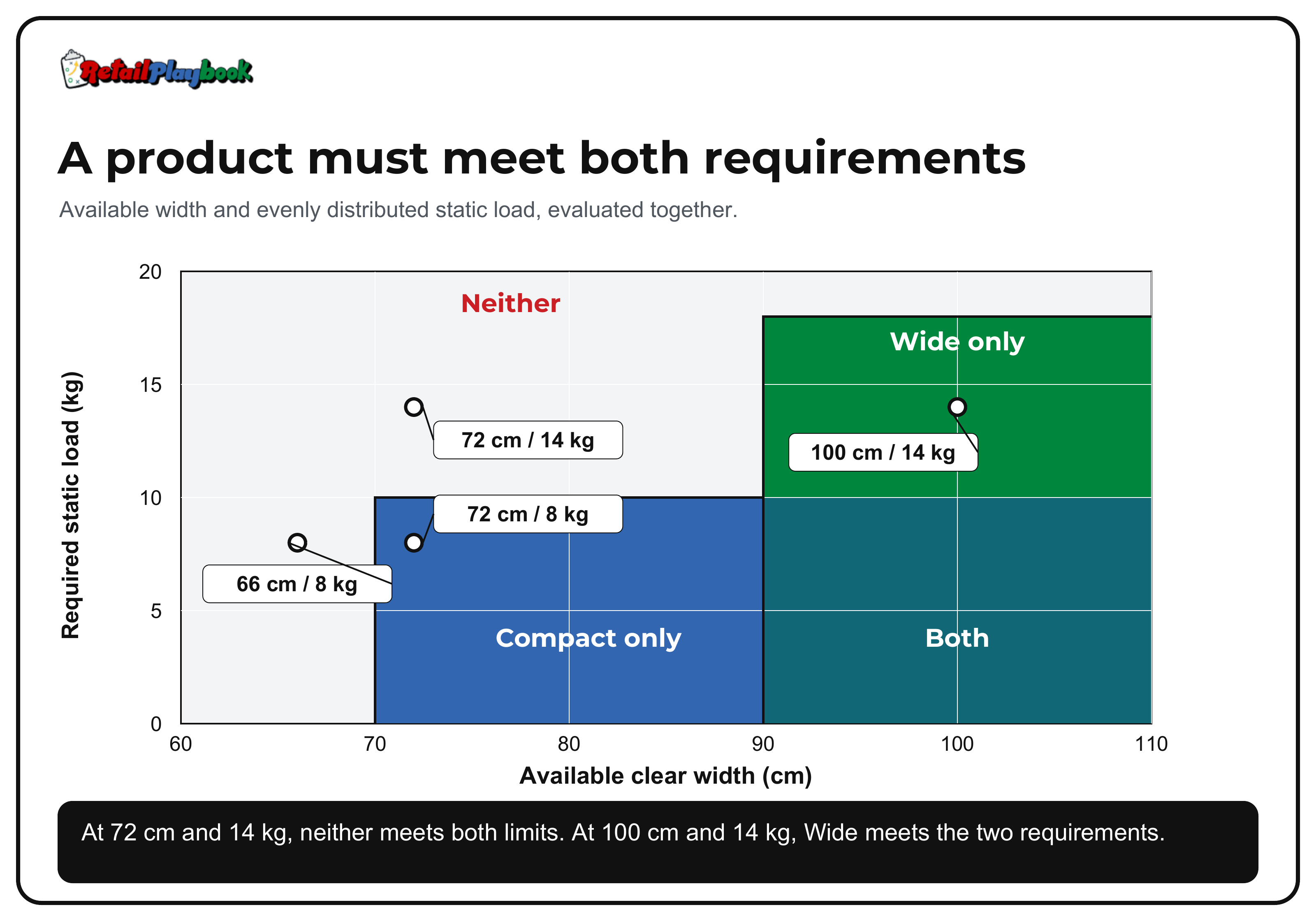
The chart evaluates only clear width and evenly distributed static load. Kit K2 and the documented setup conditions still apply. Other requirements can change the result again. Customers who own only K1 must obtain K2. An immersion-based cleaning routine rules out both main assemblies. Moving or unevenly concentrated loads fall outside the stated rating, while unknown load requirements leave the capacity-based choice unresolved.
Those conditions give the kit and care explanations their commercial importance without turning them into advantages one version does not possess. Wide’s capacity matters when it serves the customer’s needs within the available space, while Compact’s smaller footprint matters when its lower load limit remains adequate.
6. Approve the displayed page, then observe the response
Approval of the exercise covers its declared width, load, kit, contents, and care requirements once the evidence and page treatments agree. For real products, approval must extend across the material requirements of the category. One unresolved condition can still determine whether the customer should buy, regardless of how many other questions the page answers well.
Inspect the displayed page after release. Compare what the brand approved in the content file with what reached the customer: the image, selected version, and clearance explanation. Check how shared assets appear on mobile layouts, looking for inherited capacity claims, missing conditions, or kit labels that are no longer legible.
Customers may form expectations before clicking through to the product page. Wherever Sponsored Prompts introduce the product, include their version and benefit claims in the same review.11 Advertising can create misleading expectations that the product page reinforces, even when different teams approve the two separately.
Compare observed answers with expected answers
Keep a fixed question portfolio covering facts, functions, comparisons, prerequisites, ownership, objections, and combined constraints. Include cases that should produce a qualified yes, a no, or a request for missing context. Carry forward the question from Alexa’s Second Read: whether the explanation follows the available evidence when the answer changes.12
For each observation, preserve the exact prompt, relevant preceding conversation, selected product and version, date, response, and visible sources or selections. Different shoppers can encounter different Amazon experiences,13 and relevant customer context can extend beyond the immediate query.14 Record the originating page with other visible context so comparisons rest on observed conditions.
A departure from the expected answer gives the brand a defined problem to investigate. Check for necessary facts omitted from the controlled page, contradicted by other content, or left disconnected from the decision. If the information is already present, preserve that finding alongside the response rather than treating the answer as an explanation of the hidden process that produced it.
Preserve demand while improving the explanation
Managing organic search and advertising together requires baseline records of the important query portfolio, including its current wording.15 Record the relevant measures of visibility, click-through, conversion, sales, and advertising efficiency before consequential changes.
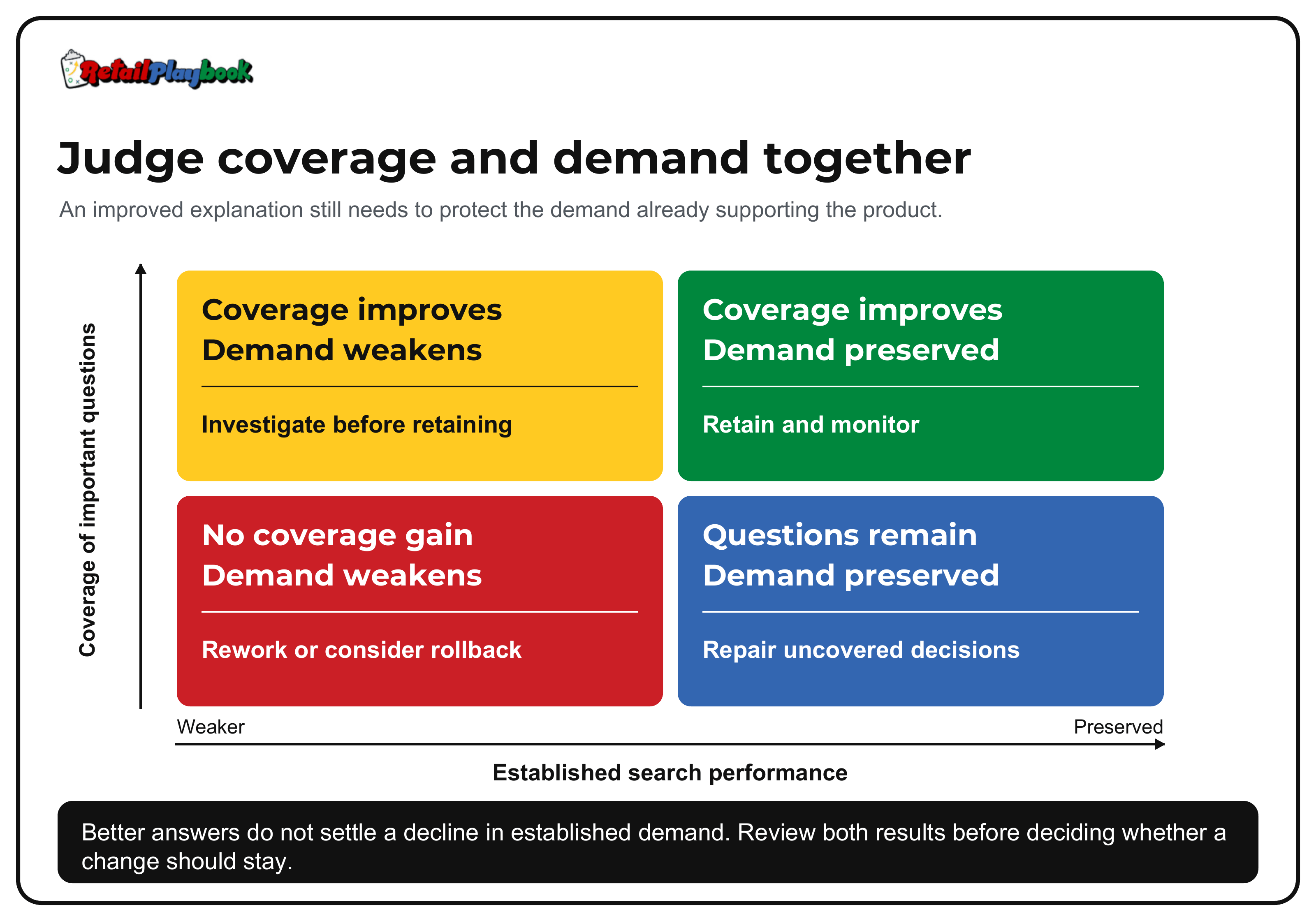
Set investigation or rollback thresholds before release according to the product’s traffic, interpreted in its commercial context. Price, availability, media, seasonality, and competition remain alternative explanations for performance movement, so crossing a threshold prompts investigation rather than establishing a cause. If buying-question coverage improves while established demand weakens, examine whether the revision displaced product language the business still needed. The release decision considers coverage of important questions alongside established search performance.
Keep the record useful after launch
Customers can move from comparison through setup requirements to compatibility questions during one investigation. Coverage must remain useful when the requirement, selected version, or current offer changes.
Suppose a later package includes K2 while the older package remains available. Blanket image updates can then correct one purchase while misrepresenting another. Update the affected contents image, setup statement, comparison, and separate-purchase explanation for each offer, then repeat the question about what arrives.
Assign a page owner to coordinate product specialists, catalog operators, writers, designers, and commercial teams. Package changes call for updates to the buying questions they affect; retain other verified facts unless new evidence or a product change requires correction.
Where the playbook continues
The Compact and Wide examples show why a product’s advantage depends on the purchase: extra capacity matters only when the product also meets the customer’s space, setup, and use requirements. Across the playbook, the work moves from relevant demand and precise product language to supported conclusions about the offered product. Customers should not have to discover after delivery the condition that would have changed their choice.
The brand should be able to account for the reasons its page gives a customer to proceed, including the limits that require another answer. When a fact changes, the team should know which buying decisions need review. The page has done its job when the brand’s reason to be chosen has become a reason the customer can actually use.
Inference Optimization: Get to the Conclusion Before Alexa for Shopping Does: Brands can prepare the information Alexa uses, but they cannot directly observe which conclusions it reaches, which it declines, or which premise prevents an answer.
Alexa for Shopping: the New Playbook for Agentic Commerce Optimization on Amazon: “Amazon ACO is the practice of engineering an ASIN so it can be retrieved by keywords, interpreted through structured data, reasoned over through semantic context, trusted through evidence, and selected as the right component inside a shopper’s larger mission”
100K Alexa for Shopping Prompt Study: Quarterly Report | Part 1 of 2: “Define each ASIN clearly: identity, the relevant constraints, supported advantages. Evaluate mission fit before assessing shelf relevance. Measure prominence separately. Useful rationales connect product evidence to buyers’ needs.”
A9 + QPO: Mapping Search Demand to the Shopping Mission on AFS: “QPO gives brands a way to connect that mission-level question to search clusters, product information, and commercial priorities. Working forward develops possible searches from a proposed mission; working backward examines search language for related requirements and develops mission hypotheses to test against the assortment.”
The Ultimate Guide to Noun Phrase Optimization the foundational language for Amazon SEO and ACO: “Noun Phrase Optimization is the process of organizing product language, product evidence, and brand-controlled content around the noun phrases that define what a product is, who it is for, where it is used, how it differs, what constraints it satisfies, and why it can be trusted.”
Titles in the WILD: Real Examples of Amazon Product Name and Item Highlights: “The 75-character Product Name carries product identity, while the 125-character Item Highlights layer carries product relevance.”
Semantic Bridging on Amazon: the Art of Expanding Meaning while Protecting Demand: “A semantic bridge is strongest when the brand can trace it from the customer’s situation to the evidence on the product page.”
Own the Process Instead of Renting It: Velocity Sellers Creative Director John Aspinall: “The skill analyzes each generated image against the original, catches its own hallucinations and regenerates.”
ACO Everywhere Comes to Amazon: “The same underlying product truth should remain consistent everywhere. But consistency does not mean publishing identical content in an identical structure on every platform.”
Alexa for Shopping Citations: Etsy, Tik Tok, Brand Sites and More: “The question for a brand is no longer only where the product ranks, but where the brand gets described, by whom, and whether those descriptions agree.”
Amazon Sponsored Prompts: the Blueprint: “The prompt shown in the ad or in the console. The sample answer shown in Ads Console. The live answer generated for an actual shopper execution.”
Alexa’s Second Read: ReFiBuy VP of Research Andrew Bell on Inference Optimization: “The farther a conclusion sits from verified product truth, the more evidence it needs to earn it.”
Two Shoppers, Two Different Amazons: BTR Media CEO Destaney Wishon on the Customized SERP: “Amazon’s whole-page-optimization research shows the same query can return distinctly different search pages depending on who’s searching.”
Amazon Customer 360: The Persistent AI Memory System Powering Alexa for Shopping Personalization.: “The prompt establishes the immediate mission. Customer memory supplies latent constraints, affinities, ownership facts, household relationships, prior decisions, and unresolved research. Product data supplies the evidence needed to connect an eligible product to both.”
The Dual Flywheel: PPC Ninja CEO Ritu Java on Winning Both A9 and Alexa for Shopping: “Ritu’s core framing, keyword search (A9) and conversational search (Alexa) are two flywheels you have to spin at the same time.”